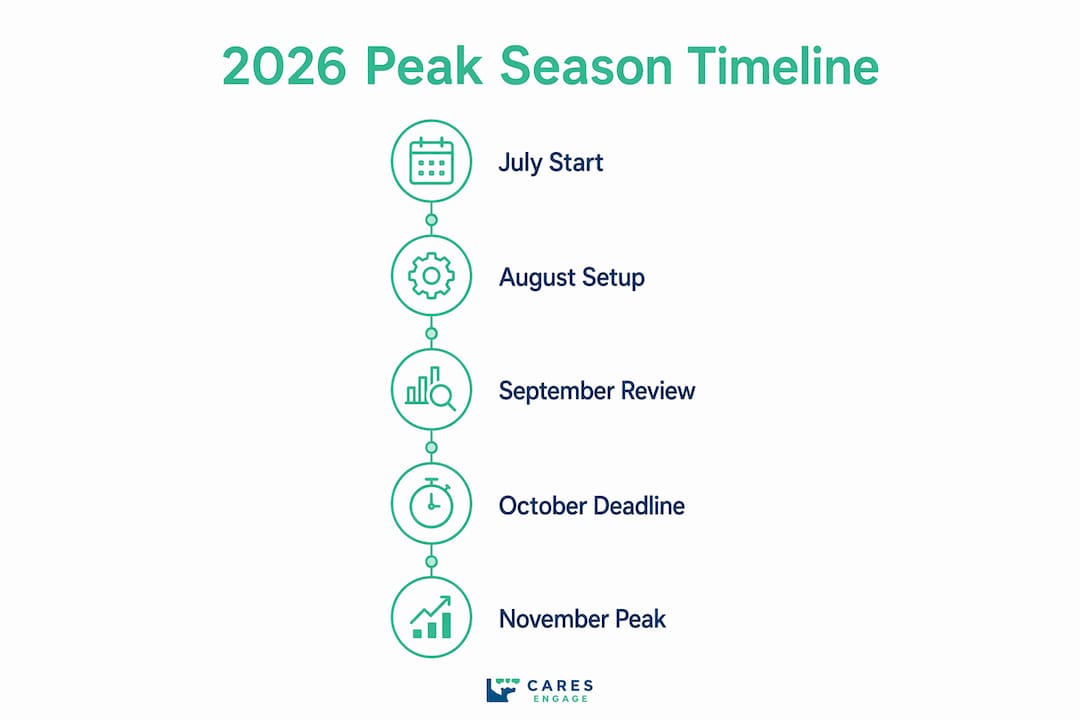
Planning and locking supplier and carrier agreements by August are essential for a successful Q4. Completing strategic planning by September and positioning inventory mid-October ensure readiness for peak season demands. Testing operations in lower-volume months helps prevent costly disruptions during the busiest shopping period.
Secure your supplier orders by August, lock carrier capacity agreements before early August, and complete all strategic planning by 1 September. Those three actions determine whether your Q4 runs on your terms or the market’s. Q4 accounts for a significant portion of annual retail sales, and brands that delay capacity commitments face punishing spot rates and degraded delivery SLAs when November arrives. The window to act is shorter than most operations teams realise.
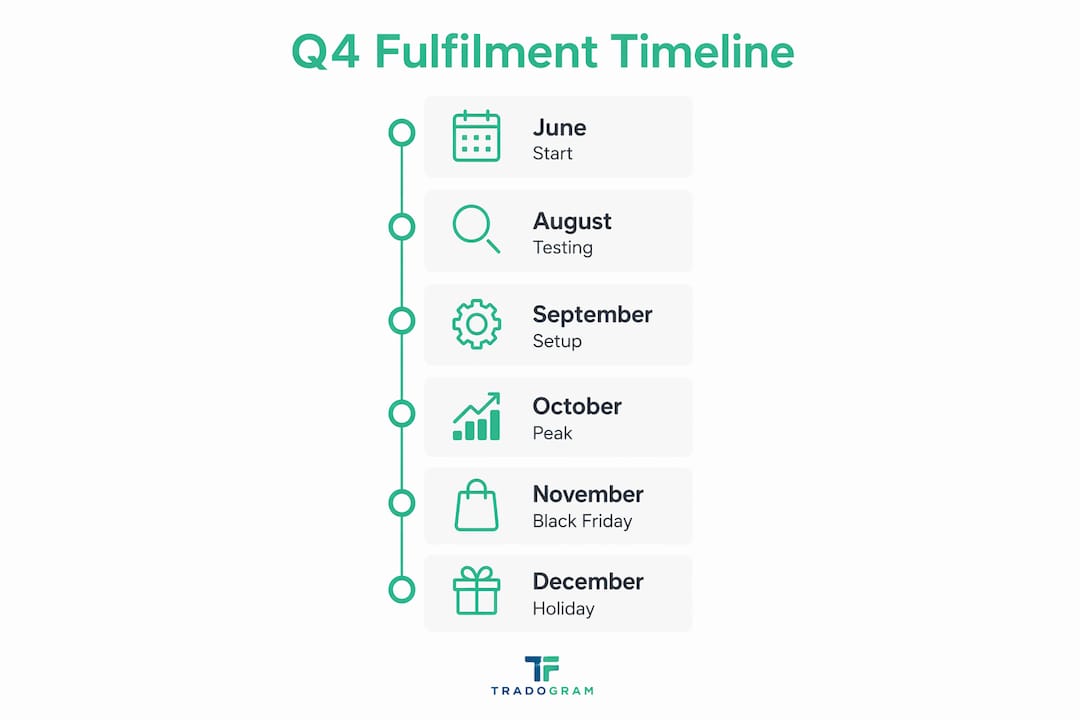
July: Open formal carrier rate negotiations; start inventory forecasting with SKU-level data
August: Place final supplier orders; lock carrier volume commitments; begin automation tests
1 September: All strategic planning complete; no major pivots after this date
Mid-October: All inventory positioned in fulfilment nodes before peak demand arrives
November–December: Execution only
Risk if you delay: Spot market carrier rates spike sharply during peak season, and shipment volumes can surge substantially above forecast. Brands without committed capacity absorb both the cost and the SLA damage.
Receive and position all inventory; complete staffing ramp; finalise returns packaging
November
Peak execution; daily KPI monitoring; activate contingency protocols if needed
December
Execution and performance review; draft budget inputs by mid-November
Do not miss these dates:
Supplier order cutoff: August (non-negotiable for UK importers)
Carrier rate lock: early August
Planning sign-off: 1 September
Inventory in nodes: mid-October
Pro Tip:Use August, while volumes are lower, to run end-to-end carrier waterfall tests. Send real orders through each carrier tier and measure transit times, label accuracy, and exception rates before peak demand exposes any gaps.
How do you forecast inventory and set safety stock for Q4?
Accurate seasonal inventory management starts with SKU-level velocity data, not category-level assumptions. Pull the last two years of daily sales by SKU, overlay your confirmed marketing calendar, and build at least two scenarios: a base case and a +15% upside.
Forecasting checklist:
Pull 24 months of SKU-level sales data; weight the most recent Q4 more heavily
Stress-test against a +15% volume scenario for your top 20 SKUs
Calculate safety stock using: (maximum daily demand × maximum lead time) minus (average daily demand × average lead time)
Set reorder points that trigger before the August supplier cutoff
For UK importers, account for Golden Week and supplier diversification risks when calculating lead times. A factory shutdown in October can leave you short in November if your reorder point assumes a standard 30-day lead time.
Stock positioning: Split inventory across multiple fulfilment nodes. Distributed networks reduce transit times and cut regional stockout risk, particularly for brands serving both mainland UK and Ireland.
How do you secure carrier capacity and control peak surcharges?
Carrier peak surcharge schedules are finalised early, and the difference between a committed rate and a spot rate during November can be substantial. Audit your current carrier mix in July, then open formal negotiations before early August.
Immediate carrier actions:
Audit current carrier performance: on-time rate, damage rate, cost per zone
Negotiate volume commitments with primary carriers (Royal Mail, DPD, DHL) before early August
Agree tiered surcharge caps where possible; get peak rate schedules in writing
Identify one or two regional carriers as secondary options for overflow or cost arbitrage
Build a carrier waterfall: primary carrier by zone and SLA, secondary for overflow, tertiary for emergency
A carrier waterfall assigns orders to the most cost-effective carrier that can meet the SLA for that zone. For example: next-day domestic orders route to your primary carrier; standard 2–3 day orders route to a regional carrier at a lower rate; international orders route to DHL or an equivalent. Test this logic in August, not November.
Pro Tip:Negotiate a separate returns contract at the same time as your outbound agreements. Returns volumes spike in January, and a pre-agreed returns rate protects margin when you are least able to absorb ad hoc costs.
Are your operations ready to scale for peak season?
Staffing and materials procurement are the two areas most likely to fail under pressure, and both require longer lead times than most managers budget for. Treat August and September as your rehearsal window.
Staffing checklist:
Confirm permanent headcount requirements based on forecast volume
Agree flexible or temporary staffing arrangements with agencies by August
Schedule training for new staff before October
Build surge rosters for Black Friday week and the pre-Christmas cut-off period
Assign a named escalation contact for each shift during peak weeks
Packing and materials:
Order packaging materials and labels in September at the latest; suppliers face their own Q4 capacity constraints
Pre-kit high-volume SKUs where possible to reduce pick/pack time per order
Audit warehouse layout for peak throughput: pick paths, packing stations, and despatch staging
Automation and integration tests (August–September):
Test rate-shopping logic under simulated peak volumes
Validate returns portal automation and label generation
Confirm real-time tracking feeds are live and accurate
When does outsourcing to a 3PL make sense for Q4?
Three signals suggest it is time to consider a 3PL partner: your warehouse is at capacity during peak, you are expanding into new geographies (Ireland, EU), or your in-house carrier mix cannot cover the SLAs your customers expect. If any of those apply, evaluating a 3PL vs in-house model now gives you enough lead time to onboard before October.
3PL benefits for Q4:
Scalable pick and pack capacity without fixed headcount costs
Pre-negotiated carrier rates across Royal Mail, DPD, DHL, and regional networks
Multi-node inventory positioning to cut transit times across UK and Ireland
Returns management with automated approvals and pre-stocked packaging
Direct integrations with Shopify, WooCommerce, Magento, Amazon, and eBay
Brands that complete onboarding by mid-September have a full month to run at live volume before Black Friday. That buffer is where peak season fulfilment confidence is built.
What contingency plans should you have in place before peak?
Contingency checklist:
Identify a backup carrier for each primary carrier in your waterfall
Agree overflow fulfilment terms with a secondary 3PL or Parcelplanet before October
Define safety stock drawdown rules: at what stock level do you trigger emergency reorders?
Pre-stock return packaging at your fulfilment node before November
Returns flow (step by step):
Customer initiates return via automated portal
System checks eligibility against pre-set rules (value, condition, return window)
Approved returns receive a pre-paid label automatically
Item received at returns node; condition assessed and restocked or quarantined
Refund or exchange triggered within agreed SLA
Automated returns can handle 70–80% of requests without manual intervention, which protects your customer service team’s capacity during the busiest weeks. Set a separate returns SLA and communicate it clearly on your website before peak season begins.
Escalation roster: Name one owner for carrier escalations, one for supplier issues, and one for customer service triage. Distribute contact details to all relevant teams before 1 November.
Which KPIs should you monitor in real time during Q4?
KPI
Definition
Target threshold
Alert owner
OTIF (On Time In Full)
Orders delivered on time and complete
—
Operations manager
Order accuracy
Orders picked and packed without error
—
Warehouse manager
Average transit time
Days from despatch to delivery
Within agreed SLA
Carrier manager
Returns rate
Returns as % of orders despatched
Monitor vs prior Q4 baseline
Operations manager
Carrier on-time rate
% of shipments delivered within SLA by carrier
— per carrier
Carrier manager
Warehouse throughput
Orders processed per hour per station
Against forecast
Warehouse manager
Reporting routine:
Daily: OTIF, order accuracy, and throughput during peak weeks (Black Friday to Christmas cut-off)
Weekly: Carrier on-time rate, returns rate, inventory levels vs forecast
Bi-weekly: Full KPI review with operations, commercial, and customer service leads
Alert thresholds should trigger an immediate escalation to the named owner, not a weekly review. If OTIF drops below 90% on any single day, treat it as a live incident.
[ ] KPI dashboards live and alert thresholds set (owner: Operations manager; deadline: 1 November)
Action
Owner
Deadline
Supplier orders placed
Procurement
August
Carrier agreements signed
Operations
Early August
Strategic planning complete
Commercial lead
1 September
Inventory in nodes
Warehouse manager
Mid-October
Integrations and automation tested
Tech/Operations
September
Returns portal live
Tech
October
KPI dashboards and alerts active
Operations manager
1 November
For workflow templates and a shipping strategy framework your ops team can use directly, Parcelplanet’s resource library covers the key planning documents.
Key takeaways
Effective Q4 fulfilment planning requires supplier orders placed by August, strategic planning complete by 1 September, and all inventory positioned in fulfilment nodes before mid-October.
Point
Details
August is the hard cutoff
Place all supplier orders by August to guarantee inventory arrives before mid-October peak.
Plan by 1 September
All strategic decisions must be finalised before September; December is for execution only.
Test carriers in August
Run carrier waterfall tests during lower-volume months to expose gaps before Black Friday.
Monitor OTIF daily in peak
Target — OTIF; treat any single-day drop below 90% as a live incident requiring immediate escalation.
Parcelplanet as Q4 partner
Parcelplanet’s multi-node fulfilment, courier integrations, and 3–4 week onboarding timeline make it a practical Q4 option for brands at capacity.
The mistake most e-commerce teams make with Q4 preparation
The single most common operational error is treating Q4 as a planning problem rather than an execution problem. Teams spend September finalising strategies that should have been locked in July, which means October becomes a scramble and November becomes a firefight.
The brands that handle peak season well are not necessarily the ones with the largest warehouses or the most carriers. They are the ones that used June, July, and August to test everything: carrier waterfalls, integration flows, returns portals, and staffing rosters. By the time Black Friday arrives, there is nothing left to decide. Every threshold is set, every escalation owner is named, and every backup carrier is contracted.
The quieter summer months are genuinely the most valuable time in the logistics calendar. Use them to stress-test your systems, build carrier relationships, and validate your forecasting assumptions. Q4 should feel like a controlled execution of a plan you made months ago, not a series of reactive decisions under pressure.
Parcelplanet’s Q4 fulfilment support for growing brands
Brands that have outgrown their in-house fulfilment capacity or need multi-node coverage across the UK, Ireland, and the EU have a practical alternative in Parcelplanet. Rather than absorbing the fixed costs of additional warehouse space and headcount, you get scalable pick and pack capacity, pre-negotiated rates with Royal Mail, DPD, and DHL, and direct integrations with Shopify, WooCommerce, Magento, Amazon, and eBay.
Onboarding takes three to four weeks from discovery to live go-live, which means brands that start conversations now can be fully operational before mid-October. Parcelplanet handles warehousing, picking, packing, shipping, returns management, and real-time tracking across all channels, so your operations team focuses on growth rather than logistics firefighting. To discuss your Q4 capacity requirements and get a tailored quote, visit Parcelplanet’s order fulfilment services page and request a consultation.
Outsourcing kitting and assembly to a specialist 3PL improves accuracy, reduces costs, and enables scalable growth. The process involves receiving components, precise picking, assembly, quality checks, and timely dispatch with real-time tracking. Proper planning, documentation, and technology integration are essential to avoid delays and errors in the first month.
If you need faster dispatch, fewer picking errors, and the ability to scale up without hiring extra staff, outsourcing your kitting and assembly to a specialist 3PL is the most direct route. Parcelplanet handles the full process, from receiving your components to despatching finished kits, with real-time tracking, integrations with Shopify, WooCommerce, Amazon, and more, and a low-risk sample run to get you started. Request a quote and book your sample run today.
Kitting means grouping individual components or SKUs into a single ready-to-ship or ready-to-use unit. The Lean Construction Institute defines it as sorting, grouping, and packaging related items into one package so workers do not need to search for parts. That principle holds whether you are running an ecommerce brand or a manufacturing facility, though the application differs considerably.
In ecommerce, kitting means pre-bundling multiple SKUs into a single despatch unit: a gift set, a subscription box, or a promotional bundle. The goal is faster pick-and-pack and a cleaner customer experience. In manufacturing and maintenance, kitting means assembling a bill-of-materials kit that supplies every fastener, fixing, and specialist part needed for a scheduled production run or field maintenance task, so technicians arrive with everything they need and nothing they do not.
Dimension
Ecommerce kitting
Industrial / manufacturing kitting
Primary purpose
Pre-bundle SKUs for consumer despatch
Supply all parts for a production or maintenance task
Common kit components include retail gift packs, seasonal promotional bundles, subscription boxes, PR and influencer packs, spare-parts kits for maintenance, and sub-assemblies for electronics or mechanical production.
How the kitting process works inside a UK 3PL
A well-run kitting operation follows a clear sequence, and each stage is where errors either get caught or compound.
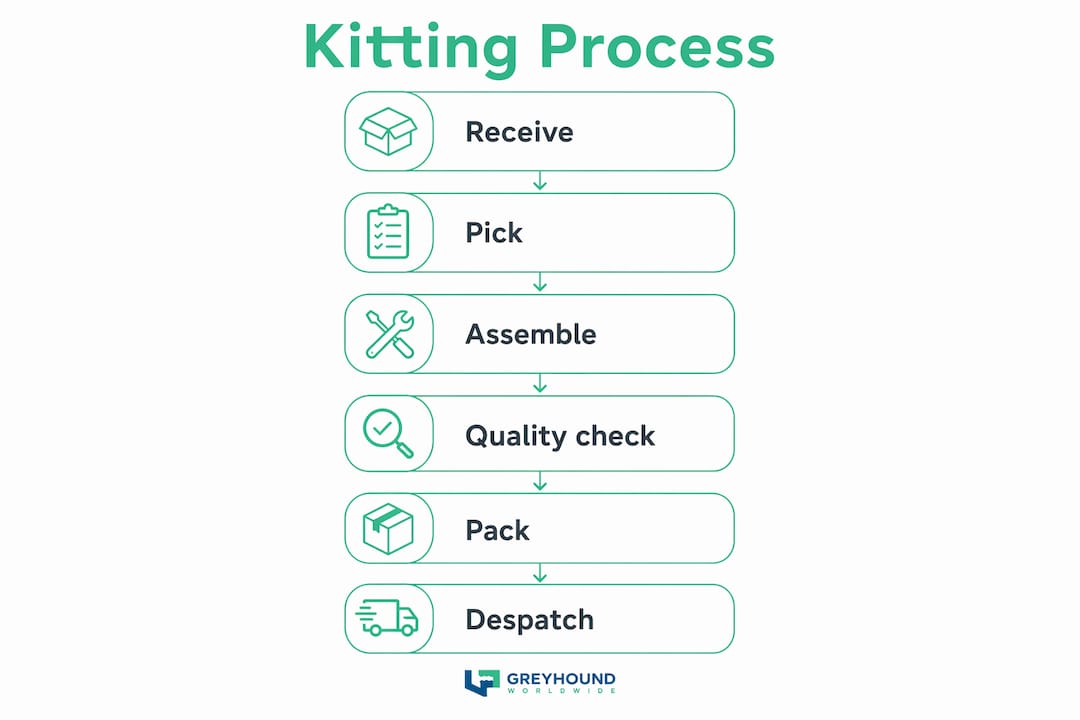
Receive and store. Inbound components are booked into the warehouse management system (WMS), assigned locations, and checked against purchase orders. Accurate goods-in data is the foundation of everything that follows.
Pick components. The WMS generates a pick list for each kit batch. Barcode scanning at the pick face confirms the right component and quantity before anything moves to the assembly area. This is where automated processes with manual oversight make a measurable difference to accuracy.
Assemble and kit. Components are brought together at a dedicated assembly station. For simple retail kits this is straightforward collation. For complex assemblies it may involve sub-assembly steps, cable routing, or torque-controlled fastening.
Quality check. Finished kits are weighed, visually inspected, and where required tested against a specification. Weight verification catches missing components quickly and cheaply. Visual checks confirm labelling, orientation, and presentation.
Pack and label. Kits are packed to your specification, labelled with the correct barcode, batch code, or carrier label, and staged for despatch.
Despatch. Orders are handed to the carrier network, with tracking data fed back into the WMS and synced to your ecommerce platform.
Throughput and lead times depend on batch size, SKU complexity, and seasonality. A simple two-component gift set can move from goods-in to despatch within 24 hours. A multi-part electronics sub-assembly with ESD-controlled handling and test requirements will take longer. Before signing with any provider, confirm their traceability records, labelling rules, packing specifications, and whether they hold the facility certifications your product category requires.
Why outsource your kitting and assembly to a 3PL?
The commercial case for outsourcing is straightforward once you account for the hidden costs of doing it in-house.
Time savings. Assembly labour is removed from your team’s workload, freeing operations staff for higher-value tasks.
Fewer errors. A dedicated kitting team with barcode scanning and QC checks consistently outperforms ad-hoc in-house assembly on accuracy rates.
Lower holding costs. A 3PL’s consolidated storage and reduced logistics costs typically beat the cost of maintaining your own warehouse space.
Scalability. A 3PL can flex labour up for peak periods, such as Christmas or a promotional launch, without you recruiting temporary staff.
Shipping consolidation. Kitting at the fulfilment centre means one outbound shipment per order rather than multiple parcels, which cuts carrier costs.
Consistent quality. Documented QC procedures produce repeatable results regardless of order volume.
Pro Tip:The trigger to outsource is not just volume. If your in-house team is spending more than two hours per day on kitting, or if seasonal peaks are causing despatch delays, those are the real signals to move to a 3PL, even at modest monthly order counts.
The top benefits of outsourcing fulfilment extend beyond cost: you gain access to carrier rate cards, technology infrastructure, and compliance expertise that would take years to build internally.
What types of kits do UK businesses typically need?
The right provider depends heavily on which kit type you are running. These are the most common categories UK businesses outsource.
Retail gift packs and seasonal bundles are the highest-volume category for ecommerce brands. They involve collating multiple SKUs, adding branded tissue or inserts, and packing to a presentation standard. Volume spikes sharply in Q4, so holiday fulfilment planning matters here.
Subscription boxes require consistent monthly assembly runs with precise component lists. Any substitution or shortfall directly affects subscriber retention, so BOM accuracy and stock management are critical.
PR and influencer packs are lower volume but high presentation standard. Single-site operations that combine decoration, personalised packing, and despatch under one roof suit this category well, as Geiger’s UK operation demonstrates for branded promotional kitting.
BOM kits for maintenance and production supply every part needed for a scheduled task, from rail maintenance fasteners to field-service spare-parts packs. Pugh & Sanders illustrate how industrial kitting aligns kit contents to work orders, reducing search time and increasing throughput on site.
Electronics sub-assemblies and medical kits require ESD-controlled environments, clean rooms, or specific certifications. General retail fulfilment centres cannot handle these; you need a provider with documented facility capabilities.
The volume threshold that typically triggers specialist kitting is around 200 or more kits per month for retail, or any production BOM kit where a missing component causes a line stoppage.
What technology and integrations should your 3PL offer?
Technology is what separates a reliable kitting partner from one that creates problems at scale. The core requirements are a WMS with barcode scanning at every stage, kit BOM management so the system knows exactly what goes into each SKU, and real-time inventory visibility so you can see stock levels and work-in-progress without calling anyone.
Platform integrations are non-negotiable for ecommerce. Your 3PL should connect directly to:
Shopify and WooCommerce for order sync and inventory updates
Amazon and eBay for marketplace fulfilment
Magento and BigCommerce for mid-market and enterprise ecommerce stacks
API connections for custom platforms or ERP systems
What each integration delivers in practice: order sync removes manual data entry and the errors that come with it; inventory sync keeps your storefront accurate so you do not oversell; kit BOM management means the WMS automatically deducts the correct components when a kit order is picked; exception handling flags shortfalls before they become despatch failures.
Parcelplanet’s ecommerce integrations cover all the major platforms, with real-time reporting so you can monitor kit assembly progress and despatch rates without logging into a separate system.
How do UK 3PLs charge for kitting, and what affects lead times?
Pricing for contract assembly in the UK follows a fairly consistent structure, though the numbers vary with complexity.
Cost component
Simple kit (2–3 SKUs)
Complex assembly (5+ components, testing)
Per-kit labour fee
~$0.50–$1.25
$15+
Set-up / tooling fee
Minimal or none
One-off charge for jigs, fixtures, or documentation
Storage
Per pallet or bin per week
Same, but higher SKU count increases footprint
Bespoke packaging
Per unit if custom box or insert required
Per unit, often higher for branded or protective pack
Sample run
Usually included or low fixed fee
May include engineering time
Published cost benchmarks show per-kit labour fees typically ranging from about $0.50–$1.25 for simple two-to-three SKU groupings, rising to $15 or more for complex, multi-component kits with testing requirements. Sterling equivalents will vary, but the complexity gradient is consistent: every additional component, labelling requirement, or QC step adds to the per-kit cost.
The main cost drivers are SKU count per kit, number of assembly steps, labelling and compliance requirements, testing or inspection time, and whether ESD or cleanroom handling is needed. Lead times are affected by the same factors, plus inbound goods-in timing and batch scheduling.
Pro Tip:Structure your sample run as a formal acceptance test. Agree on a minimum pass rate for weight checks and visual inspection before the full run begins. This protects both parties and gives you a clear baseline for SLA negotiations.
Controlling logistics costs starts with understanding exactly which cost drivers apply to your kit. Get an itemised quote, not a blended per-kit rate, so you can see where complexity is adding cost.
How to start a kitting project with Parcelplanet
Getting started is straightforward when you arrive prepared. Work through this checklist before your first conversation.
Prepare your BOM and SKU list. Document every component that goes into each kit, including quantities, dimensions, and any special handling notes.
Define your labelling requirements. Specify barcodes, batch codes, carrier labels, and any regulatory markings.
Gather packaging specifications. Provide box dimensions, void-fill rules, insert placement, and any branded packaging files.
Send sample components. Parcelplanet will use these to build a process sheet and price the assembly accurately.
Agree sample-run parameters. Set the batch size, acceptance criteria (pass rate for weight and visual checks), and rework rules before the run starts.
Set up platform integrations. Connect your ecommerce platform or ERP so order sync and inventory updates are live from day one.
Review reporting setup. Confirm which metrics you need: kit completion rates, despatch times, exception reports, and stock-level alerts.
Sign off the SLA. Agree despatch cut-off times, turnaround targets for kitting batches, and escalation contacts.
Once your sample run passes acceptance, full production can begin. Parcelplanet’s onboarding process is designed to move from first contact to live fulfilment quickly, with a dedicated contact at each stage.
Proof points: case studies and quality assurance
Parcelplanet’s kitting and assembly work spans both retail and complex fulfilment projects. The Asda Click & Collect integration demonstrates the team’s ability to handle high-volume, time-sensitive despatch with precise labelling and carrier compliance. Gift-wrapping fulfilment projects show the presentation-standard assembly that branded ecommerce clients require, where every kit must look identical and meet a visual specification before it leaves the warehouse.
You can see the process in action in Parcelplanet’s pick, pack and kitting demonstration, which shows the assembly workflow, barcode scanning at each stage, and the QC checks built into the process.
The trust signals buyers should look for in any kitting partner include:
Real-time WMS reporting with kit-level visibility
Barcode scanning at goods-in, pick, assembly, and despatch
Documented weight verification and visual inspection procedures
Courier network coverage: Royal Mail, DPD, DHL, UPS, FedEx
Facility certifications relevant to your product category (ESD, ISO cleanroom, food-safe)
For electronics and medical kits, ESD-controlled environments and documented procurement are requirements, not optional extras. Confirm these in writing before committing to a provider.
Key takeaways
Outsourcing kitting and assembly to a specialist UK 3PL reduces per-kit errors, cuts assembly labour costs, and gives you the capacity to scale through seasonal peaks without hiring.
Point
Details
Outsource when assembly consumes time
If your team spends more than two hours daily on kitting, a 3PL delivers faster and more accurately.
Complexity drives cost
Per-kit fees range from low (simple 2–3 SKU groupings) to significantly higher for multi-component kits with testing.
Technology is non-negotiable
Require WMS barcode scanning, kit BOM management, and direct platform integrations before signing.
Sample run protects both parties
Agree acceptance criteria upfront; a formal sample run sets the SLA baseline and reduces rework risk.
Parcelplanet as your kitting partner
Parcelplanet offers end-to-end kitting and assembly with real-time tracking, major platform integrations, and a structured sample-run onboarding process.
The part most guides skip: what actually goes wrong in the first month
The biggest kitting failures we see are not about picking the wrong provider. They are about arriving unprepared. A client sends components without a confirmed BOM, or the labelling spec changes after the sample run, or the ecommerce integration goes live before inventory is reconciled. Each of these adds days to the onboarding timeline and increases rework costs.
The fix is unglamorous: documentation first, then physical stock. Before a single component arrives at the warehouse, the BOM, labelling rules, and acceptance criteria should be agreed in writing. That single discipline removes the majority of first-month friction.
There is also a tendency to underestimate the value of the sample run. Clients sometimes want to skip it to save time. In practice, a well-structured sample run of 50–100 kits surfaces every process gap before they affect live orders. It is the cheapest quality assurance you will ever buy.
One more point worth making: the gap between retail kitting and manufacturing-grade assembly is wider than most buyers expect. If your product requires ESD handling, cleanroom conditions, or traceability to individual component serial numbers, confirm those facility capabilities before you negotiate price. A provider without the right environment cannot deliver the right outcome regardless of how competitive their rate is.
Ready to get your kitting and assembly running in the UK?
Parcelplanet gives growing ecommerce and manufacturing brands a faster route to accurate, scalable kitting than building the capability in-house. With direct integrations across Shopify, WooCommerce, Amazon, eBay, and Magento, plus a courier network covering Royal Mail, DPD, DHL, UPS, and FedEx, your kits move from assembly to your customer’s door without manual intervention.
The onboarding process starts with a sample run, so you can verify quality and agree SLA milestones before committing to full volume. Parcelplanet’s team handles the BOM setup, platform connection, and reporting configuration, so your operations team is not carrying the integration burden. For brands expanding into the UK market, Parcelplanet also supports multi-region despatch from day one.
Get a quote and book your sample run with Parcelplanet today.
Useful sources and further reading
The following sources informed this article and are worth consulting for deeper detail on specific areas.
Lean Construction Institute: Kitting — Cross-industry definition of kitting and the efficiency rationale behind it. Useful for understanding the shared principles between ecommerce and industrial applications.
Pugh & Sanders: Kitting Solutions — Practical detail on industrial and rail kitting, BOM alignment, and how maintenance kits are structured. Relevant for manufacturing and field-service buyers.
William Hughes: Kitting and Assembly — Manufacturing-grade kitting with JIT delivery, automated handling, and traceability for precision components. Useful for complex sub-assembly requirements.
FC Laser: Assembly Services UK — Integrated fabrication-to-assembly workflows and the lead-time benefits of keeping both under one roof.
EASL: Contract Electronics Manufacturing — Specialist guidance on ESD control, cleanroom requirements, and certifications for electronics and medical kitting.
Geiger UK: Kitting and Warehousing — Single-site branded kitting combining decoration, personalisation, and fulfilment for promotional packs.
Productiv: Kitting and Assembly Cost — Published cost benchmarks for per-kit labour fees across simple and complex assembly categories.
— A three-minute visual overview of the kitting and assembly process, useful for teams new to the concept.
Dispatch cut-off times are the final deadlines for order acceptance, directly affecting delivery promises. Warehouse and carrier cut-off times are separate, with the latter set by the carrier, and both must be aligned with your system’s timezone and holiday calendar. Verifying actual throughput capabilities and establishing clear SLA clauses are essential to ensure reliable same-day or next-day delivery commitments.
A dispatch cut-off time is the final deadline your 3PL accepts orders for a specific outbound cycle. Miss it by a minute, and your customer’s next-day promise becomes a 48-hour delivery. Before you read any further, run this check against your current provider:
Confirm the cut-off hour and whether it refers to order receipt or pick completion
Verify the carrier handover window — when does the outbound trailer actually leave the dock?
Check the facility timezone and confirm your OMS maps to it, not your head office clock
Request the holiday calendar and cross-reference it against your own promotional dates
Carriers such as Royal Mail, DPD, DHL, and UPS each operate fixed collection windows at UK fulfilment sites. Parcelplanet integrates directly with these networks, which means its configured cut-offs reflect real carrier departure times rather than aspirational marketing claims. The DCSA documents how cut-off times function as legally and operationally significant deadlines across carrier and port schedules — the same principle applies at parcel level.
What do dispatch cut-off times actually mean for your 3PL?
There are two distinct clocks running inside every fulfilment operation, and confusing them is the most common source of SLA disputes.
The warehouse (internal) cut-off is the deadline by which an order must complete pick, pack, QC, and labelling inside the facility. This is the time your 3PL publishes to merchants and the one that appears in your OMS.
The carrier (handover) cut-off is the point at which the outbound trailer is sealed and staged for collection. This is set by the carrier, not the 3PL, and it is typically earlier than most merchants expect.
The two clocks interact in sequence: an order must clear all internal processes before the carrier pickup window opens. In practice, carriers commonly set mid-afternoon terminal pickup deadlines that force warehouse cut-offs to sit conservatively earlier. A 3PL advertising a 3pm cut-off may have a carrier collection at 4pm, leaving only 60 minutes of buffer for the entire pick-pack-label-stage cycle. Local couriers can sometimes offer later collections, but that does not remove the internal constraint — the warehouse still has to finish the work.
The key principle: your published cut-off is only as reliable as the gap between it and the carrier’s actual departure time.
How a single cut-off decision cascades through your delivery promise
Understanding the domino effect of a missed cut-off helps you set realistic checkout promises and negotiate the right SLA with your provider.
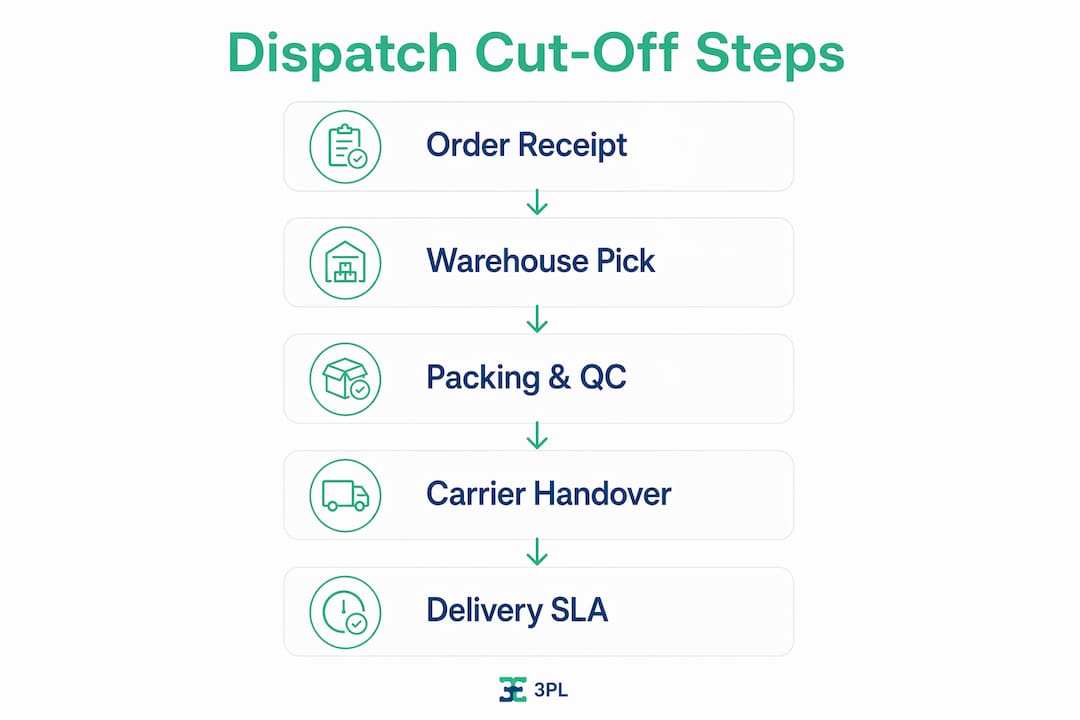
Order placed — customer selects next-day delivery at checkout; your OMS timestamps the order.
Order received by 3PL — the warehouse management system (WMS) accepts the order and queues it for picking.
Internal cut-off reached — any order not yet through QC and labelling at this point rolls to the next outbound cycle.
Carrier pickup window — the sealed trailer departs; orders not on the manifest miss this departure entirely.
Carrier injection — the parcel enters the carrier’s sortation network; transit SLA clock starts.
Customer delivery — next-day, 48-hour, or timed delivery depending on which cycle the order caught.
A 1pm cut-off typically supports next-day delivery across most of the UK mainland when paired with an afternoon Royal Mail or DPD collection. A 3pm cut-off can still achieve next-day for most postcodes, but the margin for error in the warehouse is tighter. A 9pm cut-off, where it genuinely exists, usually relies on an overnight carrier injection and is best suited to premium timed services rather than standard next-day ground.
Timezone mismatches amplify every step. A single-minute difference across a configured cut-off can change the SLA day calculation — if your OMS runs on UTC and your facility observes GMT+1 during British Summer Time, orders placed at 2:59pm your time may register as 3:01pm at the warehouse. Holiday calendars add another layer: a bank holiday not flagged in your provider’s system adds a full operational day to the delivery promise without any visible warning to the customer.
What cut-off hour ranges mean for your delivery SLAs
The table below maps the four common cut-off buckets you will encounter from UK 3PLs to their practical delivery and operational implications.
Cut-off window
Carrier pickup
Delivery SLA
Operational complexity
Cost impact
—
Early afternoon
Next-day (most UK postcodes)
Low — standard day shift
Standard per-order rate
1pm–3pm
Mid-to-late afternoon
Next-day (mainstream)
Moderate — peak pick window
Standard to slight premium
3pm–6pm
Early evening
Next-day (selective) or 48h
Higher — staggered staffing needed
Moderate surcharge likely
After 6pm
Overnight or early AM
Premium timed or next-day (major zones)
High — late shifts, QC risk
Per-order surcharge applies
“Same-day dispatch” means the order leaves the facility on the same calendar day it was received. It does not guarantee next-day delivery — that depends on which carrier service the order is injected into and the destination postcode. A 3pm cut-off with a DPD next-day service covers the vast majority of UK mainland addresses. The same cut-off with a Royal Mail 48-hour tracked service delivers in two working days. The cut-off hour and the carrier service are two separate variables; both must appear in your SLA.
SLA tracking depends on three provider settings: provider timezone, cut-off time, and SLA target. Robust systems factor in shipping days and observed holidays automatically. If your provider cannot show you these three settings in their WMS or integration dashboard, treat that as a red flag.
Why do different 3PLs set different cut-off times?
Cut-off times are not arbitrary. They reflect the physical and operational limits of a specific facility on a specific day.
Pick-and-pack throughput — the number of orders a team can process per hour sets a hard ceiling on how late the cut-off can sit without creating a backlog.
Sorter and pack-station capacity — insufficient throughput forces earlier cut-offs or staggered waves; a facility with manual sortation cannot absorb a late surge the way an automated conveyor system can.
Dock and door availability — carrier vehicles need a physical bay; if the dock is shared with inbound receipts, outbound staging competes for space.
Carrier pickup schedules — Royal Mail, DPD, DHL, and UPS each have fixed collection windows per site; the 3PL cannot unilaterally move these.
SKU complexity and QC requirements — fragile goods, multi-component kits, or items requiring serial-number scanning take longer per order, compressing the available window.
Staffing model — a single-shift operation has a hard stop; a two-shift or staggered model can push the cut-off later but introduces handover risk between teams.
Automation shifts these limits meaningfully. A facility running automated pick-to-light or goods-to-person systems can sustain higher throughput in the final hour before cut-off than a manual team. The trade-off is capital cost, which flows through to per-order pricing.
Pro Tip:When a 3PL claims a late cut-off, ask for their last-hour throughput as a percentage of daily volume. Providers who genuinely operate late cut-offs can show this figure from their WMS; those who cannot are likely quoting a theoretical maximum rather than a consistent operational reality.
How to extend your cut-off without compromising service quality
Later cut-offs are achievable, but each lever comes with a cost or a risk that you need to model before committing.
Staggered cut-offs split the day into two or three outbound waves. Orders received before 1pm go on the first wave; orders received up to 3pm go on the second. This is the most common approach and the easiest to negotiate into an SLA. Dynamic and staggered cut-offs are a standard operational response — some 3PLs offer a standard early cut-off and one or more paid later cut-offs.
Pre-picking for repeating SKUs works well for brands with predictable bestsellers. The warehouse picks and stages units for the most likely orders before they are placed, reducing the processing time per order in the late window. This requires accurate forecasting and tight inventory controls.
Later carrier pickups require a direct negotiation between your 3PL and the carrier. Some carriers offer extended collection slots for high-volume accounts. Pairing this with transport management tools that optimise slot booking can make later pickups more reliable.
Dynamic cut-offs driven by telemetry allow the WMS to extend or retract the cut-off in real time based on current pick queue depth. This is the most sophisticated option and requires API integration between your OMS and the 3PL’s WMS. Parcelplanet’s software integrations support this kind of live data exchange.
When modelling the cost, include the surcharge per late-wave order alongside the revenue impact of the extended promise. A £0.50 per-order surcharge on 200 late orders per day is £100 daily; if those orders would otherwise have been lost or required a customer service call, the maths usually favours the surcharge.
Pro Tip:Before accepting a per-order surcharge for late-wave processing, ask your 3PL to cap the percentage of daily volume eligible for the late window. Industry practice often limits last-hour processing to no more than 5% of daily volume — excess orders roll to the next day. Knowing this cap prevents a nasty surprise during peak.
What your 3PL SLA should say about cut-offs and holidays
A well-drafted SLA removes ambiguity before it becomes a dispute. These are the clauses and checklist items to negotiate.
Explicit cut-off definition — state the time in 24-hour format, the timezone (e.g., GMT/BST with BST transition dates), and whether it refers to order receipt by the WMS or pick completion.
Carrier handover definition — specify the carrier, service level, and scheduled collection time for each outbound wave.
Observed holiday list — attach a named calendar (UK bank holidays plus any facility-specific closures) and state that both parties must agree any changes in writing with at least 30 days’ notice.
Overnight and weekend rules — define whether Saturday collections are available, which carrier services apply, and at what surcharge.
Exception handling — state what happens when a carrier fails to collect (re-tender to alternative carrier, next-day priority, credit calculation).
Credit calculation — define the credit value per late dispatch and the reporting period for measuring on-time dispatch rate.
Sample clause (cut-off definition): “The Provider shall dispatch all orders received and confirmed by the WMS before 15:00 GMT (or 15:00 BST during British Summer Time) on any Business Day by the close of the same Business Day’s outbound cycle. Orders received after 15:00 GMT/BST shall be dispatched on the following Business Day. Business Days exclude the public holidays listed in Schedule A.”
Sample clause (holiday handling): “Schedule A lists all observed public holidays for the current calendar year. The Provider shall notify the Merchant of any additional facility closures no fewer than 30 days in advance. Orders received on an observed holiday shall be processed on the next Business Day without SLA penalty.”
Misaligned holiday calendars between merchant systems and a 3PL cause avoidable SLA disputes. Explicitly matching observed holidays in the contract prevents false breach flags — a point worth raising with both your operations and commercial contacts during procurement. When choosing a 3PL, ask the operations team to walk you through how their WMS handles bank holiday transitions and BST changeovers specifically.
How to verify a 3PL’s late-evening cut-off capability
A claimed 9pm cut-off is only worth the paper it is written on if the facility can sustain it consistently. Here is how to verify it before you sign.
KPIs to request:
On-time dispatch rate for the past 90 days, broken down by facility and by outbound wave (not just an aggregate figure)
Last-hour throughput as a percentage of daily volume — this reveals whether the late window is genuinely staffed or just theoretically available
Error and return rate for late-wave orders versus the day-shift average, which shows whether QC holds up under time pressure
Live tests to run during onboarding:
Inject a controlled volume of test orders into the proposed late window over five consecutive days. Review time-stamped carrier scans and manifests to confirm the orders appeared on the correct day’s collection. Run a parallel pick wave alongside the regular late wave to stress-test throughput without disrupting live orders.
Acceptable evidence looks like: operational dashboards showing per-wave dispatch timestamps, carrier proof-of-collection records, and WMS audit logs with order-level timestamps. Red flags include aggregate monthly figures with no wave-level breakdown, an inability to produce carrier manifests on request, or a late-wave error rate more than 1.5 times the day-shift rate.
Late-evening cut-offs are typically enabled by staggered shifts. Verify whether the 3PL maintains the same QC and inventory accuracy during late shifts as during day shifts — this is the question most merchants forget to ask. Robust providers configure location-level timezones and overnight cut-off logic so that the ship-by date is auditable rather than estimated. Insist on per-facility configuration evidence during onboarding.
Key takeaways
Dispatch cut-off times for 3PL operations have two layers — warehouse and carrier — and both must be documented, tested, and aligned to your OMS timezone before you can trust a same-day or next-day delivery promise.
Point
Details
Two-layer model
Confirm both the internal warehouse cut-off and the carrier handover time — they are separate deadlines.
Timezone and holiday alignment
Map your OMS to the facility’s local timezone and match holiday calendars in writing to prevent false SLA breaches.
Verify, don’t assume
Request last-hour throughput data and carrier manifests before accepting a late-evening cut-off claim.
Extend with a cost model
Staggered waves and late carrier pickups can push cut-offs later; model the per-order surcharge against lost-order revenue before deciding.
Parcelplanet
Offers timezone-aware cut-off configuration, live dispatch dashboards, and direct carrier integrations with Royal Mail, DPD, DHL, UPS, and FedEx.
Why verified cut-off logic matters more than the headline hour
There is a pattern worth naming directly. Many e-commerce brands spend weeks negotiating a headline cut-off time and almost no time verifying whether the facility can actually sustain it. A 9pm cut-off sounds impressive in a sales deck. What it means in practice is a late-shift team processing orders under time pressure, often with reduced QC oversight, into a carrier window that may or may not hold on a busy Friday evening.
The merchants who get the most value from a 3PL relationship are the ones who treat the cut-off as a system to be instrumented, not a promise to be taken on trust. They ask for wave-level dispatch data. They run controlled injection tests. They negotiate SLA clauses that define the cut-off in timezone-aware, 24-hour format with an explicit holiday schedule attached. And when the numbers stop adding up, they know when to act — whether that means renegotiating the SLA or considering a switch to a provider whose operational model genuinely supports the cut-off they need.
The headline hour is a starting point. The audit trail is what actually protects your customer promise.
Parcelplanet’s approach to transparent cut-off configuration
Parcelplanet gives e-commerce brands the operational transparency that late cut-off claims require. Every fulfilment arrangement includes timezone-aware cut-off configuration, live dispatch dashboards showing per-wave performance, and direct integrations with Royal Mail, DPD, DHL, UPS, and FedEx so that carrier handover times are visible in real time rather than reported after the fact.
Custom SOW clauses covering cut-off definitions, holiday calendars, and exception handling are standard, not an add-on. For brands managing same-day dispatch across multiple channels, Parcelplanet’s platform integrations with Shopify, WooCommerce, Magento, Amazon, and eBay mean your OMS and the warehouse WMS share the same cut-off logic. There is no guesswork about which timezone is governing the ship-by date.
To see how Parcelplanet configures cut-off times for your specific order volumes and carrier mix, request a fulfilment quote and ask for a cut-off verification exercise as part of the onboarding process.
Useful sources for ops and commercial teams
The sources below underpin the claims in this guide. Technical and operations teams will find the first three most useful for SLA configuration detail; commercial and procurement teams should focus on the contract-clause references.
Cut-Off Times in Container Shipping — DCSA — authoritative definition of cut-off times as operationally and legally significant deadlines; useful background for freight and cross-border components.
Why Cut-Off Times Vary for 3PLs — Racklify Logistics Encyclopaedia — detailed operational analysis of throughput, sorter capacity, and staggered cut-off models; recommended for operations teams reviewing 3PL capability claims.
What Does ‘Ship By Monday’ Actually Mean? — 3PL Pulse — practical explanation of timezone effects, holiday calendar mismatches, and verification steps; useful for both ops and commercial contacts.
How SLA Tracking Works — 3PL Pulse Documentation — technical documentation on provider timezone, cut-off, and SLA target configuration; recommended for integration and tech teams setting up OMS connections.
Cut-Off Date: Meaning and How It Affects Shipping — Ship4wd — glossary definition covering the distinction between cut-off date and cut-off time in international freight; relevant for merchants with cross-border or freight components.
Holiday e-commerce fulfilment tips — Parcelplanet — practical guidance on aligning holiday calendars and managing peak-period cut-off adjustments; recommended for commercial teams planning promotional calendars.
Integrating a warehouse management system with ecommerce channels is essential for real-time inventory accuracy and efficient fulfillment.
A WMS acts as a digital bridge, automating tasks and providing real-time inventory visibility across multiple platforms.
If you are outsourcing fulfilment, integrating your warehouse management system with your ecommerce channels is not optional. It is the difference between real-time inventory accuracy and daily firefighting. The practical first steps this week: run a full SKU audit to clean up reference IDs, then schedule a discovery call with your 3PL to map your platforms and courier requirements. The one exception worth noting is brands dispatching fewer than 50 orders per day with a single SKU range and no growth ambitions; for everyone else, the case for integration is clear.
A warehouse management system acts as the digital bridge between your physical warehouse operations and your online storefronts, automating the full fulfilment lifecycle from receiving through to dispatch. Every pick, putaway, and packing instruction flows through it, which means fewer manual errors and genuine real-time inventory visibility across every channel.
The distinction between a standard WMS and an e-WMS matters for growing brands. A standard WMS handles core warehouse tasks well. An e-WMS, as Anchanto explains, layers AI demand forecasting and robotic process automation on top, making it better suited to omnichannel complexity and high-volume DTC operations.
Capability
Standard WMS
e-WMS
Inventory tracking
Yes
Yes
Order routing
Basic
Automated, multi-node
AI demand forecasting
No
Yes
Robotic process automation
No
Yes
Dynamic order orchestration
Limited
Full
Returns processing
Manual
Real-time sync
Direct business benefits for outsourced fulfilment:
Higher order accuracy through guided pick instructions and barcode validation
Real-time inventory across Shopify, WooCommerce, Magento, and Amazon simultaneously
Reduced labour cost as automation handles repetitive routing decisions
Fewer mis-ships and returns driven by picking errors
Faster go-live when your 3PL uses prebuilt connectors
Dynamic order orchestration — intelligently allocating stock across channels to protect delivery promises during peak periods — is one of the most underused capabilities available through a well-configured e-WMS.
How does a WMS connect to your ecommerce platforms and couriers?
There are five practical methods for connecting a WMS to your storefronts and carriers. Each carries different trade-offs on speed, cost, and ongoing maintenance.
Method
Speed to pilot
Cost
Maintenance
Best for
Prebuilt connectors
Fast
Low
Low
Shopify, WooCommerce, Magento, Amazon
Open API
Medium
Medium
Medium
Custom storefronts, bespoke logic
Middleware / iPaaS
Medium
Medium–High
Low–Medium
Multi-platform, complex data mapping
EDI
Slow
High
High
Large retail partners, B2B channels
Webhooks
Fast
Low
Low
Real-time event triggers
Flat-file import
Slow
Low
High
Legacy systems, interim solutions
Prebuilt connectors and open APIs reduce custom development time significantly and lower the time between signing a 3PL contract and going live. For most UK ecommerce brands, a combination of prebuilt connectors for storefronts and webhooks for real-time status updates covers the majority of requirements.
A typical order data-flow runs like this: an order arrives on your storefront, the WMS validates it against available stock, a pick instruction is sent to the warehouse floor, the packer scans items and generates a carrier label, the order is handed to the courier (Royal Mail, DPD, DHL, UPS, FedEx, or Evri), and a tracking update is pushed back to your storefront and the customer. Carrier connectivity handles label creation, tracking numbers, and proof-of-delivery updates automatically.
Pro Tip:Ask your 3PL to show you a live data-flow diagram for your specific platforms before you sign. If they cannot produce one, treat it as a red flag.
Step-by-step checklist for integrating with a 3PL WMS
A structured approach prevents the most common failures. Work through these phases in order.
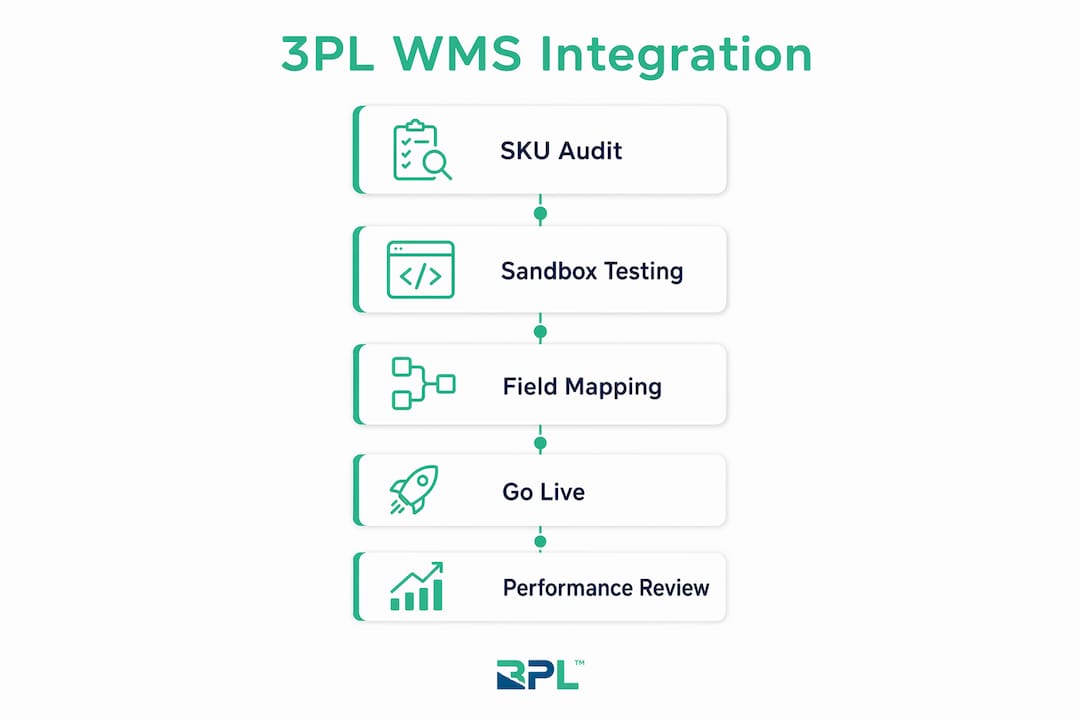
Discovery. List every platform you sell on (Shopify, WooCommerce, Magento, Amazon, and any others). Document current order volumes, peak forecasts, and SKU count. Confirm which courier accounts you hold and which your 3PL manages.
SKU audit.Mapping errors between storefront SKU references and WMS barcode IDs are the most common cause of integration failure. Clean and reconcile every SKU before mapping begins.
Field mapping. Agree the exact data fields passing between your storefront and the WMS: order ID, SKU, quantity, shipping method, customer address, and return status. Export the mapping document and keep it version-controlled.
Sandbox testing. Run sample orders through a test environment covering: a successful order, a cancelled order, a partial fulfilment, and a return that updates inventory. Do not skip this phase.
Pilot. Select a limited SKU range and a single channel for the first live run. Define rollback criteria in writing before go-live. Agree stakeholder sign-off points.
Cutover. Migrate remaining SKUs and channels in agreed batches. Monitor error logs daily for the first two weeks.
Post-go-live review. Check order accuracy, inventory sync frequency, and return processing times against agreed SLAs within the first 30 days.
A realistic timeline for a mid-sized UK ecommerce brand integrating with a 3PL WMS can vary significantly, depending on SKU complexity and the number of platforms involved.
How should your warehouse operations change when a WMS goes live?
Technology alone does not deliver the efficiency gains. Warehouse layout and slotting must be coordinated with the system’s zone logic to realise the full benefit. Move your fastest-moving SKUs closest to packing and dispatch stations, and configure those locations as priority zones in the WMS.
Operational changes to plan for:
Assign WMS zone codes to every physical location before go-live
Install barcode scanners and label printers at each pick and pack station
Confirm network coverage across the full warehouse floor
Brief pick staff on scan-confirm workflows before the pilot begins
Update receiving procedures so inbound stock is logged in the WMS before putaway
The process flow the WMS controls at each step: receiving (inbound scan and putaway instruction), replenishment (low-stock triggers), picking (guided route and scan confirmation), packing (weight and dimension check), and dispatch (label generation and carrier handoff).
Pro Tip:Coordinate physical layout changes with your integration milestones. Reslotting after go-live while staff are still learning the system creates avoidable errors. Do the layout work first, then train, then go live.
For a detailed warehouse setup checklist, Parcelplanet’s guide covers hardware requirements and zone configuration for ecommerce operations.
What KPIs, SLAs and data security checks should you set?
Agree these metrics before integration begins, not after.
KPI targets to set with your 3PL:
High order accuracy targets to ensure reliable fulfilment
High inventory accuracy targets to maintain stock reliability
Strong on-time-in-full (OTIF) performance targets to meet customer expectations
Pick rate: agreed per-hour benchmark based on your SKU profile
Prompt return processing to minimize delays
SLA items to include in your 3PL contract:
High WMS uptime to ensure system availability during trading hours
Frequent inventory data synchronization to keep stock levels current
Rapid incident response times for critical system issues
Remediation credits for SLA breaches
Protecting customer and inventory data is a contractual and regulatory obligation. Require encryption in transit for all data flows, role-based access controls so warehouse staff see only what they need, full audit logs retained in line with UK data retention practices, and a clear data breach notification process. These are not optional extras — they are the baseline for any UK ecommerce operation handling personal data.
A well-structured shipping strategy ties these KPIs directly to courier performance, giving you a single view of fulfilment health from pick to delivery.
What are the red flags to watch for when choosing a 3PL?
Warning signs during procurement:
No sandbox or test environment offered before go-live
Cannot export a field mapping document on request
Vague SLA language with no defined remediation credits
Limited courier connectivity (fewer than Royal Mail, DPD, DHL, UPS, FedEx, and Evri as a baseline for UK operations)
Opaque pricing with volume-based charges buried in small print
Questions to ask a 3PL before signing:
Which ecommerce platforms do you have prebuilt connectors for?
Can you show me a live sandbox environment?
What is your rollback procedure if go-live fails?
How do you handle SKU mapping conflicts?
What is your data breach notification process?
How frequently does inventory sync to our storefront?
A 3PL that cannot answer these questions clearly during procurement is unlikely to perform better once you are live.
How Parcelplanet integrates ecommerce platforms and couriers
Parcelplanet’s ecommerce integration capability covers prebuilt connectors for Shopify, WooCommerce, Magento, and Amazon, alongside courier integrations with Royal Mail, DPD, DHL, UPS, FedEx, and Evri. SKU onboarding follows a structured process: audit, field mapping, sandbox testing, and a phased pilot before full cutover.
Parcelplanet’s integration capabilities include:
Platform connectors for Shopify, WooCommerce, Magento, and Amazon
Automated label generation and real-time tracking updates
Returns processing with inventory sync on receipt
Dedicated onboarding support through discovery, mapping, and go-live
In practice, brands that complete the SKU audit and field mapping phase thoroughly before sandbox testing consistently reach go-live faster and with fewer post-launch corrections. The operational gains, including improved order accuracy and reduced shipping errors, become measurable within the first month of live operation.
Pro Tip:Request an integration discovery call with Parcelplanet before you finalise your platform or courier shortlist. The connector list and sandbox process are worth confirming early, as they directly affect your go-live timeline.
Key takeaways
Successful WMS integration for ecommerce requires a clean SKU audit, a structured sandbox phase, and clear SLAs agreed before go-live, not after.
Point
Details
Start with a SKU audit
Clean and reconcile every SKU reference before field mapping begins to prevent integration failures.
Insist on sandbox testing
Run successful, cancelled, partial, and return-flow test cases before any live orders touch the system.
Set SLAs before signing
Agree order accuracy, OTIF, and inventory sync frequency in the contract.
Align layout with go-live
Reslot your warehouse and configure WMS zones before staff training, not after.
Parcelplanet as your integration partner
Parcelplanet offers prebuilt connectors for Shopify, WooCommerce, Magento, and Amazon, plus full UK courier integration.
The trade-offs most brands get wrong
Most founders treat WMS integration as a technology project. It is not. It is a change management project that happens to involve technology. The brands that go live fastest are the ones that spend the most time on the SKU audit and field mapping, not the ones that rush to configure connectors.
Speed versus completeness is the central trade-off. Launching with a limited SKU range and a single channel gives you a controlled environment to catch errors before they affect your full catalogue. Staggering the rollout adds a few weeks to the timeline but typically prevents the kind of inventory discrepancies that take months to untangle.
On training: warehouse staff need to understand why the scan-confirm step matters, not just how to do it. A picker who understands that skipping a scan creates a ghost inventory record is far less likely to shortcut the process under pressure. That context takes twenty minutes to explain and saves weeks of reconciliation.
When to accelerate: if you are approaching a peak trading period, lock in your go-live date at least six weeks before it. A WMS integration that completes two weeks before Black Friday is a liability. One that completes eight weeks before gives you time to stabilise.
Parcelplanet’s fulfilment and integration services for UK ecommerce brands
Outsourcing fulfilment to a 3PL that already has your platform connectors and courier integrations built means you skip months of custom development and go live on a proven infrastructure. Parcelplanet connects directly to Shopify, WooCommerce, Magento, and Amazon, and dispatches through Royal Mail, DPD, DHL, UPS, FedEx, and Evri, with real-time tracking updates flowing back to your storefront automatically.
For UK ecommerce brands, the practical advantage is a single onboarding process that covers warehousing, pick and pack, courier selection, and platform integration in one contract. No separate integration agency, no custom middleware to maintain. Parcelplanet’s team guides you through discovery, SKU mapping, sandbox testing, and go-live, with SLAs agreed upfront. To request a quote or book an integration discovery call, visit the Parcelplanet fulfilment services page or get a tailored quote based on your order volume and platform requirements.
Useful sources and further reading
Integrating your WMS with ecommerce platforms (Uphance)
E-commerce warehouse management (Prologis)
E-warehouse management system explained (Anchanto)
WMS for retail: dynamic order orchestration (Made4net)
Ecommerce WMS guide: SKU mapping and integration (Finale Inventory)
Effective peak season fulfilment is the difference between a Q4 that builds your brand and one that damages it. The process covers everything from inventory positioning and 3PL coordination to system readiness and customer communication during the highest-volume sales windows of the year. Black Friday, Cyber Monday, and the Christmas rush are not separate problems. They are the same operational challenges, compressed and amplified. The businesses that handle them well start preparing in July, not October.
The essential components of a successful peak season are:
Demand forecasting grounded in last year’s sell-through data, adjusted for growth
Inventory accuracy with buffer stock on your top SKUs and clear inbound schedules
3PL capacity agreements locked in 60–90 days before peak
End-to-end system testing across your e-commerce platform, ERP, and warehouse management tools
Staff readiness covering both warehouse and customer service teams
Proactive customer communication with shipping deadlines published well in advance
Contingency planning for carrier delays, weather disruption, and stock shortfalls
Parcelplanet works with growing e-commerce brands across the UK to provide scalable fulfilment solutions built around exactly these requirements.
Order volume spikes 3x to 5x above normal during peak weeks, and that surge exposes every weakness in your operations simultaneously. A warehouse that handles 400 orders per day in September can be overwhelmed at 1,200 to 2,000 per day in late November. The inventory system that barely coped in October fails completely when Black Friday hits.
The most common bottlenecks include:
Inventory shortfalls caused by late purchase orders or supplier delays
Carrier capacity constraints as major networks apply demand surcharges and reduce availability
Staffing shortages when temporary recruitment is left too late
Integration failures between your storefront, ERP, and fulfilment systems
Communication breakdowns leaving customers without tracking updates or delivery estimates
Returns add further pressure. Retailers anticipate a 17% higher holiday return rate than their annual average, driven by gifting and sizing issues. Without a clear, extended return policy and a prepared reverse logistics workflow, the post-Christmas period becomes a second operational crisis.
“The biggest cause of peak season fulfilment failure is backend integration breakdown, particularly if order routing or fulfilment workflows are not tested end-to-end before volume surges.” — Operations experts cited by ScaleOps
The lesson is consistent: brands that invest in marketing but neglect their backend systems find that online sales only create problems they cannot fulfil their way out of.
Your step-by-step UK preparation timeline for 2026
Starting operational groundwork in July and August gives brands a measurable competitive edge over those who begin in October. A phased preparation calendar keeps your team focused on the right priorities each month.
Month
Key activities
July
Review last year’s results, audit fulfilment performance, set revenue targets
August
Build demand forecast, segment SKUs, place first purchase orders
September
Reserve 3PL inbound capacity, lock in carrier rates, refresh packaging
October
Test all integrations, train support staff, position inventory at fulfilment centres
Hit carrier cut-off dates, manage exceptions, prepare returns workflows
January
Process returns, run post-mortem, begin planning for next peak
The numbered milestones that matter most:
By 1 August: Complete your velocity analysis. Pull two years of Q4 sales data and identify your top 20% of SKUs by revenue.
By 15 August: Finalise your demand forecast with a 15–20% buffer on top SKUs. Place purchase orders with suppliers.
By 1 September: Provide your 3PL with week-by-week volume forecasts and inbound receiving schedules to secure staffing and dock capacity.
By 1 October: Complete end-to-end integration testing under simulated peak load. Stress-test order routing at realistic volumes.
Three weeks before peak: All inventory must be received, counted, and put away at your fulfilment centre. Inventory arriving during peak competes with outbound orders for dock time.
30 days before peak: Build your customer communication calendar with shipping deadlines, FAQ updates, and checkout page notices.
14 days before peak: Run a full readiness review with your 3PL. Confirm inventory status, carrier account setups, and escalation contacts.
UK-specific note: Royal Mail, DPD, and Evri all publish Christmas cut-off dates in October. Build your published delivery guarantees around those dates, with a conservative buffer to cover carrier delays.
Common peak season fulfilment mistakes and how to avoid them
Most peak season failures are predictable. The same five mistakes appear year after year, and each one is preventable with the right preparation.
Insufficient forecasting buffers. Brands that forecast without a safety margin run out of bestsellers in early December. Apply a moderate buffer on your top SKUs and a 10% buffer on the rest. Brands that position Q4 inventory early convert 18% better than those sending replenishments in November.
Skipping system stress tests. Order routing rules that work at 200 orders per day can break at 800. Test your full fulfilment path, including split orders, backorders, and returns, before peak begins.
Poor 3PL communication. Sending your 3PL a volume forecast in late October is too late. Formal capacity discussions need to happen 60–90 days out, with week-by-week projections and inbound schedules.
Reactive customer messaging. Waiting until orders are delayed to communicate with buyers generates support tickets and damages trust. Publish shipping deadlines on your homepage, checkout page, and order confirmations at least 30 days before peak.
Last-minute staffing. Temporary warehouse and customer service staff need time to train. Leaving recruitment until November means undertrained teams handling your busiest days.
Pro Tip:Your backend systems need as much attention as your marketing campaigns. A perfectly executed Black Friday promotion that overwhelms an untested order routing system will cost you more in customer service and refunds than the campaign generated in revenue.
How 3PL providers help you handle peak demand
A third-party logistics provider gives you access to capacity, expertise, and infrastructure that would take years to build in-house. During peak season, that access becomes the deciding factor between smooth fulfilment and operational breakdown.
The core advantages of a 3PL partnership during peak periods include:
Flexible warehousing capacity that scales with your order volume without long-term fixed costs
Experienced pick-and-pack teams already trained and ready to handle volume surges
Established carrier relationships with negotiated rates and priority access during constrained periods
Advanced tracking and integration capabilities connecting your storefront to the warehouse in real time
Specialist packaging options including gift wrapping, branded tissue paper, and promotional inserts
“3PLs that have not received your volume projections will allocate capacity to clients who gave them advance notice. The brands that get prioritised during peak are the ones that had the capacity conversation 60 to 90 days out and gave their operations team real numbers to plan against.” — ScaleOps peak season guide
To get the most from your 3PL partnership, provide a formal pre-season briefing covering your week-by-week units-per-day projections, your inbound receiving schedule, any special handling requirements, your priority SKU list, and a direct contact for your operations team during peak. Get written confirmation of their SLA for peak processing times. A 3PL that ships same-day in September may move to a 24–48-hour processing window in November. Knowing this in advance lets you set accurate delivery expectations at checkout.
For guidance on managing seasonal order spikes with a 3PL partner, Parcelplanet has published a detailed operations guide covering Black Friday and Cyber Monday preparation.
Signs your in-house fulfilment can’t keep up
Growing e-commerce businesses often hold on to in-house fulfilment longer than the operation can support. The warning signs are usually visible months before a crisis point.
Recurring order delays during busy periods, even before peak season begins
Rising error rates on picks and packs as order volume increases
Inventory management complexity that your current system cannot handle accurately
Operational costs climbing faster than revenue, driven by overtime and emergency courier spend
Inability to scale your warehouse team quickly when volume spikes
Customer service queues dominated by “where is my order” tickets
The risk of ignoring these signals is not just a bad peak season. It is customer churn, negative reviews, and lost revenue that takes months to recover. Many UK e-commerce brands find that a hybrid model works well: handling standard volume in-house while routing peak overflow to a 3PL. Others move to full outsourcing once their order volume crosses a threshold their warehouse cannot absorb. Periodic capacity reviews ahead of each peak season help you make that decision before it becomes urgent.
How AI and automation improve peak season operations
Technology has changed what is possible during peak season, particularly for brands that previously relied on manual processes and spreadsheets.
AI-driven demand forecasting analyses historical sales data, seasonal patterns, and growth rates to generate more accurate inventory plans than manual methods
Automated low-stock alerts flag when a top SKU drops below a set threshold, giving you time to reorder before a stockout occurs
Order routing automation selects the optimal fulfilment source based on inventory availability, customer location, and carrier cut-off times
Real-time inventory syncing across your e-commerce platform, ERP, and warehouse management system prevents oversell events during demand surges
Automated customer notifications at every order stage reduce “where is my order” tickets without manual intervention
Predictive carrier analytics identify slow lanes or backed-up routes before delays reach your customers
Automation across inventory alerts, order routing, and customer communications reduces manual errors and improves throughput during peak periods. Tools like NetSuite Inventory Management use demand-based replenishment to dynamically manage reorder points using historical and seasonal sales data. For rate management across carriers, platforms like Logivo support split shipment decisions and backorder processing during high-volume periods.
The integration layer connecting your storefront, ERP, and 3PL is where most peak season technology failures occur. Load-test that layer, not just your website front end, before November arrives.
How Parcelplanet supports your peak season
When your order volume doubles or triples and your current setup cannot keep pace, outsourcing to a specialist 3PL is the most direct route to a peak season your customers will not notice.
Parcelplanet provides tailored order fulfilment services for UK e-commerce and omnichannel brands, covering warehousing, picking and packing, shipping, and real-time order tracking. The platform integrates directly with major e-commerce platforms and courier networks, so your orders flow from storefront to customer without manual intervention. Unlike building warehouse capacity in-house, Parcelplanet scales with your volume, meaning you pay for what you need during peak without carrying fixed costs year-round.
For brands preparing for Black Friday, Cyber Monday, or the Christmas rush, Parcelplanet’s team works with you ahead of peak to agree capacity, handling requirements, and SLAs. You get a fulfilment partner that is ready when your busiest weeks arrive. Get in touch with Parcelplanet to discuss your peak season fulfilment requirements and receive a tailored quote.
Key takeaways
Effective peak season fulfilment depends on starting early, testing thoroughly, and communicating clearly with both your 3PL and your customers before volume surges.
Point
Details
Start planning in July
Brands that complete operational groundwork in July and August outperform those who begin in October.
Inventory must arrive early
All stock should be received and put away at your fulfilment centre at least three weeks before peak begins.
3PL briefings need 60–90 days
Provide week-by-week volume forecasts and inbound schedules to secure capacity and avoid deprioritisation.
Test systems before November
Load-test your order routing and integrations under simulated peak volume to prevent queue backlogs and data gaps.
Parcelplanet scales with you
Parcelplanet offers tailored 3PL fulfilment for UK e-commerce brands, with integrations and capacity built for peak demand.