TL;DR:
- 3PL focuses on operational execution, while 4PL provides strategic end-to-end supply chain management.
- Growing brands typically start with 3PL, upgrading to 4PL as logistics complexity increases.
- Choosing the right model depends on control preferences, scalability needs, and supply chain complexity.
The global 4PL market is forecast to grow from $59.6 billion in 2024 to $133 billion by 2034, yet many e-commerce brands still treat third-party and fourth-party logistics as though they are the same thing. They are not. Choosing the wrong model can cost you more than money; it can cost you customer trust, operational control, and the agility you need to scale. This article breaks down exactly what 3PL and 4PL mean, how they compare side by side, what each delivers in practice, and how you can make a confident, well-informed decision for your business.
Table of Contents
Key Takeaways
| Point |
Details |
| 3PL vs 4PL roles |
3PLs execute key logistics tasks while 4PLs manage and optimise the entire supply chain. |
| Strategic decision factors |
Choosing depends on your business scale, growth plans, and desired level of supply chain integration. |
| Real-world adoption |
4PL is growing quickly among successful e-commerce brands, especially those seeking full oversight and flexibility. |
| Cost and satisfaction |
Most are satisfied with 3PL services, but cost reduction is higher for those who leverage 4PL’s integrated strategies. |
| Long-term growth impact |
Picking the right logistics model can unlock substantial value as your e-commerce business scales. |
What is 3PL and what is 4PL?
With the stakes clearly established, let us clarify what each logistics model actually means for your business and why the distinction matters far more than most brands realise.
Third-party logistics (3PL) refers to outsourcing specific, operational logistics functions to an external provider. A 3PL partner handles tasks such as warehousing, order picking and packing, inventory management, and last-mile delivery on your behalf. You retain overall control of your supply chain strategy, but you hand off the physical execution. As Inbound Logistics explains, 3PL providers focus on operational execution of specific logistics functions such as warehousing, transportation, order fulfilment, and inventory management, acting as an extension of the client’s logistics team without owning the overall supply chain strategy. In short, a 3PL is your operational execution partner.
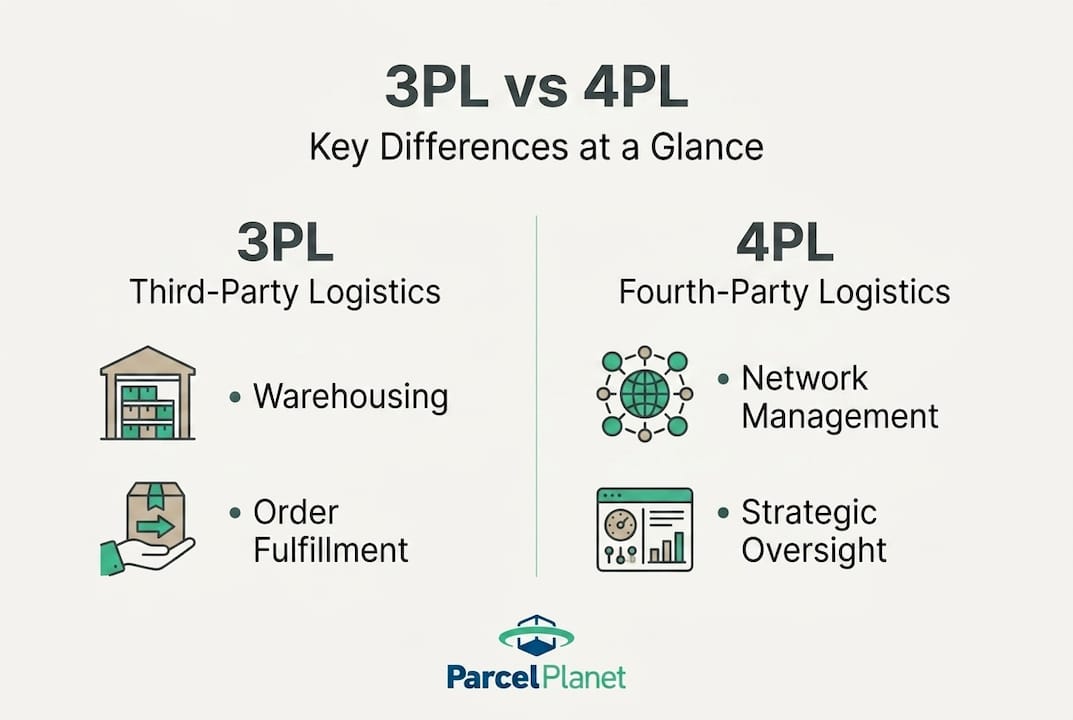
Fourth-party logistics (4PL) takes a fundamentally different approach. Rather than handling physical assets or individual logistics tasks, a 4PL provider manages your entire supply chain end to end. It coordinates multiple 3PLs, carriers, technology vendors, and other service providers on your behalf. According to Inbound Logistics, 4PL providers act as supply chain orchestrators, managing the entire end-to-end supply chain, coordinating multiple 3PLs and other vendors, providing strategic oversight, technology integration, and a single point of contact, typically non-asset based.
Here is a quick summary of what each model typically covers:
3PL services include:
- Warehousing and storage
- Order picking, packing, and despatch
- Inventory tracking and management
- Freight and courier coordination
- Returns processing and reverse logistics
4PL services include:
- End-to-end supply chain management
- Coordination of multiple 3PL and service providers
- Technology integration across all logistics nodes
- Performance monitoring and strategic reporting
- Risk management and network design
For a growing e-commerce brand, understanding 3PL in depth is an essential first step before deciding whether a more orchestrated model is right for you. Many businesses start with 3PL and scale from there, which is a perfectly sound strategy.
“A 3PL is your logistics engine. A 4PL is the driver who maps the route, maintains the engine, and manages everyone else on the road.”
That distinction shapes every decision you make about outsourcing your operations.
Key differences between 3PL and 4PL explained
With core definitions established, here is how the two approaches differ across practical and strategic dimensions that matter directly to your business.
The most important thing to understand is that 3PL and 4PL are not competing alternatives on the same spectrum. They serve genuinely different purposes. As Modula highlights, 3PL is tactical and asset-heavy, typically owning or managing warehouses and transport fleets with a transactional relationship, while 4PL is strategic, non-asset based, and operates through a performance-based partnership with full accountability for overall network performance.
| Factor |
3PL |
4PL |
| Primary role |
Tactical execution |
Strategic orchestration |
| Asset ownership |
Yes (warehouses, vehicles) |
No (coordinates providers) |
| Relationship type |
Transactional |
Performance-based partnership |
| Scope |
Specific logistics functions |
End-to-end supply chain |
| Technology |
Operational systems (WMS, TMS) |
Integrated data across all vendors |
| Accountability |
Individual tasks |
Entire network performance |
| Best suited to |
Growing brands scaling fulfilment |
Complex, multi-vendor operations |
| Control retained |
High (you manage strategy) |
Lower (provider manages strategy) |
Beyond the table, there are a few nuances worth highlighting. With a 3PL, you maintain direct involvement in strategic decisions. You choose which providers to use, which markets to enter, and how your supply chain evolves. With a 4PL, you are essentially handing that oversight to an external partner. That can be enormously powerful, but it does require a high level of trust and robust contractual accountability.
Key factors to consider when reviewing the structural differences:
- Control: 3PL keeps strategic control in your hands; 4PL hands it to a managed service provider
- Visibility: 4PL offers a unified view of all logistics data; 3PL visibility is limited to the provider’s own systems
- Flexibility: 3PL is easier to switch or adjust; 4PL involves deeper integration and longer transition periods
- Cost structure: 3PL is typically pay-for-service; 4PL often involves management fees plus performance incentives
When reviewing your 3PL vs 4PL fulfilment options, focus not just on price, but on how much strategic involvement you want to retain. That single factor often determines which model fits best.

Pro Tip: Do not underestimate the relationship and control dimension. Many brands choose a model based purely on cost, only to discover later that losing visibility over their supply chain creates problems that are far more expensive to fix.
Benefits and challenges of 3PL vs 4PL for e-commerce
Once you know how 3PL and 4PL differ structurally, it is crucial to weigh what each delivers and where they fall short in actual e-commerce operations.
Benefits of 3PL for e-commerce
3PL is the more accessible entry point for growing brands. You gain immediate access to established warehousing infrastructure, trained staff, and courier partnerships without the capital investment of building it yourself. You can scale up during peak periods such as Black Friday or Christmas without committing to permanent resource. Speed to market is fast; onboarding with a quality 3PL typically takes weeks, not months.
Research shows 89% of businesses are satisfied with their 3PL relationships, which reflects the strong operational consistency most providers deliver. That is a compelling figure. However, the same research notes that only 68% of those businesses see meaningful cost reductions, which indicates that satisfaction does not always translate directly into financial efficiency.
Benefits of 4PL for e-commerce
For brands managing multiple sales channels, international shipping lanes, and several fulfilment partners, 4PL provides something 3PL cannot: a single, unified view of the entire operation. You gain end-to-end data visibility, coordinated performance management, and a strategic partner who is actively optimising your supply chain rather than simply executing tasks within it.
4PL providers excel at identifying inefficiencies across your network, negotiating better terms with multiple carriers, and integrating technology platforms so that all your logistics data flows into one place. For brands navigating rapid growth or operating across multiple regions, this level of oversight reduces errors, improves delivery performance, and supports better business decisions.
Challenges to consider
Neither model is without drawbacks. Here are the most common challenges e-commerce brands encounter:
- Loss of operational control: With 3PL, you depend on one provider for execution quality. With 4PL, you depend on one provider for strategic decisions, both carrying risk if things go wrong.
- Integration complexity: Connecting your e-commerce platform, inventory systems, and courier networks to a new logistics partner requires technical resource and careful planning.
- Dependency risk: Over-relying on any single logistics partner, whether 3PL or 4PL, creates vulnerability. Contingency planning is essential.
- Cost transparency: 4PL fee structures can be complex. Understanding what you pay for and how performance bonuses are calculated requires careful contract review.
- Transition disruption: Switching logistics models mid-growth phase carries real operational risk. The timing of your transition matters considerably.
| Metric |
3PL performance |
4PL potential |
| Business satisfaction rate |
89% |
Varies by contract |
| Cost reduction achieved |
68% |
Higher with optimisation |
| Integration complexity |
Moderate |
High |
| Strategic oversight |
Client-led |
Provider-led |
| Scalability |
High |
Very high |
Using 3PLs to power e-commerce growth remains the most practical route for the majority of growing brands, particularly those at the scale-up stage where fast, reliable fulfilment matters most and strategic complexity is still manageable.
How to choose between 3PL and 4PL for your business
Understanding the advantages and drawbacks gives you the context. Now, here is a practical roadmap for choosing the right approach for your stage of growth and operational needs.
The single most useful question to ask is this: how complex is your current logistics operation, and how much more complex will it become in the next 12 to 24 months? Your honest answer to that question should guide most of your decision.
When 3PL is the right choice
Choose a 3PL provider when:
- You are scaling your e-commerce operations for the first time and need a reliable, plug-and-play fulfilment solution
- You operate from one or two primary markets and your logistics network is relatively straightforward
- You want to retain strategic control while outsourcing day-to-day execution
- Your order volumes are growing but your fulfilment complexity does not yet require end-to-end management
- Speed of onboarding matters, as a good 3PL can get you operational within weeks
This is the model that works for the vast majority of fast-growing e-commerce brands. It is reliable, scalable, and cost-effective when managed well.
When to consider upgrading to 4PL
The case for 4PL strengthens as your operation grows in complexity. Consider it when:
- You are managing multiple 3PL providers across several regions and coordination is becoming a full-time task
- Your data is fragmented across different systems and you lack a unified view of your supply chain
- You are expanding internationally and need a partner with the network and technology to manage cross-border logistics at scale
- Your leadership team needs to focus on product, marketing, and customer growth rather than logistics oversight
- You require performance-based accountability across your entire supply chain rather than individual service level agreements
Notably, 42% of supply chain leaders already use 4PL solutions, with a further 35% planning to adopt them. This is not a niche choice; it reflects where logistics strategy is heading across the industry.
Your decision framework
Before committing to either model, work through these questions:
- Cost: What is your current logistics spend, and where are the inefficiencies?
- Control: How much strategic oversight do you want to retain in-house?
- Technology: Do you have the systems to manage a 3PL effectively, or do you need integrated oversight?
- Scalability: Will your current model support your growth ambitions for the next two years?
- Complexity: How many vendors, channels, and regions does your operation involve?
Following structured logistics outsourcing steps ensures you evaluate each factor properly before signing contracts. And investing in seamless logistics integration from the outset saves significant time and cost further down the line.
Pro Tip: Map your logistics operation on paper before approaching any provider. Document every touchpoint from inventory receipt to customer delivery. This exercise almost always reveals inefficiencies you were not aware of, and it helps any prospective partner understand your needs far more quickly.
Why mastering logistics strategy is the real growth unlock
Here is something worth saying plainly: most e-commerce brands think about logistics as a cost to be managed rather than a capability to be built. That mindset is the single biggest barrier to scaling efficiently.
When a brand chooses a 3PL or 4PL, they are not just selecting a service provider. They are making a foundational decision about how their business will deliver on its brand promise to every single customer. Late deliveries, incorrect orders, and poor returns experiences do not get attributed to your logistics partner in the customer’s mind. They get attributed to you.
The brands that grow sustainably are the ones that treat logistics strategy with the same seriousness they give to product development and marketing. They review their logistics data regularly, hold their partners accountable to clear performance metrics, and plan their logistics evolution ahead of their growth curve rather than reacting to it. Choosing scalable logistics strategies early is far less disruptive than overhauling your entire operation after a period of rapid, unplanned growth.
There is also a subtler point worth making. The move from 3PL to 4PL is not inevitable or universally desirable. Some brands outgrow their 3PL providers and need a more orchestrated model. Others find that a well-chosen 3PL, deeply integrated into their systems and genuinely aligned with their growth goals, delivers everything they need at a fraction of the cost and complexity. The decision should always be driven by your specific operational reality, not by trend-following or the assumption that more complexity means more strategic sophistication.
Winning brands are not necessarily the ones using the most advanced logistics model. They are the ones using the right model, managed with discipline, at the right stage of their growth.
Next steps with your logistics partner
Choosing between 3PL and 4PL is a strategic decision with real consequences for your customers, your costs, and your capacity to grow. If you are evaluating your options and want proven expertise behind your fulfilment operation, we can help.

At ParcelPlanet, our order fulfilment services are built specifically for e-commerce and omnichannel brands that need reliable, scalable, and seamlessly integrated logistics. Whether you are outsourcing fulfilment for the first time or reviewing an existing arrangement, our team brings the experience and technology to get your operation running at its best. If you are new to the concept, understanding order fulfilment from the ground up is a great place to start before requesting a tailored quote.
Frequently asked questions
Can a business use both 3PL and 4PL providers simultaneously?
Yes, some complex supply chains use both, with the 4PL coordinating multiple 3PLs and other vendors to deliver fully managed, end-to-end logistics. This is common among large-scale, multi-regional e-commerce operations.
What size of e-commerce business benefits most from 4PL?
Businesses with large-scale, multi-channel sales and complex vendor networks gain the most from 4PL’s strategic oversight and integration, where coordinating several providers under one accountable partner delivers measurable efficiency gains.
Are 4PL solutions always more expensive than 3PL?
4PL services can cost more upfront, but research shows only 68% of businesses using 3PL see actual cost reductions, suggesting 4PL’s end-to-end optimisation may deliver stronger long-term financial performance for complex operations.
How does technology integration differ between 3PL and 4PL?
3PLs provide operational technology for specific logistics tasks such as warehouse management systems, while 4PLs integrate data across all vendors to create a unified, real-time view of the entire supply chain.
Recommended


