Inaccurate shipping can increase your operational costs by up to 15% through returns and reshipping alone, according to recent industry analysis. Yet many growing e-commerce brands underestimate this risk, focusing on marketing and product development while overlooking the shipping process that ultimately defines customer experience. This guide reveals how mastering shipping accuracy drives customer satisfaction, reduces waste, and enables sustainable operational scaling.
Table of Contents
Key Takeaways
| Point |
Details |
| Accurate shipping drives loyalty |
Reduces returns by up to 25% and boosts repeat purchases significantly. |
| Common errors are preventable |
SKU mislabeling, packaging mistakes, and integration failures cause most issues. |
| Metrics enable improvement |
Tracking mis-ship rate and delivery accuracy reveals where to focus efforts. |
| Technology needs process support |
Automation works only when combined with training and standardized workflows. |
| 3PL partners reduce errors |
Expert fulfilment providers cut inaccuracies by up to 35% compared to in-house operations. |
Why Accurate Shipping Matters for E-commerce Success
Shipping accuracy directly impacts your bottom line and brand reputation. When orders arrive correctly, customers trust your brand and return for more purchases. When mistakes happen, the damage extends beyond immediate costs.
Research shows shipping mistakes cause up to 25% order cancellations and a 20% drop in repeat purchases. Each error triggers a cascade of costs: customer service time, return processing, reshipping expenses, and potential refunds. These operational drains compound quickly for growing brands managing thousands of orders monthly.
Beyond financial metrics, shipping errors erode customer trust. A single wrong item or damaged package can turn a loyal customer into a detractor who shares negative reviews. In competitive e-commerce markets, where acquiring new customers costs five times more than retaining existing ones, accuracy becomes a critical retention tool.
The role of logistics in e-commerce extends beyond moving boxes. Your fulfilment process creates lasting impressions that influence purchasing decisions. Brands that prioritize accuracy build reputations for reliability, enabling premium pricing and higher customer lifetime value.
Key accuracy impacts include:
- Reduced operational costs through fewer returns and reshipping events
- Improved customer satisfaction scores and Net Promoter ratings
- Higher repeat purchase rates and customer lifetime value
- Stronger brand reputation and positive word-of-mouth marketing
- Better inventory management and demand forecasting accuracy
Common Causes of Shipping Inaccuracies in E-commerce
Understanding error sources helps you target improvements effectively. Most shipping mistakes stem from predictable operational breakdowns rather than random chance.
SKU mislabeling and manual picking errors top the list. When warehouse staff rely on visual identification or paper pick lists, fatigue and similar-looking products create confusion. A momentary lapse sends the wrong item to a customer, triggering the costly error cycle.

Technology and integration failures disrupt order accuracy even in automated environments. When your e-commerce platform fails to sync properly with warehouse management systems, orders contain outdated inventory data or incorrect shipping addresses. API disconnections and data mapping errors create invisible gaps where mistakes thrive.
Packaging mistakes contribute to 10-15% of delivery issues, yet brands frequently overlook this error source. Improper box sizing allows products to shift and break during transit. Insufficient cushioning or incorrect sealing methods result in damaged goods that customers refuse or return.
International shipping adds complexity that magnifies accuracy challenges. Customs documentation errors, incorrect harmonized tariff codes, and address format mistakes cause delays and returns. Growing brands expanding globally often underestimate these requirements until costly mistakes occur.
“The majority of shipping inaccuracies trace back to three root causes: inadequate process documentation, insufficient staff training, and poor technology integration. Addressing these systematically yields dramatic improvements.” — Supply Chain Operations Expert
Primary error sources:
- Manual data entry mistakes in order processing and fulfilment
- Poor lighting, confusing layouts, or inadequate signage in warehouses
- Rushed picking during peak periods without quality checks
- Inventory count discrepancies that show unavailable items as in stock
- Communication gaps between customer service and fulfilment teams
Measuring and Monitoring Shipping Accuracy Effectively
You cannot improve what you do not measure. Establishing clear metrics transforms shipping accuracy from an abstract goal into a manageable operational priority.
Start with your mis-ship rate: divide incorrect shipments by total shipments, then multiply by 100 for a percentage. Industry leaders maintain mis-ship rates below 0.5%, while average performers sit between 1% and 2%. Calculate this weekly to spot trends before they become expensive problems.
Delivery accuracy measures whether orders reach customers complete and undamaged. Track the percentage of orders delivered successfully on the first attempt without customer complaints or return requests. This metric captures issues missed by mis-ship tracking alone.
On-time delivery percentage reveals whether your accuracy efforts maintain speed. Calculate orders delivered by promised date divided by total orders. High accuracy with poor timing still damages customer satisfaction, so monitor both metrics together.
Benchmark your performance against industry standards to identify improvement opportunities. Compare your metrics against similar-sized brands in your vertical, adjusting for seasonal variations and growth rates.
Follow these measurement steps:
- Implement automated tracking at each fulfilment stage
- Create weekly dashboards showing accuracy trends
- Segment data by product category, warehouse location, and carrier
- Set improvement targets based on industry benchmarks
- Review metrics in regular team meetings to drive accountability
| Metric |
Calculation |
Industry Benchmark |
| Mis-ship Rate |
(Incorrect Shipments / Total Shipments) × 100 |
Below 0.5% |
| Delivery Accuracy |
(Successful First-Attempt Deliveries / Total Orders) × 100 |
Above 98% |
| On-Time Delivery |
(Orders Delivered by Promise Date / Total Orders) × 100 |
Above 95% |
| Return Rate |
(Returned Orders / Total Orders) × 100 |
Below 5% |
Dispelling Common Misconceptions About Shipping Accuracy
Several myths about shipping accuracy lead brands to misallocate resources or set unrealistic expectations. Clearing these misconceptions helps you build effective improvement strategies.
Many managers believe implementing warehouse management software instantly solves accuracy problems. Technology provides tools, but without proper training and process standardization, staff work around systems rather than with them. Software requires cultural adoption and workflow redesign to deliver promised benefits.
Packaging receives insufficient attention in accuracy discussions. Brands invest heavily in pick accuracy while ignoring how products are protected for transit. Yet packaging failures cause damage that customers perceive as shipping errors, triggering returns and complaints despite correct item selection.
Some leaders expect immediate ROI from accuracy investments. Real improvements emerge gradually as you refine processes, train teams, and gather performance data. Quick wins exist, but sustainable accuracy requires ongoing commitment rather than one-time fixes.
Common myths to avoid:
- More expensive technology always delivers better accuracy results
- Accuracy improvements slow down fulfilment speed
- Small error rate differences do not meaningfully impact profitability
- Outsourcing fulfilment means losing quality control
- Seasonal staff cannot maintain the same accuracy as permanent teams
Pro Tip: Start accuracy improvements with your highest-volume SKUs rather than trying to fix everything simultaneously. Reducing errors on your top 20% of products often cuts total mistakes by 60% or more, delivering quick wins that fund broader initiatives.
Choosing the Right Logistics Strategy to Enhance Shipping Accuracy
Your fulfilment approach fundamentally shapes accuracy potential. Growing brands face a critical decision between managing operations internally or partnering with specialized providers.
In-house fulfilment offers direct control but demands significant capital investment and ongoing management attention. You need warehouse space, staff, technology, and expertise across multiple disciplines. Scaling accurately becomes challenging as order volumes fluctuate seasonally or grow rapidly.
3PL providers reduce inaccuracies by up to 35% in growing brands versus in-house fulfilment. Specialized providers maintain dedicated teams, proven processes, and integrated technology stacks designed specifically for accuracy. They spread infrastructure costs across multiple clients, offering capabilities that would be prohibitively expensive to build independently.
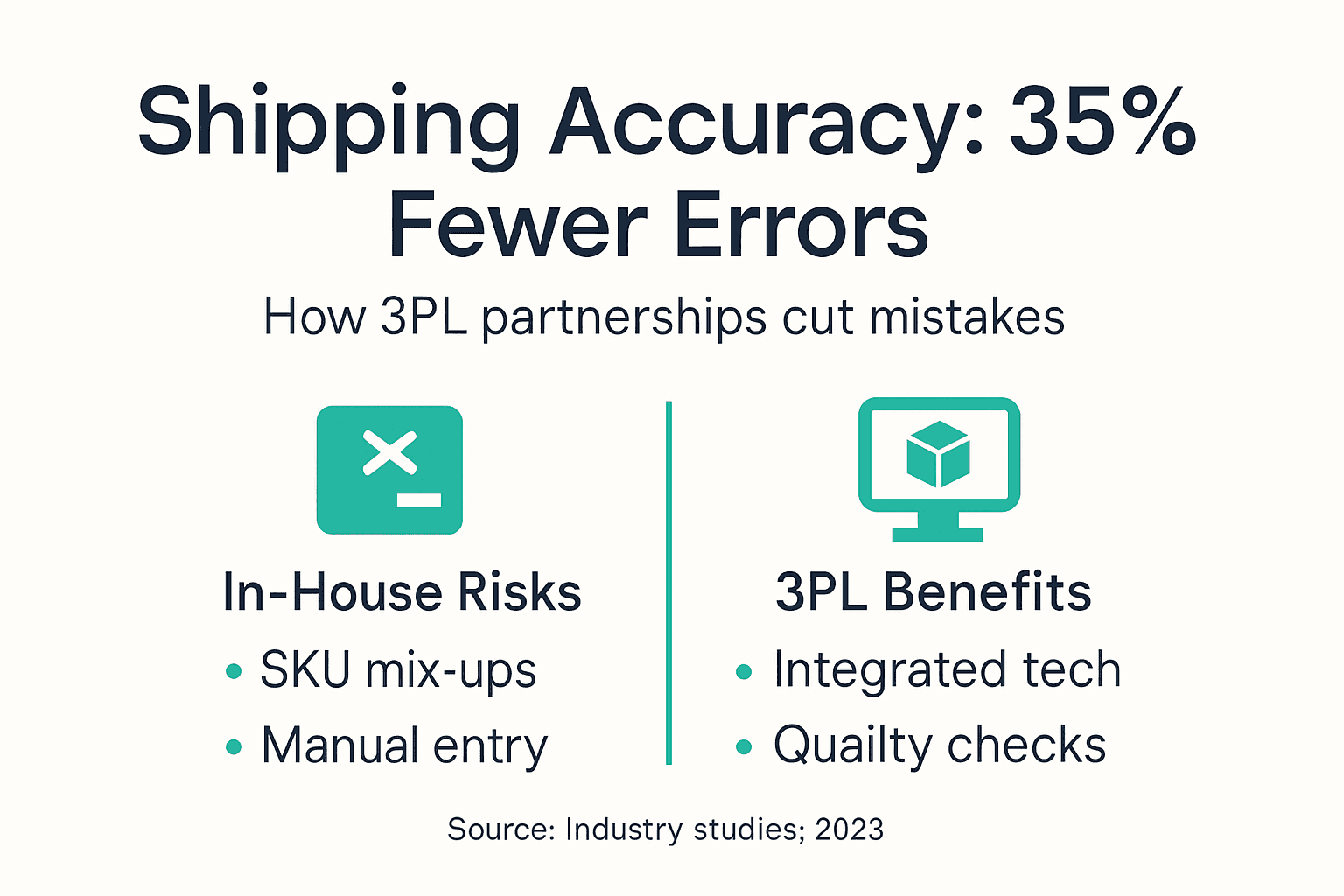
Technology integration matters more than automation alone. Select partners whose systems connect seamlessly with your e-commerce platform, providing real-time inventory visibility and order tracking. Manual data transfers between systems create error opportunities that negate other accuracy investments.
Scalability determines whether your chosen approach maintains accuracy during growth. Brands doubling order volumes face accuracy challenges as they hire and train new staff, expand warehouse space, or implement new systems under time pressure. Partners with existing capacity and proven scaling processes handle growth more reliably.
| Factor |
In-House Fulfilment |
3PL Partnership |
| Initial Investment |
High (warehouse, staff, tech) |
Low (service fees only) |
| Scalability |
Requires planning and capital |
Immediate capacity available |
| Technology Access |
Build or buy systems |
Integrated platforms included |
| Accuracy Rates |
1.5% to 3% mis-ship rate |
0.3% to 1% mis-ship rate |
| Control Level |
Direct daily oversight |
Strategic partnership management |
| Expertise Required |
Hire across multiple roles |
Access specialized knowledge |
Pro Tip: Evaluate potential 3PL partners by requesting accuracy metrics for brands similar to yours in size and product category. Generic industry statistics matter less than demonstrated performance with comparable clients.
The benefits of outsourcing order fulfilment extend beyond accuracy to include cost predictability, geographic expansion support, and access to negotiated carrier rates. Growing brands gain enterprise-level capabilities without enterprise-level overhead.
Practicing Steps to Improve Shipping Accuracy in E-commerce Operations
Improving accuracy requires systematic changes across technology, processes, and people. Follow these steps to build sustainable improvements.
1. Map your current process to identify error points
Document each step from order receipt to carrier pickup. Note where manual intervention occurs, where systems exchange data, and where quality checks happen. Error clustering reveals where to focus improvement efforts for maximum impact.
2. Implement automated SKU verification
Barcode scanning at picking and packing stages catches errors before shipment. Staff scan items rather than relying on visual confirmation, creating an electronic verification trail. This single change typically reduces mis-ships by 40% to 60%.
3. Integrate real-time tracking for immediate error detection
Modern tracking systems alert you to delivery exceptions, carrier delays, and address issues before customers notice problems. AI-enhanced tracking enables proactive communication that maintains satisfaction even when issues occur.
4. Train teams on packaging standards and process adherence
Create visual guides showing correct packaging for each product category. Conduct regular refresher training, especially before peak seasons when temporary staff join teams. Standardization reduces variability that causes damage and errors.
5. Select logistics partners based on integration and scale capability
Evaluate how well potential partners connect with your existing systems. Request case studies showing accuracy improvements for similar brands. Verify their capacity to handle your growth trajectory without quality degradation.
Essential implementation elements:
- Quality checkpoints at receiving, picking, packing, and shipping stages
- Regular audits comparing system inventory to physical counts
- Clear escalation procedures when errors occur
- Performance dashboards visible to all fulfilment staff
- Continuous feedback loops from customer service to operations
Pro Tip: Create an error log that captures not just what went wrong, but why it happened and what prevented detection. This qualitative data reveals process gaps that metrics alone miss.
Follow this ecommerce logistics checklist to ensure you address all critical accuracy factors. Additional order fulfilment efficiency tips help balance speed with accuracy for optimal performance.
Case Studies: Real-World Successes in Achieving Accurate Shipping
Real examples demonstrate how accuracy improvements translate to business results. These brands achieved measurable gains through systematic changes.
A mid-sized fashion retailer reduced mis-ship errors by 30% within six months of partnering with a specialized 3PL provider. The provider implemented barcode verification at every fulfilment stage and integrated directly with the brand’s Shopify store. Real-time inventory synchronization eliminated overselling, while automated quality checks caught picking errors before shipping.
An electronics accessories brand cut operational costs by 15% through packaging standardization and process documentation. They created packaging guides for each product category, specifying box sizes, cushioning materials, and sealing methods. Damage-related returns dropped by 40%, while customer satisfaction scores improved by 12 points.
A beauty products company saw repeat purchase rates increase by 18% after improving delivery accuracy from 94% to 99%. They invested in warehouse management software with photo verification at packing stations. Staff photographed each order before sealing, creating accountability and enabling rapid issue resolution when customers reported problems.
Success factors across cases:
- Leadership commitment to accuracy as a strategic priority
- Data-driven decision making based on regular metric reviews
- Technology investments paired with process redesign
- Staff training and engagement in improvement initiatives
- Continuous monitoring and refinement rather than one-time fixes
Summary and Next Steps for E-commerce Managers
Shipping accuracy creates competitive advantage through improved customer satisfaction, reduced operational costs, and stronger brand reputation. The path forward requires commitment to measurement, investment in appropriate technology and partners, and ongoing process refinement.
Prioritize these actions to begin your accuracy improvement journey:
- Establish baseline metrics for mis-ship rate, delivery accuracy, and on-time performance
- Identify your top error sources through process mapping and data analysis
- Implement automated verification at critical fulfilment stages
- Evaluate whether in-house operations or 3PL partnership better supports your growth goals
- Create continuous improvement cycles with regular metric reviews and team feedback
Accuracy improvements compound over time. Small gains in error reduction multiply across thousands of orders, generating substantial cost savings and customer loyalty benefits. Growing brands that master shipping accuracy position themselves for sustainable expansion and market leadership.
Discover ParcelPlanet’s Expert Order Fulfilment Solutions
Achieving shipping accuracy at scale requires the right partnership. ParcelPlanet’s order fulfilment services combine integrated technology, proven processes, and logistics expertise to reduce errors while supporting your growth ambitions. Our platform connects seamlessly with major e-commerce systems, providing real-time inventory visibility and automated order processing that eliminates common error sources.

We work with growing brands facing the accuracy challenges this guide addresses, delivering mis-ship rates below 0.5% through systematic quality controls and continuous process refinement. Understanding the importance of order fulfilment in customer experience drives everything we do. Explore how the benefits of outsourcing order fulfilment can transform your shipping accuracy and enable confident scaling.
Frequently Asked Questions
What are the most common reasons for shipping inaccuracies?
SKU mislabeling during picking, manual data entry errors, and packaging mistakes cause most shipping inaccuracies. Technology integration failures between e-commerce platforms and warehouse systems also create significant error opportunities. These issues multiply during peak seasons when staff work under time pressure.
How can e-commerce brands effectively measure shipping accuracy?
Track your mis-ship rate by dividing incorrect shipments by total shipments. Monitor delivery accuracy measuring successful first-attempt deliveries as a percentage of total orders. Calculate on-time delivery percentage to ensure accuracy efforts maintain speed, and benchmark against industry standards to identify improvement opportunities.
What is the role of 3PL providers in improving shipping accuracy?
3PL providers reduce shipping inaccuracies by up to 35% through integrated technology platforms, standardized processes, and specialized logistics expertise. They maintain dedicated quality teams, proven workflows, and scalable infrastructure that growing brands cannot cost-effectively build internally. Expert partners deliver enterprise capabilities at predictable costs.
Why isn’t technology alone enough to guarantee shipping accuracy?
Technology provides tools but requires proper training, standardized workflows, and quality controls to deliver results. Staff must understand and follow new processes for automation to work effectively. Combining software with packaging standards, regular audits, and team engagement creates sustainable accuracy improvements that technology alone cannot achieve.
Recommended


