TL;DR:
- Third-party logistics providers in the UK offer brands more control over branding, costs, and sales channels than Amazon FBA. They support custom services like cold storage, kitting, and direct-to-consumer fulfillment while ensuring compliance with UK customs and VAT. Transitioning from FBA typically takes four to eight weeks, with flexible options like full migration or hybrid models.
What are the main Amazon FBA alternatives in the UK?
For UK e-commerce brands, third-party logistics (3PL) providers offer the most practical route away from Amazon FBA’s fees, inventory restrictions, and limited branding control. Parcelplanet sits at the centre of this shift, offering UK sellers scalable order fulfilment with real-time tracking and multi-channel integration across Shopify, WooCommerce, and TikTok Shop.
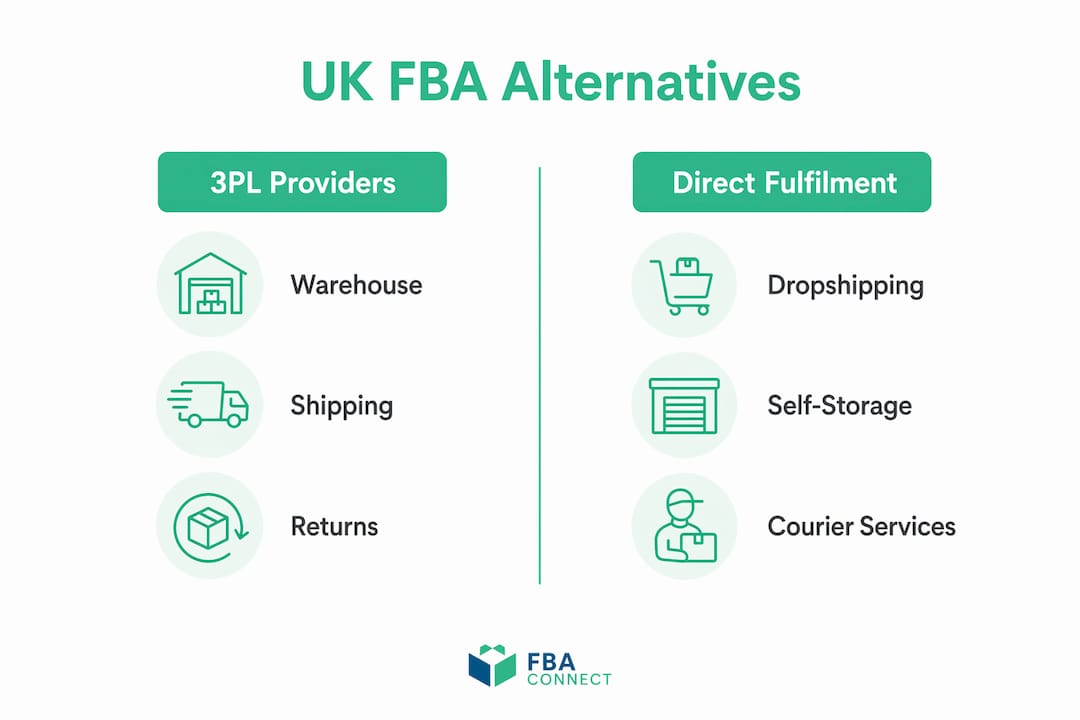
Amazon FBA’s fulfillment fees and strict inventory limits make it a poor fit for brands that need tailored storage, custom packaging, or genuine omnichannel reach. The core alternatives break down as follows:
- UK-focused 3PL providers such as Parcelplanet: full pick, pack, and ship with multi-channel sales support and real-time tracking
- Specialist cold-chain 3PLs: handle temperature-controlled goods that Amazon’s standard infrastructure cannot accommodate
- Kitting and subscription-box specialists: manage complex assembly workflows inside the platform rather than as bolt-on services
- Self-fulfilment: full control over packaging and customer experience, best suited to low-volume sellers not yet ready to outsource
- Seller Fulfilled Prime (SFP): retain the Prime badge while shipping from a certified 3PL warehouse, provided the provider meets Amazon’s demanding service-level requirements
- Fulfilled by Merchant (FBM): the lowest Amazon-side fee structure, pairing a 3PL with Amazon FBM listings alongside other sales channels
Post-Brexit, flexible UK-based fulfilment has become especially valuable. Customs complexity, VAT compliance, and cross-border shipping delays all favour providers with established UK operations and carrier relationships.
How do you choose the right fulfilment alternative for your business?
Choosing well comes down to matching your product type, order volume, and channel mix to a provider’s actual capabilities, not just their marketing claims.

| Criterion |
What to look for |
UK context |
| Service type |
Pick, pack, ship; kitting; cold storage |
Match to your product category |
| Multi-channel integration |
Shopify, WooCommerce, TikTok Shop, eBay |
Native, not middleware-dependent |
| Specialised capabilities |
Cold chain, kitting, subscription assembly |
Amazon FBA cannot support these |
| Pricing model |
Custom quote vs. published rates |
Avoid hidden storage penalties |
| Scalability |
No punishing minimums; grows with you |
Critical for seasonal UK brands |
| Ease of integration |
API or plug-and-play connectors |
Reduces onboarding time |
| Real-time tracking |
Live order and inventory visibility |
Protects customer satisfaction |
Key decision points for UK sellers:
- Returns management: providers that inspect, quarantine, or restock returned items daily give you far tighter stock control than Amazon’s model
- VAT and customs handling: post-Brexit cross-border shipments need a 3PL experienced in UK and EU compliance
- Delivery speed: UK customers expect next-day or two-day delivery; confirm your provider’s carrier network before committing
- Branding autonomy: 3PLs allow custom packaging and inserts that FBA prohibits
- Pricing transparency: pricing models vary widely across providers; always request a detailed quote covering warehousing, fulfilment, and returns
Pro Tip: When evaluating a 3PL, ask specifically about their returns handling process. Daily stock reconciliation after returns can meaningfully reduce refund delays and prevent overselling.
UK sellers making the switch: what the shift looks like in practice
Brands moving away from FBA typically follow one of two paths. The first is a full migration, where all inventory moves to a UK 3PL handling both Amazon FBM listings and direct-to-consumer orders. Most brands need several weeks to clear FBA inventory before the transition completes. The second is a hybrid approach, keeping high-velocity SKUs on FBA while routing slower-moving or specialist stock to a 3PL better equipped to handle it.
For brands selling across Shopify and a marketplace simultaneously, a 3PL with native UK ecommerce integration removes the middleware layer that often causes order sync failures. Parcelplanet’s platform connects directly with leading ecommerce systems, giving growing UK brands a single operational view across every channel.
Parcelplanet works with UK e-commerce brands ready to move beyond Amazon’s constraints. Get a tailored quote and find out how Parcelplanet’s fulfilment network can support your next stage of growth.

Key takeaways
Third-party logistics providers with UK operations give e-commerce brands more control over cost, branding, and channel reach than Amazon FBA can offer.
| Point |
Details |
| 3PLs beat FBA on flexibility |
UK 3PLs support custom packaging, kitting, and cold storage that FBA’s standardised model cannot. |
| Post-Brexit compliance matters |
Choose a provider experienced in UK VAT and cross-border customs to avoid costly delays. |
| Returns handling varies significantly |
Daily stock reconciliation after returns keeps inventory accurate and refunds fast. |
| Pricing models differ widely |
Always request a full quote covering warehousing, fulfilment, and returns before committing. |
| Migration takes planning |
Most brands need four to eight weeks to transition inventory out of FBA. |
Recommended


