TL;DR:
- Automated fulfilment uses technology to handle warehouse tasks, reducing errors and increasing speed for businesses of all sizes. It involves systems like RFID, robotics, and real-time data platforms to streamline receiving, picking, packing, and shipping processes. Adopting automation early improves accuracy, scalability, and customer satisfaction, providing a competitive advantage in e-commerce growth.
Automated fulfilment is not reserved for industry giants with vast warehouses and unlimited budgets. The same technologies that once belonged exclusively to companies like Amazon are now accessible to growing e-commerce brands of every size. Robotics, smart software, and real-time inventory systems have matured significantly, and their costs have come down sharply. Whether you are processing 200 orders a month or 20,000, understanding automated fulfilment could be the single most important operational decision you make this year.
Table of Contents
Key Takeaways
| Point |
Details |
| Sharp accuracy boost |
Automation achieves up to 99.15% picking accuracy, reducing costly errors for e-commerce businesses. |
| Lower fulfilment costs |
Automated systems cut operational costs compared to manual processes, driving better margins. |
| Faster order processing |
Automation speeds up processing, allowing quicker shipment and improved customer satisfaction. |
| Early ROI realisation |
Businesses typically see ROI from automation within two years of implementation. |
What is automated fulfilment?
At its core, automated fulfilment means using technology to handle the tasks that people once did entirely by hand. According to OPEX, automated fulfilment is supply-chain automation that fulfils and ships orders with little human intervention, using technology to manage receiving, order processing, picking, packing, and shipping tasks. That definition covers a wide range of tools and systems, not just industrial robots.
The primary technologies powering automated fulfilment include:
- RFID (Radio Frequency Identification): Tracks individual items and pallets across the warehouse in real time, reducing manual scanning errors and providing instant stock visibility.
- Robotics and autonomous vehicles: Physical machines that move, sort, and retrieve stock far faster and more consistently than a human workforce alone.
- Warehouse management systems (WMS): Software platforms that orchestrate every process, from receiving goods to dispatching parcels, and tie seamlessly into your sales channels.
- Real-time data systems: Live dashboards and APIs that connect your online store, courier service, and warehouse operations so nothing falls through the gaps.
Keeping up with e-commerce automation developments is no longer optional for brands that want to scale, because competitors who automate first gain meaningful advantages in speed and cost. Automation addresses both high-volume operations and businesses that are simply growing faster than their manual processes can keep pace with. If orders are piling up and errors are creeping in, that is the signal that automation deserves serious attention.
Applying warehouse optimisation strategies alongside automation technology helps you get the full benefit, since even the smartest software performs better in a well-organised physical space.
“Automated fulfilment is not a future concept. It is a present-day operational standard that growing brands are adopting right now to protect margins and delight customers.”
How automated fulfilment works: Key steps and technologies
Understanding what automation is gives you the foundation. Understanding how it works gives you the confidence to act on it. Here is the typical workflow, broken down step by step.
- Receiving: Goods arrive at the warehouse and are scanned automatically using RFID or barcode systems. Stock levels update instantly in the WMS, removing the need for manual counting and data entry.
- Order processing: When a customer places an order on your website, the WMS receives it in real time. It checks stock availability, assigns a pick location, and generates a picking instruction without a human needing to touch a keyboard.
- Picking: Robots or automated guided vehicles retrieve the correct items from storage and bring them to a packing station, or the system directs a warehouse operative to the exact location using light-guided or voice-directed picking tools.
- Packing: Automated packing machines select the optimal box size, pack the item, apply protective materials, and seal the carton. This reduces both packing time and wasted materials.
- Shipping: The system selects the most appropriate courier based on weight, destination, and delivery speed, prints the label, and updates tracking details across your sales channels automatically.
| Fulfilment step |
Technology used |
Primary benefit |
| Receiving |
RFID, barcode scanners |
Real-time stock accuracy |
| Order processing |
WMS, API integration |
Instant, error-free processing |
| Picking |
Robotics, voice-directed picking |
Speed and location accuracy |
| Packing |
Automated packing machines |
Consistency and material savings |
| Shipping |
Courier APIs, label printing |
Fast despatch and customer tracking |
One of the most underappreciated aspects of automation is exception handling automation. Automation extends beyond the warehouse floor into exception handling, covering issues such as duplicates, out-of-stock items captured after order placement, and address or price validation errors. Rule-based automation catches these issues and routes them for human judgement only when genuinely needed. This means your team spends time solving real problems, not chasing basic data errors.
Strong logistics integration strategies ensure your WMS, courier partners, and sales platforms communicate without friction, which is what makes the entire automated workflow actually function reliably.
Pro Tip: Set up rule-based exceptions for your three most common order issues from day one. Whether that is address format errors, oversized items, or stock mismatches, defining these rules early prevents costly manual intervention later and keeps your exception queue manageable as volume grows.
Good warehouse management insights will further guide you in structuring your physical and digital operations so that automation delivers maximum throughput.
Manual vs automated fulfilment: Cost, accuracy, and ROI
It is tempting to stick with manual fulfilment because it feels familiar and controllable. But the numbers tell a different story. Manual picking error rates sit at around 4%, which means roughly 1 in every 25 orders contains a mistake. Automated systems bring that figure down to approximately 0.04%, a hundredfold improvement. Automated warehousing can materially reduce picking error rates and warehouse fulfilment cost drivers compared with manual processes, though it does require upfront investment, integration, and ongoing maintenance.

| Factor |
Manual fulfilment |
Automated fulfilment |
| Picking error rate |
~4% |
~0.04% |
| Order processing speed |
Variable, people-dependent |
Consistent, 24/7 capable |
| Scalability |
Requires hiring |
Scales with software settings |
| Upfront cost |
Low |
Medium to high |
| Ongoing labour cost |
High |
Reduced over time |
| Change management |
Minimal |
Significant initial effort |
The ROI metrics you should track when evaluating automation investment include:
- Cost per order fulfilled: This should decrease as automation absorbs fixed labour costs across higher volumes.
- Return and error rate: Fewer errors mean fewer costly returns and customer service calls.
- Order cycle time: Measured from order placement to despatch, this is a direct indicator of customer satisfaction.
- Staff productivity per shift: Even in hybrid environments, automation typically lifts output per operative.
- Scalability headroom: How many additional orders can you handle without adding headcount?
The key insight here is that manual fulfilment has invisible costs. Every mispick generates a return, a replacement shipment, a customer service interaction, and often a lost customer. These costs rarely appear neatly on a spreadsheet, which is why many businesses underestimate how much manual errors are actually costing them. Reviewing your automation efficiency results gives you a clearer picture of what is genuinely at stake.
Key benefits and challenges of automated fulfilment
Knowing the theory is useful. Knowing what to realistically expect from automation in practice is what helps you plan well and avoid common pitfalls.
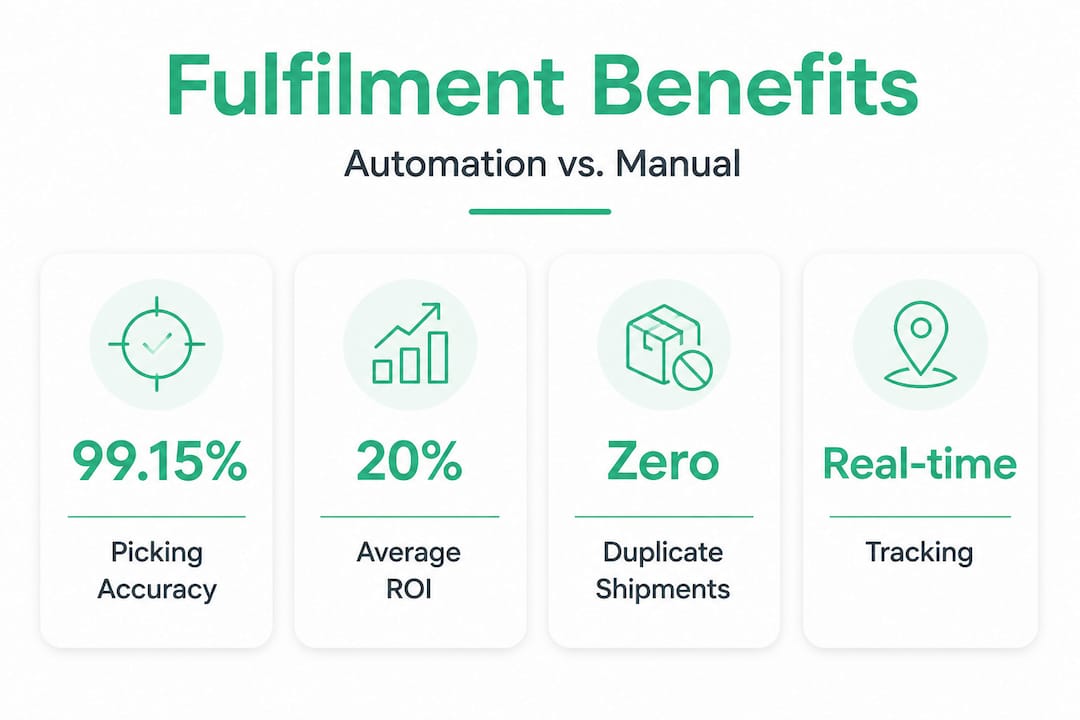
The benefits are substantial and measurable. Compiled warehouse efficiency statistics show a picking accuracy rate of 99.15% in automated environments as of 2024, with businesses reporting an average ROI of around 20% within the first two years of adopting automation. Beyond accuracy, you gain speed, consistency, and the ability to scale up rapidly during peak trading periods without hiring dozens of temporary staff.
Core benefits of automated fulfilment:
- Higher order accuracy: Dramatically fewer mispicks and wrong-item shipments.
- Faster despatch times: Orders processed around the clock, not just during business hours.
- Scalability on demand: Handle a Black Friday spike without operational chaos.
- Lower long-term labour costs: Automation absorbs volume growth without proportional headcount increases.
- Better customer experience: Faster, more accurate orders translate directly to positive reviews and repeat purchases.
Explore top fulfilment strategies to understand how automation fits within a broader operational plan for sustainable growth.
The challenges are real but manageable. Upfront costs remain the most commonly cited barrier. Integrating new technology with existing sales platforms, courier accounts, and inventory systems takes time and planning. Staff retraining is another area that businesses often underestimate. People need to understand new workflows, and there is typically a period of adjustment before efficiency gains fully materialise.
Challenges to plan for:
- Initial capital investment: Hardware, software licences, and integration development all carry cost.
- Technology integration complexity: Your WMS must connect reliably with every platform and courier you use.
- Staff retraining and change management: Teams need clear guidance and time to adapt.
- Ongoing maintenance and updates: Automated systems require regular updates to stay aligned with evolving business needs.
Using data-driven strategies to monitor performance after implementation helps you identify where the system is delivering results and where further optimisation is needed.
Pro Tip: Set a specific, measurable goal before starting any automation project. For example, aim to reduce your picking error rate by 80% within six months, or reduce cost per order by 15% within the first year. Concrete targets keep the project focused and make it much easier to demonstrate ROI to stakeholders.
Getting started with automated fulfilment in your e-commerce business
Knowing automation is beneficial is one thing. Taking the first practical steps towards it requires a structured approach. Here is how to move from consideration to action.
- Assess your current pain points honestly. Are errors climbing? Is despatch time creeping up? Are you turning down sales opportunities because fulfilment cannot keep pace? Document the specific problems automation needs to solve.
- Define your volume threshold. Automation typically delivers strong ROI once you are processing consistent order volumes. Review your monthly order data and project growth over the next 12 to 24 months.
- Research software and hardware options. Not every business needs a fully robotic warehouse. Many start with a WMS that integrates with existing couriers and sales channels, adding physical automation later as volume justifies it.
- Evaluate potential partners carefully. A 3PL provider that already has automation infrastructure in place can deliver the benefits without requiring you to build and manage the technology yourself.
- Pilot before scaling. Start with one product line, one warehouse zone, or one sales channel. Measure results carefully before rolling automation across your entire operation.
- Build internal buy-in early. Share the goals, timeline, and expected benefits with your team. Staff who understand why change is happening adapt faster and contribute more effectively to a successful rollout.
Key signs that your business is ready to automate:
- Order volume is growing faster than your team can manage.
- Picking and packing errors are generating increasing customer complaints.
- You are spending heavily on temporary staff during peak periods.
- Your courier relationships are being strained by late or incorrect despatch.
- Expanding into new channels or regions feels operationally overwhelming.
When choosing a fulfilment partner, look for one with proven automation capabilities, real-time tracking, and flexibility to handle your SKU range and order patterns. Using a practical fulfilment checklist during evaluation ensures you cover every operational and commercial consideration before committing.
Why automation is not a luxury—it’s the e-commerce standard
Here is the uncomfortable truth that many e-commerce businesses are slow to accept: waiting for the “right time” to automate is one of the most expensive decisions you can make. The common thinking is that automation is something you graduate into once you are large enough, profitable enough, or confident enough. But this logic has it backwards.
The businesses that benefit most from automation are not the ones that adopted it after reaching scale. They are the ones that adopted it to achieve scale. Every month you operate with manual fulfilment at growing volumes, you are paying in error costs, in staff hours, in lost customers, and in missed opportunities to expand.
We have seen this pattern clearly in the brands we work with. Those who delay automation often reach a crisis point where errors and costs become so painful that they are forced into urgent, poorly planned implementation. That reactive approach is far more expensive than a measured, proactive one.
The perception that automation requires vast capital is outdated. Modern 3PL partnerships mean you can access automated fulfilment infrastructure without building or owning it. Your brand benefits from robotics, real-time systems, and integrated courier despatch while paying operationally rather than carrying the full capital burden.
Scalable logistics solutions that incorporate automation are genuinely within reach for growing brands, and every month you delay is a month your competitors are gaining ground on accuracy, speed, and customer satisfaction. The competitive advantage does not come from automating eventually. It comes from automating now.
Explore expert fulfilment support with ParcelPlanet
If this guide has made you think seriously about automating your fulfilment operations, the logical next step is speaking with a partner who is already doing it at scale for e-commerce brands like yours.

At ParcelPlanet, we offer professional order fulfilment services built around real-time tracking, seamless platform integrations, and flexible handling across a wide range of SKUs and order volumes. Our infrastructure is designed to deliver the accuracy and speed that automated fulfilment promises, without you needing to build or maintain the technology yourself. Whether you are just beginning to explore automation or ready to transition from a manual operation, we are here to help you grow with confidence. Learn more about order fulfilment and get in touch with our team to discuss a tailored solution for your business.
Frequently asked questions
What types of technology are used in automated fulfilment centres?
Automated fulfilment centres use robotics, RFID systems, real-time data software, and rule-based exception handling solutions to manage receiving, picking, packing, and shipping with minimal human intervention.
How quickly can a business see ROI from implementing automated fulfilment?
Businesses typically see an average ROI of 20% within two years of adopting automated fulfilment, though gains in accuracy and efficiency often appear much sooner.
What order errors can automation reduce in fulfilment?
Automation can reduce picking errors, prevent duplicate shipments, and catch address or stock mismatches in real time through rule-based exception handling that flags issues before they reach the customer.
Is automated fulfilment only suitable for large e-commerce businesses?
No. Automated solutions are increasingly affordable and flexible, with 3PL partnerships making automation accessible to growing brands without the need for significant capital investment in hardware or software.
Recommended


