TL;DR:
- Beauty-specific 3PLs offer tailored services handling shelf-life, regulations, and fragile products.
- They provide scalable, flexible fulfillment supporting omnichannel sales during viral peaks.
- Choosing a proactive, sector-specialist partner enhances brand reputation and operational resilience.
The beauty sector moves fast. A single viral TikTok post can send orders surging overnight, and brands that rely on outdated logistics systems often find themselves scrambling to keep up. Peak surges from viral trends demand flexible, scalable infrastructure that most in-house operations simply cannot provide. This guide is written for e-commerce brand managers and entrepreneurs who want to understand how a beauty-specific third-party logistics provider can transform their fulfilment operations, protect their brand reputation, and position them to grow with confidence across every channel.
Table of Contents
Key Takeaways
| Point |
Details |
| Specialist beauty 3PL value |
A dedicated beauty 3PL streamlines logistics, scales during demand surges, and manages brand-sensitive needs far better than generic providers. |
| Integration and tech advantage |
Top beauty 3PLs use advanced integration tools to provide real-time visibility and seamless omnichannel fulfilment. |
| Handling market volatility |
With expert strategies and flexible resources, beauty 3PLs help brands adapt quickly to viral trends and seasonal peaks. |
| Choosing the right partner |
Prioritise partners with proven sector expertise, value-added services, and a culture of proactive collaboration. |
What is beauty 3PL and why does it matter?
Third-party logistics, or 3PL, refers to outsourcing your warehousing, picking, packing, and shipping to a specialist provider. For beauty brands, this means partnering with a fulfilment operation that understands your sector’s specific demands rather than treating your serums and setting sprays like generic parcels.
Beauty e-commerce is genuinely different from other product categories. Your inventory may include items with strict shelf-life requirements, batch tracking obligations, and regulatory compliance needs. Fragile glass packaging, temperature-sensitive formulations, and HAZMAT-classified products all require handling protocols that a generic warehouse simply is not built for. On top of that, your customers expect a premium unboxing experience that reflects your brand values.
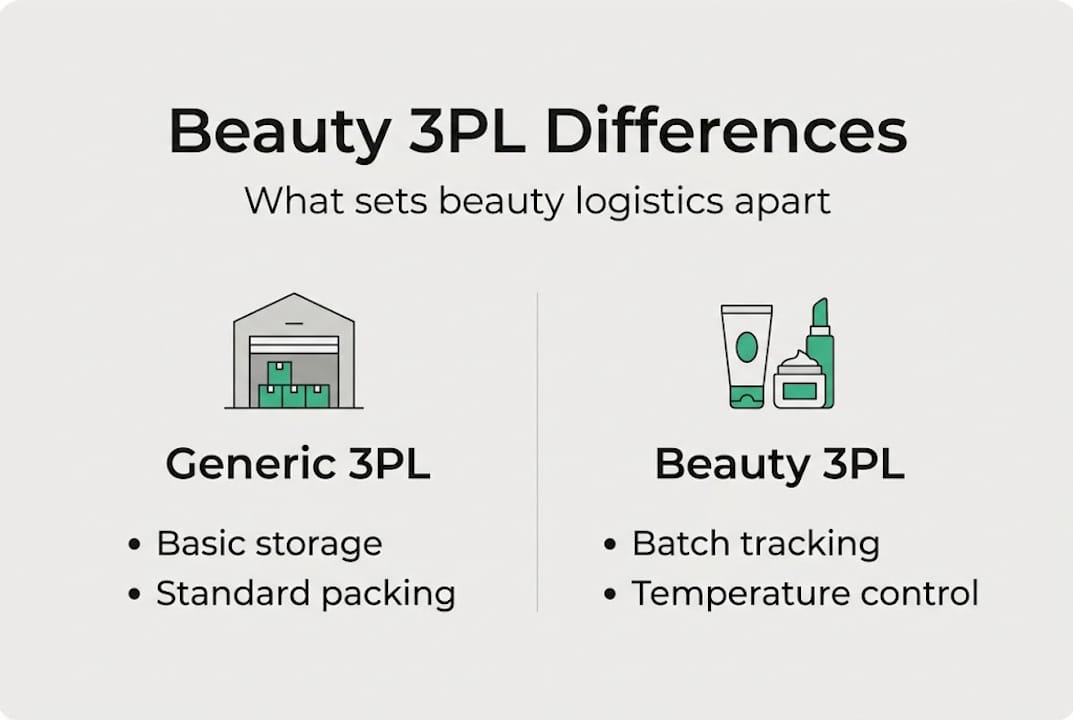
Understanding why brands need 3PL is the first step. The second is recognising that not all 3PLs are equal. Here is a direct comparison:
| Feature |
Generic 3PL |
Beauty-specialised 3PL |
| Shelf-life tracking |
Basic or none |
Batch control and expiry monitoring |
| Custom packaging |
Limited |
Branded kitting and gift wrapping |
| Regulatory compliance |
General only |
Cosmetics and HAZMAT-ready |
| Returns handling |
Standard process |
Compliant disposal and restocking |
| Omnichannel support |
Partial |
Full DTC, retail, and marketplace |
| Demand flexibility |
Rigid capacity |
Scalable for viral and seasonal surges |
Beauty-specialised 3PLs handle peak surges and flexible scaling far more efficiently than generic providers, because their systems and teams are built specifically for this kind of volatility.
Key functions a beauty 3PL performs for your growing brand include:
- Inventory management with expiry date tracking and batch control
- Specialist storage for temperature-sensitive or fragile goods
- Custom pick and pack to deliver a consistent brand experience
- Compliance management for cosmetics regulations and restricted substances
- Omnichannel fulfilment across DTC, retail, and marketplace channels
Exploring scalable fulfilment for beauty brands will show you just how much operational complexity a specialist partner can absorb on your behalf.
Essential services a beauty 3PL must provide
Choosing the right beauty 3PL partner means looking beyond price per parcel. The services on offer need to match the complexity of your product range and the expectations of your customers.
Inventory management tailored to beauty goes well beyond counting stock. You need batch-level visibility, first-expiry-first-out (FEFO) picking logic, and proactive alerts when stock is approaching its use-by date. This protects your customers and reduces costly write-offs.
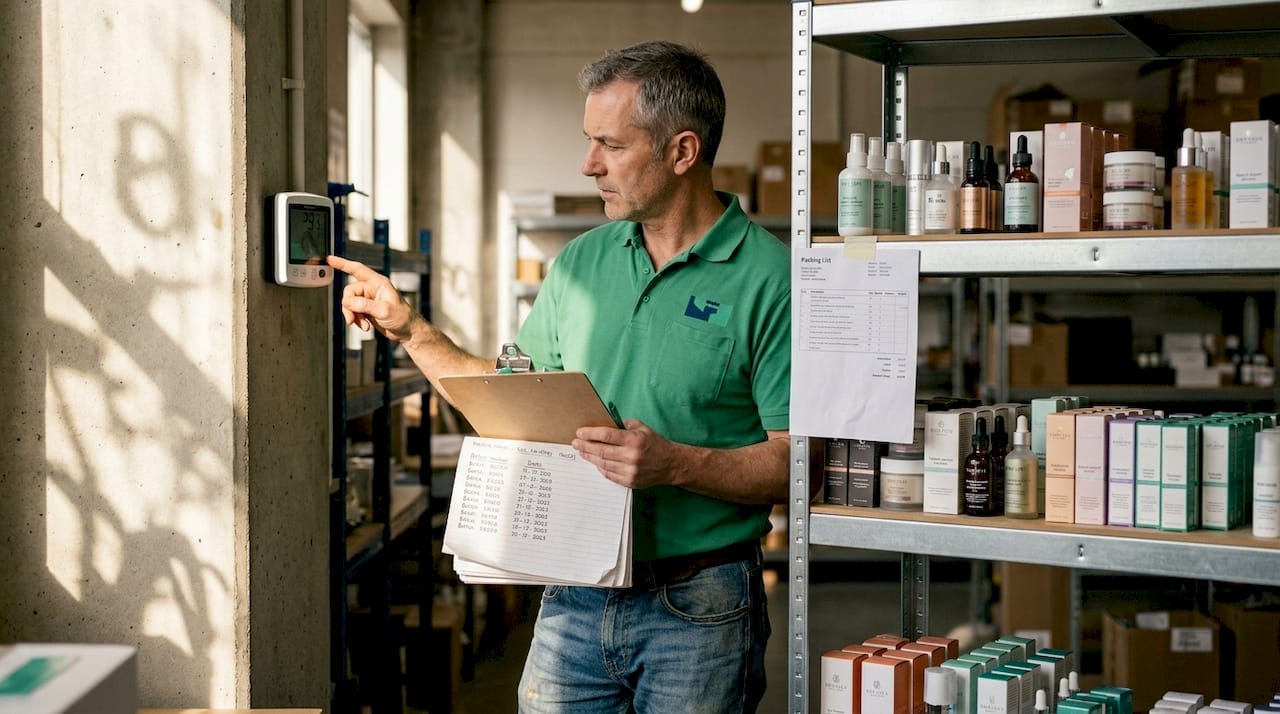
Temperature control and specialist storage matter more than many brands realise. Natural formulations, certain serums, and wax-based products can degrade in poorly controlled environments. Your 3PL should offer appropriate storage conditions and clear protocols for delicate goods.
Custom packaging and kitting are where your brand experience comes to life. Whether you need tissue paper, branded boxes, personalised inserts, or gift sets assembled at scale, customised beauty packaging is a powerful driver of customer loyalty and repeat purchases.
Returns handling and compliance is an area many brands underestimate. Beauty returns require careful assessment, compliant disposal of opened products, and accurate restocking of sellable items. HAZMAT classifications add another layer of responsibility.
Must-have integrations for a beauty 3PL include:
- EDI connectivity for retail and wholesale order processing
- E-commerce platform integrations (Shopify, WooCommerce, Magento)
- Marketplace connections (Amazon, ASOS, Zalando)
- Warehouse management system (WMS) with real-time stock visibility
- Courier management for dynamic carrier selection and tracking
Omnichannel fulfilment at scale requires EDI integration to keep retail and DTC channels synchronised without manual intervention.
Pro Tip: When evaluating beauty 3PL providers, ask specifically about their omnichannel fulfilment experience. A partner who has managed both DTC and retail channels simultaneously will anticipate integration challenges before they become your problem.
For a detailed look at what to expect, review the beauty fulfilment challenges that specialist providers are equipped to resolve. You can also explore pick and pack solutions to understand how kitting and assembly services work in practice.
Technology and integration: The backbone of modern beauty logistics
Even the most experienced fulfilment team cannot operate efficiently without the right technology. For beauty brands managing multiple channels, real-time data is not a luxury. It is essential.
A strong beauty 3PL will operate a warehouse management system (WMS) that connects seamlessly to your order management system (OMS), your e-commerce platforms, and any retail EDI requirements. This creates a single source of truth for stock levels, order status, and despatch activity.
Here is how data flows through a well-integrated omnichannel fulfilment operation:
| Stage |
Action |
Technology involved |
| Order placed |
Customer purchases via DTC or marketplace |
OMS or EDI receives order |
| Stock allocated |
Inventory reserved in real time |
WMS updates across all channels |
| Pick and pack |
Correct items selected by batch/expiry |
WMS directs warehouse team |
| Despatch |
Carrier selected based on service and cost |
Courier management system |
| Tracking |
Customer receives live updates |
Integrated tracking portal |
| Returns |
Item assessed and processed |
WMS updates stock accordingly |
The benefits of this connected approach are significant. Real-time tracking reduces customer service queries. Auto-routing selects the most cost-effective carrier for each order. Channel coordination prevents overselling and stock discrepancies across platforms.
Seamless logistics integration is what separates reactive fulfilment from genuinely proactive operations. Understanding your shipping strategy workflow in the context of 3PL technology will help you ask the right questions when evaluating providers.
Efficient omnichannel logistics for both DTC and retail channels depends on robust EDI integrations that remove manual steps and reduce error rates.
Pro Tip: Before signing with any 3PL, request a live demonstration of their dashboard. Transparent, real-time reporting is a strong indicator of operational maturity. If they cannot show you clear stock and order visibility, that is a warning sign.
Top challenges and expert strategies for successful beauty 3PL partnerships
Even with the right partner and technology in place, beauty brands face real-world challenges that require proactive planning rather than reactive fixes.
Demand volatility is the defining challenge of beauty e-commerce. A product featured by a major influencer can go from steady sales to thousands of orders within hours. Flexible scaling for viral trend surges is not optional. It is a core requirement of any credible beauty 3PL.
Returns and reverse logistics create significant operational pressure, particularly after peak periods. Beauty returns require careful inspection, compliant handling of opened or damaged goods, and timely restocking of sellable units. Brands that do not plan for this often face stock inaccuracies and delayed refunds.
On-time delivery during flash sales and seasonal peaks such as Black Friday, Valentine’s Day, and Christmas requires pre-agreed capacity plans with your 3PL well in advance. Last-minute conversations rarely produce the outcomes you need.
Expert strategies for mitigating core challenges:
- Share demand forecasts early. Give your 3PL visibility of upcoming campaigns, influencer partnerships, and promotional calendars at least four to six weeks ahead.
- Agree SLAs for peak periods separately. Standard service level agreements may not reflect the intensity of peak trading. Negotiate dedicated capacity.
- Audit returns processes before peak season. Understand exactly how your 3PL handles opened, damaged, and non-resellable items.
- Build buffer stock for hero SKUs. Identify your highest-risk products and maintain additional safety stock during high-demand windows.
- Review performance data monthly. Use your 3PL’s reporting tools to identify patterns and address issues before they escalate.
“The brands that scale successfully through peak periods are those that treat their 3PL as a strategic partner, not just a service vendor. Shared planning, transparent data, and mutual accountability are what make the difference.”
For more detail on managing growth, explore scalable cosmetic fulfilment and see how real brands have approached these challenges through our beauty logistics case study.
Our take: What most beauty brands miss about 3PL partnerships
Here is something we see consistently: beauty brands invest heavily in product development and marketing, then treat logistics as an afterthought. They select a 3PL based on cost per parcel and assume that any competent warehouse can handle the rest. That assumption is costly.
Beauty fulfilment is not just about moving boxes. It involves regulatory knowledge, brand experience management, and the operational agility to respond to a sector that changes faster than almost any other. A generic provider may tick the basic boxes, but they will struggle when a campaign goes viral, when a retail buyer demands EDI compliance, or when a batch recall requires precise tracking.
The real differentiator is a proactive specialist partner. One who flags potential issues before they reach your customers, who understands the compliance landscape, and who genuinely invests in your brand’s growth. Cost matters, but it should never be the primary filter.
Our advice: prioritise cultural fit and partnership mindset alongside technical capability. Ask how a provider has handled a crisis. Ask what proactive improvements they have made for existing clients. The answers will tell you far more than a rate card. Sector-specific 3PL solutions exist precisely because beauty brands deserve more than a generic service.
How ParcelPlanet can elevate your beauty brand logistics
If this guide has clarified what your beauty brand needs from a 3PL partner, the next step is finding a provider who can genuinely deliver it.

At ParcelPlanet, we specialise in fulfilment for e-commerce and omnichannel brands, including those operating in the beauty sector. Our order fulfilment services are built around real-time visibility, flexible capacity, and seamless integrations with the platforms and couriers your business relies on. From custom kitting to compliant returns handling, we tailor our approach to your specific needs. Explore our dedicated beauty fulfilment services or get in touch with our team to discuss a bespoke fulfilment plan for your brand.
Frequently asked questions
What are the main benefits of using a beauty 3PL provider?
Beauty 3PLs help you handle peak demand efficiently, offer specialist storage and branded packaging, and ensure your orders reach customers on time with far fewer operational headaches than managing fulfilment in-house.
How does a beauty 3PL support omnichannel sales?
By integrating with DTC and retail systems, beauty 3PLs enable real-time stock management and seamless fulfilment across every channel. Omnichannel scalability depends on robust EDI connectivity that keeps all your platforms synchronised.
What challenges are unique to beauty logistics?
Beauty products require careful handling due to shelf-life constraints, regulatory compliance, and high customer experience expectations. These sector-specific demands are often beyond the capability of generic 3PL providers.
Can a beauty 3PL help with eco-friendly or branded packaging?
Yes, many beauty 3PLs offer sustainable and branded packaging solutions as value-added services, helping you deliver a premium unboxing experience that reinforces your brand identity and encourages repeat purchases.
Recommended


