TL;DR:
- Automation improves fulfilment speed, accuracy, and scalability, boosting customer retention.
- Fully automated systems excel at repetitive tasks but struggle with complex exceptions.
- Hybrid models combining automation and human oversight are optimal for high SKU variability and complex orders.
Fulfilment quality is one of the most direct drivers of customer loyalty in e-commerce. 85% of customers will not return after a poor delivery experience, which means every missed dispatch or incorrect order carries a real commercial cost. Automation in fulfilment promises to solve this, but the reality is more nuanced than simply switching on a new system and watching errors disappear. This article walks you through what automation actually does inside a fulfilment operation, where it delivers the strongest results, where it falls short, and how to implement it in a way that genuinely improves outcomes for your brand and your customers.
Table of Contents
Key Takeaways
| Point |
Details |
| Automation accelerates fulfilment |
Faster and more accurate orders lead directly to higher customer satisfaction. |
| Hybrids outperform in complex cases |
Combining automation with skilled staff handles exceptions and boosts flexibility. |
| Clear oversight prevents pitfalls |
Automation works best when processes have strict rules and regular evaluation. |
| Financial impact can be strong |
Automation saves cost and scales well, but requires smart investment for true ROI. |
Why automation matters in fulfilment
Automation in fulfilment refers to the use of technology to carry out tasks that were previously done manually. This includes robotic picking arms, conveyor sorting systems, barcode scanning, warehouse management software (WMS), and AI-based demand forecasting tools. Each of these removes a point of human error and speeds up the flow of goods from shelf to shipment.
The reason this matters so much is simple: customers judge your brand by what arrives at their door, and when it arrives. A delayed shipment or a wrong item does not just create a support ticket. It erodes trust. Research confirms that automation leads to faster and more accurate delivery, which in turn increases customer retention. For growing e-commerce brands, retention is where long-term profitability lives.
The core benefits of automation in logistics include:
- Faster order processing: Automated picking and sorting systems can process hundreds of orders per hour with minimal downtime.
- Improved accuracy: Barcode verification and automated weight checks catch errors before parcels leave the warehouse.
- Scalability: Systems can handle volume spikes without the lead time needed to recruit and train temporary staff.
- Cost reduction: Over time, automation lowers the cost per order, particularly for high-volume, repetitive fulfilment tasks.
“A single poor delivery experience is enough to lose a customer permanently. Automation is not just an operational upgrade — it is a customer retention strategy.”
That said, automation is not a set-and-forget solution. Without proper oversight, automated systems can amplify errors at scale rather than eliminate them. A misconfigured sorting rule or an outdated inventory mapping can send hundreds of wrong orders before anyone notices. The fulfilment strategies that work best treat automation as a tool to be managed, not a replacement for operational intelligence.
Key benefits automation brings to e-commerce fulfilment
When implemented correctly, automation delivers measurable improvements across the entire order lifecycle. The most significant gains are in speed, accuracy, and the ability to scale without proportional cost increases.
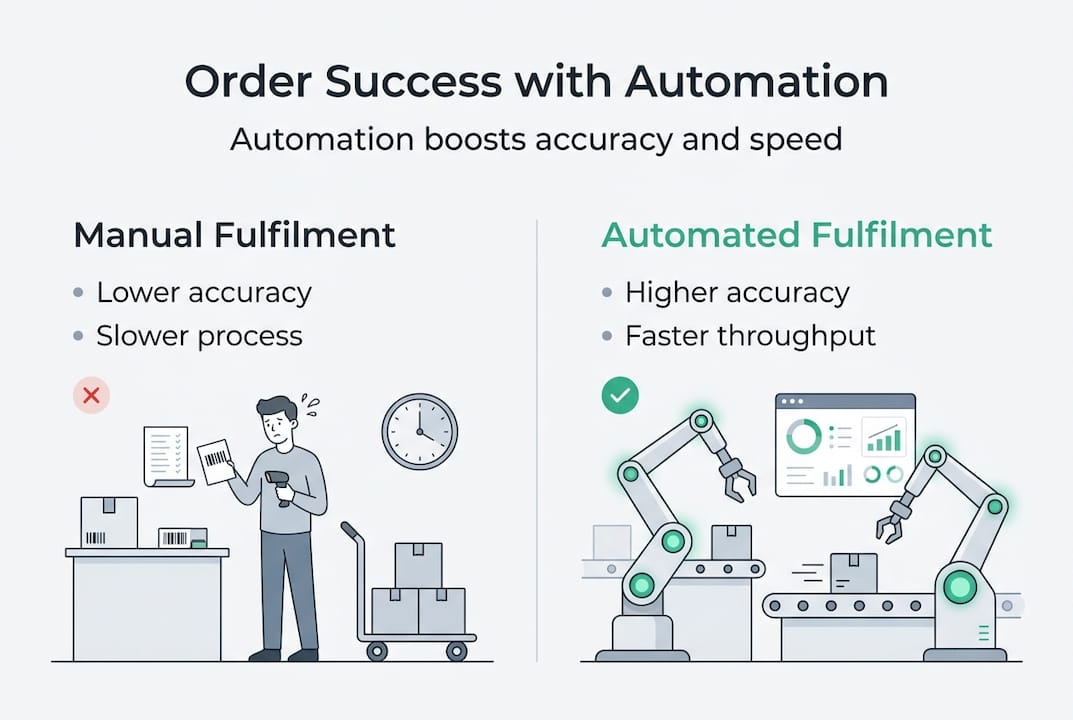
On accuracy alone, the numbers are striking. Manual fulfilment operations typically achieve accuracy rates of below 80%, meaning roughly one in five orders has some form of error. Automated systems raise accuracy rates to 99%, a transformation that directly reduces returns, customer complaints, and reshipment costs.
| Metric |
Manual fulfilment |
Automated fulfilment |
| Order accuracy rate |
Below 80% |
Up to 99% |
| Average pick rate (units/hour) |
60 to 80 |
300 to 500+ |
| Error detection method |
Visual check |
Barcode/weight scan |
| Payback period |
N/A |
2 to 5 years |
| Peak season scalability |
Limited by staffing |
High, with system capacity |
Beyond accuracy, automated systems also improve throughput dramatically. A well-configured warehouse with conveyor sorting and robotic assistance can process three to five times more orders per hour than a comparable manual team. During peak trading periods such as Black Friday or the Christmas run-up, this capacity advantage is critical.
The financial case is also strong over the medium term. While upfront investment in automation can be significant, the reduction in labour costs, error-related reshipments, and returns processing creates a compelling return. Most operations see payback within two to five years, depending on order volume and the complexity of the implementation.
Key operational benefits to consider:
- Reduced labour dependency: Automation reduces reliance on seasonal temporary staff, which are expensive to recruit, train, and manage.
- Consistent performance: Automated systems do not have bad days. They perform at the same standard at 3am on a Sunday as they do at 9am on a Monday.
- Better warehouse management: Integrated WMS platforms provide real-time inventory visibility, reducing stockouts and overstock situations.
- Support for scalable logistics: As your brand grows into new channels or regions, automated systems adapt more readily than manual processes.
Pro Tip: Before investing in automation, map every step of your current fulfilment process and identify the three highest-error or highest-cost tasks. Automate those first. Partial improvements applied to the wrong steps can create new bottlenecks rather than solving existing ones.
The limits of automation: nuances and hybrid models
Automation is genuinely powerful, but it has real limits that are often underestimated during the planning stage. Understanding these limits is what separates a successful implementation from a costly one.
The most common challenge is high SKU variability. Robotic picking systems are optimised for consistent, predictable items. When your catalogue includes hundreds of different shapes, sizes, and weights, robot SKU validation rates can drop to as low as 5% initially. This is not a failure of the technology so much as a mismatch between the tool and the task.
Exception handling is another area where full automation struggles. Exceptions include damaged goods, customer-specific packaging requests, unusual returns, and orders that fall outside standard parameters. When exception rates exceed 4 to 6%, automation systems begin to throttle overall throughput, and hybrid models become the recommended approach.
For subjective decisions, such as assessing whether a returned item is resaleable or fulfilling a bespoke gift order, manual handling remains superior. Human judgement is still faster and more cost-effective for one-off tasks that require context.
| Factor |
Fully automated |
Hybrid model |
Manual |
| Exception handling |
Poor |
Strong |
Strong |
| High SKU variety |
Limited |
Good |
Good |
| Peak season flexibility |
High (within capacity) |
Very high |
Low |
| Cost per order (high volume) |
Low |
Medium |
High |
| Setup complexity |
High |
Medium |
Low |
When should you choose a hybrid model? Here are the clearest signals:
- Your exception rate consistently sits above 4%.
- You sell products with significant size or weight variation.
- You handle returns that require condition assessment.
- You experience sharp, unpredictable volume spikes.
- You offer personalisation or custom packaging as part of your proposition.
Pro Tip: Do not wait until your automation system is failing to introduce human oversight. Build oversight into the process from day one. Assign a team member to monitor exception queues daily and review system performance weekly. Catching a misconfiguration early saves significant time and cost.
The optimising logistics approach that consistently delivers the best results is one where technology handles the repetitive, high-volume tasks and skilled people handle the edge cases. Neither replaces the other.
Implementing automation: steps for e-commerce brands
Knowing the benefits and the limits of automation is useful. Knowing how to implement it effectively is what actually moves the needle for your operation. Here is a practical framework for getting started.
1. Audit your current fulfilment operation
Before you invest in any technology, understand exactly where your errors, delays, and costs are concentrated. Use your warehouse operations checklist to document every step from order receipt to dispatch. Identify which tasks are high-volume and repetitive, and which require human judgement.
2. Benchmark your current performance
Set a clear baseline. Track your current order accuracy rate, average pick time, cost per order, and return rate. Without this data, you cannot measure whether automation is actually improving your operation.
3. Prioritise quick wins
Not every automation investment requires a full warehouse overhaul. Barcode scanning, automated weight verification, and WMS integration are relatively low-cost changes that deliver immediate accuracy improvements. Start there before committing to robotics or conveyor systems.
4. Define success metrics and process rules
Automation requires clear oversight and well-defined process rules to avoid pitfalls. Set thresholds for exception rates, accuracy targets, and throughput goals before you go live. This gives your team a clear framework for identifying when something is going wrong.
5. Choose the right technology and logistics partners
The technology you choose should integrate seamlessly with your existing e-commerce platforms and courier services. Use data to optimise your configuration over time, and consider how tracking and fleet management tools can extend visibility beyond the warehouse.
6. Build in continuous evaluation
Automation is not a one-time project. Review your system performance monthly, update process rules as your product catalogue evolves, and adjust staffing levels to match exception volumes. The brands that get the most from automation are those that treat it as an ongoing operational discipline.
Pro Tip: Involve your warehouse team in the implementation process from the beginning. The people who work on the floor every day will identify practical issues that no consultant or software vendor will spot from the outside. Their input makes implementations faster and more effective.
A fresh perspective on automation in fulfilment
The loudest voices in logistics often advocate for total automation as the obvious end goal. We think that framing misses something important. The most resilient fulfilment operations we see are not the most automated ones. They are the ones where technology and people are genuinely well-integrated.
The biggest fulfilment failures we encounter stem not from a lack of automation, but from an underestimation of exception scenarios. A brand invests heavily in robotic systems, launches confidently, and then discovers that 8% of its orders require manual intervention. The automation system was never designed for that, and the human oversight layer was never built.
The brands that consistently outperform are those that view logistics integration as a living system rather than a fixed infrastructure project. They automate aggressively where it makes sense, keep skilled people in the loop for complex decisions, and review performance data regularly. That combination is what actually delivers the 99% accuracy rates and the customer retention gains that make automation worth the investment.
Take your fulfilment further with expert support
If your brand is ready to improve fulfilment accuracy, reduce operational costs, and scale with confidence, the right partner makes all the difference.
At ParcelPlanet, we offer order fulfilment services that are built for modern e-commerce and omnichannel brands. Whether you are weighing up the right 3PL vs 4PL model for your business or looking for a partner who can handle volume spikes without compromising accuracy, our team is ready to help. We also support brands in understanding how 3PL logistics cost reduction can improve your bottom line. Get in touch today to explore a solution tailored to your brand’s needs.
Frequently asked questions
How does automation improve order accuracy?
Automation raises defect detection rates from under 80% to as high as 99%, reducing errors and boosting consistency across every order dispatched.
Is it possible to automate fulfilment for businesses with high SKU variety?
High-SKU variability limits robot validation rates significantly, so hybrid systems that combine automation with human oversight tend to deliver the best results for complex catalogues.
What are the risks of over-relying on automation in fulfilment?
Overreliance on automation risks system breakdowns, AI errors, and unhandled exceptions unless robust human oversight is built into the process from the outset.
How quickly can automation investments pay off in fulfilment?
The payback period for fulfilment automation typically ranges from two to five years, depending on order volume, implementation complexity, and the specific tasks being automated.
Recommended