TL;DR:
- UK businesses must achieve net zero shipping emissions by 2050 as part of government mandates. They need to adopt verified emission reductions, insetting strategies, and engage multiple carriers to meet regulation and sustainability goals. Early action and credible certification are essential for cost-effective, compliant, and environmentally responsible logistics.
What carbon neutral shipping means for UK businesses in 2026
Carbon neutral shipping means eliminating or balancing out the greenhouse gas emissions generated when transporting goods, so that the net contribution to the atmosphere is zero. For UK businesses, this is no longer a voluntary ambition. The UK government published its maritime decarbonisation strategy in March 2025, setting binding milestones that affect every operator moving goods through UK waters and ports.
The targets are clear:
The UK government has set binding targets to reduce greenhouse gas emissions from shipping by 30% by 2030, 80% by 2040, and to reach net zero by 2050, as outlined in Online SAP Calculations: London’s fast track to energy efficiency compliance – Home Energy Model.
Critically, the UK Emissions Trading Scheme (UK ETS) is expanding to cover maritime shipping. Operators of larger vessels, including tankers and cruise ships, will pay directly for their greenhouse gas emissions under this framework. For UK businesses that rely on freight and logistics, this creates both a compliance obligation and a cost pressure that will only grow as the milestones approach.
The distinction between carbon neutral and net zero matters here. Carbon neutral shipping typically involves a combination of emission reductions and verified offsetting to balance remaining emissions. Net zero, the 2050 target, requires eliminating emissions at source as far as technically possible. Understanding where your supply chain sits on that spectrum is the starting point for any credible sustainability plan.
How carbon neutral shipping is practically achieved in the UK
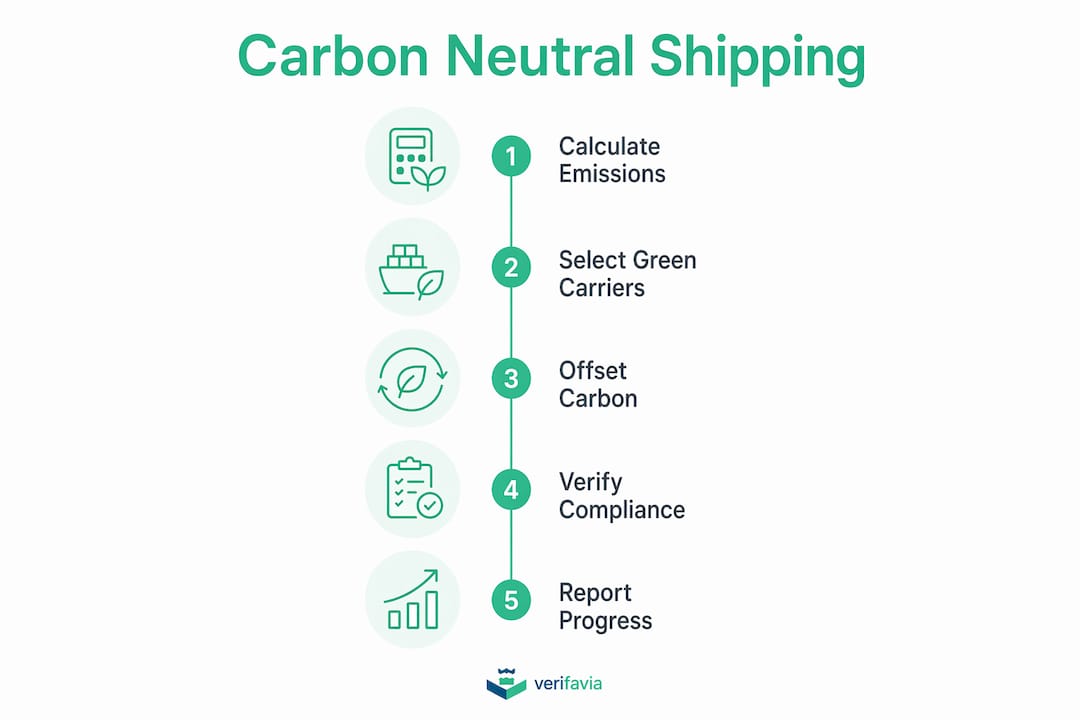
Reducing your shipping carbon footprint is not a single action. It is a combination of operational changes, fuel choices, and verified compensation for emissions that cannot yet be eliminated.
The main approaches UK shippers are using right now include:
- Sustainable Aviation Fuel (SAF) and biofuels: SAF can reduce lifecycle emissions by up to 80% compared to conventional fossil fuels. Produced from renewable sources such as waste oils and fats, it is increasingly used across logistics networks to cut the carbon footprint of air freight and road transport.
- Cleaner vessel technologies and shore power: The government’s strategy places hydrogen, electric, and ammonia vessels at the centre of the 2050 transition. Shore power chargeports, such as the multi-berth facility being developed at Portsmouth, allow ships to plug into renewable energy while docked rather than running diesel generators.
- Batching and route consolidation: Grouping shipments to reduce the number of journeys is one of the most cost-effective ways to cut emissions. Fewer trips with fuller loads directly lowers the carbon intensity per unit shipped.
- Low-emission last-mile vehicles: Electric vans and cargo bikes are replacing diesel vehicles for urban deliveries. The first and final delivery miles offer the biggest opportunity for emission reductions through route consolidation and low-emission vehicles.
- Carbon insetting vs offsetting: Insetting reduces emissions within your own supply chain, for example by funding cleaner fuels or electric vehicles used by your carriers. Offsetting funds external projects such as woodland planting or renewable energy. Insetting is more credible for Scope 3 reporting because it targets emissions you are directly responsible for.
Pro Tip: Working with multiple carriers gives you the flexibility to select the greenest available option for each shipment, balancing environmental performance with cost and delivery speed. A multi-carrier approach is widely regarded as the most effective way to manage eco-friendly logistics at scale.

Which partnerships and programmes are advancing green shipping in the UK?
Several well-established programmes give UK businesses a credible route to verified carbon neutral delivery, rather than relying on self-reported claims.
- Carbon Neutral Britain: One of the UK’s leading third-party certification bodies, Carbon Neutral Britain has offset millions of tonnes of CO₂ and provides recognised, independently verified certification for carbon neutral delivery. Businesses that achieve certification can use it in marketing, tender responses, and ESG disclosures.
- DP World UK’s Carbon Inset Programme: This programme rewards cargo owners with verified carbon certificates for low-carbon shipping activities at UK terminals. The certificates offset more than 90% of emissions from last nautical mile operations, including ship manoeuvring and terminal handling. It is one of the most concrete inset programmes available to UK shippers today.
- DHL GoGreen Plus: DHL’s GoGreen Plus programme allows businesses to allocate Sustainable Aviation Fuel to specific shipments, generating a verified reduction in lifecycle emissions that can be reported against Scope 3 targets.
- GreenBox and 123Carbon: These platforms help businesses track and report emission reductions across their supply chains, providing the data infrastructure needed to support formal sustainability disclosures and carrier performance comparisons.
- Offset Britain: Offset Britain provides audit-ready certification for shipping and logistics companies, with carbon credits retired on registries including Verra, Gold Standard, and UNFCCC on the client’s behalf.
The credibility of any programme depends on independent verification. Partnerships with bodies that issue registry retirement IDs and third-party audit reports are the ones that will hold up under scrutiny from procurement teams and regulators alike.
How UK businesses should navigate compliance and source green shipping solutions
Compliance with UK ETS is not optional for operators of larger vessels, and the financial implications are real. For businesses that use freight carriers rather than operating their own fleet, the pressure arrives indirectly through carrier pricing as operators pass on their ETS costs.
Practical steps for UK businesses:
- Understand your Scope 3 exposure: Shipping emissions fall under Scope 3 in most businesses’ carbon accounting. Carriers are increasingly required to provide per-shipment emission data, and procurement teams are asking for it in tender responses.
- Source audit-ready certifications: When selecting offset or inset programmes, look for providers that issue registry retirement IDs and independent verification reports. Gold Standard and Verra are the two most widely recognised registries. A certificate without a registry ID is not audit-ready.
- Assess carrier sustainability credentials: Ask carriers for their Scope 3 data, their fuel mix, and whether they participate in a recognised inset or offset programme. Carriers that cannot provide this data are a liability in any ESG disclosure.
- Register for inset programmes early: DP World UK’s Carbon Inset Programme, for example, requires cargo owners to register and submit customs declarations to receive certificates. The process takes time, so starting now gives you a reporting advantage before the 2030 milestone tightens.
Pro Tip: Engage with multiple carrier partners rather than relying on a single provider. Different carriers are at different stages of their sustainability transition, and spreading your volume gives you both negotiating leverage and access to a broader range of green delivery options.
For e-commerce businesses considering expanding into the UK market, building carbon neutral shipping into your logistics model from the outset is far simpler than retrofitting it later.
What will carbon neutral shipping cost, and when do you need to act?
Budgeting for the transition is one of the most common challenges UK businesses face. The costs fall into several categories, and the timeline is tighter than many operators realise.
- UK ETS charges: As the scheme expands to cover maritime shipping, operators of larger vessels will face direct costs for their emissions. These costs will be passed through supply chains, increasing freight rates over time.
- Carbon offset purchases: Verified offsets from Gold Standard or Verra-registered projects carry a cost per tonne of CO₂. The price varies by project type and verification standard, but audit-ready certificates from providers such as Carbon Neutral Britain or Offset Britain are available at accessible price points for businesses of all sizes.
- Fuel switching and technology upgrades: Transitioning to SAF, hydrogen, or electric vessels requires capital investment. For most UK businesses, this is a carrier-level decision, but it will affect the rates you pay and the options available to you.
- Certification fees: Third-party certification from bodies such as Carbon Neutral Britain involves an annual fee. This is a relatively modest cost compared to the commercial value of verified sustainability credentials in tender processes.
- The 2030 milestone is the first pressure point. A 30% emission reduction target in four years requires action now, not in 2028. Businesses that begin measuring, reporting, and reducing their shipping emissions today will be better positioned to meet the milestone without disruptive last-minute changes.
Early adoption also carries a competitive advantage. Buyers and procurement teams are already asking for Scope 3 data and offset documentation. Businesses that can provide it win contracts that others cannot. Reviewing your shipping cost reduction options alongside your sustainability plan is a practical way to make the transition financially manageable.
Expert guidance on best practices for adopting carbon neutral shipping
The businesses making the most credible progress on climate neutral transport are doing three things consistently: reducing emissions at source, insetting within their supply chains, and verifying everything independently.
Key best practices from industry experience:
- Prioritise insetting over offsetting where possible. Insetting directly reduces Scope 3 emissions in your own supply chain by funding cleaner fuels or vehicles used by your carriers. It is favoured in audits because it targets emissions you are responsible for, not emissions elsewhere in the world.
- Invest in operational efficiency first. Operational improvements in the first and last mile, particularly route density optimisation, deliver carbon reductions that exceed what offset payments can achieve. Consolidating deliveries and reducing failed delivery attempts are two of the highest-impact changes available to e-commerce businesses.
- Demand transparent data from your carriers. Sustainability claims without data are not credible. Ask for per-shipment emission figures, fuel mix disclosures, and participation in recognised programmes. Carriers that provide this data are the ones worth building long-term partnerships with.
- Use multi-carrier platforms for optimisation. Platforms that aggregate carrier options allow you to select the greenest route for each shipment without sacrificing delivery performance. This is the most practical tool available for managing zero emissions shipping at scale.
- Verify everything independently. Carbon neutral claims that rely solely on self-reporting will not survive procurement scrutiny. Independent verification, with registry retirement IDs and audit reports, is the standard that matters.
Pro Tip: When selecting an offset provider, ask specifically for their registry retirement ID format and a sample verification report before committing. Providers who cannot supply these documents immediately are unlikely to meet the audit-ready standard required for formal ESG disclosures.
UK businesses implementing carbon neutral shipping: what the evidence shows
Several UK businesses and logistics operators have moved beyond planning and are delivering measurable results. The sustainable logistics case studies emerging from 2025 and 2026 share a common pattern: the most successful implementations combine carrier partnerships, verified certification, and operational efficiency rather than relying on any single approach.
DP World UK’s Carbon Inset Programme is the most concrete example of a UK-specific inset mechanism in operation. Cargo owners using UK terminals can receive verified certificates covering more than 90% of last nautical mile emissions, including manoeuvring and terminal handling. This is a direct, measurable reduction tied to specific shipping activity, not a generic offset.
Businesses participating in Carbon Neutral Britain’s certification programme have used their verified status to differentiate in competitive tender processes, particularly in sectors where sustainability credentials are now a procurement requirement. The certification provides a recognised third-party endorsement that procurement teams can rely on without conducting their own audit.
The pattern across these cases is consistent: businesses that started early, built relationships with verified programme providers, and invested in carrier data transparency are the ones achieving credible, reportable results. Those that waited for regulatory pressure to force action are now paying higher costs for less favourable options.
Regulatory compliance and penalties for UK shipping operators
The UK ETS expansion to maritime shipping is the most significant regulatory development for UK logistics operators in 2025. Operators of larger vessels are now required to pay for their greenhouse gas emissions under the scheme, and non-compliance carries financial penalties.
The compliance framework includes several key obligations:
- Monitoring, reporting, and verification (MRV): Operators must monitor and report their emissions accurately. The UK ETS requires verified data, not estimates, and the verification must be conducted by an accredited body.
- Surrender of allowances: Operators must surrender UK ETS allowances equal to their reported emissions. Failure to surrender sufficient allowances results in a penalty, and the shortfall must still be covered in the following compliance period.
- Scope 3 reporting obligations: For businesses using third-party carriers, Scope 3 emissions from shipping are increasingly expected in annual sustainability reports, particularly for listed companies and those responding to large procurement frameworks.
- Penalties for non-compliance: The UK ETS carries financial penalties for operators who fail to surrender allowances or submit accurate reports. The penalty structure is designed to make non-compliance more expensive than compliance, creating a direct financial incentive to act.
- IMO alignment: The UK government has committed to pushing for high ambitions at the IMO, meaning international shipping regulations will tighten in parallel with domestic UK ETS requirements. Businesses with international supply chains need to track both frameworks.
Staying ahead of these requirements is not just about avoiding penalties. Businesses that demonstrate proactive compliance are better positioned in procurement processes, investor relations, and customer communications. The regulatory direction is clear, and the businesses building compliance infrastructure now will face significantly less disruption as the 2030 milestone approaches.
Key takeaways
Carbon neutral shipping in the UK requires a combination of verified emission reductions, supply chain insetting, and audit-ready certification, all aligned to the government’s 30%, 80%, and net zero milestones by 2030, 2040, and 2050 respectively.
| Point |
Details |
| Government targets are binding |
The UK ETS covers maritime shipping; operators of larger vessels must pay for emissions, with 30% reduction required by 2030, 80% by 2040, and net zero by 2050. |
| Insetting beats offsetting for audits |
Funding cleaner fuels or vehicles within your own supply chain is more credible for Scope 3 reporting than external offset projects. |
| SAF cuts lifecycle emissions significantly |
Sustainable Aviation Fuel can reduce lifecycle greenhouse gas emissions by up to 80% compared to fossil fuels. |
| Certification must be audit-ready |
Gold Standard and Verra registry retirement IDs are the minimum standard for verified carbon neutral shipping claims. |
| Multi-carrier approach maximises green options |
Engaging multiple carriers gives you access to the broadest range of sustainable shipping options across cost, timing, and environmental performance. |
How Parcelplanet supports your carbon neutral shipping goals

Parcelplanet works with UK e-commerce and omnichannel brands to build order fulfilment services that are efficient, cost-effective, and aligned with your sustainability commitments. Through multi-carrier partnerships and real-time tracking, Parcelplanet gives your business the flexibility to select greener shipping options without compromising on delivery performance.
If you are ready to build carbon neutral shipping into your fulfilment strategy, get in touch with the Parcelplanet team for a tailored quote.
Recommended


