TL;DR:
- Beauty fulfilment requires specialized handling of regulations, returns, and hazardous materials.
- Integrated systems enable real-time inventory management and rapid response to demand spikes.
- Partnering with a specialist 3PL ensures compliance, scalability, and operational efficiency during surges.
Most beauty brands assume their biggest logistics challenge is shipping speed. In reality, the hardest part is everything that happens before the parcel leaves the warehouse. Beauty products sit at a complex crossroads of regulatory compliance, volatile demand, and high return rates that generic logistics simply cannot handle well. Brands achieving true scale have demonstrated that 99.999% order accuracy and 57% faster shipping are attainable, but only with fulfilment built specifically around the beauty sector’s demands. This guide walks you through the key practices, systems, and partner decisions that separate fast-growing beauty brands from those stuck firefighting operational failures.
Table of Contents
Key Takeaways
| Point |
Details |
| Beauty sector complexity |
Cosmetic fulfilment demands specialist expertise for handling returns, regulations, and hazardous items. |
| Integrated tech advantage |
Real-time inventory and order integration boost accuracy and prevent costly errors across sales channels. |
| Surge readiness matters |
Scalable fulfilment operations are essential for meeting viral demand without service failures. |
| Specialist 3PL benefits |
Partnering with a beauty-focused provider reduces compliance risk and enhances growth agility. |
What makes cosmetic fulfilment unique?
Cosmetic fulfilment is not simply warehouse storage plus parcels. It is a specialist operation shaped by regulations, product sensitivities, and customer expectations that differ significantly from general e-commerce categories.
One of the most persistent challenges is returns. Beauty customers return products because a foundation shade does not match their skin tone, or a formula triggers unexpected sensitivity. These are not defective goods in the traditional sense, yet they require careful inspection, quality control and batch-level tracking before any item can be deemed fit for resale. Without a defined disposition workflow, returned stock either piles up untracked or gets reshelved incorrectly, both of which create downstream problems.
Hazardous materials add another layer of complexity. Aerosols, nail polishes, and certain alcohol-based products are classified as hazmat goods, which means they require specialist storage conditions, compliant packaging, and specific carrier approvals. A generic 3PL without hazmat expertise can inadvertently violate carrier agreements or storage regulations, exposing your brand to significant liability.
Then there is the regulatory environment. The Modernisation of Cosmetics Regulation Act, known as MoCRA, has fundamentally changed how beauty brands operating in the US must manage their supply chain. MoCRA compliance mandates batch traceability, facility registration, and adverse event reporting within 15 days. These are not optional add-ons. They are legal requirements that your fulfilment operation must be built to support from day one.
Here is a summary of what makes beauty fulfilment requirements distinct from general e-commerce logistics:
- Returns complexity: Shade mismatches and formula reactions mean returns need quality assessment, not just restocking
- Hazmat handling: Aerosols and flammable products require certified storage and compliant carrier protocols
- Batch traceability: MoCRA demands lot-level tracking across every SKU, every order, every channel
- Adverse event reporting: Any product-linked health issue must be reported to the FDA within 15 days
- Viral demand sensitivity: Beauty is uniquely prone to sudden, social media-driven demand spikes that stress unprepared warehouses
Brands that treat cosmetic fulfilment as interchangeable with general e-commerce logistics consistently encounter compliance gaps, quality failures, and operational bottlenecks that erode customer trust and threaten growth.
Integrated systems for seamless omnichannel growth
Compliance and product handling set the baseline, but scalable beauty fulfilment also depends on the quality of your systems integration. Without unified, real-time data across every sales channel, even well-run warehouses make costly mistakes.
Consider the challenge of selling across your own website, Amazon, and wholesale retail simultaneously. Each channel has different fulfilment windows, packaging standards, and inventory allocation rules. Without a single source of truth, you risk overselling on one channel while stock sits idle for another. Real-time WMS and OMS integration with platforms such as Shopify and WooCommerce is essential for preventing these misalignments and enabling omnichannel success.
Real-time data also enables rapid responses to demand changes. When a product goes viral on social media, you may have hours, not days, to respond. A warehouse operating on batch-updated inventory reports simply cannot react fast enough. Integrated systems flag the spike immediately, allowing your team to prioritise picking queues, redirect stock, and communicate accurate availability to customers.

Automation plays a critical supporting role. Automated sorting, label generation, and pick-path optimisation reduce human error during high-volume periods and speed up fulfilment considerably. Intelligent Parcel Processing technology, sometimes referred to as IPP, has helped leading brands achieve measurably faster transit times alongside higher labour productivity. The operational impact is real and quantifiable.
Pro Tip: Before signing with any 3PL, ask specifically how their warehouse management system connects to your sales channels and whether it supports real-time inventory visibility across all of them. A vague answer is a warning sign.
The table below illustrates how integrated versus non-integrated fulfilment operations compare across key performance indicators:
| Performance indicator |
Integrated operation |
Non-integrated operation |
| Inventory accuracy |
Real-time, 99%+ |
Batch-updated, 85-92% |
| Response to demand spike |
Within hours |
24-48 hours |
| Order error rate |
Under 0.1% |
1-3% |
| Channel oversell risk |
Minimal |
High |
| Labour productivity |
Optimised via automation |
Manual, variable |
For more on building efficient warehouse operations, the warehouse integration strategies that support e-commerce scaling are worth reviewing. Understanding how shipping workflow optimisation connects to broader fulfilment performance is equally valuable.
Scaling fulfilment to handle viral surges and peak periods
Growth in the beauty sector rarely follows a predictable curve. A single influencer post or press feature can generate thousands of orders within 24 hours. Your fulfilment operation either absorbs that surge confidently or fails publicly in front of new customers.
The numbers from real-world beauty brands are instructive. One beauty brand working with a specialist fulfilment partner saw a 232% increase in daily units processed during viral surges, while maintaining 99.999% order accuracy and achieving a 14% reduction in labour costs. That combination of volume, precision, and efficiency is only possible with the right infrastructure in place before the surge happens.
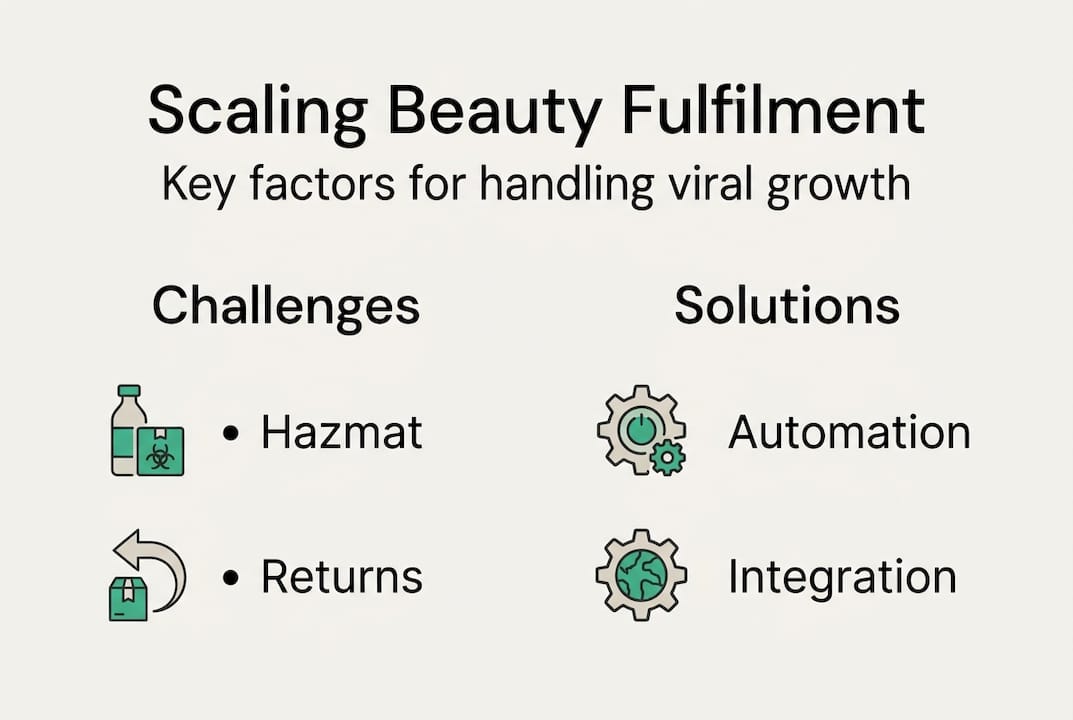
Social media-driven demand spikes and omnichannel complexity require a genuinely agile 3PL, not one that simply adds temporary staff when orders stack up. Agility here means pre-built capacity, flexible staffing models, and automated processes that scale without proportionally increasing error rates.
Here is how surge-ready beauty fulfilment operations are typically structured:
- Demand forecasting: Use historical sales data combined with social media monitoring to anticipate spikes weeks or days in advance
- Flex staffing agreements: Maintain contracts with specialist warehouse staff agencies to scale headcount quickly without onboarding delays
- Automated picking systems: Ensure pick-path optimisation tools are live before peak periods, not implemented reactively
- Returns workflow pre-planning: Define exactly how returned goods are inspected and dispositioned so high return volumes during peak do not create bottlenecks
- SLA tiering: Agree on clear service level agreements with your 3PL for both standard and surge operating conditions
The comparison below shows what separates specialist beauty 3PLs from generic providers during peak trading:
| Capability |
Beauty specialist 3PL |
Generic 3PL |
| Hazmat surge handling |
Certified and pre-planned |
Often unprepared |
| QC returns processing |
Integrated into workflow |
Ad hoc or outsourced |
| Viral demand response |
Hours |
Days |
| MoCRA compliance readiness |
Built into operations |
Retrofitted or absent |
| SLA maintenance under pressure |
Consistently high |
Variable |
Reviewing omnichannel fulfilment examples from brands that have scaled successfully gives useful context for what genuine surge readiness looks like in practice. Pairing that with fulfilment strategy insights will help you stress-test your current operational model.
Choosing the right partner: Specialist vs. generic 3PLs
The partner decision is where many growing beauty brands make their most expensive mistake. Cost is an obvious factor, and generic 3PLs often quote lower rates. But the true cost of a compliance failure, an Amazon delisting, or a wave of negative reviews from delayed orders during a viral moment significantly outweighs any saving on warehouse fees.
Specialised 3PLs reduce compliance failures related to MoCRA and Amazon regulations compared to generic providers, who frequently lack the systems and expertise to navigate beauty-specific requirements. The consequences of getting this wrong are not merely operational. Brands have faced product delistings, regulatory warnings, and lasting reputational damage from avoidable logistics failures.
When evaluating a beauty-specialist fulfilment partner, use this checklist:
- Compliance track record: Can they demonstrate MoCRA-ready batch traceability and adverse event reporting processes?
- Hazmat certification: Are they certified to store and ship aerosols, flammables, and other beauty-sector hazardous materials?
- Returns and QC workflow: Do they have a defined, documented process for inspecting and dispositioning beauty returns?
- Technology stack: Does their WMS integrate in real time with your sales channels, including Shopify, WooCommerce, and Amazon?
- Surge capacity: What is their specific plan for handling a 200%+ increase in daily order volume at short notice?
- Reference clients: Can they provide references from beauty or personal care brands of a similar size and complexity?
Generic 3PLs are not universally poor choices for every product category. For beauty, however, the regulatory complexity, returns intensity, and viral demand patterns create a risk profile that genuinely requires specialist capability.
Pro Tip: Request a mock compliance audit during your vetting process. Ask your prospective 3PL to walk you through exactly how they would handle a MoCRA adverse event report or a batch recall. Their ability to answer confidently and in detail tells you everything about their readiness.
Why most brands underestimate beauty fulfilment challenges
Here is the uncomfortable truth: most beauty brands do not realise their fulfilment operation is failing until customers do. By the time negative reviews accumulate, SLAs are consistently missed, or a compliance warning arrives, the operational gaps have often existed for months.
The prevailing assumption is that fulfilment is a background function, something any competent warehouse can handle. That thinking is wrong for beauty, and the evidence is clear. MoCRA compliance, hazmat management, returns intensity, and surge response are not optional capabilities to layer on later. They are core operational requirements that must be designed in from the start.
We have seen brands invest significantly in product development, marketing, and influencer partnerships, then appoint the cheapest available 3PL as an afterthought. When a campaign goes viral, that 3PL cannot cope. Orders are delayed, quality slips, and the brand’s carefully built reputation suffers at the exact moment it should be growing. Exploring omnichannel fulfilment growth case studies consistently shows that the brands who scale successfully treat logistics as a strategic investment, not a cost to minimise. The right partner, the right systems, and the right compliance foundations in place before you need them is what separates brands that grow sustainably from those that stall at the first major peak.
Unlock reliable, scalable cosmetic fulfilment today
Growing beauty brands need more than a warehouse. They need a fulfilment partner that understands regulatory obligations, manages returns with precision, and scales seamlessly when demand surges. That is exactly what ParcelPlanet is built to deliver.

Our order fulfilment solutions are tailored to the specific demands of beauty and personal care brands, covering compliance-ready storage, multi-channel integration, and surge-capacity operations. Whether you are launching new product lines or expanding into new markets, we can help you integrate your stores and build an operation that grows with your brand. Get in touch today to discuss a solution designed around your goals.
Frequently asked questions
What is cosmetic fulfilment?
Cosmetic fulfilment refers to specialised logistics for beauty products, covering storage, order processing, regulatory compliance, and the handling of sector-specific challenges such as returns and hazmat goods.
How does MoCRA affect cosmetic fulfilment?
MoCRA requires batch traceability, facility registration, and adverse event reporting within 15 days for all cosmetics sold in the US, meaning your fulfilment operation must be built to capture and report this data accurately.
Why can’t any 3PL handle cosmetics?
Cosmetics involve hazmat handling, high returns, and strict regulatory requirements that generalist 3PLs frequently lack the systems, certifications, and expertise to meet reliably.
How do brands manage surges in beauty order volumes?
Leading brands partner with specialist 3PLs equipped with automation and pre-built surge capacity, enabling a 232% surge in daily units to be handled without sacrificing order accuracy or service levels.
Recommended


