TL;DR:
- Cross-border shipping involves multiple parties such as freight forwarders, customs brokers, and carriers to ensure timely delivery. Accurate documentation and choosing the appropriate shipping method are crucial for avoiding delays and reducing costs. Building reliable partnerships and scalable strategies enable international growth while minimizing operational risks.
Selling across borders sounds straightforward until your first international shipment gets held at customs for a week, your customer demands a refund, and you realise you filed the wrong HS code. Cross border shipping explained properly goes well beyond “print a label and post it abroad.” The global e-commerce cross-border shipping market was valued at USD 43,895 million in 2025 and is projected to grow at 4.5% CAGR through 2034. The opportunity is real. So is the complexity. This guide breaks down every layer of international shipping so you can expand confidently.
Table of Contents
Key takeaways
| Point |
Details |
| Cross-border shipping involves multiple parties |
Freight forwarders, customs brokers, carriers, and warehouses all play distinct roles in getting your order delivered. |
| Documentation accuracy is non-negotiable |
A single error on a commercial invoice or HS code can delay your shipment or trigger a fine. |
| Shipping method choice affects margins |
Air freight is fast but costly; sea freight suits bulky goods; courier services work best for small parcels. |
| DDP terms reduce customer friction |
Including duties and taxes upfront removes delivery surprises and improves conversion rates. |
| 3PLs and overseas warehousing speed up delivery |
Pre-positioning stock near your customers cuts transit times and lowers return handling costs. |
Cross border shipping explained: the key components
Understanding cross-border shipping starts with recognising that international logistics complexity multiplies compared to domestic shipping due to additional parties, regulatory requirements, and transportation modes. When you ship domestically, you deal with one carrier and one set of rules. Cross-border logistics involves a chain of specialists, each responsible for a critical stage.
Here are the main players you will encounter:
- Freight forwarders coordinate the movement of goods across borders, arranging transportation, documentation, and often customs clearance on your behalf. They act as the operational backbone of international shipments.
- Customs brokers specialise in navigating customs regulations in the destination country. They submit declarations, calculate duties, and work with customs authorities to release your goods.
- Carriers physically move the goods, whether by air, sea, rail, or road. Major international carriers include global courier networks and specialist freight operators.
- Warehouses and fulfilment centres receive, store, and dispatch goods. Overseas warehouses, in particular, allow you to pre-position stock closer to your customers.
- Regulatory agencies at both origin and destination countries inspect shipments, enforce import restrictions, and verify compliance with product standards.
Multimodal transportation combines air, sea, rail, and road to balance cost and speed in international logistics. For example, a seller shipping electronics from the UK to South-East Asia might use road freight to the port, sea freight to a hub, and last-mile road delivery to the customer. Each leg requires its own documentation and carrier coordination.
Pro Tip: Build a relationship with a reliable freight forwarder before you need one urgently. Having an established contact saves days when a shipment runs into trouble.
Essential documentation and customs processes
Documentation precision is the single biggest factor preventing costly customs delays. Get this wrong and your goods sit in a bonded warehouse while your customer raises a dispute. Here is a numbered breakdown of the documents you need and what each one does:
- Commercial invoice. This is the primary document for customs clearance. It must include the seller and buyer details, a full description of goods, quantity, unit price, total value, country of origin, and the agreed trade terms (Incoterms).
- Packing list. A detailed breakdown of what is inside each package, including dimensions and weight. Customs officers use this alongside the commercial invoice to verify shipments.
- Certificate of origin. Confirms where the goods were manufactured. This affects tariff rates under trade agreements. For example, goods produced in the UK may qualify for reduced duties when exported to countries with which the UK has a free trade agreement.
- HS (Harmonised System) codes. Since September 2025, six-digit HS codes must appear on all international commercial shipments. These universal product classifications tell customs what you are shipping and what duty rate applies.
- Customs declaration form. Submitted electronically in most countries, this declares the nature, value, and classification of goods. Inaccuracies here are the most common cause of delays.
- Incoterms. These internationally recognised trade terms define who is responsible for freight costs, insurance, and customs duties at each stage. Common terms include EXW (Ex Works), FOB (Free on Board), and DDP (Delivered Duty Paid).
Accurate and complete documentation is critical to avoiding costly delays and penalties. Even a minor error, such as a mismatched product description between your invoice and packing list, can result in goods being held or fines being issued.
Pro Tip: Use a customs information resource such as customs documentation guidance to double-check duty rates and required paperwork before you ship to a new market.

Refer to the cross-border shipping checklist from Parcelplanet for a practical step-by-step reference you can use when onboarding new destination countries.
Comparing international shipping methods
Choosing the right shipping method directly affects your margins and your customer’s experience. Here is a clear comparison of the four main options used in cross-border e-commerce:
| Method |
Typical speed |
Cost level |
Best for |
Key limitation |
| Air freight |
2–7 days |
High |
High-value, low-weight goods |
Cost-prohibitive for heavy items |
| Sea freight |
20–40 days |
Low |
Bulky or heavy goods in volume |
Slow; not suited to urgent orders |
| Rail freight |
12–20 days |
Medium |
Asia-Europe trade routes |
Limited route coverage globally |
| Courier services |
1–10 days |
Medium-high |
Small parcels, B2C e-commerce |
Weight and size restrictions apply |
Ocean freight suits bulky goods, while air freight is faster but significantly more expensive. Rail offers a middle ground, particularly for Asia-Europe trade, with transit times around two to three weeks at lower cost than air.
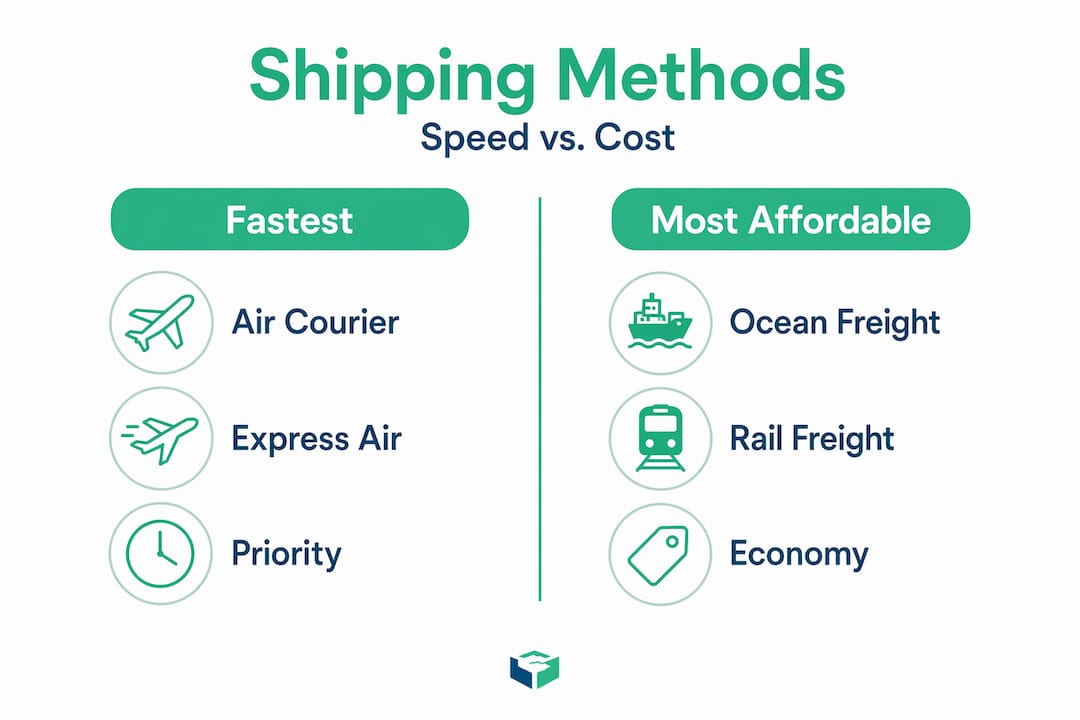
For most e-commerce sellers shipping small parcels, international courier services are the standard choice. DHL Express delivers internationally in one to two business days, while standard postal services can take six to ten or more days. DHL includes customs brokerage in its service, which simplifies clearance. Budget services can lose tracking visibility once goods clear customs, creating customer service headaches.
The right method depends on three factors: the weight and size of your goods, the value of the shipment, and your customer’s delivery expectations. A seller of handmade jewellery sending small high-value parcels to the United States will almost always choose an express courier. A brand shipping furniture to Europe will likely consolidate stock via sea freight and use an overseas warehouse for local despatch.
Challenges and best practices
Cross-border e-commerce introduces a set of challenges that simply do not exist in domestic fulfilment. Knowing them in advance lets you build solutions into your process rather than scrambling to fix them after the fact.
- Unexpected duties and taxes. Without upfront calculation, customers can be hit with unexpected charges at delivery. This is one of the leading causes of parcel rejection and cart abandonment on international orders. Delivered Duty Paid (DDP) terms simplify purchases by including duties and taxes upfront, reducing surprises and friction. With de minimis exemptions removed in 2025, DDP is increasingly the standard for cross-border e-commerce.
- Complex returns. International return shipping costs are high. Best practice is to be upfront with customers that they may bear return shipping costs, or to build a local returns process via an overseas warehouse or third-party returns partner.
- Tracking visibility gaps. Tracking data often breaks at the point of customs entry. Invest in a carrier or platform that maintains end-to-end tracking so your customer service team is not fielding “where is my order?” calls blindly.
- Regulatory differences. Each country has its own import restrictions, labelling requirements, and product compliance rules. What is freely sold in the UK may be restricted or require certification elsewhere.
Pro Tip: Use landed cost calculators and shipping management software to estimate the true cost of each international order including duties, taxes, and freight. These tools cost far less than hiring additional logistics staff and prevent margin surprises.
Scalable strategies for growing cross-border fulfilment
Once you understand the fundamentals, the next step is building a fulfilment model that scales without proportionally increasing your workload or costs. These are the strategies that experienced cross-border sellers rely on:
- Overseas warehousing. E-commerce sellers increasingly adopt overseas warehousing to pre-position stock near customers, enabling faster delivery and easier returns. Stocking goods in a fulfilment centre in Germany, for example, allows you to serve the entire EU market with delivery times comparable to domestic orders.
- Partnering with a 3PL. A third-party logistics provider handles warehousing, picking, packing, and carrier relationships on your behalf. This removes the operational burden of managing international logistics in-house and gives you access to negotiated carrier rates that individual sellers cannot access independently.
- Digital integration. Connecting your e-commerce platform to a fulfilment and shipping management system gives you real-time stock visibility, automated order routing, and integrated customs documentation. This is particularly valuable as you add multiple destination countries.
- Regional shipping strategies. Not every market requires the same approach. Tailor your carrier selection, service levels, and pricing thresholds by region based on demand volume, average order value, and customer delivery expectations.
The combination of overseas warehousing and AI-driven inventory forecasting can significantly reduce transit times and improve customer satisfaction in international e-commerce. For sellers scaling beyond a handful of international orders per week, this approach shifts international shipping from a cost centre to a genuine competitive advantage.
Explore Parcelplanet’s guidance on scalable e-commerce logistics and the top logistics solutions for 2026 to understand how to structure your fulfilment model as you grow.
My perspective on getting cross-border shipping right
I have worked alongside many e-commerce businesses making their first international moves, and the same mistake comes up repeatedly. Sellers assume that because the product is good and the demand is there, the logistics will sort themselves out. They will not.
In my experience, the businesses that struggle most with cross-border shipping are not the ones that picked the wrong carrier. They are the ones that underinvested in documentation processes and chose fulfilment partners based on price alone. When a shipment gets stuck in customs because of a misclassified HS code, no amount of customer goodwill saves the relationship.
What I have found actually works is treating documentation as seriously as product quality. Build a standard operating procedure for every new market you enter. Verify your HS codes before the first shipment, not after a delay. Confirm which Incoterms you are operating under and make sure both your carrier and your customer understand what that means.
The other thing I would push back on is the assumption that DDP is always too expensive. Yes, absorbing duties upfront adds complexity. But the number of customers who abandon at checkout because of unclear landing costs, or who reject a parcel at the door because of an unexpected charge, is a far greater loss. I have seen sellers recover significant conversion rates simply by switching to DDP and displaying total landed cost at checkout.
Cross-border e-commerce rewards sellers who do the groundwork. The ones who invest time in understanding the process, choosing the right shipping strategy workflow, and building reliable partnerships grow internationally in a way that is repeatable and profitable.
— Lukasz
How Parcelplanet helps you ship internationally with confidence
Expanding internationally is a significant step, and managing cross-border logistics alone adds layers of operational complexity that pull you away from growing your business.

Parcelplanet operates as a dedicated 3PL and order fulfilment partner for e-commerce brands managing international growth. From warehousing and pick-and-pack to carrier integrations and real-time tracking, Parcelplanet handles the operational complexity so you can focus on sales. The platform integrates directly with your e-commerce channels, giving you visibility across orders, stock levels, and shipment status without switching between systems. Whether you are shipping to ten countries or scaling to fifty, Parcelplanet’s fulfilment services are built to grow with you. Get in touch with the team today to discuss your international fulfilment requirements.
FAQ
What is cross-border shipping in e-commerce?
Cross-border shipping is the process of sending goods sold online from one country to a buyer in another. It involves international carriers, customs clearance, import duties, and documentation such as commercial invoices and HS codes.
What documents are needed for cross-border shipping?
The core documents include a commercial invoice, packing list, certificate of origin, customs declaration, and HS codes. Since September 2025, six-digit HS codes are mandatory on all international commercial shipments.
What is the difference between DDP and DDU shipping?
DDP (Delivered Duty Paid) means the seller covers all duties, taxes, and import fees so the customer pays nothing extra at delivery. DDU (Delivered Duty Unpaid) means the buyer is responsible for these charges, which can lead to parcel rejection and poor customer experience.
How do I choose the right international shipping method?
Match your method to your goods and customer expectations. Courier services suit small, high-value parcels with fast delivery expectations. Sea freight is cost-effective for large or heavy shipments where speed is less critical. Air freight works well for time-sensitive goods at lower weights.
How can a 3PL help with cross-border logistics?
A third-party logistics provider manages warehousing, fulfilment, carrier relationships, and often customs documentation on your behalf. This reduces operational burden, gives access to better carrier rates, and allows you to scale internationally without building your own logistics infrastructure.
Recommended


