TL;DR:
- Many brands mistakenly believe that selling across multiple channels automatically equates to cross-channel logistics, which leads to inefficiencies. True cross-channel logistics involves integrated data sharing, inventory management, and intelligent order routing across all sales platforms. Implementing unified order management, warehouse systems, and real-time stock visibility enhances scalability, reduces costs, and improves customer experience.
Many e-commerce and omnichannel brands assume they’re already doing cross-channel logistics simply because they sell on their website, a marketplace, and in-store. That assumption is costing them money, speed, and customer satisfaction. True cross-channel logistics isn’t about the number of channels you operate on. It’s about how intelligently those channels share data, inventory, and fulfilment capacity. In this guide, we break down what cross-channel logistics really means, how its core components work together, and how your brand can apply these principles to scale efficiently and reliably.
Table of Contents
Key Takeaways
| Point |
Details |
| Unified orchestration |
True cross-channel logistics seamlessly connects sales and fulfilment for maximum efficiency. |
| OMS integration is essential |
A centralised, integrated order management system underpins scalable omnichannel success. |
| Smart routing lowers costs |
Real-time inventory and rules-based fulfilment minimise expenses and exceed customer expectations. |
| Best practices drive scale |
Brands that focus on continuous improvement of logistics frameworks grow faster and operate more efficiently. |
What is cross-channel logistics?
Cross-channel logistics is the seamless orchestration of inventory, orders, and fulfilment operations across every sales and delivery channel your brand uses. It’s not simply being present on multiple platforms. It’s ensuring every one of those platforms talks to the same unified system, so orders are fulfilled accurately, efficiently, and at the lowest possible cost.
For multi-channel logistics explained, the common starting point is listing products on Amazon, your own Shopify store, and perhaps a physical outlet. But without a unified layer connecting all those channels, you’re running separate operations that duplicate effort and create stock discrepancies.
The goal of cross-channel logistics is to meet your customer promise at the lowest operational cost. This means routing each order to the most appropriate fulfilment node, whether that’s a distribution centre, a store location, or a third-party warehouse, based on real-time data.
Here are the key capabilities that define genuine cross-channel logistics:
- Unified order management: All orders from all channels are captured and processed through one system.
- Real-time stock visibility: Inventory levels are updated instantly across every location and channel.
- Intelligent order routing: Orders are assigned to the best fulfilment node based on proximity, cost, and availability.
- Flexible fulfilment methods: Including ship-from-store, ship-from-DC (distribution centre), BOPIS (Buy Online, Pick Up In Store), curbside collection, and locker delivery.
- Consistent customer experience: Regardless of where a customer places an order, they receive the same quality of communication and delivery.
“A common methodology is omnichannel fulfilment orchestration: use unified order management rules to decide where and how each order should be fulfilled, based on real-time inventory and capacity.”
Pro Tip: The brands getting the best results from cross-channel logistics aren’t the ones with the most warehouses. They’re the ones with the most flexible routing rules. Define your sourcing logic clearly before you add new channels or fulfilment nodes.
Core components and workflow
With the strategic definition clear, let’s look at what actually makes up an effective cross-channel logistics operation, step by step.
Three technology systems form the foundation of any well-functioning cross-channel logistics operation. Each one serves a distinct purpose, and all three must be integrated to work properly.
| System |
Full name |
Primary role |
| OMS |
Order Management System |
Captures, routes, and tracks all orders |
| WMS |
Warehouse Management System |
Manages picking, packing, and stock at each node |
| ATP |
Available-to-Promise |
Calculates real-time stock availability for fulfilment decisions |
For efficient fulfilment strategies to work at scale, the data flow between these systems must be instantaneous. When an order lands, the OMS queries ATP to confirm stock, then applies routing rules to select the best fulfilment node. The WMS at that node then executes the pick, pack, and despatch. This entire sequence should happen in seconds, not hours.
The unified inventory layer that connects OMS and WMS integration is the backbone that enables smart fulfilment decisions across your entire operation.
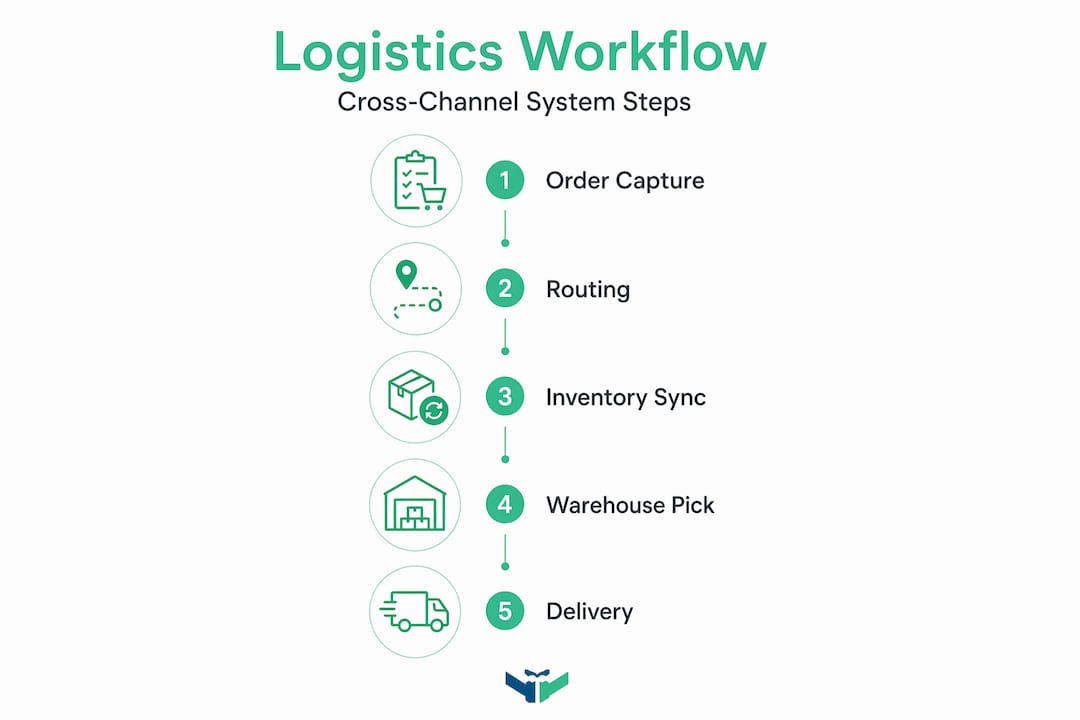
Here’s how a standard cross-channel order workflow looks in practice:
- Order placed: A customer places an order via your website, marketplace, or in-store terminal.
- OMS receives the order: The system captures all order details and initiates the routing process.
- ATP check: Real-time stock availability is confirmed across all fulfilment nodes.
- Routing rules applied: The OMS selects the optimal node based on cost, proximity, and delivery promise.
- WMS activated: The selected warehouse or store receives the pick instruction and begins fulfilment.
- Despatch and tracking: The order is packed and handed to the courier, with tracking details sent to the customer automatically.
- Inventory updated: Stock levels are decremented across all systems in real time to prevent overselling.
For warehouse management tips that support this workflow, the key is keeping your WMS synchronised with your OMS at all times. Any lag in this connection creates data gaps that lead to mispicks, stockouts, and delayed orders.
Pro Tip: Before investing in additional warehouse capacity, audit your current OMS-WMS integration. Most scaling inefficiencies come not from lack of space but from systems that don’t share data quickly enough.
Cross-channel logistics vs multi-channel: What’s the difference?
As we outline the building blocks of cross-channel logistics, it’s important to clarify how it compares with, yet is fundamentally different from, multi-channel strategies. This is one of the most misunderstood distinctions in e-commerce operations.
Multi-channel logistics means operating across multiple sales platforms, but each channel has its own dedicated inventory pool, fulfilment team, and reporting. Orders from your website don’t share stock with your marketplace listings. Returns from one channel can’t be processed through another. The result is operational fragmentation, higher carrying costs, and a customer experience that feels inconsistent.
Cross-channel logistics, on the other hand, connects everything through a single orchestration layer. Inventory is shared, orders are routed intelligently, and the customer sees one coherent brand regardless of where they shop.
| Feature |
Multi-channel logistics |
Cross-channel logistics |
| Inventory management |
Siloed per channel |
Shared, unified pool |
| Order routing |
Fixed per channel |
Dynamic, rules-based |
| Customer experience |
Varies by channel |
Consistent across all touchpoints |
| Technology stack |
Separate systems per channel |
Integrated OMS, WMS, ATP |
| Cost structure |
Higher due to duplication |
Optimised through shared resources |
| Scalability |
Difficult, adds complexity |
Designed to scale efficiently |
| Returns handling |
Channel-specific only |
Cross-channel returns processing |
Consider a practical example. A brand selling on its own website and a marketplace holds separate stock for each. A spike in marketplace orders depletes that channel’s inventory while the website stock sits idle. Customers see out-of-stock messages on one channel while the product is available on another. This is the multi-channel trap. With cross-channel logistics, that same inventory pool serves both channels, and the OMS routes each order to whichever node is best placed to fulfil it quickly and cheaply.
The key outcome of cross-channel orchestration is that every order is fulfilled based on unified data, not channel-specific assumptions.
For a deeper look at the practical implications, our guide on multichannel vs cross-channel logistics walks through the trade-offs in detail. The key takeaway is this: multi-channel gets you presence, but cross-channel gives you performance.
Brands planning to expand into new regions or add sales channels will find that multi-channel logistics becomes exponentially more complex with every addition. Cross-channel logistics, built on a unified foundation, is genuinely designed to scale.
Best practices for implementing cross-channel logistics
Understanding the distinction leads directly to action. Here’s how to implement cross-channel logistics effectively and avoid the common pitfalls that slow growing brands down.
The implementation process doesn’t have to be overwhelming. Breaking it into structured phases makes it manageable and ensures each component is properly integrated before the next is added.
Step-by-step implementation framework:
- Audit your current systems: Map every tool you use for orders, inventory, and fulfilment. Identify where data gaps exist between channels and systems.
- Select a unified OMS: Choose a single order management system that can connect all your sales channels and fulfilment nodes. This is your most important technology investment.
- Integrate your WMS: Connect your warehouse management system to the OMS so stock data flows in real time across every location.
- Define ATP logic: Configure your available-to-promise rules so the OMS always works from accurate, live inventory figures.
- Set routing rules: Decide the criteria for order routing. Common variables include distance to customer, stock levels at each node, delivery promise, and fulfilment cost.
- Connect all sales channels: Integrate your website, marketplaces, and any physical retail systems into the OMS so every order passes through the same workflow.
- Test thoroughly before going live: Run parallel operations during a transition period to validate that routing, inventory updates, and despatch notifications all work correctly.
- Monitor and refine: Track key metrics including order accuracy, fulfilment speed, and cost per order. Use this data to continuously improve your routing rules.
Before you begin, check our cross-border fulfilment checklist if international expansion is part of your growth plan. Cross-channel logistics becomes even more valuable when you’re managing fulfilment across multiple countries.
Common mistakes to avoid during implementation:
- Building technology silos: Adding a new sales channel without connecting it to your unified OMS immediately fragments your operation again.
- Ignoring returns: Returns management must be part of your cross-channel strategy from day one. A returns process that isn’t integrated into your inventory system creates manual work and inaccurate stock figures.
- Skipping data integration: Partial integrations are often worse than no integration. If your WMS updates every 30 minutes rather than in real time, your ATP figures will be unreliable.
- Underestimating routing rule complexity: Simple rules work initially, but plan for how they’ll evolve as you add nodes, channels, and service level requirements.
For brands considering outsourcing as part of their strategy, our guide on third-party logistics for e-commerce explains how a 3PL partner can accelerate your cross-channel setup by providing pre-built integrations and fulfilment infrastructure.
The unified order management rules that govern your cross-channel operation should be treated as living rules. They need regular review as your order volumes, SKU range, and geographical reach evolve.
Pro Tip: Start your implementation with one unified OMS as the single source of truth for all orders and inventory. Every other system should feed into it. Resist the temptation to use separate tools for separate channels, even temporarily. That temporary fix almost always becomes a permanent bottleneck.
Why cross-channel logistics is a growth multiplier, not an operational headache
Most brands approach cross-channel logistics as a cost to manage. They see the system integrations, the process redesigns, and the staff training involved, and they frame it as complexity they’d rather avoid. That framing is the single biggest mistake growing e-commerce brands make.
Cross-channel logistics, when properly implemented, is one of the highest-return investments your operation can make. Here’s why. Every improvement in routing logic, even a small one, compounds across your entire order volume. If you process 5,000 orders per week and a routing refinement saves you £1.20 per order by choosing a closer fulfilment node, that’s £6,000 per week in recovered margin. No new channel, no new warehouse, no new marketing spend required.
The brands that consistently win on customer retention aren’t necessarily the ones with the most sales channels. They’re the ones whose customers always receive the right product, on time, regardless of where they ordered from. That consistency is only possible with unified, intelligent fulfilment orchestration.
We’ve seen firsthand that brands who invest in data-driven routing rules rather than simply adding more warehouses grow faster and more profitably. More fulfilment nodes without smarter routing logic just means more complexity. Real-time integration between your OMS, WMS, and sales channels is where the leverage lies.
For brands exploring scalable e-commerce logistics, the lesson is consistent. Prioritise the quality of your data infrastructure over the quantity of your physical assets. A brand with three well-integrated fulfilment nodes and excellent routing logic will outperform a brand with six poorly connected warehouses every time.
Cross-channel logistics is not a complexity tax. It’s the infrastructure that allows you to say yes to more channels, more markets, and more growth, without your operations falling behind.
How ParcelPlanet enables cross-channel logistics success
Ready to put cross-channel logistics into practice? ParcelPlanet is built specifically to support e-commerce and omnichannel brands like yours in making it happen.
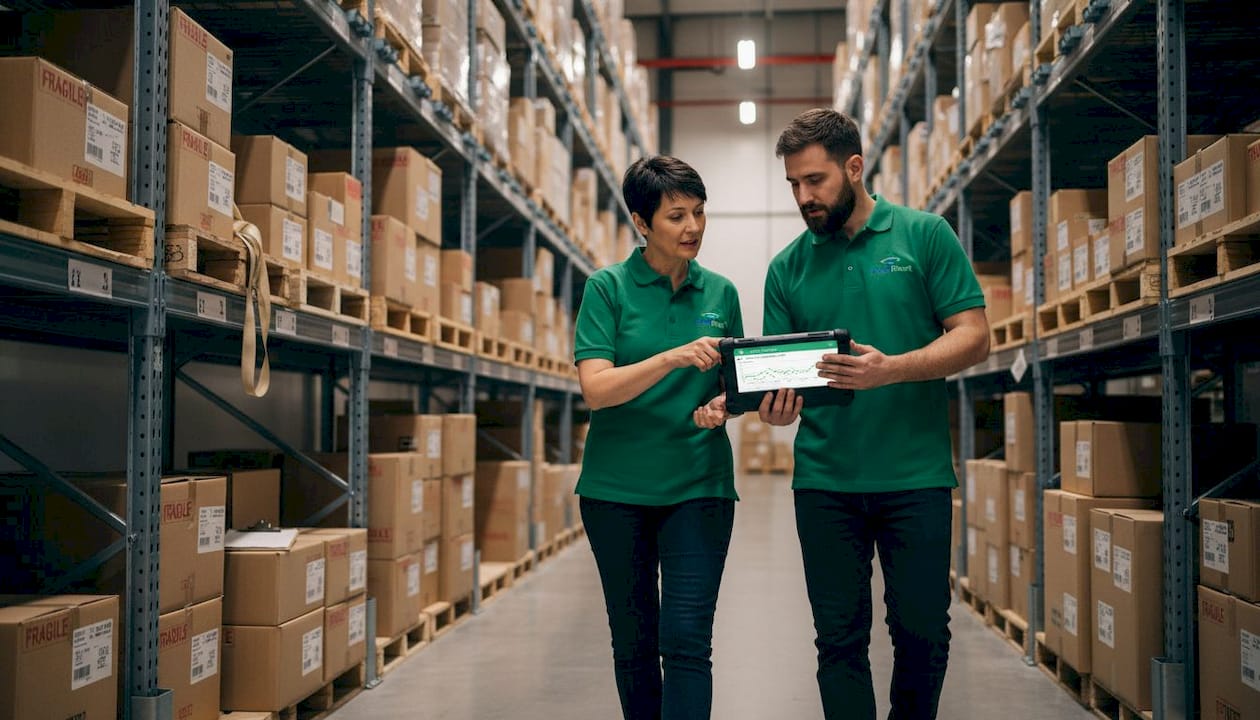
Our order fulfilment services are designed around the exact principles covered in this guide. We provide unified OMS and WMS integration, real-time inventory visibility, and intelligent order routing across multiple channels and regions. Whether you’re managing five SKUs or five thousand, our systems scale with your operation. We also offer a wide range of e-commerce integrations connecting your existing sales platforms directly into our fulfilment infrastructure, so you can start benefiting from cross-channel efficiency without rebuilding your technology stack. Get in touch with our team today to request a tailored quote.
Frequently asked questions
What’s the main benefit of cross-channel logistics for e-commerce brands?
It enables efficient fulfilment from the most cost-effective location while consistently meeting customer promises, reducing both operational costs and delivery times simultaneously.
How is cross-channel logistics different from multi-channel logistics?
Cross-channel logistics uses a unified system for inventory and orders across all channels, while multi-channel logistics operates in silos, with each channel managed and stocked separately.
What technology is essential for cross-channel logistics?
A unified OMS that integrates with all sales and fulfilment channels is the most critical component, supported by a WMS and real-time ATP for accurate routing decisions.
Can cross-channel logistics improve delivery speeds?
Yes, because smart routing uses real-time inventory data to fulfil each order from the fastest available location, reducing transit times and improving on-time delivery rates.
Recommended