Integrating your e-commerce platform with your fulfillment provider can reduce order processing times by nearly a third, transforming how you scale operations. Struggling with manual order entry, inventory mismatches, and shipping delays often signals it’s time to automate. This guide explains how integration solves these critical problems, delivering faster fulfillment, happier customers, and significant cost savings.
Table of Contents
Key Takeaways
| Point |
Details |
| Automation drives efficiency |
Integration synchronizes order fulfillment and inventory management automatically. |
| Error reduction |
Real-time data sharing cuts errors and overselling by over 40%. |
| Customer satisfaction |
Integrated workflows boost satisfaction scores by 20% or more. |
| Cost savings |
Automation reduces operational costs by at least 15%. |
| Strategic choice |
Choosing the right integration approach is critical to long-term success. |
E-commerce platform integration connects your sales platforms directly with logistics and fulfillment systems, enabling seamless data flow without manual intervention. When orders arrive, they automatically transfer to your warehouse management system, triggering picking, packing, and shipping processes instantly.
Without integration, you face constant operational friction. Manual order entry consumes hours of labor and introduces transcription errors. Inventory counts become outdated, leading to overselling popular items or holding excess stock. Fulfillment slows because your team manually transfers data between systems, creating bottlenecks that frustrate customers.
Integration automates workflows and provides real-time synchronization that improves operational efficiency dramatically. Your inventory updates instantly when products sell or arrive at the warehouse. Orders route automatically to fulfillment centers based on stock availability and shipping logic. This automation enables you to scale from hundreds to thousands of daily orders without proportionally increasing staff.
The benefits extend beyond speed:
- Real-time data visibility across all sales channels
- Dramatic reduction in manual errors and overselling
- Faster order-to-ship times improving customer satisfaction
- Scalability supporting business growth without operational chaos
Pro Tip: Evaluate specific pain points in your current workflows to target integration efforts effectively. If inventory accuracy causes the most customer complaints, prioritize real-time stock synchronization over other features.
Understanding the role of logistics in e-commerce success helps you recognize how integration transforms operations from reactive to proactive.
How Integration Improves Order Fulfillment Speed and Accuracy
Integration can reduce order processing times by nearly 30% by eliminating the manual steps that slow traditional fulfillment. When a customer clicks purchase, integrated systems instantly transmit order details to your fulfillment center, triggering warehouse operations without human intervention.
Manual order entry creates delays measured in hours or even days. Staff must log into multiple systems, copy order information, verify addresses, and update inventory counts. Each step introduces potential errors. Integration removes this friction entirely, reducing order-to-ship time from days to hours.
Real-time inventory updates prevent the costly problem of overselling. Your e-commerce platform displays accurate stock levels because integration synchronizes inventory counts instantly when orders process or new stock arrives. Customers see only available products, eliminating the frustration of purchasing items you cannot ship.
Accurate shipping cuts e-commerce errors by 35%, and integration ensures shipping labels generate automatically with correct addresses verified against customer records. Your fulfillment team picks, packs, and ships faster because they work from validated data rather than manually entered information prone to mistakes.
Key improvements include:
- Instant order transmission eliminating data entry delays
- Automated address validation reducing shipping errors
- Real-time stock synchronization preventing overselling
- Automatic shipment tracking updates sent to customers
Pro Tip: Use integration solutions that support instant data sync rather than batch updates for optimal speed. Batch processing creates delays and temporary inventory inaccuracies.
Integration transforms your shipping strategy workflow by connecting every step automatically. This efficiency becomes crucial when boosting e-commerce sales with omnichannel strategies that multiply order volumes across platforms.
Impact of Integration on Customer Experience and Retention
Integration directly improves customer satisfaction by delivering the transparency and speed modern shoppers expect. Real-time shipment tracking becomes accessible via customer portals because integrated systems automatically update order status from warehouse to doorstep. Customers receive notifications at each fulfillment stage without your team manually sending updates.
Faster responses to order changes and cancellations reduce customer frustration significantly. When integration connects your e-commerce platform with fulfillment systems, modification requests process instantly rather than waiting for manual intervention. A customer who realizes they ordered the wrong size can update their order before it ships, building goodwill and preventing returns.
Customer satisfaction scores improve by over 20% following platform integration because predictability increases. Customers receive accurate delivery estimates based on real-time fulfillment data. They trust your brand more when promised delivery dates prove reliable.
Increased transparency builds the trust that encourages repeat purchases. When customers track their orders in real time and receive proactive updates about any delays, they feel informed and valued. This communication reduces anxious inquiries to your support team while strengthening customer relationships.
Key benefits include:
- Real-time order tracking accessible 24/7
- Proactive notifications about order status changes
- Faster processing of modifications and cancellations
- Predictable delivery windows building trust
- Reduced support inquiries freeing team resources
Strategies to boost e-commerce sales depend on delivering exceptional customer experiences. Integration provides the operational foundation for customer satisfaction improvements that convert first-time buyers into loyal advocates.
Cost and Efficiency Gains from Integrated Workflows
Integration reduces operational costs by 15-20%, supporting scalable growth by automating labor-intensive processes. Labor represents your largest fulfillment expense, and integration minimizes the hours spent on manual data entry, inventory updates, and order processing tasks.

Automation lowers labor costs by eliminating repetitive manual steps. Staff who previously spent hours entering orders can focus on value-added activities like optimizing warehouse layout or improving packaging efficiency. This reallocation of human resources delivers compounding productivity gains as your order volume grows.
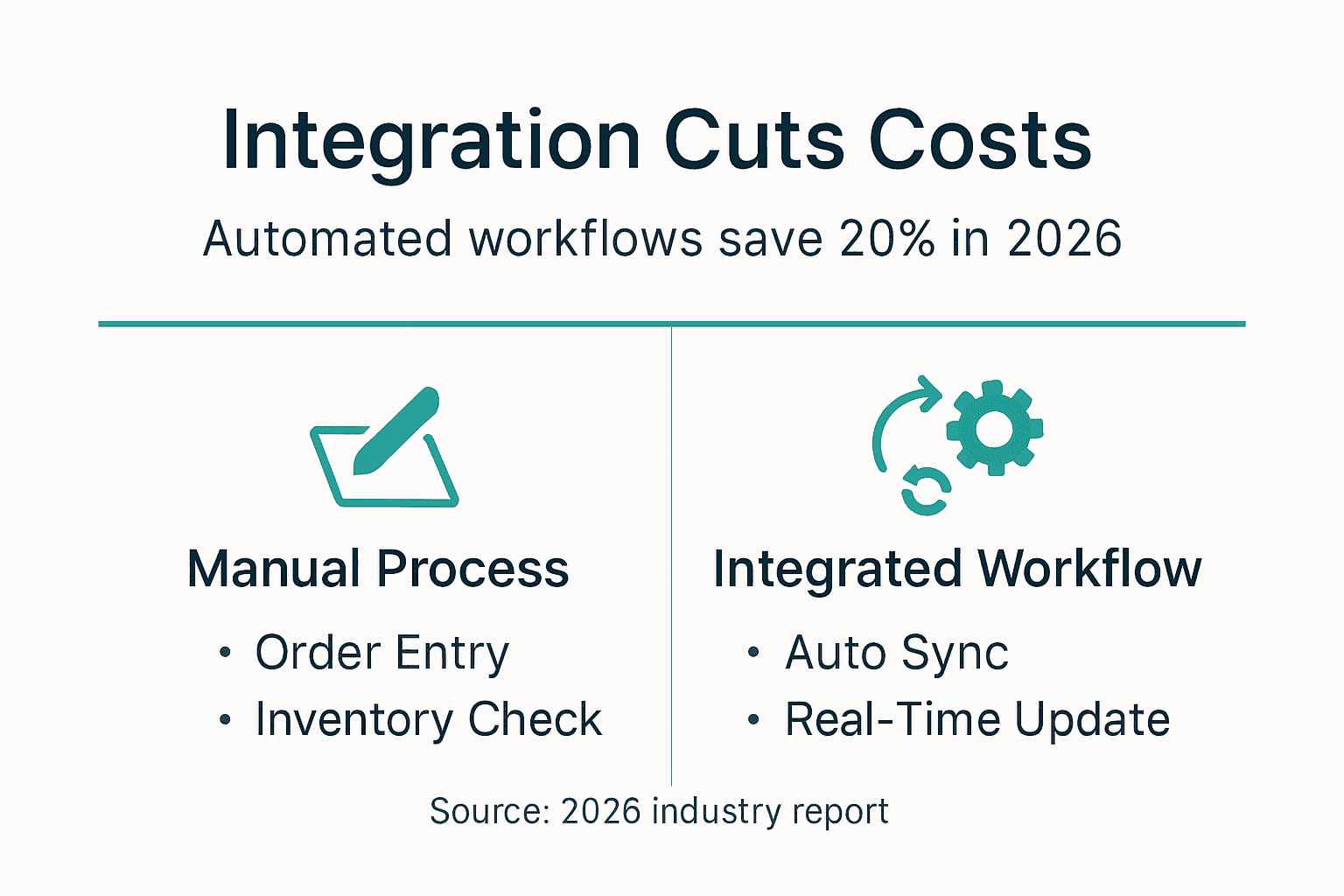
Integration enables better carrier and shipment route selection through synchronized data. Your system automatically compares shipping rates across carriers based on package dimensions, weight, and destination, selecting the most cost-effective option. These optimizations accumulate into substantial savings across thousands of shipments.
Synchronized inventory reduces excess stock and carrying costs by providing accurate demand visibility. You avoid over-ordering products that tie up capital and warehouse space. Real-time data helps you maintain optimal stock levels, improving cash flow while preventing stockouts.
Follow these steps to maximize cost savings:
- Audit current labor hours spent on manual order processing
- Calculate potential savings from eliminating data entry tasks
- Evaluate carrier rate optimization opportunities through integration
- Project inventory carrying cost reductions from better synchronization
- Measure total ROI by comparing implementation costs against annual savings
| Metric |
Before Integration |
After Integration |
Improvement |
| Order Processing Time |
45 minutes |
15 minutes |
67% faster |
| Labor Cost per Order |
£2.80 |
£0.95 |
66% reduction |
| Shipping Cost Accuracy |
75% |
98% |
31% improvement |
| Inventory Carrying Cost |
£15,000/month |
£12,000/month |
20% reduction |
| Order Error Rate |
8% |
2% |
75% decrease |
Strategies to boost e-commerce sales work best when supported by efficient operations. Understanding cost savings from integration helps justify the investment and secure stakeholder buy-in.
Myth 1: Integration requires heavy IT involvement and long development times. Many brand managers assume integration demands months of custom development and expensive IT consultants. Reality: Modern plug-and-play connectors cut setup time by 50% compared to custom solutions. Most e-commerce platforms offer pre-built integrations with popular 3PL providers that launch in days, not months.
Myth 2: Integration compromises data security and increases breach risk. Some managers worry that connecting systems creates vulnerabilities exposing customer data. Reality: Secure APIs reduce data breach risk by 70% compared to manual data transfers involving spreadsheets and email. Properly configured integrations use encrypted connections and role-based access controls that exceed manual process security.
Myth 3: ROI is insufficient to justify integration costs. Decision makers sometimes believe integration benefits don’t outweigh implementation expenses, especially for smaller brands. Reality: 15-20% cost reductions deliver positive ROI within months, not years. Labor savings alone often cover integration costs in the first quarter of operation.
| Myth |
Fact |
Data Point |
| Requires extensive IT resources |
Pre-built connectors simplify setup |
50% faster deployment |
| Compromises data security |
Secure APIs improve protection |
70% lower breach risk |
| Poor ROI for integration investment |
Fast payback period |
15-20% cost reduction |
| Only benefits large enterprises |
Scales for all business sizes |
Positive ROI in 3-6 months |
| Creates system complexity |
Simplifies workflows |
30% faster processing |
These misconceptions often prevent brands from pursuing integration that would solve their most pressing operational challenges. Understanding the reality helps you make informed decisions based on facts rather than outdated assumptions.
Comparison of Integration Methods and Technologies
API-based integration enables real-time data exchange and suits high-volume brands needing instant synchronization. APIs (Application Programming Interfaces) create direct connections between your e-commerce platform and fulfillment systems, transmitting data immediately when events occur. This method provides the fastest updates and greatest flexibility.
Batch file transfer offers simpler implementation but delayed updates and less scalability. Systems exchange data files on scheduled intervals, such as every hour or daily. This approach works for lower-volume operations but creates synchronization gaps that can lead to inventory inaccuracies during high-traffic periods.
Plug-and-play connectors reduce implementation time compared to custom development by providing pre-configured integrations between popular platforms. Many e-commerce systems and 3PL providers offer these ready-made solutions that require minimal technical expertise to deploy.
Key trade-offs between methods:
- Real-time APIs: Instant updates, higher complexity, best for scaling brands
- Batch transfers: Simpler setup, delayed synchronization, limited scalability
- Pre-built connectors: Fast deployment, platform-specific, reduced customization
- Custom integrations: Maximum flexibility, highest cost, longest implementation
| Integration Method |
Update Speed |
Implementation Time |
Scalability |
Best For |
| Real-Time API |
Instant |
2-4 weeks |
Excellent |
High-volume brands |
| Batch File Transfer |
Hourly/Daily |
1-2 weeks |
Limited |
Low-volume operations |
| Plug-and-Play Connector |
Near real-time |
3-7 days |
Good |
Mid-sized brands |
| Custom Development |
Variable |
2-6 months |
Excellent |
Unique requirements |
Choosing the right logistics integration methods depends on your order volume, technical resources, and growth projections. Most growing e-commerce brands benefit from API-based or connector solutions that balance speed, scalability, and implementation complexity.
Applying Integration Strategies to Scale Your E-Commerce Brand
Identify signs you need integration when you notice frequent order errors, slow fulfillment cycles, or struggles managing increasing order volumes. If your team spends hours daily on manual data entry, or customers complain about inventory accuracy and shipping delays, integration addresses these root causes.
Evaluate compatibility between your e-commerce platform and potential 3PL or fulfillment providers before selecting partners. Most major platforms like Shopify, WooCommerce, and Magento offer extensive integration options, but verify that your chosen fulfillment provider supports direct connections or provides robust APIs.
Implement integration using APIs or middleware connectors to enable automation across your entire order fulfillment workflow. Start with core functions like order transmission and inventory synchronization, then expand to advanced features like automated carrier selection and customer notification systems.
40% of integration failures result from underestimating ongoing maintenance needs. Assign dedicated resources to monitor integration health, update API credentials, and troubleshoot connectivity issues. Regular monitoring prevents small problems from becoming operational disasters.
Maintain integrations actively by monitoring key performance indicators regularly:
- Assess current pain points: frequent errors, slow processing, scaling challenges
- Research compatible integration solutions for your platform and fulfillment provider
- Select the appropriate method: API, batch transfer, or plug-and-play connector
- Implement integration starting with core order and inventory functions
- Assign dedicated staff to monitor integration health and performance metrics
- Measure KPIs: order processing time, error rates, customer satisfaction scores
- Optimize continuously based on performance data and business growth
Successful logistics success strategies depend on treating integration as an ongoing operational asset rather than a one-time project. Regular optimization ensures your integrated systems continue delivering value as your business evolves.
Streamline Your E-Commerce Logistics with ParcelPlanet
Discover how ParcelPlanet’s integrated logistics platform syncs seamlessly with major e-commerce systems to eliminate manual processes and accelerate fulfillment. Our solutions deliver the automation and real-time visibility this guide describes, transforming your order processing from reactive to proactive.
Benefit from plug-and-play connectors designed for fast deployment and scalability. ParcelPlanet integrates with Shopify, WooCommerce, Magento, and other leading platforms, providing the instant synchronization that reduces processing times by 30% and cuts errors by 35%. Your team focuses on growth while our systems handle fulfillment complexity.
Leverage expert support to optimize your shipping strategy workflow and reduce costs through intelligent carrier selection and route optimization. Our integrated platform provides the transparency and speed your customers expect while delivering the operational efficiency your business requires.
Key features supporting your integration goals:
- Real-time order and inventory synchronization across all channels
- Pre-built connectors for major e-commerce platforms
- Automated carrier selection optimizing shipping costs
- Comprehensive tracking and customer notification systems
- Dedicated support for implementation and ongoing optimization
Explore ParcelPlanet’s comprehensive order fulfillment services designed to scale with your e-commerce brand.
Frequent order errors, manual data entry consuming multiple staff hours daily, and customer complaints about inventory accuracy signal integration needs. Struggles processing growing order volumes or delays between order receipt and warehouse transmission also indicate it’s time to automate.
How long does it typically take to implement integration with minimal IT resources?
Pre-built connectors deploy in 3-7 days for most popular e-commerce platforms. API-based integrations require 2-4 weeks including testing and staff training. Custom solutions take 2-6 months but most growing brands succeed with faster connector-based approaches.
Does integration increase risk of data breaches or can it improve security?
Properly configured integration improves security by 70% compared to manual data transfers using spreadsheets and email. Modern APIs use encrypted connections and role-based access controls that exceed manual process security. Choose providers with SOC 2 compliance and regular security audits.
Can small brands benefit from integration or is it only for large operations?
Small brands achieve positive ROI within 3-6 months through labor savings and error reduction. Integration scales efficiently from hundreds to thousands of daily orders, making it valuable at any size. Start with basic order and inventory sync, then add features as you grow.
Track order processing time reduction, labor hours saved on manual tasks, shipping cost optimization, inventory carrying cost decreases, and error rate improvements. Compare these operational gains against integration costs. Most brands see 15-20% cost reductions within the first year of implementation.
Recommended