TL;DR:
- Seamless omnichannel fulfilment relies on unified inventory and integrated systems.
- Implementing advanced workflows like ship-from-store and BOPIS improves efficiency and customer experience.
- Choosing flexible, well-integrated 3PL partners is essential for scalable omnichannel growth.
Adding more sales channels does not automatically grow your brand. In fact, many omnichannel brands discover the hard way that expanding to new channels without the right fulfilment infrastructure creates more problems than it solves: stockouts, split shipments, and frustrated customers who expect consistency everywhere. The real competitive advantage lies in how seamlessly you fulfil orders across every touchpoint. Brands that get this right see measurable results, including reduced logistics costs, faster delivery, and significantly higher customer lifetime value. This guide takes you from the fundamentals of omnichannel fulfilment through to the advanced strategies and partnerships that drive sustainable, scalable growth.
Table of Contents
Key Takeaways
| Point |
Details |
| Unified fulfilment is vital |
Integrating inventory and order management for all channels leads to faster, cheaper, and more consistent service. |
| Advanced systems drive performance |
Centralised OMS, dynamic routing, and real-time automation underpin scalable omnichannel operations. |
| Scalability demands expert partners |
Working with 3PLs skilled in omni-integration lets brands expand reach without losing efficiency. |
| Short-term complexity brings long-term gains |
Accepting initial integration challenges creates the foundation for sustainable revenue growth and better customer experiences. |
What makes omnichannel fulfilment different?
Omnichannel fulfilment is not simply selling across multiple channels. It is the ability to fulfil orders from any channel using a unified view of inventory, systems, and customer data. Where multichannel fulfilment treats each channel as a separate operation, omnichannel connects them all. The result is a single source of truth for stock levels, order status, and delivery performance.
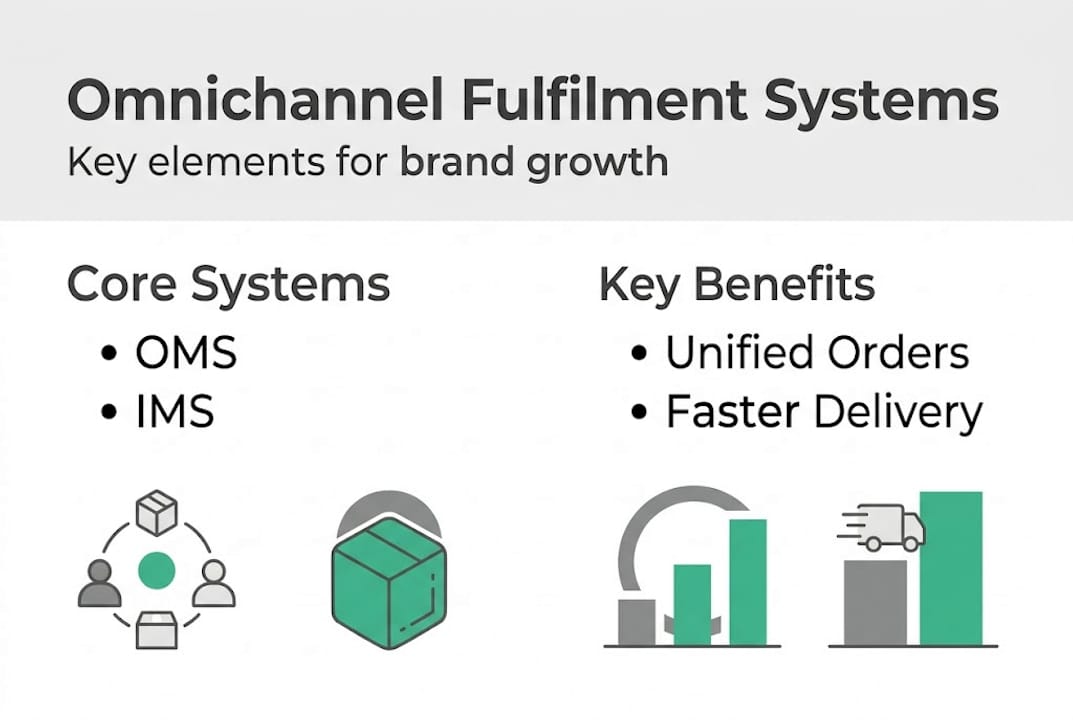
At the heart of this model are two critical systems. An Order Management System (OMS) orchestrates where each order should be fulfilled from, based on proximity, stock availability, and cost. A Warehouse Management System (WMS) controls the physical movement of goods inside each fulfilment location. Together, they enable omnichannel fulfilment to unify inventory, order management, and delivery across multiple sales channels using shared inventory pools and centralised systems.
| Feature |
Multichannel fulfilment |
Omnichannel fulfilment |
| Inventory management |
Siloed per channel |
Unified across all channels |
| System integration |
Minimal, often manual |
Centralised OMS/WMS |
| Customer experience |
Inconsistent |
Seamless and consistent |
| Cost efficiency |
Higher at scale |
Optimised through consolidation |
| Scalability |
Limited |
Built for growth |
The benefits of making this shift are significant:
- Fewer stockouts because inventory is shared, not locked to one channel
- Faster delivery through smarter order routing
- Consistent customer experience whether someone shops online, in-store, or via a marketplace
- Lower fulfilment costs through consolidated shipping and reduced duplication
Brands that invest in unified fulfilment infrastructure see real results. Retailers using omnichannel models report 2.9x higher CLV and Target achieved a 40% reduction in fulfilment costs after implementing ship-from-store. These are not marginal gains. They are structural advantages.
The trade-off is honest: integration complexity increases in the short term. You need compatible systems, clean data, and aligned processes across locations. But the scalability you gain far outweighs the initial investment, especially as your channel mix grows.
Core methodologies powering top omnichannel brands
Knowing what omnichannel fulfilment is and actually operating it at scale are two different things. The brands pulling ahead are doing so because of the specific methodologies they have built into their operations.
A centralised OMS combined with a Distributed Order Management (DOM) layer is the engine behind all of it. DOM allocates each order to the optimal fulfilment node in real time, factoring in stock levels, delivery speed targets, and cost-to-serve. This is what separates reactive fulfilment from genuinely intelligent logistics.
The five critical workflows that define leading omnichannel operations are:
- Dynamic routing: Orders are automatically directed to the nearest or most cost-effective fulfilment point
- Ship-from-store: Physical retail locations act as mini-warehouses, reducing last-mile distances
- BOPIS (Buy Online, Pick Up In Store): Customers buy digitally and collect in person, reducing delivery costs entirely
- Automated inventory sync: Stock levels update in real time across all channels and locations
- SLA management: Service-level agreements are monitored and enforced automatically to protect delivery promises
| Methodology |
Customer experience impact |
Operational efficiency |
| Ship-from-store |
Faster local delivery |
Reduces warehouse pressure |
| BOPIS |
Immediate availability |
Eliminates last-mile cost |
| Warehouse fulfilment |
Consistent, trackable |
High volume capability |
| Dynamic routing |
Reliable ETAs |
Lowers cost-per-order |
The numbers back this up. Ship-from-store fulfils over 80% of Target’s online orders, which is a core reason for their cost reduction. Italian footwear retailer Pittarello saw +58% year-on-year growth after implementing omnichannel fulfilment. Explore warehouse optimisation strategies to understand how physical operations support these workflows.
Pro Tip: Use AI-driven orchestration rules within your OMS to automatically balance proximity, cost-to-serve, and SLA compliance. This removes manual decision-making and ensures every order is routed optimally without human intervention.
For a broader view of how these approaches work in practice, reviewing top fulfilment solutions gives useful context on what leading brands are implementing right now.
Overcoming challenges: Integration, cost, and complexity
Even brands with the right intentions hit significant obstacles when scaling omnichannel fulfilment. Understanding these challenges in advance is what separates brands that transition successfully from those that stall.
The primary challenges you will face include:
- System integration: Connecting your OMS, WMS, e-commerce platforms, and courier services without data gaps
- Split inventories: Legacy setups that still ring-fence stock per channel, creating artificial shortages
- Cost-per-order spikes: Poorly routed orders or split shipments that erode margin
- Maintaining customer experience: Keeping delivery promises consistent while systems and processes are in transition
Research confirms that multichannel offers easier start-up but less efficiency at scale, while omnichannel brings better customer experience and scalability at the cost of higher initial complexity. This is not a reason to avoid the transition. It is a reason to plan it carefully.
The most effective approaches to managing this complexity are:
- Consolidate your tech stack before adding new channels. Fewer, better-integrated systems outperform many loosely connected ones
- Roll out incrementally. Start with two or three channels and a single fulfilment node, then expand once processes are stable
- Test process flows before going live. Simulate peak volumes to identify bottlenecks before they affect real customers
- Monitor cost-per-order and split-ship rates as leading indicators. If these metrics rise, your routing logic needs adjustment
For practical guidance on reducing fulfilment costs during this transition, there are proven frameworks worth reviewing. Equally, strong warehouse management tips can help you stabilise physical operations while digital systems catch up.
Pro Tip: When selecting 3PL partners and IT systems, prioritise flexibility above all else. Your logistics infrastructure needs to absorb rapid channel launches and seasonal traffic spikes without requiring a full rebuild each time.
How to leverage third-party logistics (3PL) to scale efficiently
For most growing omnichannel brands, building all of this infrastructure in-house is neither practical nor cost-effective. The smarter path is partnering with a 3PL that is genuinely built for omnichannel complexity.
Choosing the right 3PL is a structured process. Follow these steps:
- Map your requirements first. Define your channel mix, SKU count, order volumes, and peak season demands before approaching any provider
- Evaluate OMS and WMS compatibility. Your 3PL’s systems must integrate cleanly with your existing platforms
- Assess SLA track record. Request data on order accuracy, on-time dispatch rates, and returns processing times
- Benchmark customer experience. Ask for case studies from brands of similar size and complexity
- Review tech integration depth. Confirm the 3PL can connect to your e-commerce platforms, marketplaces, and courier network without manual workarounds
The capabilities your 3PL must have include:
- Multi-channel inventory visibility and management
- Ability to support ship-from-store or distributed fulfilment models
- Real-time analytics and reporting dashboards
- Flexible contract structures that accommodate channel expansion
The impact of getting this right is substantial. Omnichannel retailers see 2.9x higher CLV and 40% greater revenue growth when leveraging unified fulfilment and advanced 3PL support. These results are achievable, but only when your 3PL contract is aligned to omnichannel KPIs, not just cost-per-pick metrics.
Building scalable logistics strategies into your 3PL relationship from day one prevents costly renegotiations later. And if you want a clear view of what best-in-class looks like, reviewing fulfilment strategies from leading brands will sharpen your evaluation criteria.
Why the conventional approach won’t deliver sustainable growth
Here is the uncomfortable truth that most logistics guides avoid: adding new sales channels without fixing your fulfilment architecture does not accelerate growth. It accelerates operational debt.
We see this pattern regularly. A brand launches on a new marketplace or opens a new retail location, and suddenly customer service tickets spike, stock discrepancies multiply, and delivery promises become unreliable. The channel added revenue on paper but subtracted margin and trust in practice.
The brands that consistently outgrow their competitors are not the ones with the most channels. They are the ones with the most unified back-end operations. They invest in invisible improvements: cleaner data, tighter system integrations, smarter routing logic. Customers never see these changes directly, but they feel them in every order that arrives on time and every return that is processed without friction.
There is also a dangerous misconception that the cheapest 3PL is the best 3PL. Real omnichannel success demands partners who understand your business model, not just your parcel volume. If you are serious about boosting e-commerce sales through omnichannel selling, the quality of your fulfilment partnership is as important as the quality of your product.
Scale your omnichannel fulfilment with expert support
If this guide has confirmed that your fulfilment infrastructure needs to evolve alongside your channel strategy, the next step is finding a partner who can make that happen efficiently.
ParcelPlanet works with growing omnichannel brands to deliver seamless, scalable order fulfilment services across multiple channels and regions. Our platform connects directly with your existing tech stack, including InventoryPlanner for smarter stock management and a wide range of software integrations to keep your operations running without manual intervention. Whether you are managing rapid growth, entering new markets, or simply ready to stop firefighting logistics, our team is ready to support you. Get in touch today to discuss a tailored solution.
Frequently asked questions
What is the main difference between omnichannel and multichannel fulfilment?
Omnichannel fulfilment uses unified inventory and systems across all channels, while multichannel typically runs each channel separately, creating inefficiencies and inconsistent customer experiences.
How fast can an omnichannel fulfilment model improve shipping speeds?
Many brands see dramatic improvements quickly. Pittarello reduced Black Friday fulfilment from two weeks to four days after implementing ship-from-store through an integrated OMS.
What should I look for in a 3PL for omnichannel fulfilment?
Prioritise a 3PL with a strong tech stack, proven multi-channel integration, and real-time visibility. The best outcomes come when brands and 3PLs align systems and incentives across all channels.
Can omnichannel fulfilment reduce overall logistics costs?
Yes. Unified fulfilment can reduce costs by up to 40% through optimised inventory placement and consolidated shipping. Target achieved this after implementing ship-from-store at scale.
Recommended