TL;DR:
- End-to-end logistics covers the entire supply chain from sourcing to returns, ensuring visibility and control.
- Implementing unified systems reduces costs, improves customer experience, and supports scalable growth.
- Successful adoption relies on integrating the right technology, careful planning, and ongoing management.
Many e-commerce businesses assume logistics simply means getting a parcel from A to B. In reality, end-to-end logistics is a comprehensive approach managing the entire supply chain, from product receipt through to delivery and returns. That single misconception causes costly gaps in operations, from poor inventory visibility to broken returns processes. This guide explains exactly what end-to-end logistics covers, why it matters for your e-commerce business, and how to implement it in a way that supports growth, reduces costs, and keeps your customers coming back.
Table of Contents
Key Takeaways
| Point |
Details |
| Holistic logistics coverage |
End-to-end logistics includes every supply chain stage, from sourcing to returns. |
| Technology drives efficiency |
Automation and integrated platforms make end-to-end logistics scalable and transparent. |
| Improved customer experience |
A unified logistics approach leads to reliable deliveries and hassle-free returns for customers. |
| Common gaps and mistakes |
Many businesses fail by overlooking reverse logistics and integration challenges. |
| Actionable implementation steps |
A practical roadmap helps e-commerce owners transition to successful end-to-end logistics. |
Defining end-to-end logistics
Now that we have established why logistics is more than delivery, let’s break down exactly what ‘end-to-end logistics’ covers.
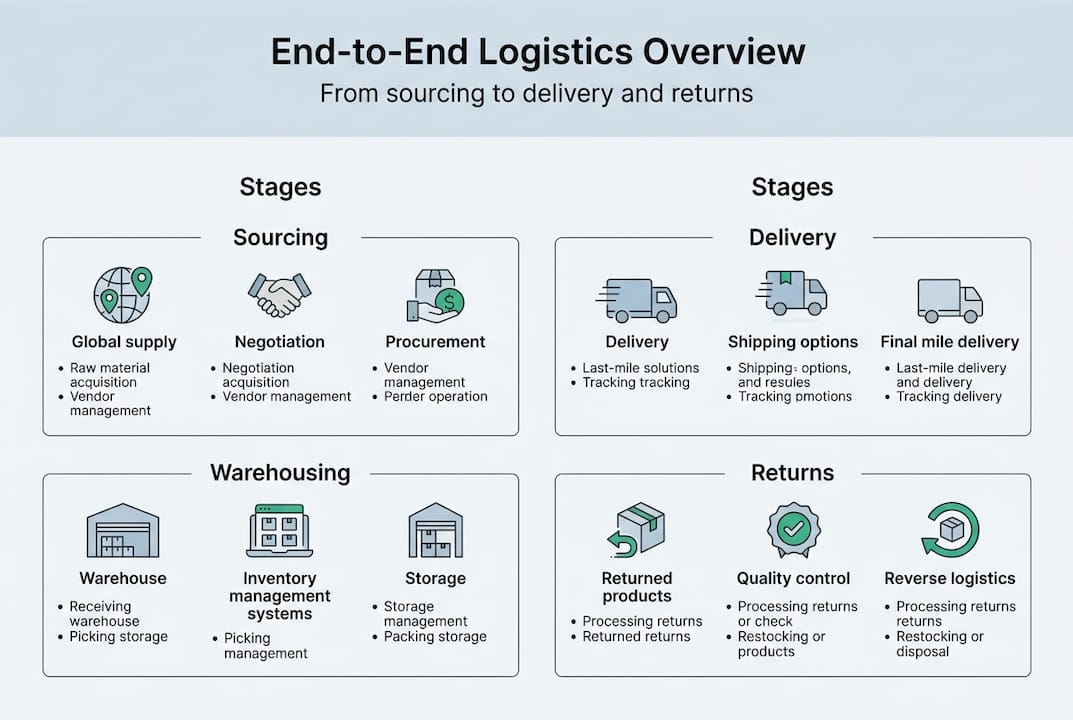
At its core, end-to-end logistics is a comprehensive approach managing the entire supply chain from sourcing raw materials or product receipt, through delivery to the customer, and including returns and reverse logistics. It is not simply about shipping. It is about having visibility, control, and coordination across every stage of your supply chain.
For e-commerce brands, understanding logistics in e-commerce means recognising that a broken link anywhere in the chain creates problems your customers will feel. A delayed shipment, a mispicked item, or a clunky returns process all trace back to gaps in the logistics model.
Here are the key stages that a genuine end-to-end logistics solution covers:
- Procurement and inbound receiving: Products arrive at the warehouse and are checked, logged, and stored accurately.
- Warehousing and inventory management: Stock is organised, tracked in real time, and replenished based on demand signals.
- Order picking and packing: When an order is placed, the correct items are selected and packaged to the required standard.
- Dispatch and delivery: Orders are handed to courier partners and tracked through to the customer’s door.
- Returns and reverse logistics: Returned items are received, assessed, restocked or disposed of, and refunds or exchanges are processed.
To illustrate how end-to-end logistics compares to a fragmented approach, consider the following:
| Factor |
Fragmented logistics |
End-to-end logistics |
| Visibility |
Limited, siloed data |
Real-time, unified view |
| Cost control |
Higher due to inefficiencies |
Optimised across all stages |
| Returns handling |
Often an afterthought |
Fully integrated process |
| Scalability |
Difficult to scale quickly |
Designed to grow with you |
| Customer experience |
Inconsistent |
Reliable and transparent |
When each stage operates in isolation, problems compound. A warehouse team unaware of a courier delay cannot proactively update customers. A returns team disconnected from inventory cannot restock efficiently. End-to-end logistics removes those silos and replaces them with a connected, responsive system.
Core benefits of end-to-end logistics for e-commerce
Having clarified the main stages, we can now examine why end-to-end logistics is transformative for e-commerce businesses.
End-to-end logistics enables unified control over inventory, order processing, delivery, and returns, optimising performance at every touchpoint. That unified control translates into four practical advantages your business will feel immediately.
1. Unified tracking and transparency
When your logistics operates as one connected system, you and your customers always know where an order is. Real-time tracking reduces inbound customer service queries, builds trust, and gives your team the data to resolve issues before they escalate.

2. Lower operational costs
Fragmented logistics means paying for inefficiencies at every handover point. End-to-end solutions consolidate those processes, reducing duplication, minimising errors, and lowering the cost per order over time. Exploring proven fulfilment strategies can help you identify where savings are available in your current setup.
3. Improved customer experience
Fast, accurate delivery and a smooth returns process are no longer optional for e-commerce brands. Customers expect both. A connected logistics model makes it possible to deliver consistently, even during peak trading periods.
4. Scalability for growth
As your order volumes grow, a fragmented logistics approach becomes increasingly difficult to manage. Scalable logistics solutions are built to flex with your business, handling higher volumes without a proportional increase in cost or complexity.
Beyond commercial benefits, there is a growing expectation around sustainability. Brands that adopt sustainable logistics practices are better positioned to meet regulatory requirements and customer expectations around environmental responsibility.
Here is a quick summary of benefits by business priority:
- Efficiency: Fewer manual handovers, faster processing, and reduced error rates.
- Cost: Lower cost per order through consolidated operations.
- Customer retention: Reliable delivery and returns build loyalty.
- Growth readiness: Systems that scale without rebuilding from scratch.
These are not theoretical gains. Businesses that invest in connected logistics infrastructure consistently outperform those operating with disconnected tools and partners.
Key technologies powering end-to-end logistics
To unlock these benefits, technology is essential. Let’s explore the critical tools that make end-to-end logistics possible.
Technology platforms and automation are fundamental to effective end-to-end logistics, enabling real-time tracking across all supply chain stages. Without the right tools, even the best operational processes break down under volume or complexity.
Here are the core technologies your logistics setup should include:
- Warehouse management system (WMS): Controls inventory location, picking routes, and stock accuracy within your fulfilment centre. A strong WMS reduces pick errors and speeds up order processing.
- Transport management system (TMS): Manages carrier selection, shipment scheduling, and delivery tracking. It connects your warehouse output to your courier network.
- E-commerce platform integrations: Seamless logistics integration with platforms like Shopify, WooCommerce, or Magento means orders flow automatically from sale to fulfilment without manual input.
- Automation tools: Barcode scanning, automated sorting, and conveyor systems reduce manual handling and speed up throughput. Automation in logistics is no longer reserved for large enterprises. Scalable automation is accessible for growing brands.
- Data analytics and reporting: Data-driven logistics gives you the insight to forecast demand, identify bottlenecks, and make informed decisions about stock levels and carrier performance.
Choosing the right combination of tools depends on your current order volumes, the complexity of your SKU range, and your growth trajectory. Innovative software solutions can help bridge gaps between existing systems and new logistics platforms.
Pro Tip: Before investing in new technology, audit your current tools for integration capability. A system that cannot connect to your WMS or courier network will create more friction than it solves.
The goal is not to have the most technology. It is to have the right technology, connected and working together, so your team spends less time fixing problems and more time growing the business.
Implementing end-to-end logistics: practical guidance for e-commerce
Understanding the technology is only half the battle. Here is a practical roadmap for implementing end-to-end logistics successfully.
Adopting end-to-end logistics demands careful integration across procurement, warehousing, fulfilment, delivery, and returns management. Rushing the transition without a clear plan is one of the most common and costly mistakes businesses make.
Follow these steps to implement end-to-end logistics effectively:
- Audit your current logistics setup. Map every stage of your supply chain and identify where delays, errors, or visibility gaps occur. Be honest about where your current approach is failing.
- Define your requirements. Determine your order volumes, SKU complexity, delivery speed expectations, and returns rate. These factors will shape the solution you need.
- Choose the right partners. A reliable third-party logistics provider can manage warehousing, picking, packing, and shipping on your behalf, removing the operational burden from your team.
- Integrate your platforms. Ensure your e-commerce platform, WMS, and courier systems are connected. Data should flow automatically between them to eliminate manual entry and reduce errors.
- Plan for returns from day one. Returns management is often bolted on as an afterthought. Build it into your logistics model from the start.
Common mistakes to avoid:
Pro Tip: Start with a phased implementation. Tackle your highest-volume fulfilment stages first, then layer in returns management and advanced analytics once the core system is stable.
Implementation does not need to happen overnight. A measured, staged approach reduces disruption and gives your team time to adapt to new processes and tools.
Why real end-to-end logistics is rare — and what e-commerce leaders get wrong
Here is something most logistics guides will not tell you: very few e-commerce businesses actually achieve true end-to-end logistics. They build something that looks connected on paper but falls apart at the edges.
The most common blind spot is returns. Brands invest heavily in outbound fulfilment and neglect the inbound returns process entirely. That creates a growing backlog of unprocessed stock, unhappy customers, and inaccurate inventory data. It is a slow leak that quietly damages your operation.
The second gap is the assumption that integrating software is straightforward. In practice, connecting a WMS, a TMS, an e-commerce platform, and multiple courier APIs requires ongoing maintenance, not just a one-time setup. Systems change. APIs update. Without someone actively managing those connections, the data breaks down.
Our experience working with growing e-commerce brands shows that the businesses achieving scalable logistics solutions are the ones that treat logistics as a strategic function, not an operational afterthought. They review their supply chain regularly, invest in the right partnerships, and build returns into their customer experience from the start.
True end-to-end logistics is not a destination. It is an ongoing commitment to keeping every stage of your supply chain connected, visible, and responsive.
Streamline your logistics with ParcelPlanet
For those ready to streamline their e-commerce logistics, here is how ParcelPlanet delivers on the promise of end-to-end solutions.
Bridging the gap between fragmented processes and a fully connected supply chain is exactly what we do. At ParcelPlanet, our order fulfilment services cover every stage, from inbound receiving and warehousing to picking, packing, dispatch, and returns management.
If you are still unsure what order fulfilment involves and how it fits into your wider logistics strategy, we can walk you through it. Our team works with brands at every stage of growth, from start-ups managing their first outsourced fulfilment to established retailers scaling across multiple channels and regions. Get in touch today to request a tailored quote and take the first step towards a logistics operation that works as hard as you do.
Frequently asked questions
How does end-to-end logistics differ from traditional logistics?
End-to-end logistics integrates every stage of the supply chain, including returns and reverse logistics, while traditional logistics often focuses mainly on delivery and warehousing. The key difference is unified visibility and control across all stages rather than managing each in isolation.
What technologies are essential for end-to-end e-commerce logistics?
Automation, tracking platforms, warehouse and transport management systems, and data analytics are key to seamless end-to-end logistics. Technology platforms and automation are fundamental to enabling real-time tracking across all supply chain stages.
Can small businesses implement end-to-end logistics?
Yes. With the right partners and integrated technology, small e-commerce businesses can achieve end-to-end logistics for improved efficiency. Careful integration across procurement, warehousing, fulfilment, delivery, and returns management is achievable at any scale when approached in stages.
What are common pitfalls when transitioning to end-to-end logistics?
Neglecting returns management, poor software integration, and unclear supply chain visibility are typical mistakes. Returns and reverse logistics are part of comprehensive supply chain management and must be planned for from the outset, not added later as an afterthought.
Recommended