TL;DR:
- Expanding a UK e-commerce business to Ireland requires establishing a valid Irish entity with operational substance. This move provides access to the EU single market and benefits from Ireland’s low 12.5% corporate tax rate.
Expanding a UK e-commerce business to Ireland means establishing a legally compliant Irish entity with real operational presence, not just a registered address. Done properly, it gives you direct access to the EU single market, Ireland’s 12.5% corporation tax rate, and a growing consumer base that already shops in English. Ireland recorded 323 new foreign direct investments in 2025, a 38% increase from 2024. That figure reflects genuine commercial confidence, not just tax optimism. Budget €20,000–€50,000 for setup covering legal, banking, and substance requirements, and allow 4–8 weeks for incorporation and banking.
What are the legal and corporate setup requirements to expand to Ireland from UK?
The correct corporate form for most UK e-commerce businesses entering Ireland is a Private Company Limited by Shares, registered with the Companies Registration Office (CRO). This structure limits liability, suits investor requirements, and is the standard vehicle used by foreign-owned subsidiaries operating in Ireland.
One critical requirement catches many UK founders off guard. Irish companies must have at least one EEA-resident director, or the company must post a Section 137 non-resident director bond. That bond costs roughly €25,000 and acts as a financial guarantee. Appointing a qualified Irish or EU-resident director is almost always the more practical and cost-effective route.
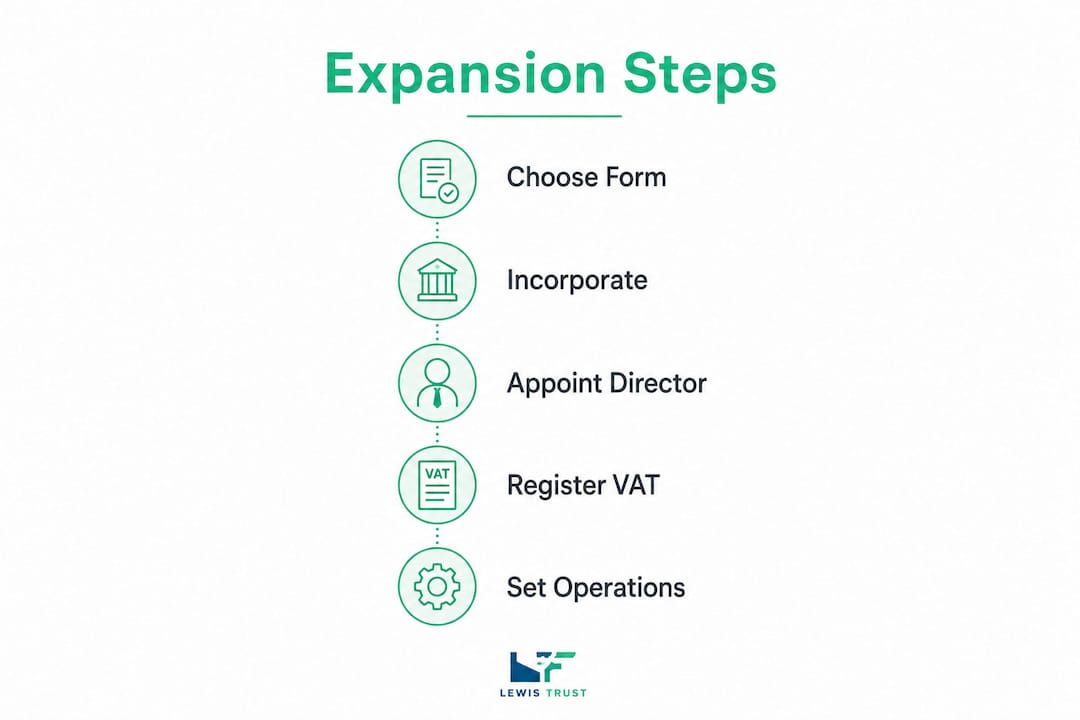
The incorporation process involves filing a Constitution and Form A1 with the CRO, registering beneficial ownership with the Register of Beneficial Ownership (RBO), and then registering separately with Revenue Commissioners for Corporation Tax, VAT, and PAYE. Each registration is distinct and carries its own timeline. VAT registration alone can take two to four weeks once Revenue requests supporting documentation.
No mechanism exists to redomicile a UK company to Ireland. You must incorporate a new Irish entity and migrate assets, contracts, and operations across. That migration requires careful planning to avoid triggering UK tax charges on transferred assets.
Pro Tip: Register for VAT before you begin trading in Ireland. Retroactive VAT registration creates compliance gaps that Revenue Commissioners will scrutinise.
| Step |
Action required |
| Choose corporate form |
Incorporate a Private Company Limited by Shares via the CRO |
| Director requirement |
Appoint one EEA-resident director or post a Section 137 bond |
| Beneficial ownership |
Register all beneficial owners with the RBO within five months of incorporation |
| Tax registrations |
Register for Corporation Tax, VAT, and PAYE with Revenue Commissioners |
| Substance |
Secure a physical office address and at least one local employee or executive |
How should UK businesses structure tax and governance to avoid double taxation?
The most common structure is a UK holding company owning 100% of an Irish subsidiary. This arrangement lets profits accumulate in Ireland at the 12.5% rate while the UK parent retains ownership. The Double Taxation Agreement between the UK and Ireland prevents the same profit being taxed twice, but the structure must be documented correctly, with share capital recorded and transfer pricing policies in place.
Irish corporate tax residency depends entirely on where “central management and control” sits. Real decision-making must occur in Ireland, not just registration. That means holding board meetings in Ireland, with Irish-based directors making substantive decisions, and keeping detailed minutes that demonstrate local governance. A UK CEO dialling into every board meeting from London and overriding Irish directors will undermine the residency claim.
Dividend flows, management fees, and intercompany loans all require documented arm’s-length pricing. Revenue Commissioners apply transfer pricing rules to related-party transactions, and undocumented arrangements attract penalties. Appoint a qualified Irish tax adviser before the first intercompany invoice is raised.
- Hold at least two formal board meetings per year in Ireland with a quorum of Irish-resident directors
- Document all decisions in detailed minutes stored at the Irish registered office
- Set management fees and intercompany loans at arm’s-length rates with written agreements
- File annual Corporation Tax returns with Revenue Commissioners on time to avoid surcharges
- Review transfer pricing documentation annually as the business grows
Pro Tip: Treat your Irish board minutes as legal evidence, not a formality. Revenue Commissioners have challenged tax residency claims where minutes were vague or clearly drafted retrospectively.
What are the employment and operational requirements for UK businesses in Ireland?
Irish employment law applies immediately when an employee or executive begins working in Ireland, regardless of what their UK contract says. Home-country contracts do not override Irish statutory protections covering working hours, annual leave, and dismissal rights. Every person working in Ireland needs an Ireland-compliant employment contract from day one.
Non-EEA nationals relocating to Ireland to work for your Irish subsidiary typically require either a Critical Skills Employment Permit or an Intra-Company Transfer Employment Permit. Critical Skills permits apply to roles with salaries above €32,000 in shortage occupations. Intra-Company Transfer permits suit senior managers or specialists moving from a UK parent to the Irish subsidiary. Both require Revenue-registered payroll before the permit application proceeds.
Local executives matter for more than compliance. The “mind and management” test for Irish tax residency requires that key decisions are made by people physically present in Ireland. Placing a capable, senior person in Dublin, not just a nominal director, is the single most effective step you can take to protect your tax position and build genuine commercial presence.
- Draft Ireland-specific employment contracts covering statutory leave, notice periods, and dismissal procedures
- Register your Irish payroll with Revenue Commissioners before the first salary payment
- Apply for employment permits at least eight weeks before the intended start date
- Provide a written statement of core employment terms within five days of employment starting
- Engage a local HR adviser familiar with the Workplace Relations Commission’s enforcement approach
Pro Tip: Do not assume Irish employment law mirrors UK law. Redundancy calculations, probationary period rules, and unfair dismissal thresholds differ significantly. Get local HR advice before you hire.
How can UK e-commerce businesses manage logistics and fulfilment in Ireland?
Using an Irish fulfilment centre is the most direct way to serve EU customers efficiently after Brexit. Goods stored in Ireland are already inside the EU customs territory. That means no customs declarations, no import VAT complications, and no delivery delays for customers in France, Germany, or the Netherlands. The advantages of an EU fulfilment centre post-Brexit are substantial for any UK brand selling across Europe.

Cross-border shipments from the UK to Ireland do require customs documentation. Every commercial shipment needs a commodity code, a customs declaration, and correct VAT treatment at the point of import. Getting customs clearance right from the outset prevents goods being held at Dublin Port and protects your delivery promise to customers. Errors in commodity codes or undervalued consignments attract Revenue scrutiny and potential penalties.
Parcelplanet operates warehousing and logistics infrastructure in Ireland, giving UK e-commerce brands a ready-made fulfilment base without the capital cost of leasing their own warehouse. Outsourcing pick, pack, and dispatch to a specialist 3PL lets your Irish entity focus on sales and customer relationships rather than operational complexity.
Banking is a separate logistics challenge that many UK businesses underestimate. Opening an Irish bank account requires significant local substance documentation and traditional banks often take three months or more to complete Know Your Customer checks. Start the banking process on the same day you file incorporation documents.
Pro Tip: Consider a fintech business account such as Revolut Business or Stripe Treasury as a bridging solution while your traditional Irish bank account application is processed. This keeps supplier payments moving.
What are the most common mistakes UK e-commerce businesses make when expanding to Ireland?
The most damaging mistake is treating Ireland as a tax play rather than a genuine market entry. Businesses that approach Ireland as a distinct market with its own commercial dynamics consistently outperform those that treat it as a UK annex. Irish consumers have specific preferences, and Irish B2B buyers expect local account management.
Registering a company is not enough. Revenue Commissioners require local directors, a physical office, and real staff before granting the tax benefits that make Ireland attractive. A ‘brass plate’ entity with no substance risks losing its preferential tax rate and facing back-taxes with interest.
Other frequent errors include:
- Delaying the appointment of a local director, which blocks CRO registration and banking
- Ignoring Irish employment law and issuing UK contracts to Irish-based staff
- Underestimating setup costs, with many businesses budgeting for legal fees alone and missing banking, office, and payroll costs
- Failing to register for VAT before trading begins, creating retrospective compliance gaps
- Not securing specialist Irish tax, legal, and logistics advice before incorporation
Irish State funding supports, including loan guarantee schemes unavailable in the UK, are accessible to qualifying Irish subsidiaries. Most UK businesses miss these because they engage only a UK accountant rather than a local Irish adviser who knows the Enterprise Ireland and Microfinance Ireland programmes.
Pro Tip: Engage an Irish solicitor, an Irish tax adviser, and a logistics partner before you file your first CRO document. The cost of early specialist advice is a fraction of the cost of fixing structural mistakes after trading begins.
Key takeaways
Successful business expansion to Ireland requires legal substance, local governance, and integrated logistics planning from the outset, not as an afterthought.
| Point |
Details |
| Incorporate correctly |
Register a Private Company Limited by Shares with the CRO and appoint an EEA-resident director. |
| Build real substance |
Appoint local executives, secure office space, and hold board meetings in Ireland to satisfy Revenue. |
| Plan banking early |
Start the Irish bank account application on incorporation day; expect three or more months for approval. |
| Comply with Irish employment law |
Issue Ireland-specific contracts and register payroll with Revenue before the first hire starts work. |
| Use Irish fulfilment |
Store goods in Ireland to serve EU customers without customs delays and to support your substance case. |
Ireland expansion: what I’ve learned from watching UK brands get it right and wrong
The businesses I see succeed in Ireland share one trait: they commit. They hire a real person in Dublin, they hold actual board meetings, and they treat the Irish operation as a standalone business unit with its own P&L. The ones that struggle are those that file the paperwork, appoint a nominee director, and then run everything from a UK head office. Revenue Commissioners are not naive. They have seen every variation of the brass-plate structure, and they challenge it.
What surprises most UK e-commerce founders is how much Ireland’s Common Law legal system and English-language environment actually accelerate setup. Contracts, court processes, and regulatory correspondence all work in English. That removes a layer of friction that UK businesses face in every other EU member state. Ireland is genuinely the most accessible EU market for a UK brand, but accessible does not mean automatic.
The logistics piece is where I see the most avoidable pain. Founders spend months on corporate structure and then try to sort warehousing in the final week before launch. Getting your EU fulfilment strategy sorted early means you can start shipping to Irish and EU customers from day one, which builds revenue that funds the rest of your setup costs.
My honest advice: treat the €20,000–€50,000 setup budget as a minimum, not a target. The businesses that underspend on setup almost always overspend on fixing problems later.
— ChiefPlaneteer
Parcelplanet: your Irish fulfilment partner from day one
Getting your logistics right is as critical as getting your legal structure right. Parcelplanet provides order fulfilment services from Ireland, giving UK e-commerce brands a fully operational warehousing and distribution base inside the EU from the moment they begin trading.

Parcelplanet handles pick, pack, dispatch, and real-time tracking across multiple sales channels, so your Irish entity can focus on growing revenue rather than managing warehouse operations. With integrations across major e-commerce platforms and established courier partnerships, Parcelplanet removes the operational complexity of cross-border selling. Whether you are shipping to Irish consumers or fulfilling orders across the EU, Parcelplanet gives you the infrastructure to do it reliably. Get in touch to discuss a fulfilment solution built around your expansion plans.
FAQ
What corporate structure should UK e-commerce businesses use in Ireland?
A Private Company Limited by Shares, registered with the Companies Registration Office, is the standard structure. It limits liability and is the vehicle used by most foreign-owned Irish subsidiaries.
How long does it take to set up an Irish company from the UK?
The full incorporation and banking process typically takes 4–8 weeks. Banking can take three months or more, so start that process on the same day as incorporation.
Do UK employment contracts apply to staff working in Ireland?
No. Irish employment law overrides home-country contracts immediately when employees begin work in Ireland. Ireland-specific contracts are required from day one.
Why does Ireland require a local director?
The CRO requires at least one EEA-resident director to comply with the Companies Act 2014. Without one, the company must post a Section 137 non-resident director bond of approximately €25,000.
How does an Irish fulfilment centre help UK brands sell in the EU?
Goods stored in Ireland sit inside the EU customs territory. This removes customs declarations and import VAT complications for deliveries to EU customers, reducing cost and delivery time compared with shipping from the UK.
Recommended


