TL;DR:
- Fashion fulfilment involves complex logistics including high SKUs, seasonality, and high return rates.
- Partnering with a specialized 3PL can significantly reduce costs and enable scalable growth.
- A tailored fashion fulfilment solution improves customer experience and boosts brand loyalty.
The global 3PL market is projected to reach $1.42 trillion in 2026, and fashion brands are leading the charge in outsourcing logistics to capture those gains. For small and medium-sized online retailers, the pressure to ship faster, manage returns efficiently, and deliver a branded experience is relentless. Yet many brands are still trying to handle fulfilment in-house, watching margins shrink and growth stall. This guide breaks down everything you need to know about fashion fulfilment, from the core components and real costs to how the right third-party logistics partner can help you scale confidently and profitably.
Table of Contents
Key Takeaways
| Point |
Details |
| Fashion fulfilment definition |
It is the specialised process for managing, packing, and delivering fashion e-commerce orders. |
| Cost efficiency matters |
Smart fulfilment strategies can lower per-order costs and enable rapid business scaling. |
| Technology and partners are key |
Leverage expert 3PLs and automation to boost efficiency, customer experience, and growth. |
| Returns require special handling |
The fashion sector’s high return rates demand flexible, customer-centric solutions. |
| Scalable logistics fuels brand growth |
Data-driven fulfilment helps online retailers expand quickly and sustainably. |
What is fashion fulfilment and why it matters
Fashion fulfilment is the end-to-end logistics process of receiving, storing, picking, packing, shipping, and managing returns for apparel and accessory brands selling online. It sounds straightforward, but fashion is one of the most demanding sectors in e-commerce logistics. It is not simply a matter of moving boxes.
What separates fashion fulfilment from general e-commerce fulfilment is the sheer complexity involved. Consider these sector-specific challenges:
- Seasonality: Collections change every few months, meaning inventory levels spike and drop dramatically throughout the year.
- High return rates: Fashion return rates online can exceed 30%, requiring a robust and fast reverse logistics process.
- SKU complexity: A single garment in five sizes and four colours creates 20 individual SKUs. Multiply that across a catalogue and the numbers grow quickly.
- Customer experience expectations: Shoppers expect branded packaging, fast delivery, and seamless returns. A poor unboxing experience can cost you repeat business.
- Multi-channel selling: Most fashion brands sell across their own website, marketplaces, and social commerce simultaneously, each with different fulfilment requirements.
Getting fulfilment right in fashion is not just an operational concern. It directly affects revenue and customer loyalty. A delayed shipment or a clumsy returns process will push a customer to a competitor. On the other hand, a smooth, well-branded delivery builds trust and encourages repeat purchases.
“Fashion fulfilment leverages advanced 3PL strategies to boost scalability and cost-efficiency, making it a strategic priority rather than a back-office function.”
You can explore a detailed fashion fulfilment overview to understand how leading brands approach these challenges. The right infrastructure, whether built in-house or through a specialist partner, determines whether your brand can grow or gets held back by logistics bottlenecks. Investing in purpose-built fashion fulfilment solutions is increasingly the differentiator between brands that scale and those that plateau.
Key components of an effective fashion fulfilment strategy
Knowing why fashion fulfilment matters is one thing. Knowing what a high-performing strategy actually looks like is another. Here are the five core components every fashion brand needs to get right:
- Inbound logistics and inventory management: When stock arrives at a fulfilment centre, it must be accurately received, labelled, and stored. For fashion, this means managing multiple SKUs, tracking seasonal stock, and forecasting demand to avoid both overstock and stockouts.
- Order processing, picking, and branded packing: Speed and accuracy in picking are non-negotiable. Branded packaging, tissue paper, and personalised inserts elevate the customer experience and reinforce your brand identity at the moment of delivery.
- Multi-channel integration and automation: Your fulfilment system should connect seamlessly with your Shopify, WooCommerce, or marketplace accounts. Automated order routing reduces manual errors and speeds up processing times significantly.
- Returns handling: A slick returns process is a competitive advantage in fashion. Customers are more likely to buy again if they know returning an item is easy. Your 3PL should inspect, restock, or quarantine returned items quickly.
- Data-driven reporting: Real-time dashboards showing order status, stock levels, and return rates allow you to make smarter buying and operational decisions. Continuous improvement depends on having reliable data.
Optimising these components together has a measurable impact. Optimal fulfilment processes can reduce network costs by 4% and increase throughput by 65%. That is a significant operational gain for any growing brand.
Building a reliable shipping workflow for e-commerce is central to making these components work together. And if you are planning for long-term growth, understanding the full scope of optimising logistics for growth will help you build a strategy that scales with your brand rather than against it.
Pro Tip: When evaluating a fulfilment partner, ask specifically how they handle peak periods like Black Friday and seasonal launches. A partner who cannot scale up quickly during surges will create delays precisely when your brand reputation is most at risk.
Fashion fulfilment costs: What to expect and how to optimise
Cost is often the first question brands ask when considering outsourced fulfilment. Understanding the full cost structure helps you make an informed decision and avoid surprises.
Here is a breakdown of the major cost categories:
| Cost category |
Typical range |
Notes |
| Receiving and inbound |
Per pallet or per unit |
Varies by volume and complexity |
| Storage |
Per pallet or cubic metre per week |
Seasonal stock increases this |
| Pick and pack |
Per order |
Branded packaging adds cost |
| Shipping |
Per shipment by weight/zone |
Negotiated rates reduce this |
| Returns processing |
£2 to £12 per item |
High in fashion due to return rates |
Average fulfilment costs run between $14 and $18 per order, with returns costing between $2.50 and $15 per item. As your order volume grows, costs as a percentage of revenue typically fall to around 14%.
In-house vs. outsourced fulfilment: A quick comparison
| Factor |
In-house |
3PL partner |
| Upfront investment |
High (warehouse, staff, tech) |
Low (pay-as-you-go model) |
| Flexibility |
Limited by fixed capacity |
Scales up and down with demand |
| Shipping rates |
Standard carrier rates |
Negotiated bulk rates |
| Technology |
Requires separate investment |
Included in service |
| Labour costs |
Fixed overhead |
Variable, reduces by up to 40% |
The case for outsourcing becomes clearer at scale. Brands working with 3PLs report up to 30% lower shipping costs through negotiated carrier rates and up to 40% reductions in labour costs. Capacity can grow by as much as 400% without requiring you to sign a new warehouse lease.
Pro Tip: Do not evaluate fulfilment costs in isolation. Factor in the cost of your team’s time, warehouse space, and technology when comparing in-house fulfilment to a 3PL. The true cost of doing it yourself is almost always higher than it appears on a spreadsheet.
For practical guidance on reducing fulfilment costs without sacrificing service quality, there are proven strategies that fashion brands are using right now to protect their margins.
How fashion brands scale with third-party fulfilment partners
The numbers around 3PL-driven growth are striking. Brands leveraging 3PLs have achieved 10x revenue scaling alongside significant reductions in per-order costs. That kind of growth is not accidental. It is the result of aligning with a partner who has the network, technology, and expertise to support rapid expansion.
Here is what a strong 3PL partnership enables for fashion brands specifically:
- Surge capacity: During Black Friday, seasonal drops, or viral moments, your 3PL absorbs the volume spike without you needing to hire temporary staff or rent extra space.
- Faster shipping times: Access to strategically located fulfilment centres means shorter distances to customers, which translates to faster delivery and lower shipping costs.
- International expansion: A 3PL with cross-border capabilities allows you to enter new markets without setting up local warehousing infrastructure.
- Technology integration: Real-time inventory visibility, automated order routing, and tracking updates keep your customers informed and your team in control.
- Consistent accuracy: Professional pick and pack teams with quality control processes reduce mis-picks and damaged goods, protecting your brand reputation.
Here is a snapshot of the KPIs that fashion brands typically improve after partnering with a specialist 3PL:
| KPI |
Before 3PL |
After 3PL partnership |
| Order accuracy rate |
92 to 95% |
99%+ |
| Shipping cost per order |
High, standard rates |
Reduced by up to 30% |
| Returns processing time |
5 to 10 days |
1 to 3 days |
| Capacity during peak |
Fixed ceiling |
Up to 400% increase |
| Revenue scaling potential |
Limited by operations |
Up to 10x growth |
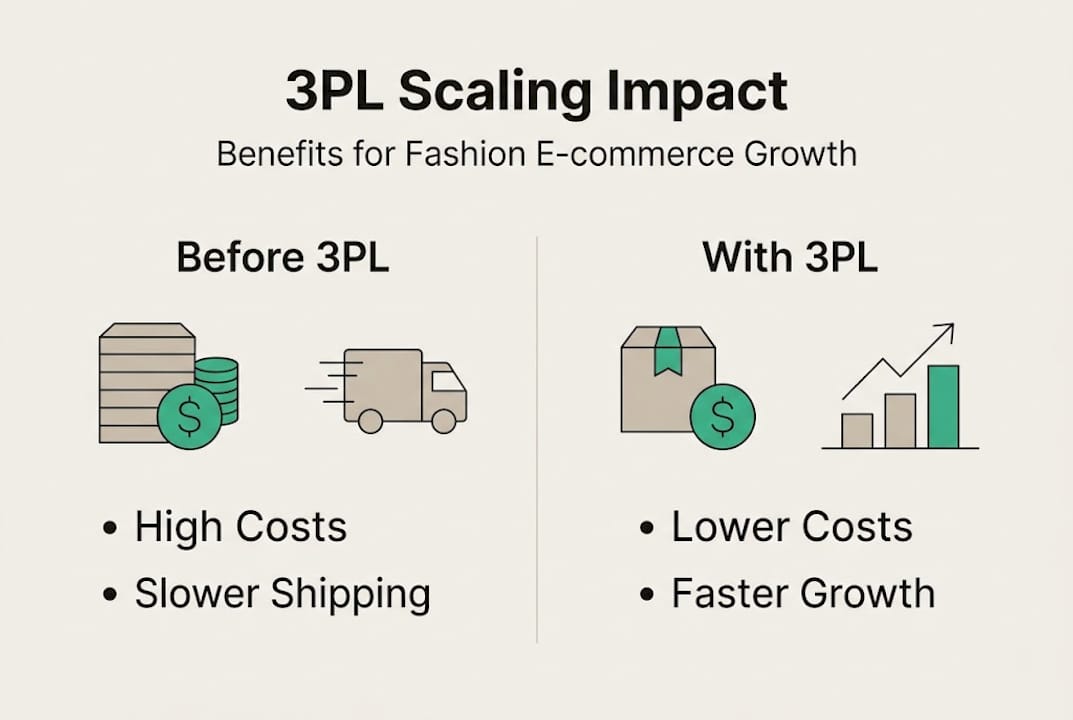
Understanding logistics scalability is essential before you commit to a partner. The brands that grow fastest are those who treat fulfilment as a growth lever, not just an operational cost. Exploring scalable logistics solutions purpose-built for e-commerce gives you a clearer picture of what is possible.
Here is something most brands discover too late: a generic 3PL is not built for fashion. General logistics providers are optimised for uniform products with predictable demand. Fashion is the opposite. High return volumes, seasonal swings, SKU complexity, and the need for branded presentation require a fundamentally different operational approach.
We have seen brands switch from a generic provider to a fashion-focused partner and immediately notice the difference. Returns are processed faster. Seasonal stock transitions happen without disruption. Branded packaging is handled consistently. These are not small details. They directly affect customer satisfaction and repeat purchase rates.
The right partner also integrates deeply with your sales channels and buying cycles. They understand that your peak in November is not the same as a general retailer’s peak, and they plan accordingly. Choosing tailored fulfilment strategies built around the realities of fashion e-commerce is not a luxury. It is the foundation of sustainable, scalable growth.
Connect with a fashion fulfilment expert for scalable growth
If you are ready to move beyond the limitations of in-house fulfilment and build a logistics operation that grows with your brand, the next step is straightforward. ParcelPlanet’s fashion fulfilment services are designed specifically for e-commerce brands that need speed, accuracy, and flexibility across every sales channel.
Whether you are shipping 500 orders a month or 50,000, our team is ready to build a solution around your brand’s specific needs. From branded packing to seamless returns and real-time tracking, we handle the logistics so you can focus on growth. If you are new to outsourcing, understanding order fulfilment is a great place to start before requesting your tailored quote.
Frequently asked questions
What is fashion fulfilment in e-commerce?
Fashion fulfilment refers to the end-to-end logistical process of receiving, storing, picking, packing, shipping, and handling returns for fashion and apparel brands selling online. It covers specialised handling for high-SKU, seasonal, and high-return product categories that generic logistics providers are not optimised to manage.
How much should I budget for fashion fulfilment costs?
Expect to pay between $14 and $18 per order for standard fulfilment, plus $2.50 to $15 per returned item. Costs as a percentage of revenue typically fall to around 14% as your order volume increases.
Can outsourced fulfilment really help a fashion brand scale?
Yes. Top fashion brands have used 3PL partnerships to cut shipping costs by 30%, reduce labour costs by 40%, boost capacity by 400%, and achieve up to 10x revenue scaling without proportional increases in operational overhead.
What advantages does a fashion-specialised fulfilment partner offer?
A fashion-focused 3PL understands seasonal demand cycles, high return volumes, and SKU complexity, and supports branded unboxing experiences. These sector-unique capabilities go well beyond what a generic logistics provider typically offers apparel sellers.
Recommended