Speed used to be the only metric that mattered in e-commerce fulfilment. Get the parcel there fast, and the customer is happy. But consumer preferences have shifted significantly, moving away from pure speed towards reliability, choice, and consistency across every channel. Brands that still operate on a speed-only model are leaving money on the table and customers frustrated. This guide explains what flexible fulfilment actually means, how its core mechanics work, which models suit different business types, and how you can implement it to drive measurable results.
Table of Contents
Key Takeaways
| Point |
Details |
| Fits changing demand |
Flexible fulfilment adapts to channel shifts, surges, and customer preferences for better reliability. |
| Boosts cost-efficiency |
It can reduce fulfilment costs by up to 31% and deliver higher customer satisfaction. |
| Supports global reach |
Flexible fulfilment simplifies cross-border orders with built-in compliance and local partnerships. |
| Reduces risk |
Using multiple providers and modular systems prevents single-point failures and bottlenecks. |
| Scalable for growth |
Flexible fulfilment scales seamlessly with your brand, handling both small rollouts and huge peaks. |
Flexible fulfilment explained: The essentials
Flexible fulfilment is the ability to align your fulfilment processes rapidly in response to shifting demand, new sales channels, and supply chain disruptions. It is not a single technology or a single warehouse. It is a framework built on several interconnected components working together.
The core mechanics include unified inventory visibility across all locations, distributed order management (DOM), real-time available-to-promise (ATP) checks, and rule-based routing. DOM acts as the decision engine, determining which node fulfils each order based on proximity, stock levels, and cost. ATP checks confirm stock availability in real time before a promise is made to the customer. Together, these components allow order management systems to route orders intelligently rather than defaulting to a single warehouse.
The business case is strong. Brands that lead on flexible fulfilment report 20 to 31% lower fulfilment costs and a 24% higher customer satisfaction score compared to those using rigid, single-node models. These are not marginal gains. They represent a structural advantage that compounds over time.
Here is a summary of the key mechanics and their benefits:
- Unified inventory visibility: Eliminates stock blind spots across warehouses, stores, and 3PL partners
- Distributed order management: Routes each order to the most efficient fulfilment node
- Real-time ATP checks: Prevents overselling and broken delivery promises
- Rule-based routing: Balances cost, speed, and capacity automatically
- Shared SKU pools: Reduces safety stock requirements and improves fill rates
Building a solid shipping strategy workflow around these mechanics is the first step towards meaningful cost reduction. If you are already looking at ways to reduce fulfilment costs, flexible fulfilment is the structural answer.
With these essentials established, let us break down the main flexible fulfilment models powering leading brands.
Types of flexible fulfilment models
There is no single model that suits every brand. The right approach depends on your order volume, product type, customer base, and growth ambitions. Here is a direct comparison of the most widely used models.
| Model |
Description |
Strengths |
Key consideration |
| 3PL outsourcing |
Outsource warehousing, picking, packing, and shipping to a specialist provider |
Scalable, cost-efficient, no capital outlay |
Partner selection is critical |
| Ship-from-store |
Retail stores act as mini fulfilment hubs |
Reduces last-mile distance, uses existing stock |
Requires store staff training |
| BOPIS |
Buy online, pick up in store |
Zero delivery cost, drives footfall |
Needs real-time inventory sync |
| Drop shipping |
Supplier ships directly to customer |
No stock holding, low risk |
Less control over quality and speed |
| Micro-fulfilment centres (MFCs) |
Small, automated hubs close to urban demand |
Fast last-mile, lower delivery cost |
Higher setup investment |
| Subscription fulfilment |
Recurring order batching and dispatch |
Predictable volumes, efficient planning |
Requires robust scheduling systems |
These fulfilment types each carry distinct advantages and trade-offs. 3PL outsourcing suits brands that want to scale without building infrastructure. Ship-from-store and BOPIS work well for omnichannel retailers with physical locations. MFCs are increasingly popular for urban delivery speed.

Pro Tip: Do not feel locked into one model. Many high-growth brands combine 3PL outsourcing for standard orders with ship-from-store for same-day urban demand. This hybrid approach, covered in detail in our guide to fulfilment partners, gives you resilience without sacrificing efficiency. Our article on using third-party logistics explains how to structure these partnerships effectively, and our overview of scalable logistics strategies covers the broader framework. If you are weighing provider types, our 3PL vs 4PL comparison is a useful reference.
Having mapped available models, it is vital to see how flexible fulfilment tackles real-world volatility and complexity.
Meeting volatility: Handling surges, returns, and cross-border shipping
Flexible fulfilment earns its value most clearly when things get difficult. Peak trading periods, unexpected demand spikes, high return volumes, and international shipping complexity are where rigid models break down.
“Brands that build overflow triggers and modular workflows into their fulfilment operations consistently outperform those relying on fixed-capacity, single-node models during periods of volatility.” — Rebellion Research, Fulfilment Flexibility Analysis
Peak surges require overflow triggers, where additional capacity is activated automatically when a primary node reaches a defined threshold. Modular workflows allow you to switch fulfilment paths without rebuilding your entire operation. Our holiday fulfilment tips cover this in practical detail for seasonal planning.
Returns are a particular pressure point. A flexible returns process handles reversals across any channel, whether the original order was placed online, in-store, or via a marketplace. Cross-channel returns visibility is essential for maintaining accurate inventory and customer trust.
For international shipping, cross-border fulfilment requires customs compliance, VAT registration in relevant markets, and integration with localised carriers. The Brexit fulfilment effects on UK-EU trade are a clear example of how regulatory change can disrupt unprepared operations overnight.
Here is a stepwise approach to managing these challenges:
- Map your peak triggers: Define the order volume thresholds that activate overflow capacity at each fulfilment node
- Build modular return workflows: Create channel-agnostic return paths that feed back into unified inventory
- Audit your international compliance: Confirm VAT registration, customs documentation, and carrier agreements for each target market
- Test cross-border routing: Run pilot shipments to validate carrier performance and landed cost accuracy before scaling
- Review after every peak: Use post-peak data to refine triggers and workflows for the next cycle
Pro Tip: Maintain shared SKU pools across nodes and keep your workflows modular. When a single node is overwhelmed, modular design means you reroute without manual intervention, protecting your delivery promise and your customer relationship.
Understanding these exceptions, we now explore how flexible fulfilment delivers proven value through cost reduction and enhanced customer satisfaction.
Flexible fulfilment in action: Results, advantages, and challenges
The performance data behind flexible fulfilment is compelling. Micro-hubs cut delivery costs by 28% and reduced average delivery time from 5.4 days to 2.1 days in documented case studies. Flexport reported 100% network growth alongside a 15% increase in pick rates after adopting flexible fulfilment infrastructure.
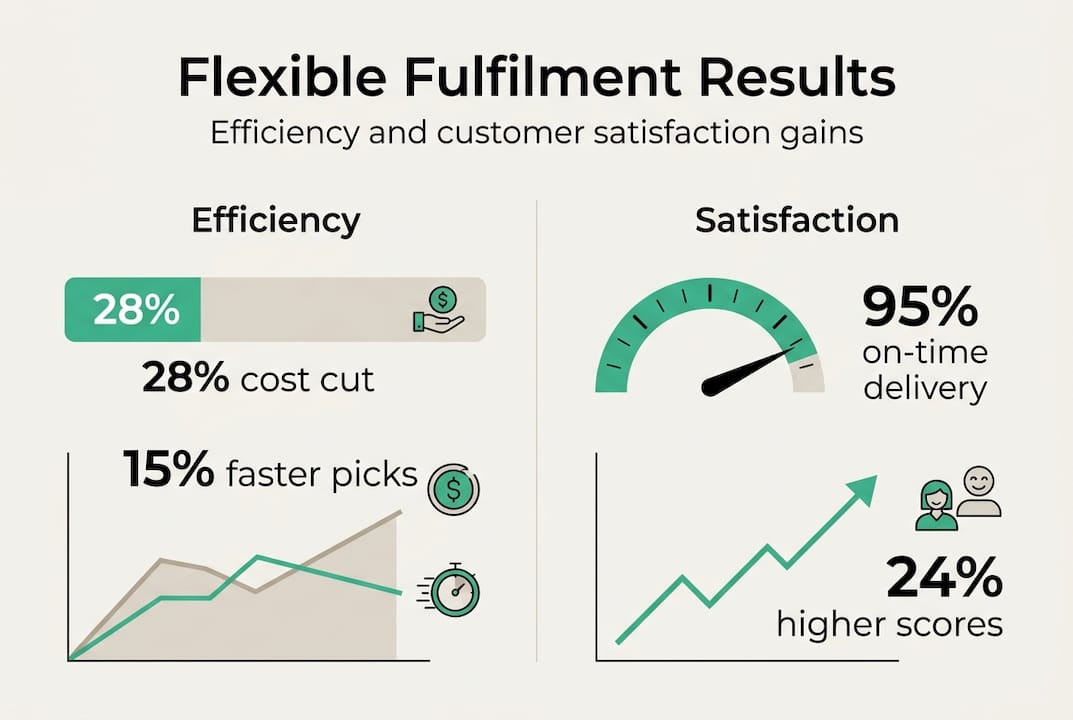
Industry benchmarks show 95% on-time delivery, 15% higher pick rates, and a 24% improvement in customer satisfaction scores for brands operating flexible models versus those on fixed infrastructure. These figures are consistent across sectors and order volumes.
Here is a summary of key performance outcomes:
| Metric |
Flexible fulfilment |
Rigid model |
| Fulfilment cost reduction |
Up to 31% |
Baseline |
| On-time delivery rate |
95%+ |
Variable |
| Customer satisfaction (CSAT) |
24% higher |
Baseline |
| Average delivery time (MFC model) |
2.1 days |
5.4 days |
| Pick rate improvement |
15% higher |
Baseline |
The advantages are clear. Flexible fulfilment supports brand growth through logistics by reducing operational costs, accelerating delivery, and improving the customer experience. It also scales with your business rather than constraining it.
That said, there are genuine challenges to consider:
- Single-provider risk: Over-reliance on one 3PL or carrier creates vulnerability. Diversify your partner base.
- Over-automation: Automated routing without human oversight can amplify errors at scale. Keep human-in-the-loop checks at critical decision points.
- Technology integration complexity: Connecting DOM, WMS, and carrier systems requires upfront investment and ongoing maintenance.
- Not suited to every brand: Very low-volume or highly bespoke brands may find the overhead of flexible infrastructure disproportionate to the benefit.
For brands actively working on cost reduction strategies, the supply chain frameworks underpinning flexible fulfilment provide a structured path to measurable improvement.
With a grasp of real-world impact, let us focus on how to implement flexible fulfilment for practical business advantage.
Steps to implement flexible fulfilment
Implementing flexible fulfilment does not require a complete operational overhaul from day one. A phased approach reduces risk and allows you to validate each component before scaling.
- Audit your current fulfilment operation: Map every node, carrier, and inventory location. Identify where delays, costs, and errors concentrate.
- Define your fulfilment requirements: Clarify order volumes, SKU complexity, channel mix, and geographic reach. This shapes your technology and partner choices.
- Select and integrate your technology stack: Prioritise DOM and WMS integration alongside real-time ATP capability. These are the non-negotiable foundations.
- Establish shared SKU pools: Consolidate inventory visibility across all nodes to enable intelligent routing and reduce safety stock.
- Pilot with a defined scope: Choose one channel or region to test your flexible model. Measure performance against your baseline before expanding.
- Build hybrid partner options: Identify at least two fulfilment partners for redundancy. Our guide to selecting a fulfilment partner outlines the key criteria.
- Scale and optimise: Use location-level data to refine routing rules, adjust overflow triggers, and improve cost efficiency as you grow.
Pro Tip: Measure performance at the location level, not just in aggregate. A strong overall on-time rate can mask a single underperforming node that is quietly damaging customer satisfaction in a specific region. Location-level accuracy is where true scalability is built.
To conclude, here is what flexible fulfilment means for brands in 2026 and why it should be part of every future-ready omnichannel strategy.
Conclusion: Why flexible fulfilment is a future-proof strategy
Flexible fulfilment is not a trend. It is the operational standard that separates growing brands from those that plateau. Leaders with predictive, flexible models achieve 20% lower costs and consistently outpace competitors still relying on fixed infrastructure.
Looking ahead, three forces will continue to shape fulfilment strategy. First, hybridisation will increase as brands combine 3PL, ship-from-store, and MFC models to serve diverse customer segments. Second, AI-assisted routing will improve decision-making speed, but human oversight will remain essential to catch edge cases and maintain quality. Third, customer centricity will drive further investment in returns experience, delivery optionality, and real-time communication.
The question for your business is not whether to adopt flexible fulfilment. It is how quickly you can build the infrastructure to support it. Assess your current fulfilment adaptability now, before the next peak season or market shift forces the decision.
Flexible fulfilment solutions for your brand
If this guide has clarified what flexible fulfilment requires, the next step is finding the right partner to make it a reality for your brand. Flexible fulfilment works best when your technology, your processes, and your logistics partner are all aligned.

At ParcelPlanet, we provide fulfilment solutions designed specifically for e-commerce and omnichannel brands that need to scale without the overhead of managing their own warehouse infrastructure. From 3PL services for growing businesses to seamless platform and carrier integrations, we support your fulfilment operation at every stage of growth. Get in touch with our team today to discuss a tailored solution for your business.
Frequently asked questions
What does flexible fulfilment really mean?
Flexible fulfilment enables fast, reliable delivery across multiple sales channels by adapting processes and capacity to changing demand. It relies on unified inventory and DOM to route orders intelligently across all available nodes.
How does flexible fulfilment reduce costs?
By optimising inventory placement and routing each order to the most cost-efficient node, flexible fulfilment leaders achieve up to 31% lower costs compared to fixed-model operations.
Can flexible fulfilment handle peak order spikes and returns?
Yes. Overflow triggers and modular workflows allow operations to scale capacity automatically during surges, while cross-channel return paths keep inventory accurate and customers satisfied.
Is flexible fulfilment suitable for international shipping?
Absolutely. Flexible fulfilment supports cross-border VAT and customs compliance alongside local carrier integration, making it well suited to brands expanding into new international markets.
What are the risks of flexible fulfilment?
The main risks are single-provider dependency and over-automation without human-in-the-loop oversight. Both are manageable by diversifying your partner base and maintaining manual review at critical decision points.
Recommended


