TL;DR:
- Fulfilment centres focus on rapid, item-level order processing for consumers.
- Warehouses prioritize bulk storage and long-term inventory management.
- Hybrid models optimize fast-moving SKUs with fulfilment centres and slow movers with warehouses.
Mixing up fulfilment centres and warehouses is one of the most common and costly mistakes growing e-commerce brands make. At first glance, both facilities store products, but their purposes, processes, and impact on your customers are fundamentally different. Pick the wrong model and you risk delayed deliveries, rising operational costs, and frustrated customers who simply won’t return. This guide breaks down the real differences, shows you how each facility type affects your customer experience, and gives you a practical framework to make the right call for your business at every stage of growth.
Table of Contents
Key Takeaways
| Point |
Details |
| Understand core functions |
Fulfilment centres focus on fast order processing and customer experience, while warehouses emphasise bulk storage and distribution. |
| Consider customer impact |
Your choice or mix of facilities directly affects shipping times, accuracy, and satisfaction. |
| Hybrid models for growth |
Blending fulfilment centres and warehouses allows brands to optimise for both speed and storage depending on product demand. |
| Use a practical framework |
Assess your product volumes, order channels, and operational goals before deciding on logistics facilities. |
Defining fulfilment centres and warehouses: What’s the real difference?
Now that you know why this distinction matters, let’s break down exactly what each facility type does and why that impacts your customers and bottom line.
At its core, a fulfilment centre is a high-velocity operation built around individual consumer orders. When a customer places an order on your website, the fulfilment centre receives it, picks the product from shelving, packs it securely, attaches a courier label, and ships it directly to the customer’s door. Most fulfilment centres also manage returns, processing them back into usable stock efficiently. The entire workflow is designed around speed and accuracy, measured in hours rather than days.
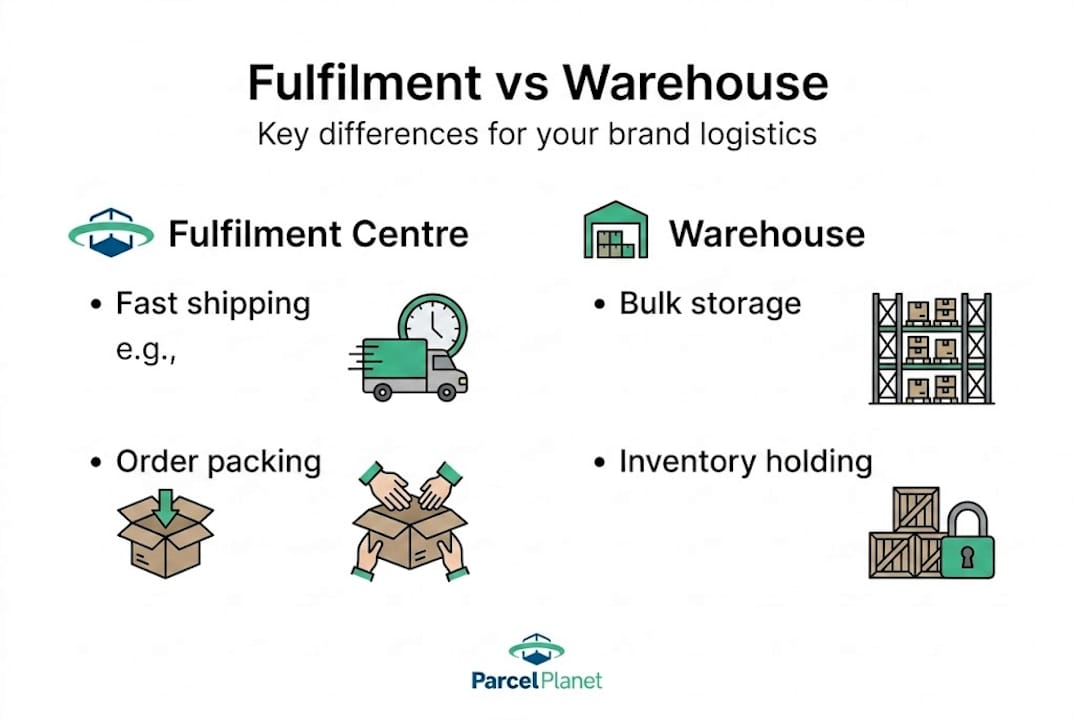
A warehouse, by contrast, is built for volume and duration. Its primary job is to store large quantities of stock safely over extended periods and move goods in bulk, typically on pallets or cases, to retailers, wholesalers, or distribution hubs. Warehouses are optimised for inbound logistics and space efficiency, not rapid individual order dispatch.
Understanding how fulfilment centres work is essential before committing to any facility strategy, because the operational implications run deeper than most brands initially realise. As one industry analysis makes clear, a fulfilment centre is optimised for high-velocity direct-to-consumer order processing, covering receiving, picking, packing, shipping, and returns, whereas a traditional warehouse is primarily optimised for longer-term bulk storage and bulk movement.
Here is a direct side-by-side comparison to make the distinction tangible:
| Feature |
Fulfilment centre |
Warehouse |
| Primary purpose |
Individual order processing |
Long-term bulk storage |
| Order type |
Direct-to-consumer (D2C) |
Retailer or wholesale replenishment |
| Storage duration |
Short-term |
Medium to long-term |
| Picking method |
Item-level, unit picking |
Pallet or case level |
| Returns handling |
Standard process |
Rarely supported |
| Technology reliance |
High (WMS, barcode, automation) |
Moderate |
| Staffing model |
Flexible, peak-ready |
Consistent, lower volume |
“A fulfilment centre is optimised for high-velocity direct-to-consumer order processing, whereas a traditional warehouse is primarily optimised for longer-term bulk storage and movement.” — Peoria Pros Logistics
These differences are not trivial. They determine how quickly your orders ship, how accurately customers receive what they ordered, and how efficiently you handle the post-purchase experience. Treating them as interchangeable is where many brands begin to lose control of their logistics.
Key operational differences: How fulfilment centres and warehouses impact your customer experience
With the definitions clear, it becomes crucial to see how these differences shape the experience for your end customers.
Consider a peak trading period such as the run-up to Christmas or a major promotional event. For a direct-to-consumer brand using a fulfilment centre, that period is manageable. The facility is staffed and structured for order surges, with technology integrations that push orders directly from your e-commerce platform into the picking queue within minutes of a customer checking out. Orders are picked, packed, and handed to a courier within the same day or the next morning. Customers receive tracking updates almost immediately.
Now picture that same period for a brand relying solely on a traditional warehouse. The warehouse team is skilled at preparing pallet shipments for retail partners, but they are not equipped to handle thousands of individual consumer parcels simultaneously. Processing times lengthen. Errors creep in. Customers wait longer and complain more. The returns process, if it exists at all, is slow and disorganised.
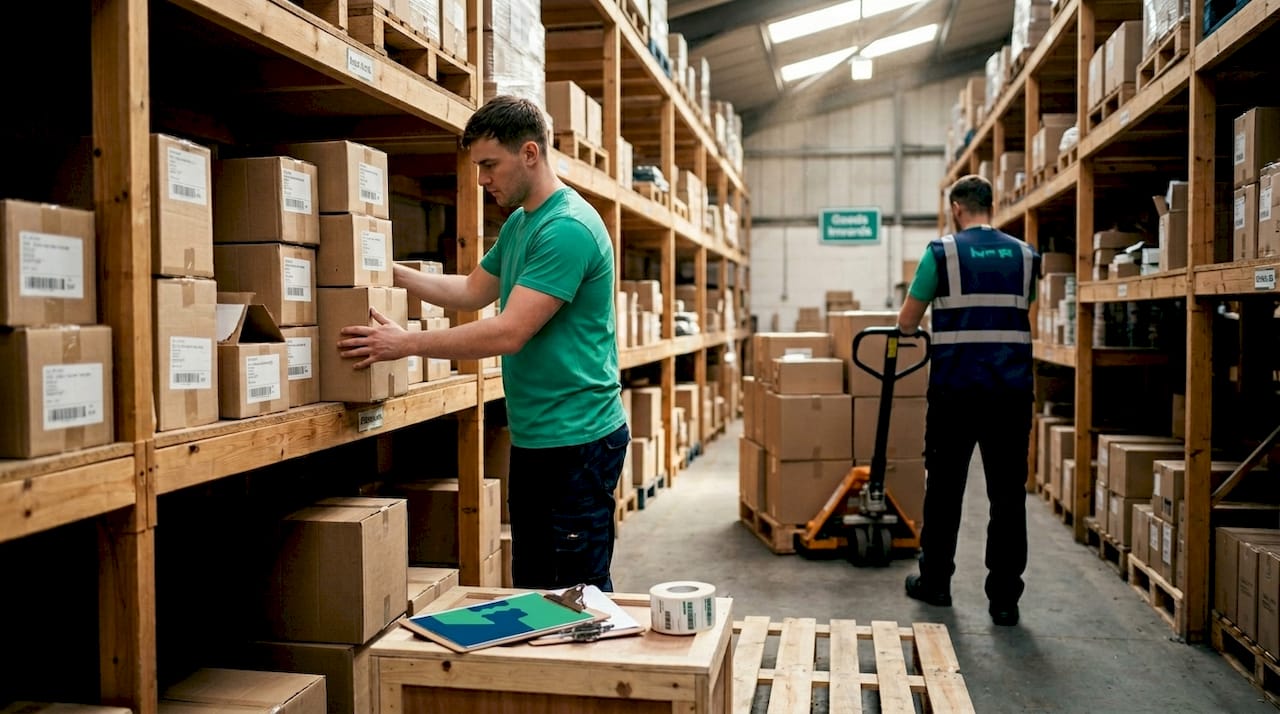
The operational distinction is sharp, as industry evidence confirms: fulfilment centres focus on order picking, packing, and shipping, while warehouses focus on storage and bulk distribution.
Here is how each facility type directly influences key customer experience metrics:
- Delivery speed: Fulfilment centres ship individual orders same-day or next-day. Warehouses are designed for scheduled bulk despatch, not urgent single-unit shipping.
- Order accuracy: Modern fulfilment centres use barcode scanning and warehouse management systems (WMS) to verify every pick, reducing errors significantly.
- Returns experience: A smooth, fast returns process builds customer loyalty. Fulfilment centres manage returns as a standard operation. Warehouses typically do not.
- Shipping costs: Fulfilment centres negotiate volume rates across multiple courier partners, often passing savings to their clients. This is much harder to achieve in a standalone warehouse arrangement.
- Scalability during peaks: Fulfilment centres flex staffing and shift patterns around peak trading. Traditional warehouses are built for consistent, predictable throughput.
Applying fulfilment best practices and understanding warehouse management tips will help you align your facility choice with the specific demands your customers place on your logistics operation. The right match between facility type and customer expectation is one of the biggest levers you can pull to improve satisfaction and retention.
Pro Tip: Track your order-to-ship time monthly. If your current facility consistently takes more than 24 hours to process individual consumer orders during normal trading, you are likely using a warehouse where you need a fulfilment centre.
Hybrid models: Is a mixed fulfilment centre and warehouse strategy right for you?
Some brands struggle with one-size-fits-all logistics. What if you could combine the strengths of both approaches?
The reality is that many growing e-commerce and omnichannel brands reach a point where neither a pure fulfilment centre nor a pure warehouse arrangement serves them optimally. They carry a broad SKU range, some products sell quickly while others move slowly, and they serve both retail partners and direct consumers simultaneously. Forcing every product through a single facility type creates unnecessary bottlenecks and costs.
This is where hybrid allocation provides a genuine operational edge. As logistics strategy research confirms, better operational fit comes via hybrid allocation, directing fast movers to fulfilment nodes and slower movers to storage nodes, rather than forcing every SKU or channel through one facility type.
Here is what a well-structured hybrid model looks like in practice:
- Fast-moving SKUs (top sellers, seasonal hero products, promotional lines) are held at your fulfilment centre, close to consumers and ready to ship within hours.
- Slow-moving SKUs (bulky items, niche variants, overstocked lines, B2B replenishment stock) are held in a warehouse where long-term storage is cost-effective.
- Seasonal transfers move stock between facility types based on demand forecasts, keeping your fulfilment centre lean and your warehouse economically utilised.
- Returns flow back to the fulfilment centre for reprocessing into active stock, reducing the cost of handling and the time items sit idle.
- Channel-specific allocation means retail replenishment orders ship from the warehouse, while D2C orders ship from the fulfilment centre.
Exploring hybrid logistics models and applying warehouse optimisation strategies can significantly sharpen how efficiently you use each facility.
The pitfalls to avoid in a hybrid model are real. Without clear inventory visibility across both facilities, you risk overselling stock that is sitting in the wrong location. Systems integration is critical. Your e-commerce platform, your fulfilment centre’s WMS, and your warehouse management system must talk to each other in real time. If they do not, you are creating confusion rather than solving it.
Pro Tip: Before committing to a hybrid model, run a SKU velocity analysis across a 90-day period. Identify which products sell more than ten units per week consistently. Those are your candidates for fulfilment centre allocation. Everything else can be evaluated for warehouse placement, based on size, value, and lead time tolerance.
Decision framework: Which logistics solution fits your brand’s growth stage?
Even with the right model in mind, the next step is actually choosing based on your unique growth and operations.
The facility choice that works for a brand processing 200 orders per month looks very different from one processing 20,000. Your current stage of growth, your product profile, and your customer promises should all drive the decision. Here is a practical step-by-step framework to work through:
-
Audit your order volume and pattern. Calculate your average daily orders, your peak-to-average ratio, and your order growth trajectory. If you are consistently shipping hundreds of individual consumer orders per day and growing, a fulfilment centre is almost certainly the right primary facility.
-
Analyse your SKU velocity. Categorise every SKU into fast movers (top 20% by volume) and slow movers (bottom 40%). This tells you whether a hybrid model is worth exploring or whether your range is concentrated enough for a single facility type.
-
Define your customer delivery promises. If you advertise next-day or two-day delivery, a fulfilment centre is non-negotiable. If your business serves wholesale accounts where lead times of five to seven days are standard, a warehouse may serve that channel adequately.
-
Map your channel mix. Brands selling exclusively through their own website need fulfilment centre agility. Brands serving a mix of retail partners, marketplaces, and D2C need to match facility type to each channel’s requirements.
-
Evaluate your returns volume. High return rates, common in apparel, footwear, and electronics, demand a fulfilment centre’s structured returns process. A warehouse is not built to handle this efficiently.
-
Stress-test for peak periods. Ask yourself honestly whether your current or prospective facility can absorb a 300% order surge without service degradation. Fulfilment centres are designed for this. Most standalone warehouses are not.
-
Revisit the strategy every six months. Facility strategy is not a one-time decision. As your brand grows, your SKU range changes, and your customer base evolves, what worked at one stage may limit you at the next.
Using fulfilment efficiency with data tools alongside a regular review of warehouse optimisation practices ensures your facility mix stays aligned with your operational reality rather than lagging behind it.
As the research reinforces, hybrid allocation by SKU and channel consistently outperforms a rigid one-facility approach for brands managing complex product ranges and multiple sales channels.
Pro Tip: Build a logistics review into your quarterly business planning cycle. Treat it with the same discipline you apply to financial planning. Logistics decisions have direct revenue impact, and leaving them unreviewed for 12 months is too long in a fast-moving e-commerce environment.
Why ‘either/or’ thinking fails: Hard-won lessons from modern e-commerce logistics
With the practical framework in hand, let’s step back and reflect on what truly drives growth for e-commerce brands navigating fulfilment challenges.
The most common mistake we see is brands treating the fulfilment centre versus warehouse decision as a permanent binary choice. They pick one, build operations around it, and then struggle when their business model evolves. The brands that win on logistics do not make this mistake. They treat facility strategy as a dynamic tool, not a fixed infrastructure decision.
We have seen brands in the apparel sector start with a warehouse because their initial B2B wholesale model demanded it. As D2C growth accelerated, they were slow to shift inventory into fulfilment-ready nodes, and their delivery speed suffered relative to competitors who had already made the move. The cost was not just operational. It showed up in customer satisfaction scores and repeat purchase rates.
The lesson here is not simply “choose the right facility.” It is that your logistics mix should actively respond to where your brand is going, not just where it has been. Reviewing a logistics integration case study of how brands have navigated this transition can give you a concrete picture of what an adaptive strategy looks like in practice. Logistics is a competitive advantage when it is treated as one.
Unlock seamless fulfilment with ParcelPlanet’s tailored solutions
Ready to put these insights into action and transform your fulfilment strategy? Choosing between a fulfilment centre, a warehouse, or a hybrid model is only the starting point. The real advantage comes from working with a logistics partner who understands your specific needs and builds a solution around them.

At ParcelPlanet, we provide order fulfilment services tailored specifically to e-commerce and omnichannel brands. Whether you need rapid D2C order processing, scalable warehousing for slower-moving stock, or a hybrid model that flexes with your growth, our team builds the right solution around your operation. We integrate seamlessly with your e-commerce platforms and courier partners, giving you real-time visibility at every stage. If you are ready to understand what order fulfilment can do for your brand’s growth, get in touch with our team today for a tailored quote.
Frequently asked questions
Is a fulfilment centre the same as a warehouse?
No, a fulfilment centre specialises in picking, packing, and shipping individual e-commerce orders, while a warehouse focuses on long-term storage and bulk distribution to retailers or wholesalers. As industry analysis confirms, a fulfilment centre is optimised for high-velocity direct-to-consumer processing, whereas a warehouse is optimised for longer-term bulk storage.
When should an e-commerce brand use a hybrid model?
Hybrid models work best when you have fast-moving SKUs that need rapid fulfilment alongside slower-moving lines best suited to cost-effective bulk storage. Research supports that hybrid allocation by SKU and channel delivers better operational fit than forcing everything through one facility type.
How do fulfilment centres handle returns differently from warehouses?
Fulfilment centres treat returns as a standard, structured workflow, processing items quickly back into usable stock. Traditional warehouses are not designed for this function, as confirmed by high-velocity processing definitions that specifically include returns handling as a fulfilment centre capability.
Are fulfilment centres more expensive than warehouses?
Fulfilment centres often carry a higher cost per unit of storage, but the speed, accuracy, and customer experience they deliver typically generate better returns through reduced errors, fewer complaints, and higher repeat purchase rates. The true cost comparison must factor in the revenue impact of slower or less accurate fulfilment, not just the storage rate alone.
Recommended


