TL;DR:
- Fulfilment centres handle the complete order process, prioritizing speed and accuracy over storage.
- They support e-commerce growth by offering scalable, technology-enabled logistics solutions.
- Choosing the right centre involves evaluating location, tech integration, scalability, and performance metrics.
Fulfilment centres explained: Streamline your e-commerce growth
Many e-commerce managers use the terms “warehouse” and “fulfilment centre” interchangeably, but they are not the same thing. This confusion leads to poor outsourcing decisions, slower growth, and frustrated customers. If you are running a growing online retail brand and wondering why your logistics feels like it is always two steps behind your sales, the answer often lies in how you understand and use fulfilment infrastructure. This article breaks down exactly what fulfilment centres are, how they work, why they matter for scalable e-commerce, what happens inside them, and how to choose the right partner for your brand.
Table of Contents
Key Takeaways
| Point |
Details |
| Fulfilment centres defined |
Fulfilment centres handle every step from receiving stock to shipping customer orders, enabling online retail efficiency. |
| Growth engine for e-commerce |
Leveraging fulfilment centres removes scale bottlenecks, cuts costs, and boosts customer satisfaction for expanding brands. |
| Process clarity empowers better results |
Understanding key processes and metrics helps managers avoid common errors and pick the right fulfilment partner. |
| Best fit beats best-in-class |
Choosing flexible, data-driven fulfilment partners yields better long-term results than chasing theoretical top performance. |
What fulfilment centres are and how they work
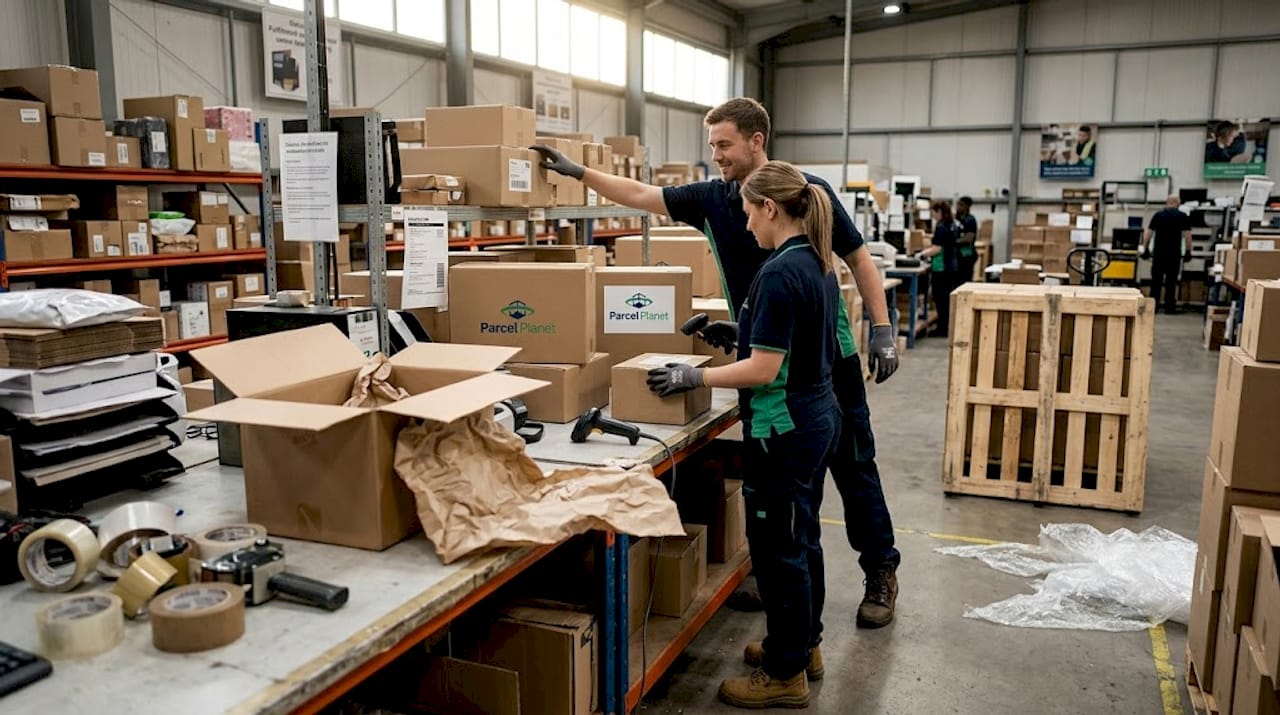
A fulfilment centre is a specialist facility that handles the entire journey of an order, from the moment stock arrives to the moment a parcel lands on your customer’s doorstep. It is not simply a room full of shelves. It is an operational system built specifically around speed, accuracy, and volume.
Think of it this way. A traditional warehouse is primarily a long-term storage facility. Goods sit there until they are needed. A fulfilment centre, by contrast, is built for constant movement. Stock flows in, gets processed rapidly, and flows back out as individual customer orders. The focus is on throughput, not storage duration.
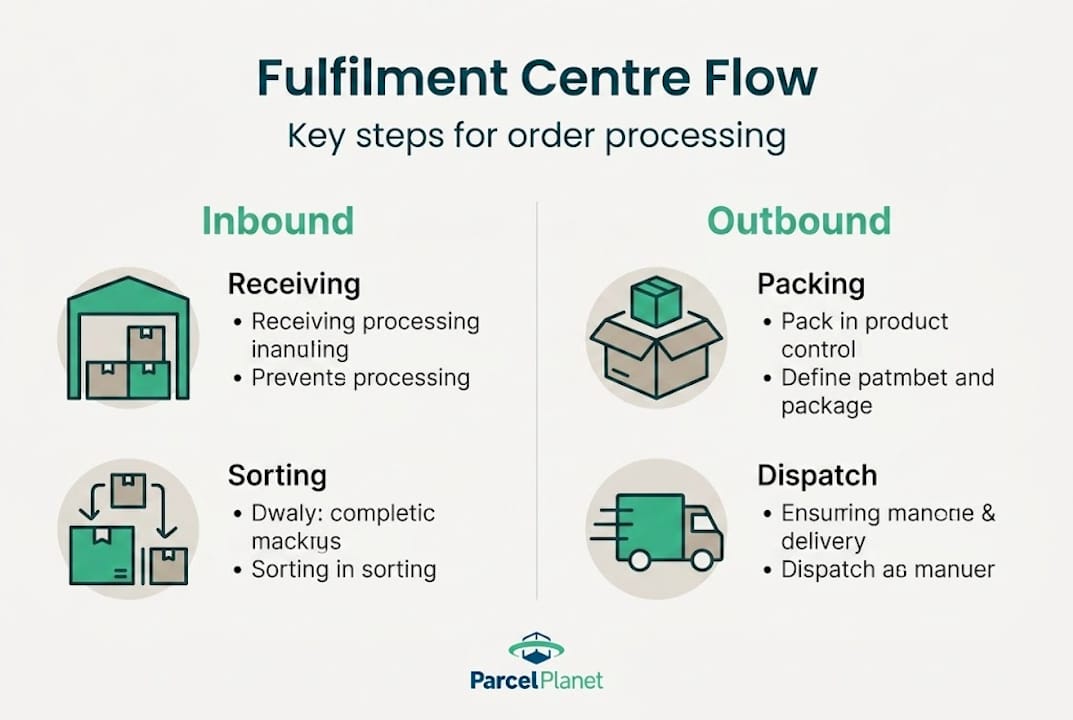
Here is how a typical order moves through a fulfilment centre:
- Receiving: Your supplier delivers stock in bulk. The centre logs each item against your inventory system, checks for damage, and places goods in assigned locations.
- Storage: Items are stored strategically, often based on pick frequency, so fast-moving SKUs are easiest to access.
- Picking: When a customer places an order on your website, the warehouse management system (WMS) triggers a pick instruction. A team member or automated system locates the exact item.
- Packing: The picked items are packed according to your brand’s specifications, including branded packaging, inserts, or specific box sizes.
- Shipping: The parcel is labelled, sorted by courier, and dispatched. Tracking details are automatically sent to your customer.
- Returns management: Returned items are received, inspected, and either restocked, flagged for disposal, or processed as per your returns policy.
The difference from a warehouse is significant. As WERC metrics note, best-in-class fulfilment performance is hard to sustain as SKU counts and labour challenges grow. This highlights why the design and processes of a fulfilment centre matter far more than its size.
| Feature |
Traditional warehouse |
Fulfilment centre |
| Primary purpose |
Long-term storage |
Order processing and dispatch |
| Typical client |
Wholesalers, manufacturers |
E-commerce and omnichannel brands |
| Throughput speed |
Slow to moderate |
Fast, often same or next day |
| Technology use |
Basic inventory tracking |
Integrated WMS, courier APIs |
| Returns handling |
Rarely included |
Standard service |
Understanding fulfilment strategies early helps you make smarter infrastructure decisions as your brand grows. Equally, getting to grips with centralised inventory basics ensures your stock data stays accurate across all sales channels.
Pro Tip: One of the most common mistakes e-commerce businesses make is treating a fulfilment centre like a storage unit. If you are not actively managing SKU velocity data and communicating it to your fulfilment partner, you are slowing down your own pick times and increasing error rates.
Why fulfilment centres are vital for scalable e-commerce
Once you understand what a fulfilment centre does, the next question is why it matters so much for your growth trajectory. The answer is straightforward: in-house fulfilment works at small volumes, but it breaks down quickly as your brand scales.
Consider the practical realities. You are managing a peak season surge, onboarding new product lines, expanding into new markets, and trying to maintain next-day delivery promises. Doing all of that from a back office or self-managed warehouse puts enormous strain on your team and your margins.
The key challenges a quality fulfilment centre solves include:
- Space constraints: You do not need to lease and manage your own warehouse space. The centre absorbs your stock growth without you signing long leases.
- Labour management: Picking, packing, and shipping are labour-intensive. A fulfilment centre employs and manages that workforce on your behalf.
- Technology investment: Integrated warehouse management systems, courier connections, and real-time tracking are already built in, saving you significant capital expenditure.
- Seasonal flexibility: During peak periods, a fulfilment centre scales its capacity. You are not scrambling to hire temporary staff or find overflow space.
- Shipping rates: High-volume centres negotiate carrier rates that individual brands cannot access independently, reducing your per-parcel cost.
Here is a direct comparison to help you assess your current position:
| Factor |
In-house fulfilment |
Third-party fulfilment centre |
| Upfront cost |
High (lease, fit-out, tech) |
Low (pay per order or storage) |
| Scalability |
Limited by space and staff |
Flexible and on-demand |
| Shipping rates |
Standard retail rates |
Negotiated volume rates |
| Technology |
Requires investment |
Included in service |
| Peak period handling |
Difficult and costly |
Managed by the centre |
| Management time |
High |
Minimal |
Research from WERC metrics reinforces this point: prioritising the right performance metrics becomes increasingly difficult amid SKU growth and labour shortages, making third-party support critical for consistency.
Stat to note: Brands that outsource fulfilment to specialist centres regularly report measurable improvements in order accuracy and shipping times within the first three months of partnership. Faster, more accurate deliveries directly improve customer retention.
Scaling your brand sustainably requires thinking carefully about your logistics infrastructure. Exploring scalable logistics strategies gives you a framework to plan ahead, while understanding how to approach cutting fulfilment costs ensures you are not leaving savings on the table.
The customer experience angle is also worth emphasising. Customers do not see your warehouse. They see delivery speed, packaging quality, and how easy it is to return a product. A fulfilment centre is your brand’s invisible customer service team, and its performance shapes loyalty.
Key processes inside a fulfilment centre
Knowing that a fulfilment centre is valuable is one thing. Understanding exactly what happens inside one is what allows you to manage the partnership effectively and hold your provider accountable.
Here is a stepwise breakdown of the core processes:
- Intake and receiving: Incoming stock is checked against purchase orders, scanned into the WMS, and quality-checked. Errors at this stage cascade into picking errors later, so accuracy here is non-negotiable.
- Inventory management: Items are assigned bin or shelf locations. High-frequency SKUs are placed closest to packing stations to reduce pick travel time. Inventory counts are maintained in real time.
- Order picking: When your store receives an order, the WMS generates a pick list. Depending on the centre’s setup, this could be single-order picking, batch picking, or zone picking, each with different efficiency profiles.
- Packing: Packers assemble orders according to specified requirements. This may include branded tissue paper, custom boxes, marketing inserts, or specific void-fill materials. Accuracy checks occur before sealing.
- Shipping and dispatch: Parcels are assigned to the appropriate carrier based on destination, weight, and service level. Labels are printed, scanned, and tracked from the moment they leave the building.
- Returns processing: Returned parcels are received, logged, inspected, and either returned to saleable stock or flagged as damaged. Fast, accurate returns processing protects your inventory levels and customer experience simultaneously.
The tools behind these processes matter enormously. Warehouse management systems, barcode scanners, automated conveyor systems, and courier API integrations all play a role in keeping throughput high and errors low.
“WERC’s research highlights critical metrics and challenges in fulfilment centre operations, pointing to order accuracy, inventory accuracy, and on-time shipping as the primary indicators of operational health.”
Bottlenecks most often appear at the receiving stage and the returns stage. Slow intake processing leads to invisible stock. Poor returns handling leads to inventory discrepancies that ripple through your entire operation.
Pro Tip: Ask your fulfilment partner for their order accuracy rate and on-time dispatch rate before signing any agreement. If they cannot provide these figures readily, that tells you everything you need to know about their data transparency.
Using a warehouse operations checklist helps you audit your current setup or assess a potential partner’s processes in detail. For brands ready to benchmark their own performance, the e-commerce fulfilment checklist offers a structured way to identify where costs and errors are hiding.
How to evaluate and choose the right fulfilment centre partner
Choosing a fulfilment centre is one of the most consequential operational decisions you will make as an e-commerce manager. Get it right and your brand has a growth engine. Get it wrong and you face delayed orders, angry customers, and mounting costs.
Here is a practical checklist of criteria to assess:
- Location: Is the centre positioned to reach your primary customer base within your target delivery window? A poorly located centre can add a day to standard delivery times.
- Platform integration: Does the centre connect directly with your e-commerce platform, whether Shopify, WooCommerce, or another system? Seamless integration eliminates manual data entry and errors.
- Scalability: Can the centre handle your peak season volume without performance degradation? Ask for data on how they managed previous peak periods.
- Pricing model: Understand the full cost structure, including receiving fees, storage fees, pick and pack fees, and any minimum volume commitments.
- Reporting and visibility: Do they offer real-time inventory dashboards and order tracking? Data transparency is not optional; it is essential for informed decision-making.
- Returns management: Is returns processing included, and how quickly are returned items processed back into stock?
- Contract flexibility: Can you scale up or down without punitive penalties? Rigid contracts are a red flag for growing brands whose volumes fluctuate.
| Evaluation factor |
What to look for |
Red flag |
| Technology integration |
Direct API with your platform |
Manual CSV uploads only |
| Order accuracy rate |
Above 99.5% |
Unable to provide data |
| Scalability |
Flex capacity for peak periods |
Fixed staffing with no surge plan |
| Pricing transparency |
Itemised cost breakdown |
Vague or bundled pricing |
| Returns handling |
Fast processing, real-time updates |
Outsourced to a separate provider |
| Contract terms |
Flexible, short-term options available |
Long lock-in with no exit clause |
As WERC metrics confirm, best-in-class fulfilment is shaped by performance metrics, the ability to scale, and responsiveness to SKU growth and market shifts. Use these as your evaluation benchmarks, not just cost alone.
Questions worth asking a potential partner directly:
- What is your average order processing time from receipt to dispatch?
- How do you handle a sudden 300% volume spike during a promotional period?
- What does your SLA look like for order accuracy and on-time shipping?
- How do you communicate errors or delays to your clients?
Common pitfalls include choosing on price alone, ignoring technology compatibility, and failing to visit the physical facility before committing. A fulfilment partner selection guide gives you a structured framework to work through each of these decisions systematically. Pairing this with a focus on efficiency with data ensures you have the metrics in place to hold your partner accountable from day one.
Our take: Why best-in-class isn’t always the best goal
Here is something most articles on fulfilment centres will not tell you. Chasing the “best-in-class” provider on paper can actually work against you, especially if you are a small or medium-sized e-commerce brand.
The largest, most acclaimed fulfilment centres are optimised for volume. Their systems, pricing, and processes are built around clients shifting tens of thousands of orders per week. If you are not at that scale, you are often paying premium prices for infrastructure that does not match your actual needs.
As WERC metrics show, even leaders in the sector struggle to sustain the very top metrics at scale. So the assumption that bigger automatically means better is flawed. What matters most for your brand is fit, not fame.
Flexibility, data transparency, and responsiveness to your specific SKU mix and seasonal patterns will drive more meaningful results than any industry ranking. The right partner grows with you, communicates openly, and adapts when conditions change. We have seen brands thrive with mid-sized regional fulfilment providers because those providers genuinely understood the client’s product range and customer expectations. That understanding is worth more than any benchmark trophy. For practical guidance on managing this well, warehouse management tips provide actionable steps tailored to brands at exactly this stage of growth.
Ready to optimise your fulfilment?
If this article has clarified what fulfilment centres are and how they can support your brand’s growth, the natural next step is finding a partner who can put that into practice for you.

At ParcelPlanet, we work with growing e-commerce brands to deliver seamless, accurate, and scalable fulfilment across multiple sales channels. Whether you are handling hundreds of orders per week or thousands, our team can tailor a solution that fits your product range, your customers, and your growth ambitions. From real-time inventory tracking to integrated courier dispatch and hassle-free returns management, we make fulfilment one less thing to worry about. Get a quote today and see how partnering with the right fulfilment team can transform your customer experience and operational efficiency.
Frequently asked questions
What is the main difference between a warehouse and a fulfilment centre?
A warehouse is used mostly for storing goods long-term, while a fulfilment centre handles the complete order journey from receiving and picking through to packing, shipping, and returns for online customers.
How do fulfilment centres improve e-commerce customer experience?
They enable faster, more accurate deliveries and straightforward returns processing, both of which directly increase customer satisfaction. Fulfilment performance has a measurable impact on how customers perceive and rate your brand.
What metrics should I track when partnering with a fulfilment centre?
Track order accuracy rate, on-time dispatch rate, inventory accuracy, and cost per order. WERC outlines these as the primary indicators of reliable, high-performing fulfilment operations.
Can fulfilment centres adapt to business growth and seasonal spikes?
Yes. Quality fulfilment centres build flexible capacity into their model to handle demand surges and new SKUs without major disruptions. That said, top fulfilment performance is harder to sustain as SKU counts and labour needs escalate, so choosing a centre with proven surge management is essential.
Recommended


