Choosing the wrong fulfilment partner can silently drain 30-40% of your logistics budget while damaging customer loyalty. Many e-commerce brands mistakenly believe self-fulfilment offers better control and savings, yet operational costs skyrocket as order volumes climb beyond 500 monthly shipments. This guide reveals critical selection criteria, technology requirements, and delivery benchmarks that separate scalable fulfilment partnerships from costly operational bottlenecks, helping you build a logistics foundation that drives retention and growth.
Table of Contents
Key takeaways
| Point |
Details |
| Cost reduction potential |
Choosing the right fulfilment partner reduces logistics costs by 30-40% through transparent pricing and operational efficiency. |
| Technology integration |
Real-time tracking and platform integration are essential for accuracy, speed, and reducing order errors by 15%. |
| Delivery expectations |
70% of consumers expect 2-day delivery, making bicoastal warehouse networks critical for competitive service levels. |
| Growth stage transition |
Brands exceeding 500 monthly orders should evaluate 3PL partnerships to manage complexity and scale efficiently. |
| Cross-border expertise |
Partners with customs knowledge prevent penalties and delays that cause 85% of customers to abandon brands after bad deliveries. |
Introduction to e-commerce fulfilment and its impact
E-commerce fulfilment encompasses the complete order lifecycle: receiving inventory, storing products in warehouses, picking and packing customer orders, then shipping to final destinations. Third-party logistics (3PL) partners specialise in executing these operations for brands seeking to outsource warehousing, labour, and shipping coordination. This partnership model allows growing businesses to focus on product development and marketing whilst experts handle complex logistics infrastructure.
The financial impact of fulfilment choices extends far beyond shipping labels. Inefficient processes inflate storage fees, packaging waste, and labour hours, whilst technology gaps create inventory discrepancies that lead to stockouts or overstocking. These operational failures cascade into customer experience problems: delayed shipments, incorrect orders, and poor communication that erode trust.
Consider the retention cost of poor fulfilment. Poor fulfilment experiences cause 70% of shoppers to abandon a brand after just two negative incidents, and 85% will not return following a bad delivery. Each abandoned customer represents lost lifetime value, negative reviews, and diminished brand reputation that compounds over time.
Key operational elements include:
- Inventory receiving and storage: Efficient warehouse management maintaining accurate stock levels and product condition.
- Order processing speed: Technology-driven picking and packing that minimises errors and expedites dispatch.
- Carrier coordination: Strategic partnerships with multiple couriers ensuring cost-effective, reliable delivery options.
- Returns management: Streamlined reverse logistics that maintain customer satisfaction during product returns.
Scalability becomes the ultimate test of fulfilment infrastructure. Self-managed operations that work smoothly at 200 monthly orders often collapse under 1,000, requiring emergency hiring, expanded warehouse space, and fragmented systems that introduce chaos. Strategic partner selection prevents these growing pains by providing elastic capacity, proven processes, and established carrier relationships that adapt to demand fluctuations without operational disruption.
Key criteria for choosing a fulfilment partner
Transparent pricing structures separate professional 3PL providers from partners who profit through hidden fees and vague invoicing. Transparent and predictable pricing models from fulfilment providers are a structural advantage that compounds as order volume grows, supporting cost control in scaling e-commerce businesses. Request detailed breakdowns covering storage (per pallet or cubic metre), pick and pack fees per unit, shipping rates by zone, and any surcharges for special handling or seasonal volume spikes.
Technology integration determines operational efficiency and accuracy. Modern fulfilment requires seamless connections between your e-commerce platform, warehouse management system, and carrier networks. Real-time inventory synchronisation prevents overselling, whilst automated order routing reduces manual entry errors that delay shipments. Partners offering API integrations with platforms like Shopify, WooCommerce, and Amazon ensure inventory updates flow automatically, maintaining accuracy across all sales channels.

Delivery speed expectations have shifted dramatically. Seventy per cent of consumers now expect 2-day delivery, making warehouse location and carrier partnerships critical evaluation factors. Partners with strategically distributed fulfilment centres reduce transit times and shipping costs by positioning inventory closer to customer concentrations. Bicoastal coverage in large markets like the United States or multi-regional European facilities enable faster, more affordable delivery that meets customer expectations whilst controlling freight expenses.
Scalability and flexibility protect against future constraints. Evaluate whether partners can accommodate seasonal demand surges, new product launches requiring different packaging, or international expansion without forcing you to switch providers. Ask specific questions about maximum daily order capacity, warehouse space availability for inventory growth, and experience handling similar product categories.
Essential evaluation criteria:
- Pricing transparency: Itemised quotes with no hidden fees or vague “market rate” language.
- Platform integration: Native connections to your sales channels ensuring real-time data flow.
- Geographic coverage: Warehouse locations strategically positioned to reach your customer base quickly.
- Scalability proof: Case studies or references from brands that grew significantly with the partner.
- Specialisation match: Experience with your product type, whether fragile, oversized, perishable, or high-value items.
Pro Tip: Request a detailed ecommerce fulfilment checklist covering technology requirements, SLA benchmarks, and cost breakdowns to systematically evaluate potential partners against your specific operational needs and growth projections.
Technology and automation in modern fulfilment operations
Automation transforms fulfilment accuracy and speed by eliminating manual processes prone to human error. Automation reduces order errors by 15% and seamless real-time integration avoids delays by maintaining inventory accuracy. Warehouse robotics, barcode scanning systems, and automated conveyor networks accelerate picking and packing whilst ensuring the correct products reach customers consistently.
Real-time tracking provides visibility across the entire fulfilment chain. Customers expect precise delivery estimates and proactive updates when shipments encounter delays. Partners offering tracking portals accessible to both brands and end customers reduce support enquiries whilst building confidence through transparency. This visibility extends to inventory levels, allowing brands to trigger reorders before stockouts occur.
Fulfilling ecommerce orders requires integrated platforms that connect storefronts, warehouses, and carriers in real time to maintain inventory accuracy. Disconnected systems create dangerous gaps where online stores display products as available whilst warehouse stock has depleted, leading to cancelled orders and disappointed customers. Modern warehouse management systems (WMS) synchronise inventory changes instantly, whether from new receipts, outbound shipments, or returns processing.
Disconnected manual fulfilment processes introduce compounding delays. Each handoff between systems requires human data entry, verification, and coordination that slows order processing and creates error opportunities. A customer order might sit in an email queue awaiting manual entry into warehouse systems, then require separate carrier booking and tracking number updates back to the e-commerce platform. These inefficiencies become unmanageable as order volume scales.
Technology advantages include:
- Inventory synchronisation: Real-time stock updates across all sales channels preventing overselling.
- Automated order routing: Smart assignment to optimal warehouse locations based on customer proximity and stock availability.
- Predictive analytics: Data-driven insights identifying slow-moving inventory, seasonal patterns, and optimal reorder timing.
- Exception management: Automated alerts for potential issues like inventory shortages or shipping delays requiring intervention.
Pro Tip: During partner evaluation, request live demonstrations of their warehouse management system and platform integrations to verify claims about automation capabilities and real-time connectivity rather than relying on marketing materials alone.
Comparing fulfilment models: in-house, 3PL, and dropshipping
Self-fulfilment offers maximum control over packing presentation, quality checks, and immediate problem resolution, but self-fulfilment becomes time-consuming and less cost-effective with increasing order volumes, requiring transition to 3PL partners. Small brands processing under 200 monthly orders often benefit from direct oversight, learning customer preferences and product handling requirements firsthand. However, labour costs, warehouse rent, packing materials, and carrier negotiations quickly become overwhelming as volume scales.
Third-party logistics providers deliver cost-effective scaling through shared infrastructure and established carrier relationships. 3PL providers offer scalability, advanced technology, and expanded geographic coverage compared to in-house and dropshipping models. They absorb seasonal fluctuations without requiring permanent staff increases, provide bulk shipping discounts unavailable to individual brands, and maintain technology investments that would be prohibitively expensive for single operations. Geographic expansion becomes straightforward as established warehouse networks enable rapid market entry without capital investment.
Dropshipping eliminates inventory investment and fulfilment infrastructure by routing orders directly from suppliers to customers. This model suits brands testing new markets or products without financial commitment, but introduces significant control limitations. You depend entirely on supplier reliability, packaging quality, and shipping speed without ability to intervene when problems arise. Customer complaints about delayed shipments or poor packaging quality damage your brand despite originating from supplier failures.
| Model |
Control Level |
Cost Structure |
Scalability |
Best For |
| Self-fulfilment |
Complete oversight |
High fixed costs, labour intensive |
Limited by space and staff |
Startups under 200 orders monthly |
| 3PL partnership |
Moderate oversight |
Variable costs scaling with volume |
Highly scalable with partner capacity |
Growing brands 500+ orders monthly |
| Dropshipping |
Minimal control |
Low fixed costs, per-order fees |
Easily scalable but quality variable |
Product testing or niche markets |
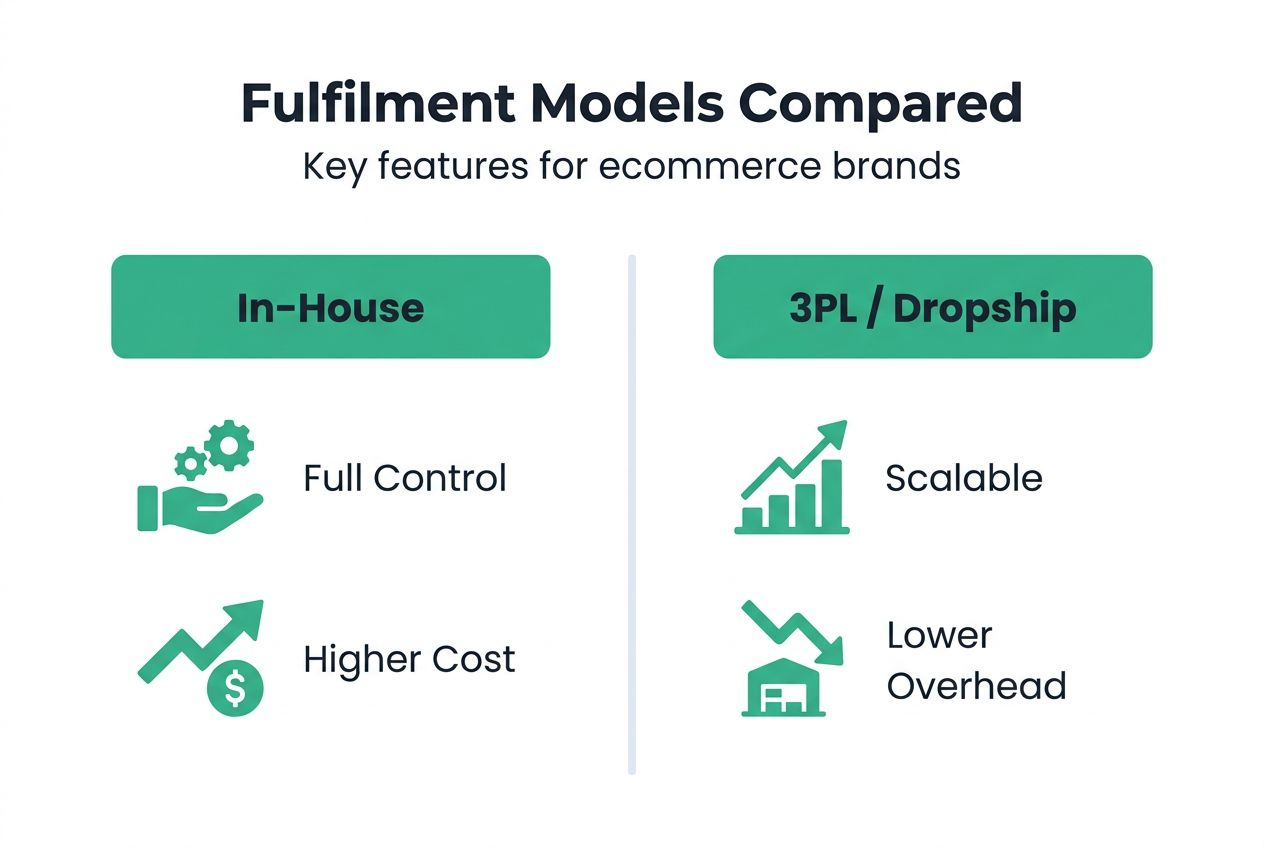
Transition timing matters significantly. Brands often start with self-fulfilment to understand operations, then migrate to 3PL partnerships when monthly orders exceed 500 or when warehouse space constraints emerge. This transition requires careful planning to maintain service levels during handover, including inventory transfers, system integrations, and customer communication about potential shipping changes.
Common order fulfilment challenges include managing peak season capacity, coordinating multiple warehouse locations, and maintaining service quality across geographies. Understanding these challenges helps brands select models and partners equipped to handle their specific growth trajectory and operational complexity.
Customer-centric delivery preferences and competitive SLAs
Consumer delivery expectations have fundamentally shifted. 70% of consumers expect 2-day delivery and bicoastal warehouse networks significantly improve delivery coverage and speed. This expectation stems from marketplace giants offering expedited shipping as standard, training customers to view fast delivery as baseline service rather than premium offering. Brands unable to meet these timelines face competitive disadvantage as customers abandon carts or choose faster alternatives.
Bicoastal and multi-regional warehouse networks enable competitive delivery speeds without premium freight costs. Positioning inventory in strategic locations reduces average transit distances, allowing ground shipping to reach most customers within two days. A brand shipping exclusively from a single East Coast warehouse might require expensive air freight to meet West Coast delivery promises, whilst dual-location inventory achieves the same timeline using affordable ground services.
Service-level agreements (SLAs) formalise delivery performance commitments and establish accountability when failures occur. Strong SLAs specify guaranteed processing times from order receipt to carrier handoff, shipping speed by destination zone, and remedies for missed commitments. These agreements protect brands from partner underperformance that damages customer relationships and revenue.
Delivery failures create lasting damage. As noted earlier, poor fulfilment experiences cause 70% of shoppers to abandon a brand after just two negative experiences and 85% will not return after a bad delivery. Each delayed shipment compounds customer frustration, negative reviews proliferate across platforms, and acquisition costs skyrocket as retention rates plummet. The financial impact extends beyond individual lost sales to decreased customer lifetime value and increased marketing spend replacing churned customers.
Negotiating effective SLAs requires balancing cost, speed, and reliability:
- Processing time commitments: Maximum hours from order receipt to warehouse dispatch, typically 24 hours for standard items.
- Shipping speed guarantees: Delivery timelines by geographic zone with penalties for missed deadlines.
- Accuracy targets: Acceptable error rates for incorrect items, typically under 0.5% of orders.
- Communication protocols: Required notification timing for inventory issues, shipping delays, or quality concerns.
“Fast, reliable delivery has become the minimum viable product for e-commerce success. Brands competing on delivery speed alone will struggle, but those failing to meet baseline expectations will not survive.” – E-commerce logistics strategist
Cross-border fulfilment and regulatory compliance considerations
International expansion introduces complex customs regulations, import duties, and documentation requirements that vary by destination country. Products moving across borders require accurate commercial invoices, harmonised system (HS) codes for tariff classification, and compliance with country-specific restrictions on materials, labelling, or product categories. Partners lacking cross-border expertise introduce penalties, shipment delays, and frustrated international customers that damage market entry efforts.
Customs holds and penalty fees arise from documentation errors, incorrect duty calculations, or prohibited item classifications. A single shipment detained at customs might face daily storage fees whilst paperwork corrections process, turning profitable orders into financial losses. Partners with established customs brokerage relationships and documentation automation prevent these costly delays through accurate initial submissions.
International returns management requires additional infrastructure and expertise. Customers returning products across borders face complex processes potentially involving duty refunds, import fees, and extended timelines that frustrate resolution. Partners offering streamlined international returns processing, including prepaid return labels and local return centres, maintain satisfaction even when purchases do not meet expectations.
Regulatory compliance extends beyond customs to product safety standards, packaging requirements, and consumer protection laws varying by jurisdiction. European Union markets require CE marking for many products, whilst other regions mandate specific language labelling or restricted material certifications. Partners familiar with destination market regulations help navigate these requirements without costly compliance failures.
Cross-border partner evaluation checklist:
- Customs brokerage relationships: Established partnerships expediting clearance and resolving issues quickly.
- Documentation automation: Systems generating accurate commercial invoices and customs declarations automatically.
- Duty and tax calculation: Accurate landed cost estimation for customer transparency and compliance.
- Returns infrastructure: International returns processing avoiding customer burden and regulatory complications.
- Regulatory knowledge: Experience with destination market product requirements and restricted items.
Common misconceptions about fulfilment models
Many brands believe self-fulfilment always delivers cost savings and superior control, but self-fulfilment scales poorly despite perceived control savings, often increasing costs and complexity. Initial monthly savings from avoiding 3PL fees evaporate as order volume demands additional warehouse space, seasonal labour, packing materials purchased at retail rather than bulk rates, and management time diverted from strategic activities. The true cost comparison must account for opportunity cost of founder time spent packing boxes rather than developing products or acquiring customers.
Another prevalent myth suggests all 3PL providers offer equivalent technology integration and transparent pricing. In reality, capabilities vary dramatically between basic warehouse operations offering simple storage and shipping versus sophisticated partners providing real-time inventory synchronisation, automated order routing, and predictive analytics. Similarly, pricing transparency ranges from itemised quotes with clear per-unit costs to vague agreements hiding fees in surcharges and seasonal adjustments.
Dropshipping misconceptions suggest this model eliminates fulfilment challenges entirely whilst maintaining quality control. Whilst dropshipping removes inventory investment and warehouse management, it introduces dependency on supplier reliability, packaging quality, and shipping speed beyond your direct control. Customer complaints about delayed shipments or poor presentation damage your brand reputation despite originating from supplier failures you cannot immediately resolve.
Automation myths suggest technology only benefits massive operations processing thousands of daily orders. Modern warehouse management systems and platform integrations deliver value at much smaller scales by reducing manual errors, accelerating order processing, and providing inventory visibility that prevents stockouts. Even brands processing 500 monthly orders benefit from automation reducing the labour hours required per shipment.
Key misconceptions to avoid:
- Self-fulfilment cost advantage: Savings disappear rapidly as volume scales beyond 500 monthly orders.
- 3PL uniformity: Technology capabilities and pricing transparency vary dramatically between providers.
- Dropshipping simplicity: Removes inventory burden but introduces uncontrollable quality and timing risks.
- Automation scale requirements: Technology benefits emerge well before reaching thousands of daily orders.
Pro Tip: Request detailed case studies from potential partners showing how they have supported brands similar to yours through growth stages, paying particular attention to technology adoption timing and the operational challenges addressed at different volume thresholds.
Conclusion and practical steps to selecting the right fulfilment partner
Effective fulfilment partner selection balances cost efficiency, technology capabilities, scalability, delivery performance, and compliance expertise. This guide has explored how transparent pricing reduces hidden costs, technology integration improves accuracy and speed, strategic warehouse networks enable competitive delivery, and cross-border expertise prevents costly international errors. These pillars form the foundation for partnerships supporting sustainable growth whilst maintaining customer satisfaction.
Implementing this knowledge requires systematic partner evaluation and clear decision criteria:
- Define your requirements: Document current order volume, growth projections, product handling needs, and geographic delivery priorities.
- Research potential partners: Identify 3-5 candidates with relevant experience, appropriate geographic coverage, and technology matching your platform.
- Request detailed proposals: Obtain itemised pricing, technology integration specifics, SLA commitments, and scalability evidence.
- Verify technology claims: Schedule live demonstrations of warehouse management systems and platform integrations rather than accepting marketing materials.
- Check references thoroughly: Contact current clients processing similar volumes and product types, asking specific questions about performance during peak periods.
- Negotiate clear SLAs: Establish written commitments for processing times, shipping speeds, accuracy rates, and remedies for failures.
- Plan transition carefully: Develop detailed timelines for inventory transfers, system integrations, and customer communications during partner onboarding.
- Monitor performance continuously: Track key metrics including processing speed, accuracy rates, delivery times, and customer satisfaction to ensure SLA compliance.
Partner selection should align with your current operational stage whilst accommodating projected growth. A brand processing 300 monthly orders today but projecting 1,000 within twelve months needs partners capable of scaling seamlessly rather than requiring disruptive provider changes mid-growth.
Successful fulfilment partnerships evolve alongside your business. Regular performance reviews, open communication about challenges, and collaborative problem solving strengthen relationships whilst ensuring logistics infrastructure supports rather than constrains growth ambitions. Apply this systematic approach to transform fulfilment from operational constraint into competitive advantage driving customer loyalty and sustainable expansion.
Discover expert order fulfilment services tailored for your e-commerce growth
Scaling e-commerce operations demands fulfilment partners combining advanced technology, strategic warehouse networks, and transparent pricing that adapts to your growth trajectory. Whether you are transitioning from self-fulfilment or seeking to replace an underperforming 3PL, the right partnership transforms logistics from operational burden into competitive advantage.

ParcelPlanet specialises in order fulfilment services designed for growing e-commerce brands requiring scalable infrastructure, real-time inventory visibility, and delivery speeds meeting customer expectations. Our platform offers seamless ecommerce integrations connecting your storefronts, warehouse systems, and carrier networks for automated order processing and accurate inventory synchronisation. Discover why order fulfilment matters for customer retention and explore tailored solutions aligning with your specific product requirements and expansion goals.
FAQ
What factors most impact the cost savings when choosing a fulfilment partner?
Transparent pricing covering storage, pick and pack fees, and shipping rates without hidden surcharges delivers the most significant cost control. Technology integration reducing manual labour and errors, combined with strategic warehouse locations minimising freight distances, further decreases operational overhead whilst improving delivery speed.
How important is technology integration in selecting a fulfilment partner?
Technology integration proves essential for operational accuracy and speed. Real-time inventory synchronisation prevents overselling across sales channels, automated order routing reduces processing time, and integrated tracking systems decrease customer support enquiries. Partners lacking seamless platform connections risk costly delays and inventory discrepancies damaging customer satisfaction.
When should a growing e-commerce brand switch from self-fulfilment to a 3PL partner?
Transition becomes advisable when monthly orders consistently exceed 500 or warehouse space constraints emerge. At this volume, 3PL partnerships reduce labour costs and operational complexity whilst improving scalability through shared infrastructure and established carrier relationships. Earlier transition may benefit brands experiencing rapid growth or seasonal volume spikes.
How can cross-border fulfilment challenges affect customer experience?
Customs delays and penalty fees cause shipment holdups that frustrate international customers expecting timely delivery. Incorrect documentation or tariff classification can detain orders for weeks whilst corrections process, destroying customer confidence. Partners with customs expertise and automated compliance documentation ensure smooth international deliveries maintaining satisfaction across markets.
What delivery speed expectations should fulfilment partners meet in 2026?
Seventy per cent of consumers now expect 2-day delivery as baseline service, making this the competitive standard for most product categories. Fulfilment partners should demonstrate capability to meet this timeline through strategic warehouse positioning and established carrier relationships, with transparent SLAs specifying processing and transit commitments by geographic zone.
Recommended


