TL;DR:
- Expanding international fulfilment enhances revenue and competitiveness by positioning products closer to customers.
- Successful scaling requires thorough market research, inventory regionalisation, system integration, and ongoing compliance management.
Expanding your fulfilment operations internationally is one of the most significant steps your e-commerce business can take. It unlocks new revenue, gets products closer to customers, and sharpens your competitive edge. But without a solid global fulfilment expansion guide behind you, the complexity can quickly outpace your capacity. International shipping rules, VAT obligations, customs clearance, and the challenge of mastering international order fulfilment all arrive at once. This guide walks you through the key stages of planning, building, and operating a scalable global fulfilment network.
Table of Contents
Key takeaways
| Point |
Details |
| Start with market research |
Identify where your customers are before placing inventory or selecting regional partners. |
| Compliance is ongoing |
VAT, HS codes, and data privacy require regular auditing, not a one-time setup. |
| Regionalise inventory early |
Placing stock close to customers cuts transit times, shipping costs, and customs friction. |
| Systems integration is non-negotiable |
Real-time data flow between order management, inventory, and carriers prevents costly errors. |
| Choose partners carefully |
Your 3PL network is only as strong as its weakest node. Vet partners with operational rigour. |
Preparing for global fulfilment expansion
Before you ship a single parcel across a border, preparation separates businesses that scale smoothly from those that get buried in operational chaos.
Understand your customer geography first. Order data, website analytics, and demand forecasting will tell you where your customers actually are, not where you assume they are. Use this to decide which regions justify fulfilment investment and which are better served through existing carrier partnerships.
From there, assess your infrastructure needs honestly:
- Warehouse capacity: Do you need owned facilities, third-party warehousing, or a hybrid model?
- Technology stack: Can your order management system handle multi-currency orders, international tax calculations, and multi-carrier routing?
- Carrier network: Are your current courier relationships equipped for the regions you are targeting?
- Organisational readiness: Who owns compliance, carrier negotiation, and international customer service internally?
The compliance side deserves particular attention before you go live. Cross-border e-commerce compliance in 2026 requires accurate HS code classification, VAT threshold monitoring, customs documentation, and adherence to data privacy laws. Gaps in any of these areas can cost thousands in fines and delays annually. Working through a structured cross-border shipping checklist before launch is far less expensive than fixing mistakes after the fact.
Pro Tip: Do not wait until you are already operating internationally to assign compliance ownership. Designate a specific person or team responsible for monitoring regulatory changes in each target market from day one.
Building a regional fulfilment network
Regionalised fulfilment is the backbone of any serious international fulfilment strategy. The principle is straightforward: storing inventory close to customers reduces transit times, lowers shipping costs, and minimises customs friction. The execution is where the work lies.
By the end of 2023, 97% of companies were reconfiguring their supply chains towards regionalisation to meet rising delivery expectations. If you have not yet started, you are already behind where your competitors are heading.
Here is how to build your regional network step by step:
-
Map demand by region. Use 12 to 24 months of order data to identify your highest-volume markets. These become your priority fulfilment nodes.
-
Choose your operating model. Decide whether you will run owned warehouses, partner with a 3PL in each region, or use a hybrid approach. For most growing e-commerce brands, partnering with regional 3PLs offers the fastest path to market with manageable upfront costs.
-
Define your integration architecture. Every new fulfilment node must connect to your central order management system and inventory platform. Integration maps showing real-time data flow are critical during onboarding to prevent manual reconciliation and delays.
-
Standardise SKU data across all nodes. Inconsistent item master data is the single biggest operational bottleneck in multi-node networks. Accurate HS code mapping and inventory data prevent phantom stock, misrouted orders, and customs holds.
-
Run parallel operations during transition. Before fully switching volume to a new node, run it in parallel with your existing fulfilment for a defined period. This surfaces integration errors before they affect customers.
-
Establish SLAs and escalation protocols. Each regional partner or node needs agreed service level agreements covering order processing times, accuracy rates, and incident response.
Pro Tip: Treat your first regional node as a pilot. Keep the SKU range limited, nail the integration, and prove the model before expanding the catalogue or adding more nodes.
The technology layer deserves special emphasis here. Your inventory management system must provide a single source of truth across all nodes. Without this, you will spend more time reconciling stock discrepancies than growing your business.

Managing compliance and customs
Compliance in international fulfilment is not a box you tick before launch. It is an ongoing operational commitment that requires regular attention as regulations evolve, trade agreements shift, and your business moves into new markets.
The two Incoterms that matter most for e-commerce are DDP (Delivered Duty Paid) and DAP (Delivered At Place). Understanding the difference is not just about logistics terminology. It is a strategic decision that affects your pricing, your customer experience, and your liability.
| Incoterm |
Who pays import duties |
Customer experience |
Operational complexity |
| DDP |
Seller |
No surprise charges at delivery |
Higher, seller manages all import formalities |
| DAP |
Buyer |
Risk of unexpected charges on receipt |
Lower for seller, but higher customer friction |
DDP as a strategic tool significantly reduces delivery friction by making the seller responsible for all import duties and formalities. Customers receive their parcel without surprise charges, which directly reduces rejection rates and improves satisfaction.
Beyond Incoterms, your ongoing compliance programme should cover:
- VAT registration: Register in each country where you meet the local VAT threshold. The EU’s One-Stop-Shop (OSS) scheme simplifies multi-country VAT filing within the EU but does not remove the obligation to monitor thresholds.
- HS code accuracy: Incorrect HS codes lead to customs delays and potential fines. Audit your HS code library whenever you add new product categories.
- Data privacy: GDPR applies to all EU customers regardless of where your business is based. Similar frameworks exist in other major markets.
- Landed cost transparency: Show customers the full landed cost at checkout, including duties and taxes. This reduces failed deliveries and chargebacks.
Customs delays and fines are among the most common causes of margin erosion in international fulfilment. Investing in customs automation software and working with experienced customs brokers pays for itself quickly at scale.
Pro Tip: Schedule a quarterly compliance review for each market you operate in. Regulations change, thresholds shift, and what was compliant last year may not be this year.
With your network built and compliance processes in place, the focus shifts to execution. How you allocate inventory, route orders, and handle returns will determine whether your international fulfilment strategy actually delivers on its promise.
Here are the key operational practices that distinguish efficient international fulfilment from costly chaos:
-
Demand-driven inventory allocation. Use sales velocity data and seasonal trends to pre-position stock at each regional node. Avoid the temptation to hold equal stock everywhere. Data should drive the split.
-
Automated order routing. Configure your order management system to automatically route each order to the nearest or most cost-effective fulfilment node. Manual routing does not scale and introduces errors.
-
Carrier selection rules. Define rules for carrier selection based on destination, delivery speed, parcel dimensions, and cost. The UK courier industry in 2026 increasingly supports dynamic carrier switching, which helps you maintain service levels when individual carriers experience delays.
-
Returns management. International returns are expensive and complicated. Define clear returns policies per region, establish local returns addresses where volume justifies it, and automate returns processing to keep reverse logistics costs manageable.
-
Automation in warehouse operations. Automation reduces manual errors and speeds processing as order volumes scale. Start with automated receiving, label printing, and despatch scanning before investing in pick automation.
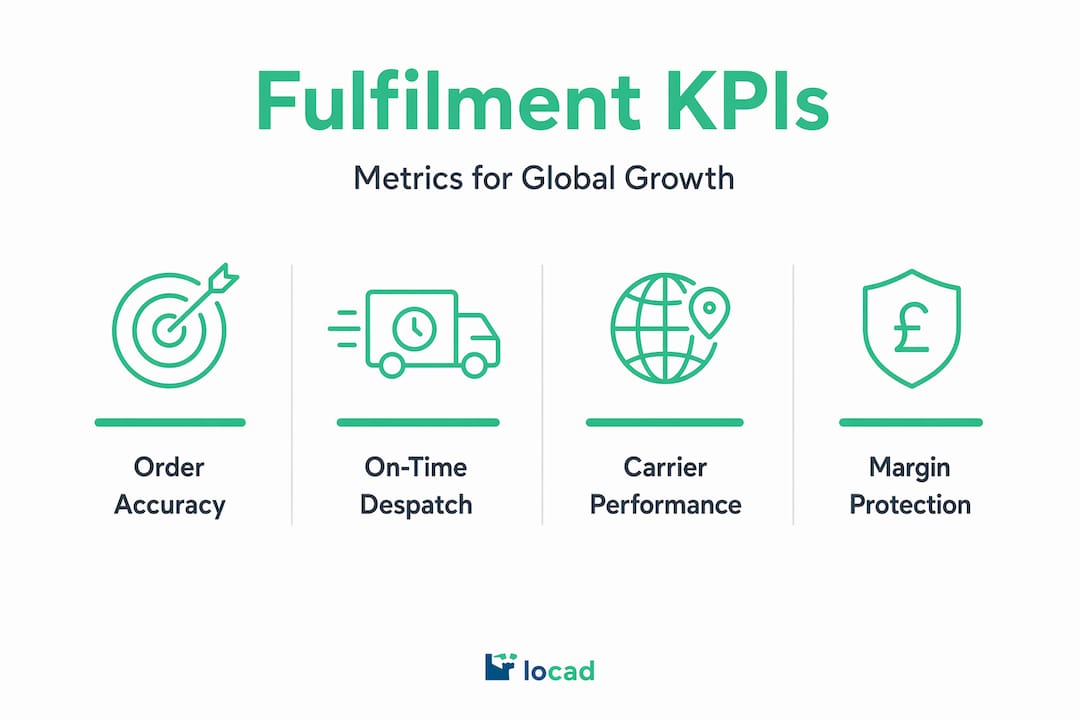
The key performance indicators you should track across all nodes are order accuracy rate, on-time despatch rate, carrier on-time delivery rate, return rate by region, and cost per order by node. Review these monthly and use the data to identify which nodes are underperforming and why. Most problems trace back to either data quality issues or integration gaps. Both are fixable, but you need the numbers to find them.
For a deeper look at optimising your overall logistics network to support growth, the logistics optimisation guide for 2026 covers tactics that apply directly to international scaling.
My honest take on global expansion
I have seen businesses treat global expansion as primarily a commercial decision, which it is, but execution is what determines whether that decision pays off. The brands that scale international fulfilment successfully share one trait: they invest in systems and compliance before they invest in volume.
What I have found consistently is that the bottleneck is rarely the shipping itself. It is inventory truth. When your stock data is inaccurate across nodes, everything downstream breaks. Orders route to locations with phantom stock. Customs declarations are wrong. Customers receive incorrect items. The problem compounds quickly.
My other strong view is that compliance should be treated as a living operational control, not a setup task. Compliance as an ongoing audit process rather than a one-time checklist is the only approach that holds up as you enter new markets and regulations evolve.
Regionalisation genuinely works. The cost and speed advantages are real. But those advantages only materialise if your integration is solid and your data is clean. I would always recommend starting smaller than feels comfortable, proving the model in one region with a limited SKU set, and then scaling with confidence rather than speed.
— Lukasz
How Parcelplanet supports your global growth
Growing your fulfilment network internationally requires a partner who understands the operational and compliance realities of cross-border trade.

Parcelplanet provides scalable order fulfilment services designed for e-commerce brands expanding across borders. From multi-channel inventory management and real-time order tracking to carrier integrations and international shipping support, the team at Parcelplanet brings hands-on expertise to every stage of your expansion. The inventory planning tools help you keep regional stock aligned with actual demand, reducing both overstock and out-of-stock situations across your fulfilment network. Whether you are just entering your first international market or scaling an existing network, Parcelplanet can help you build the operational foundation your growth requires. Get in touch for a tailored quote.
FAQ
What is a global fulfilment expansion guide?
A global fulfilment expansion guide is a structured framework that walks e-commerce businesses through the key stages of scaling their fulfilment operations internationally. It covers market research, compliance, regional network setup, systems integration, and performance management.
How do I start expanding my fulfilment network internationally?
Begin by analysing your order data to identify your highest-demand markets, then assess your infrastructure and compliance readiness before selecting regional fulfilment partners or warehouse locations.
What does DDP mean in international fulfilment?
DDP stands for Delivered Duty Paid. Under DDP, the seller takes responsibility for all import duties and customs formalities, which removes surprise charges for the customer at delivery and significantly reduces order rejection rates.
What are the most common compliance mistakes in international fulfilment?
The most frequent mistakes include incorrect HS code classification, missing VAT registrations in threshold markets, and failing to update compliance processes as regulations change. Regular audits by market are the most reliable way to catch and correct these issues.
Track order accuracy rate, on-time despatch rate, carrier on-time delivery rate, return rate by region, and cost per order by node. These five metrics give you a clear picture of where your network is working and where it needs attention.
Recommended


