TL;DR:
- Effective order fulfilment is essential for ecommerce growth, with speed, accuracy, SLA governance, and automation directly influencing conversions and customer retention. Building multi-node networks and automating returns reduce costs, transit times, and improve inventory availability, enabling scalable expansion. Regular SLA reviews and investing in technology are crucial for maintaining fulfilment quality and supporting long-term growth success.
Effective order fulfilment is the single most direct operational lever for ecommerce growth, connecting delivery speed, inventory accuracy, and cost control to conversion rates and customer retention. Research from Shopify shows that every 100ms of added latency reduces conversion by approximately 3.5%, a principle that extends directly to fulfilment: slow despatch, missed delivery windows, and poor returns handling all erode the revenue your marketing spend works to generate. Understanding how fulfilment accelerates growth means looking beyond the warehouse floor and into the mechanics of multi-node networks, SLA governance, and returns automation. These are the three levers that separate brands scaling confidently from those stuck firefighting logistics problems.
How fulfilment accelerates growth: the core mechanisms
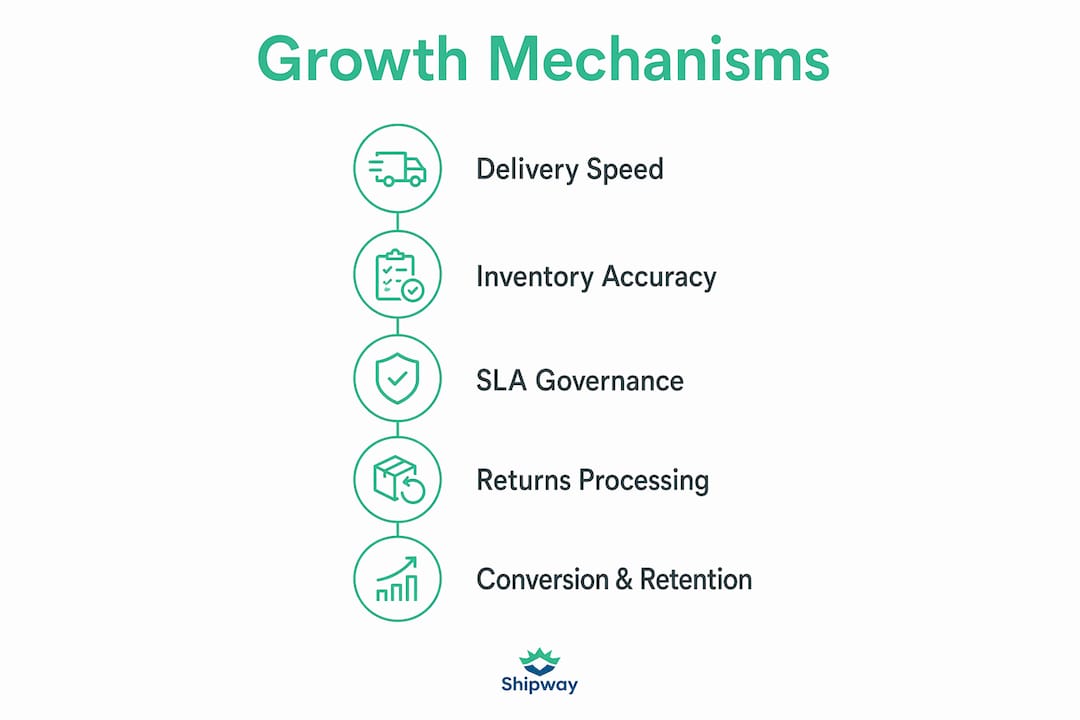
Order fulfilment, in the industry’s standard terminology, refers to the complete process from receiving stock to delivering a confirmed order to the customer, including returns handling. For ecommerce brands, the fulfilment strategy impact on growth operates through four distinct channels.
Delivery speed and customer expectations
Customers now treat fast delivery as a baseline expectation, not a premium feature. When your despatch times slip, cart abandonment rises and repeat purchase rates fall. The connection between speed and conversion is measurable and consistent across order volumes and product categories.
Pick, pack, and inventory accuracy
Incorrect picks and inaccurate inventory records create a compounding problem. A mispicked order generates a return, a customer service interaction, a restock delay, and a potential lost customer. Brands that secure customer loyalty through accurate fulfilment report materially higher lifetime values than those treating accuracy as a secondary metric.
Returns processing and restock velocity
Returns are not a cost centre to minimise. They are a growth system to manage. A return processed in 72 hours gets that product back on sale. A return sitting in a cage for 14 days is dead inventory that cannot fund your next purchase order.
Conversion and retention correlation
The four mechanisms above combine to produce a measurable effect on your two most important growth metrics: conversion rate and repeat purchase rate. Brands that address fulfilment challenges early consistently outperform peers on both.
Pro Tip: Track your return-to-resale cycle time as a standalone KPI. If it exceeds five days, you have a recoverable margin problem that no amount of marketing spend will fix.
How does a multi-node fulfilment network support faster growth?
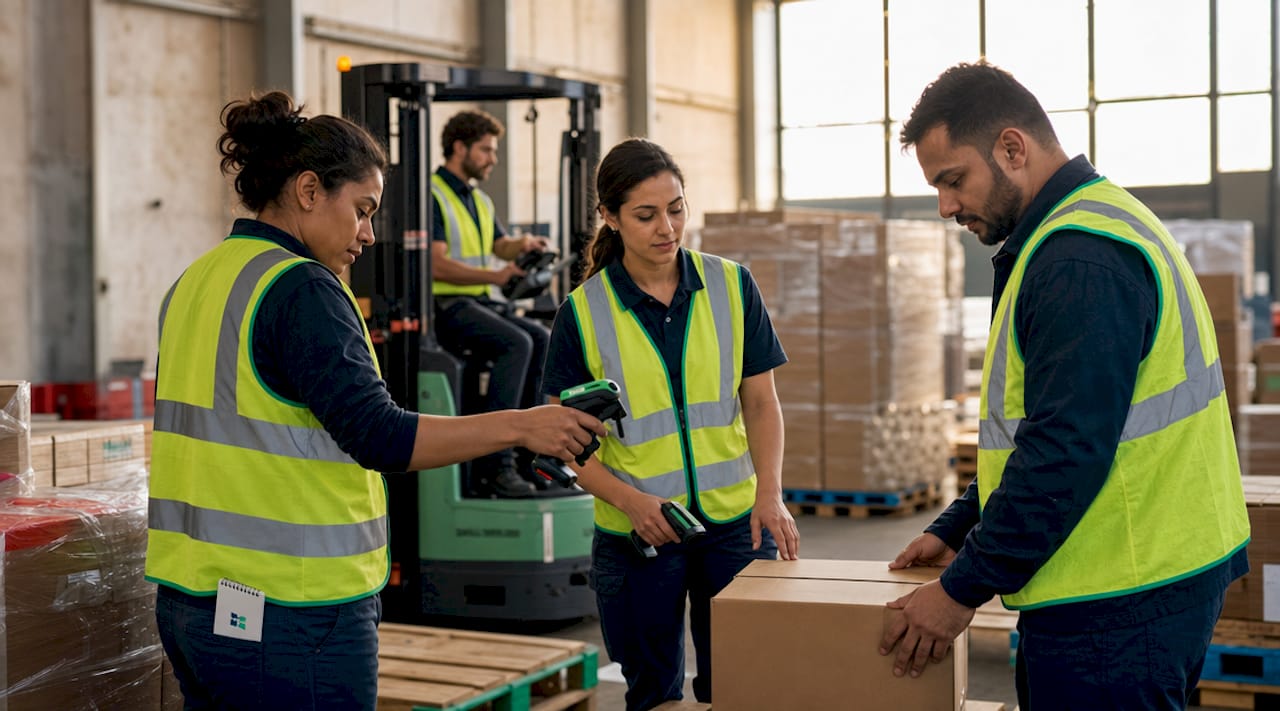
A multi-node fulfilment network distributes your inventory across multiple warehouse locations, placing stock closer to your customers and reducing the number of shipping zones each parcel crosses. Fewer zones mean lower carrier costs and shorter transit times, both of which feed directly into fulfilment efficiency growth.
The financial case is well established. Multi-node networks break even in 60 to 120 days for brands with sufficient order volume, driven by carrier cost reductions that compound month on month. For context, ShipBob’s 50-node US network covers 73% of US consumers within 100 miles, enabling annual carrier savings of £136,000 to £257,000 for brands shipping around 8,000 orders per month. That is not a marginal efficiency gain. It is growth capital recovered from your existing cost base.
Building a multi-node network requires four sequential decisions:
- Map your order geography. Identify where your customers are concentrated. If 60% of your orders ship to two regions, those regions define your first two nodes.
- Model the zone reduction. Calculate how many parcels currently cross three or more shipping zones and what the cost reduction looks like if those orders ship from a closer node.
- Select inventory placement tooling. Without a capable order management system (OMS) or inventory management system (IMS), inventory splitting fails to reduce zones even when the physical nodes are in place. The routing logic must match the network design.
- Set break-even targets before committing. Input costs include storage fees at each node, inbound freight to split inventory, and any minimum volume commitments. Model these against projected carrier savings before signing contracts.
The table below compares single-node and multi-node fulfilment across the metrics that matter most for scaling brands.
| Metric |
Single-node fulfilment |
Multi-node fulfilment |
| Average shipping zones crossed |
3 to 4 |
1 to 2 |
| Carrier cost per parcel |
Higher baseline |
15 to 30% lower |
| Average transit time |
3 to 5 days |
1 to 2 days |
| Break-even timeline |
Not applicable |
60 to 120 days |
| Operational complexity |
Low |
Medium to high |
The complexity column is worth noting. Multi-node networks require more sophisticated inventory management, and brands that deploy them without the right software infrastructure often find that proximity alone does not reduce delays. The zone optimisation benefit only materialises when routing logic assigns each order to the closest appropriate node automatically. You can also review Amazon FBA warehouse locations to understand how large-scale distributed networks are structured in practice.
What role does SLA governance play in sustaining fulfilment quality?
SLA governance is the practice of formally tracking, reviewing, and enforcing the service level agreements you hold with your 3PL provider. It is also the area where most ecommerce brands leave the most growth on the table.
The data is stark. The median OTIF rate across 137 Shopify brands is 94.2% against a contracted target of 98%. That gap represents orders arriving late or incomplete, and it compounds across every peak period. More troubling is the review frequency: only 22% of brands review SLA performance monthly, and 44% never review their contracted SLAs at all. A performance gap you are not measuring is a gap you cannot close.
The business impact of this accountability deficit is direct. Every percentage point below your OTIF target represents customer experience failures, negative reviews, and reduced repeat purchase probability. For brands scaling through fulfilment, the biggest constraint is often not warehouse capability but the absence of a governance process that holds the 3PL accountable.
Practical governance requires three things:
- Monthly SLA reviews with your 3PL covering OTIF, pick accuracy, and returns processing time. These should be structured meetings with data shared in advance, not informal check-ins.
- Chargeback clauses in your 3PL contract for consistent SLA misses. Without financial consequences, performance gaps persist. With them, they get resolved.
- Returns SLA management treated as a separate category. Returns must have their own peak-aware SLAs, audited regularly, because neglecting them risks margin erosion that directly reduces your capacity to fund growth.
Pro Tip: Request a rolling 90-day OTIF report from your 3PL at every monthly review. If they cannot produce it, that absence of data is itself a governance red flag worth addressing in your next contract negotiation.
Learning how to scale logistics operations effectively means building governance into your fulfilment model from the start, not retrofitting it after a peak period failure.
How can automation in fulfilment accelerate business outcomes?
Returns automation is the most immediately impactful technology investment available to scaling ecommerce brands in 2026. The economics are clear and the payback period is short.
Manual returns processing at a 3PL typically costs £2.75 to £3.95 per unit and takes an average of 14 days from receipt to resale. Brands integrating returns automation reduce per-return processing fees to £1.42 to £1.97 per unit and compress the return-to-resale cycle to under 72 hours. That is not just a cost saving. It is a fundamental change in how quickly returned inventory re-enters your available stock pool.
The table below compares manual and automated returns processing across the metrics that affect growth most directly.
| Metric |
Manual processing |
Automated processing |
| Processing cost per unit |
£2.75 to £3.95 |
£1.42 to £1.97 |
| Return-to-resale time |
~14 days |
Under 72 hours |
| Labour dependency |
High |
Low |
| Inventory accuracy |
Variable |
Consistent |
| Overall cost reduction |
Baseline |
30 to 40% |
Automated disposition workflows are the mechanism behind these improvements. When a return arrives at the warehouse, an automated system photographs the item, checks it against condition criteria, and routes it to the correct outcome: restock, refurbishment, liquidation, or disposal. This removes the manual inspection bottleneck and produces consistent, auditable decisions at scale.
The margin impact compounds over time. Returns automation cuts 3PL processing costs by 30 to 40%, and the recovered cost directly funds growth activities. For a brand processing 2,000 returns per month, the saving at the midpoint of those ranges represents meaningful annual capital that can be redirected to marketing, product development, or inventory investment. Exploring ways to reduce fulfilment costs further can compound these gains across your entire operation.
Key takeaways
Fulfilment drives ecommerce growth through four compounding mechanisms: delivery speed, inventory accuracy, SLA governance, and returns automation, each of which directly affects conversion rates, customer retention, and recoverable margin.
| Point |
Details |
| Speed drives conversion |
Every 100ms of added latency reduces conversion by ~3.5%, making despatch speed a direct revenue lever. |
| Multi-node networks pay back fast |
Distributed warehouse networks break even in 60 to 120 days and can save over £100,000 annually in carrier costs. |
| SLA governance is underused |
Only 22% of brands review SLA performance monthly, leaving a measurable OTIF gap unaddressed and growth constrained. |
| Returns automation changes the economics |
Automated returns cut processing costs by 30 to 40% and reduce return-to-resale time from 14 days to under 72 hours. |
| Inventory placement tooling is non-negotiable |
Multi-node networks fail to reduce zones without a capable OMS or IMS routing orders to the correct node automatically. |
The fulfilment decisions that actually move the needle
I have worked with enough ecommerce brands to know that the conversation about growth almost always starts with marketing and almost never starts with fulfilment. That is the wrong order. Your fulfilment operation is the physical expression of your brand promise, and when it underperforms, no amount of paid acquisition recovers the customer experience damage.
The insight that consistently surprises brand leaders is the SLA governance gap. Most assume their 3PL is performing because they have not heard otherwise. The Forthmatch data showing that 44% of brands never review their contracted SLAs is not an anomaly. It reflects a widespread assumption that signing a contract is the same as enforcing one. It is not.
The other shift I would encourage is treating returns as a growth system rather than a cost to suppress. Brands that invest in returns automation and set tight return-to-resale targets consistently report better cash flow and higher inventory availability during peak periods. Those two outcomes fund growth more reliably than most marketing channels.
Same-day and next-day shipping expectations are expanding beyond major urban centres in 2026. Brands that build multi-node networks now, with proper OMS infrastructure, will have a structural cost and speed advantage that late movers will struggle to close. The window to build that advantage affordably is open, but it will not stay open indefinitely. Choosing the right fulfilment partner is the decision that makes all the other decisions possible.
— Lukasz
How Parcelplanet supports your fulfilment growth strategy
Parcelplanet’s order fulfilment services are built for ecommerce and omnichannel brands that need accurate, fast, and scalable logistics without the overhead of managing it in-house.

Parcelplanet handles warehousing, picking, packing, and shipping across multiple sales channels and regions, with real-time tracking and integrations with leading ecommerce platforms and courier services. The service is designed to support the multi-node principles and SLA accountability frameworks covered in this article, giving your brand the operational foundation to grow without logistics becoming the constraint. If you are ready to explore how outsourcing fulfilment can accelerate your growth, get in touch with the Parcelplanet team for a tailored quote.
FAQ
Does fulfilment directly affect ecommerce conversion rates?
Yes. Research shows that delivery speed and store performance both influence conversion, with every 100ms of added latency reducing it by approximately 3.5%. Slow or unreliable fulfilment creates the same friction at the post-purchase stage.
What is a multi-node fulfilment network?
A multi-node fulfilment network distributes inventory across several warehouse locations to reduce shipping zones and transit times. Networks structured this way can break even within 60 to 120 days and deliver significant annual carrier cost savings for brands with sufficient order volumes.
Monthly reviews are the minimum standard. Only 22% of brands currently review SLA performance monthly, which means the majority are operating with undetected performance gaps that constrain growth.
What is the benefit of returns automation for growing brands?
Returns automation reduces processing costs by 30 to 40% and cuts return-to-resale time from approximately 14 days to under 72 hours, recovering both margin and inventory availability that fund further growth.
When should an ecommerce brand consider outsourcing fulfilment?
Outsourcing becomes the right decision when in-house logistics costs, space constraints, or operational complexity are limiting your ability to scale. The benefits of outsourcing fulfilment include access to established carrier networks, professional SLA management, and the ability to redirect internal resource toward growth activities.
Recommended


