TL;DR:
- Logistics flexibility allows quick adaptation to changing demands and supply disruptions without sacrificing efficiency.
- Building flexibility into systems improves resilience, customer satisfaction, and reduces costs during disruptions.
- Practical strategies include modular workflows, multi-source suppliers, shared inventory, carrier redundancy, and real-time visibility tools.
Efficiency has long been the holy grail of logistics. Lean processes, just-in-time stock, tightly optimised routes — for years, these were the markers of a well-run operation. Yet fast-growing e-commerce brands are discovering that maximum efficiency, without flexibility built in, leaves their fulfilment dangerously exposed. One unexpected demand spike, one supplier delay, one viral product launch, and a rigid system buckles. The brands winning in today’s unpredictable market are not simply the most efficient — they are the most adaptable. This article explains what logistics flexibility means, why it has become essential, and how you can put it to work across your fulfilment operation.
Table of Contents
Key Takeaways
| Point |
Details |
| Flexibility beats rigidity |
Flexible logistics systems handle market shifts better than rigid, single-path approaches. |
| Improves fulfilment results |
Brands using flexible logistics see fewer errors, faster delivery, and happier customers. |
| Reduces supply chain risks |
Operational flexibility buffers your business against disruptions and supply shocks. |
| Easy steps to implement |
Modular workflows and smart supplier choices make building flexibility realistic for growing brands. |
What is logistics flexibility and why is it vital?
Logistics flexibility is the ability of your fulfilment operation to adapt quickly and reliably to changing conditions, whether that means shifting order volumes, new product lines, seasonal peaks, or unexpected supply disruptions. It is not about abandoning efficiency. It is about building in the capacity to respond without breaking.
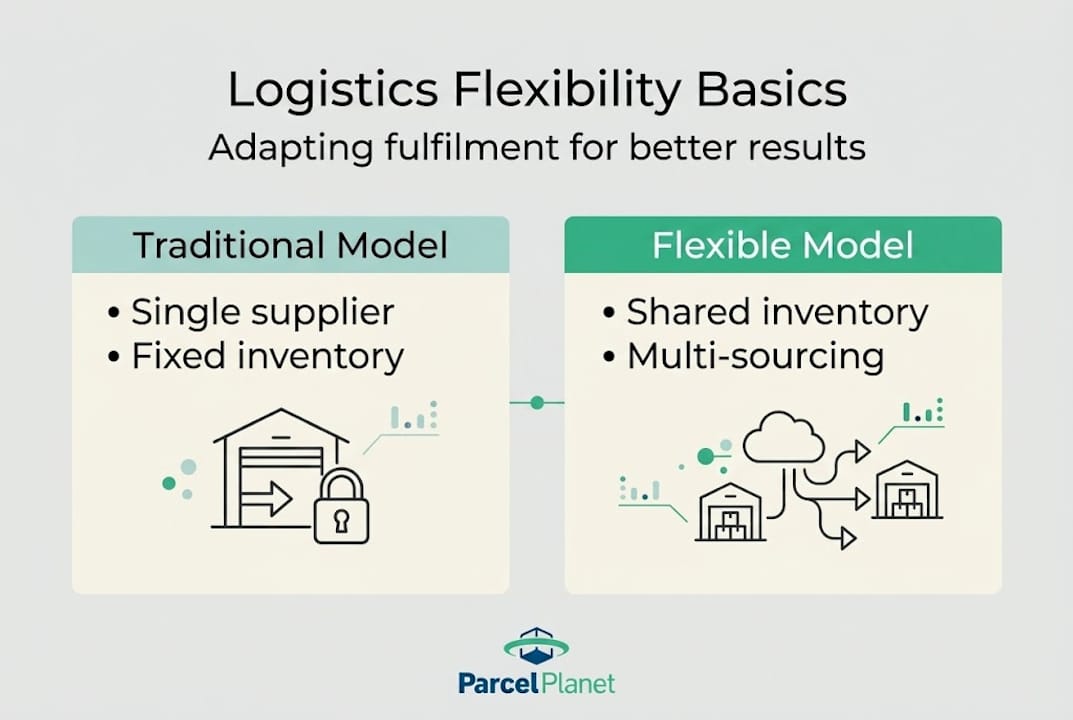
In practical terms, a flexible logistics system can handle multiple order types from a single pool of shared inventory. It can scale up during peak trading periods, shift workflows when a product range changes, and route orders through alternative carriers when one fails to deliver. Compare this to a rigid, single-path system, which optimises relentlessly for one scenario and struggles the moment reality changes.
Rigid systems are under real pressure right now. Supply chains face ongoing volatility from geopolitical shifts, raw material shortages, carrier capacity crunches, and unpredictable consumer behaviour. A system built for one steady state cannot cope gracefully with this level of variation.
Consider these real examples of where flexibility proves its worth in e-commerce:
- Subscription boxes: Order composition changes monthly. SKU combinations vary by customer tier. A flexible fulfilment system handles these variations without costly manual intervention.
- Bundled kits and promotional sets: Temporary product bundles require different pick-and-pack workflows. Flexibility allows you to activate and deactivate these workflows rapidly.
- Multi-channel e-commerce: Selling across your own website, marketplaces, and retail partners simultaneously requires one inventory pool to serve very different order formats and SLAs.
- Seasonal demand surges: Peak trading periods like Black Friday or Christmas demand rapid throughput increases. A flexible system scales without requiring permanent infrastructure investment.
As noted in the research on fulfilment flexibility, logistics flexibility enables handling diverse order types from shared inventory using modular workflows, reducing SKUs and costs while improving throughput. That is a compelling case in itself.
“Logistics flexibility is not a luxury for large enterprises. It is a structural advantage available to any brand willing to build adaptable systems, and it pays dividends in cost, speed, and customer satisfaction.”
You can explore how this applies in practice through our flexible fulfilment guide, which covers the core principles in detail.
The evolution from efficiency to flexibility
For decades, logistics strategy was dominated by one goal: maximum efficiency. Just-in-time inventory, single-source suppliers, lean warehousing, and tightly sequenced workflows all pointed in the same direction. Strip out every ounce of redundancy, reduce holding costs to zero, and run the leanest possible operation. This model worked brilliantly in stable, predictable conditions.
The problem is that stable, predictable conditions are no longer the norm.
When the COVID-19 pandemic disrupted global supply chains in 2020, ultra-lean logistics operations were among the hardest hit. Brands with no buffer stock, no alternative suppliers, and no adaptive workflows faced weeks or months of fulfilment failure. The contrast with more flexible operations was stark.
Here is how the two models compare:
| Feature |
Traditional efficiency model |
Flexible logistics model |
| Inventory approach |
Just-in-time, minimal buffer |
Shared pools with adaptive buffers |
| Supplier strategy |
Single source for cost savings |
Multi-source for resilience |
| Workflow design |
Fixed, optimised for one scenario |
Modular, switchable workflows |
| Response to disruption |
Slow, costly reconfiguration |
Rapid adaptation via contingency paths |
| Scalability |
Difficult without major investment |
Built-in capacity for volume changes |
| Cost structure |
Lower in stable conditions |
Better overall risk-adjusted cost |
The shift from efficiency to flexibility represents a new paradigm for resilience amid volatility, moving away from just-in-time and single paths towards agility and a smart mix of redundancy. Pure efficiency fails in disruptions, and the evidence from recent years makes that impossible to ignore.
This does not mean abandoning efficiency. The goal is not to run a wasteful, over-stocked, slow operation. Rather, it means building strategic redundancy and adaptability into the right points of your logistics flow, while maintaining lean principles everywhere that genuine stability exists.
“The brands that survived and thrived through recent disruptions were not the leanest — they were the ones who had invested in optionality: the ability to reroute, substitute, and scale.”
Pro Tip: Audit your current fulfilment process for single points of failure. If one carrier delays, one supplier fails, or one warehouse hits capacity, what happens? Every answer of “everything stops” is a signal to build in flexibility at that junction.
You can find a detailed roadmap for this kind of strategic review in our guide to optimising logistics growth.
The business value: How flexibility improves outcomes
The case for logistics flexibility is not just theoretical. Concrete, measurable business outcomes follow from building adaptability into your fulfilment operation, and the data from real disruption events is particularly persuasive.

Empirical evidence from COVID-19 shows that higher operational flexibility led to better inventory growth, fewer redundancies, and higher operational efficiency. Critically, smaller firms benefited more in inventory management than their larger counterparts. This matters directly for fast-growing e-commerce brands: you do not need to be a global enterprise to capture the benefits of flexibility. In fact, your size may be an advantage.
Here is how the performance differences look in practice:
| Performance metric |
Rigid logistics operation |
Flexible logistics operation |
| Inventory availability in disruption |
Frequently stockout |
Maintained through buffer strategy |
| Order fulfilment speed |
Slows under pressure |
Maintained or improved via adaptive routing |
| Workforce stability |
Layoffs during demand troughs |
Flexible staffing models retain capability |
| Customer satisfaction |
Drops during disruptions |
Sustained through reliable fulfilment |
| Recovery time after shock |
Weeks to months |
Days to weeks |
The business wins from flexible logistics span every part of your operation:
- Improved throughput: Modular workflows handle multiple order types simultaneously without bottlenecks.
- Workforce stability: Flexible staffing and process design mean you retain skilled people through peaks and troughs, rather than cycling through costly hiring and redundancy.
- Reduced excess inventory: Shared inventory pools serve multiple channels and order types, lowering total stock holdings while maintaining availability.
- Superior customer experience: Orders fulfilled accurately and on time, even during periods of disruption, drive retention and repeat purchase.
- Lower risk-adjusted cost: While some flexibility investments carry upfront cost, the reduction in disruption-related losses, expediting fees, and stockout penalties delivers a strong overall return.
For growing brands, the strategic case is clear. Scalable logistics for growth depends on building systems that remain reliable under pressure, not just systems that are cheap to run in ideal conditions. As order volumes increase and your product range expands, flexibility becomes the foundation that lets you scale without constant crisis management.
Understanding how scalable e-commerce logistics work in practice helps you translate these performance gains into your own fulfilment strategy.
Building flexible logistics: Key principles and proven strategies
Knowing that flexibility matters is one thing. Building it into your operation is another. The good news is that logistics flexibility is not a single, expensive transformation project. It is a set of design choices you can make incrementally, starting with the highest-risk areas of your current operation.
Here are the practical steps to introduce and strengthen logistics flexibility in your e-commerce business:
-
Adopt modular workflows. Design your pick, pack, and dispatch processes as interchangeable modules rather than fixed sequences. This allows you to activate different workflows for different order types, promotional bundles, or channel requirements without reconfiguring your entire operation.
-
Multi-source your suppliers. Relying on a single supplier for key products or packaging materials is one of the most common sources of rigid risk. Identifying at least one alternative source for critical inputs means you can switch rapidly when disruption hits, without losing fulfilment capability.
-
Implement shared inventory systems. Rather than ring-fencing stock for individual sales channels, move to a shared inventory pool that serves all channels. This increases availability, reduces total stock requirements, and gives you greater flexibility to prioritise fulfilment where it matters most.
-
Standardise packaging where possible. Standardised packaging reduces the number of carton sizes and materials you need to hold, simplifies packing workflows, and makes it easier to adapt to volume changes without a corresponding increase in complexity.
-
Build carrier redundancy into your shipping strategy. Working with multiple courier partners means that if one carrier experiences delays, capacity restrictions, or price increases, you can redirect volume without customer-facing disruption.
-
Invest in real-time visibility tools. Digital dashboards, warehouse management systems, and order tracking integrations give you the data you need to make fast, informed decisions when conditions change. Reactive decisions made with poor information are costly and slow.
-
Use AI-assisted planning and dynamic playbooks. The balance between redundancy and flexibility is best managed using AI tools and pre-built response playbooks that allow real-time adaptation rather than reliance on static plans. When a disruption signal appears, your system should already know the first three steps to take.
Pro Tip: Build flexibility into your supplier contracts, not just your physical logistics flows. Include provisions for volume changes, lead time flexibility, and alternative sourcing in your commercial agreements. Flexibility that exists only in your warehouse but not in your supply contracts will fail when you need it most.
You can get practical guidance on warehouse-level implementation through our warehouse flexibility tips, and broaden your approach with these e-commerce fulfilment strategies that bring these principles together.
Why chasing efficiency alone puts your fulfilment at risk
Here is the uncomfortable truth that the logistics industry has been slow to acknowledge: the metrics we used to celebrate efficiency have, in some cases, made operations more fragile. Inventory turns, cost-per-unit shipped, warehouse utilisation rates — these are all legitimate measures of operational performance. But they can become dangerous when optimised at the expense of resilience.
The “just-in-time” model delivered real value in an era of stable global supply chains. But that era has passed. The pandemic was not a once-in-a-generation anomaly. Supply chain shocks from extreme weather events, geopolitical conflict, shipping lane disruptions, and cyber incidents on logistics infrastructure are all increasing in frequency. Brands still running ultra-lean, single-path logistics are not just accepting risk — they are amplifying it.
We have seen this play out repeatedly. Brands that had invested in flexible fulfilment principles moved faster, retained customers, and came out of disruption periods stronger. Brands that had stripped out all redundancy spent those same periods apologising, expediting, and firefighting.
The reframe we would encourage every e-commerce leader to make is this: logistics is not just a cost centre to be optimised. It is a resilience engine that protects your revenue, your customer relationships, and your brand reputation when conditions get difficult. Investing in flexibility is not waste — it is insurance that pays a commercial return.
For fast-scaling brands specifically, this reframe is urgent. The faster you grow, the more complex your logistics become, and the more exposed you are to rigid systems that cannot keep pace. Building flexibility early, before a crisis forces it upon you, is consistently the smarter commercial decision.
Unlock next-level fulfilment with flexible logistics solutions
If this article has prompted you to look more critically at your current logistics approach, the next step is assessing where flexibility gaps exist in your operation and what it would take to close them.
At ParcelPlanet, we have built our fulfilment model around the exact principles covered here: modular workflows, shared inventory, multi-carrier integration, and real-time visibility tools that keep your operation adaptive. Our flexible order fulfilment services are designed for growing e-commerce brands that need a partner capable of scaling with them and absorbing the unexpected. Pair that with our flexible inventory solutions, and you have the operational foundation to fulfil confidently across every channel and every season. Get in touch to explore a tailored fulfilment solution for your brand.
Frequently asked questions
How does logistics flexibility impact customer satisfaction?
Greater flexibility in fulfilment enables faster, more accurate order processing across diverse order types, reducing delays and errors that damage the customer experience.
Is logistics flexibility more expensive than efficient, rigid systems?
While flexibility may require upfront investment in systems or supplier relationships, the cost of rigid failure during disruptions far outweighs the cost of building adaptability in advance.
What practical steps can e-commerce brands take to build logistics flexibility?
Brands can begin with modular workflows, multi-sourcing suppliers, and shared inventory pools, supported by AI-driven planning tools that allow real-time adaptation over rigid static plans.
Did smaller e-commerce businesses really benefit more from logistics flexibility during recent disruptions?
Yes. Research on COVID-19 disruptions confirms that smaller firms with higher operational flexibility achieved better inventory growth and greater stability than larger, less adaptable competitors.
Recommended