Managing logistics becomes exponentially harder as your e-commerce business scales. What worked when you shipped 10 orders daily from your garage fails spectacularly at 100 orders, and choosing the wrong third-party logistics (3PL) partner compounds these problems with hidden fees, integration failures, and operational bottlenecks. This guide walks you through a structured, data-driven approach to evaluate and select the optimal 3PL partner for your growing brand, helping you avoid costly mistakes whilst building a foundation for sustainable expansion.
Table of Contents
Key Takeaways
| Point |
Details |
| Structured evaluation scorecards |
A structured RFP process with weighted scorecards enables objective comparison of 3PL providers. |
| Tech cost and fit |
The most important criteria include technology, cost, scalability and industry fit. |
| Test integrations avoid hidden fees |
Testing integrations and avoiding hidden fees prevent post switch headaches. |
| Early switch timing |
Switching proactively as volumes approach ten to twenty orders per day improves efficiency and readiness for growth. |
Understanding your 3PL needs and preparation
Before contacting any 3PL provider, conduct a thorough audit of your current logistics operations and future requirements. This preparation ensures you ask the right questions and evaluate proposals against your actual needs rather than generic checklists.
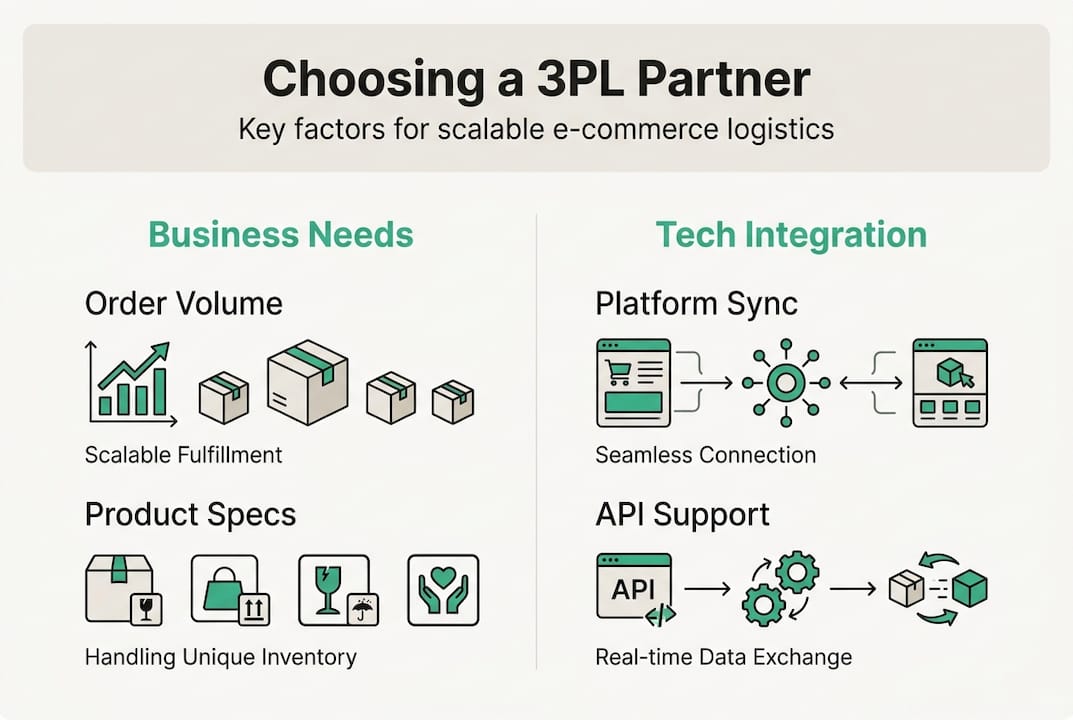
Start by documenting your current order volume and realistic growth projections for the next 12-24 months. Many brands underestimate their growth trajectory, then find themselves locked into contracts with providers lacking the capacity to scale. If you’re processing 15-25 orders daily now, plan for 50-100 within 18 months and select partners who can handle that volume without renegotiating terms.
Your product characteristics directly impact 3PL requirements. Temperature-sensitive goods, hazardous materials, high-value items, and oversized products each demand specialised handling capabilities and compliance expertise. Document any regulatory requirements, special packaging needs, or quality control protocols your products require. A generalist 3PL might quote lower rates but lack the infrastructure to handle your specific needs properly.
Define your budget parameters transparently, including current per-order fulfilment costs and acceptable cost ranges for outsourced operations. Understanding your break-even point helps you evaluate whether a 3PL’s pricing genuinely delivers value or simply shifts costs around. Factor in the hidden costs of managing logistics internally, such as warehouse rent, staff wages, packaging materials, and your own time spent coordinating shipments.
Technology integration requirements deserve careful consideration upfront. List every platform you use: e-commerce systems like Shopify or WooCommerce, inventory management software, accounting tools, and customer service platforms. Your 3PL must integrate seamlessly with these systems to avoid manual data entry and reconciliation headaches. Request specific details about API capabilities, EDI standards, and real-time synchronisation protocols during initial discussions.
Geographic shipping requirements shape your 3PL selection significantly. If 80% of your customers live in the Southeast, a 3PL with warehouses in Scotland creates unnecessary shipping delays and costs. Map your customer distribution and identify optimal warehouse locations that enable two-day ground shipping to your primary markets. The fulfilment partner selection guide for scalable e-commerce success provides frameworks for matching warehouse locations to customer demographics.
Pro Tip: Create a one-page business profile summarising your order volumes, product specifications, growth targets, technology stack, and geographic priorities. Share this document with every 3PL candidate to ensure consistent, comparable proposals that address your actual requirements rather than generic service descriptions.
Using a structured RFP process with weighted scorecards
Objective 3PL selection requires moving beyond gut feelings and sales pitches to data-driven evaluation. A structured RFP process with weighted scorecards enables you to compare providers systematically across the criteria that matter most to your business.
Begin by defining evaluation categories and assigning weights based on your priorities. Industry research suggests weighting technology at 25-37%, delivery performance at 25%, cost at 20-25%, and scalability at 20%, but adjust these percentages to reflect your specific situation. A brand launching internationally might weight geographic coverage higher, whilst a subscription box company might prioritise kitting and customisation capabilities.
Your RFP should request specific, quantifiable information in each category:
- Industry experience: years operating, client retention rates, vertical expertise, case studies from similar brands
- Technology capabilities: integration methods, real-time inventory visibility, reporting dashboards, mobile access, API documentation
- Cost structure: per-order fees, storage rates, receiving charges, returns processing, minimum commitments, peak season surcharges
- Scalability metrics: maximum daily order capacity, warehouse expansion plans, multi-location capabilities, seasonal flex capacity
- Delivery performance: average ship times, carrier partnerships, shipping zones covered, on-time delivery rates, damage/error rates
Structure your scorecard to convert qualitative responses into numerical ratings. For example, score technology integration as follows:
- Create a comparison table for all RFP responses:
| Provider |
Technology Score |
Delivery Score |
Cost Score |
Scalability Score |
Total (Weighted) |
| Provider A |
8/10 (×0.30) |
9/10 (×0.25) |
6/10 (×0.20) |
7/10 (×0.25) |
7.55 |
| Provider B |
9/10 (×0.30) |
7/10 (×0.25) |
8/10 (×0.20) |
8/10 (×0.25) |
8.05 |
| Provider C |
7/10 (×0.30) |
8/10 (×0.25) |
9/10 (×0.20) |
6/10 (×0.25) |
7.40 |
-
Supplement scores with reference checks from current clients in your industry and order volume range. Ask specific questions about integration challenges, billing surprises, and how the 3PL handled growth spurts or operational problems.
-
Conduct pilot programmes with your top two candidates before making final decisions. Ship 50-100 orders through each provider to test order accuracy, shipping speed, integration reliability, and customer service responsiveness under real conditions.
This systematic approach transforms 3PL selection from a gamble into a calculated decision backed by comparable data. The top scalable logistics solutions for e-commerce growth demonstrates how leading brands use these frameworks to identify partners that genuinely support expansion rather than creating new bottlenecks.
Pro Tip: Weight your scorecard categories before receiving proposals to prevent unconscious bias towards providers who excel in less important areas. Lock in your evaluation criteria and weightings, then score all responses against the same framework for true comparability.
Key considerations and common pitfalls when choosing a 3PL
Even with structured evaluation processes, specific considerations and common mistakes can derail your 3PL selection. Understanding these nuances helps you avoid expensive errors that only become apparent after you’ve switched operations.
Vertical expertise matters far more than most brands initially recognise. A 3PL specialising in fashion handles returns, seasonal inventory fluctuations, and SKU proliferation differently than one focused on electronics or consumables. Generalist providers lack the specialised knowledge for regulated products like supplements, cosmetics, or food items, leading to compliance violations, improper storage, and increased liability exposure. Prioritise candidates with demonstrated experience in your specific product category, even if their base rates appear slightly higher.
Technology integration failures create ongoing operational friction that compounds over time. Beyond confirming API availability, test the actual integration process during pilot programmes. Verify that inventory updates occur in real-time, order data flows bidirectionally without manual intervention, and error handling protocols prevent orders from falling through cracks. Request access to the provider’s technology roadmap to ensure their platform evolves alongside e-commerce innovations rather than becoming obsolete.
Pricing transparency separates professional 3PLs from those banking on hidden fees and contract lock-in. Scrutinise proposals for vague language around “additional charges” or “standard fees.” Demand itemised breakdowns of every potential cost: receiving fees per pallet, storage charges per cubic foot, pick and pack rates per item, shipping materials, special handling, returns processing, and account management fees. Poor 3PL fit leads to costly manual reconciliation when billing discrepancies require hours of investigation each month.
Common pricing pitfalls include:
- Minimum monthly fees that exceed your actual usage during slower periods
- Storage calculated on reserved space rather than actual inventory levels
- Per-item pick fees that make multi-item orders prohibitively expensive
- Inbound receiving charges that weren’t disclosed in initial quotes
- Peak season surcharges applied broadly rather than to actual capacity constraints
Contract terms deserve legal review before signing. Watch for auto-renewal clauses, lengthy termination notice periods, and inventory transfer fees that trap you with underperforming providers. Negotiate performance guarantees with financial remedies for missed service levels, and ensure you retain ownership of all customer data and can export it in standard formats.
“Switching 3PLs mid-growth creates operational chaos. Invest time in thorough evaluation upfront to avoid the disruption and costs of changing providers after you’ve already migrated operations.”
Geographic coverage affects both shipping costs and delivery speeds. A single warehouse location forces you to use expensive expedited shipping to reach distant customers quickly, whilst multi-location 3PLs enable cost-effective ground shipping with faster transit times. However, splitting inventory across multiple warehouses increases complexity and can create stock-outs if allocation algorithms aren’t sophisticated. The order fulfilment challenges faced by growing companies often stem from geographic distribution mismatches between warehouse locations and customer concentrations.
Evaluating scalability and aligning with your growth strategy
Your 3PL selection must support not just current operations but your business trajectory over the next 3-5 years. Switching providers mid-growth creates operational disruption, customer service problems, and strategic distraction when you can least afford it.

Assess scalability across multiple dimensions beyond simple order volume capacity. Technology platforms should accommodate increasing SKU counts, multiple sales channels, international expansion, and evolving customer expectations without requiring system replacements. Question providers about their largest clients’ order volumes and growth rates to verify they’ve successfully scaled operations similar to your projections.
Compare scalability features systematically:
| Capability |
Provider A |
Provider B |
Provider C |
| Maximum daily orders |
5,000 |
15,000 |
3,000 |
| Warehouse locations |
2 (UK only) |
8 (UK + EU) |
1 (UK only) |
| International shipping |
Limited |
Extensive |
None |
| Contract flexibility |
12-month minimum |
Month-to-month after 6 months |
24-month minimum |
| Technology updates |
Annual |
Quarterly |
Infrequent |
| Multi-channel support |
Basic |
Advanced |
Moderate |
Contract flexibility enables you to adjust services as your business evolves without renegotiating entire agreements. Providers offering modular pricing and month-to-month terms after initial commitments give you room to experiment with new channels, test markets, and pivot strategies without contractual constraints. Scorecards should prioritise scalability and growth alignment to ensure your 3PL supports increasing order volumes efficiently rather than becoming a growth bottleneck.
Geographic expansion capabilities determine whether your 3PL can support international growth or new market entry. Providers with established operations in target markets offer faster, cheaper shipping and better returns handling than those requiring you to coordinate multiple regional partners. Verify their customs clearance expertise, international carrier relationships, and landed cost calculation accuracy before committing.
Multi-warehouse support becomes essential as you scale beyond regional operations. Distributed inventory reduces shipping costs and transit times but requires sophisticated allocation algorithms to prevent stock-outs whilst minimising total inventory investment. Question providers about their inventory distribution logic, rebalancing procedures, and how they handle transfers between locations.
Technology adaptability ensures your 3PL keeps pace with e-commerce evolution. Providers investing in automation, AI-powered demand forecasting, and advanced analytics deliver competitive advantages that compound over time. Request their technology roadmap and ask about recent platform enhancements to gauge their innovation commitment. The guide to optimising logistics for scalable e-commerce growth explains how leading 3PLs leverage technology to drive efficiency improvements that benefit their clients.
Align your 3PL choice with long-term business plans by mapping their capabilities against your strategic roadmap. If you plan to launch subscription boxes, ensure they offer kitting and customisation services. If international expansion sits on your three-year horizon, verify their global fulfilment capabilities now rather than facing another provider switch later. Understanding what logistics scalability means for e-commerce fulfilment helps you evaluate whether providers can genuinely grow alongside your business.
Pro Tip: Request client retention statistics and ask why customers leave. High churn rates signal scalability problems, whilst long-term client relationships indicate the provider successfully supports growth. Speak with clients who’ve been with the 3PL for 3+ years about how the partnership evolved as their businesses scaled.
Discover ParcelPlanet’s 3PL solutions for scalable growth
Choosing the right 3PL partner transforms logistics from a growth constraint into a competitive advantage. ParcelPlanet specialises in reducing logistics costs for SMEs whilst providing the flexibility and technology integration growing e-commerce brands require.
Our order fulfilment services combine advanced warehouse management systems with seamless e-commerce platform integrations, delivering real-time inventory visibility and automated order processing that eliminates manual reconciliation. Flexible contract terms and transparent pricing mean you scale operations smoothly without hidden fees or lengthy commitments constraining your growth.
Whether you’re processing 20 orders daily now or planning for 200, ParcelPlanet’s scalable infrastructure and expert support team ensure your logistics operations enhance rather than limit your business expansion. Discover when to consider switching your 3PL provider and how our tailored solutions address the specific challenges outlined in this guide.
FAQ
What is the best time to switch to a 3PL partner?
The optimal time to engage a 3PL is when you reach 10-20 orders daily, before logistics complexity overwhelms your internal operations. Proactive switching at this threshold prevents the operational chaos and customer service problems that emerge when you wait until fulfilment failures force emergency changes. Early partnership also gives you time to test integrations and refine processes during manageable volumes rather than under crisis conditions. Review when to consider switching your 3PL provider for specific indicators that signal readiness for outsourced fulfilment.
Run pilot programmes to test technology integrations before full commitment, verifying that API connections synchronise inventory, orders, and tracking data in real-time without manual intervention. Request detailed technical documentation about their integration methods, supported platforms, and error handling protocols during the evaluation phase. Require clear service level agreements covering data synchronisation frequency, system uptime, and resolution timeframes for integration failures. ParcelPlanet’s e-commerce integrations support major platforms with pre-built connectors that eliminate custom development requirements.
What are common hidden fees to watch for in 3PL contracts?
Storage fees often extend beyond simple pallet costs to include minimum space commitments, long-term storage surcharges, and inventory receiving charges that weren’t disclosed upfront. Order minimum surcharges penalise slower months by charging fees when your volume falls below contractual thresholds. Watch for hidden fees in long contracts covering returns processing, special handling for oversized items, peak season capacity charges, and account management fees that add 15-25% to quoted base rates. Demand itemised pricing breakdowns for every potential charge and negotiate caps on variable fees to protect against billing surprises.
Why is vertical expertise important when choosing a 3PL?
Specialists understand product-specific handling requirements, regulatory compliance, and returns management far better than generalist providers attempting to serve every industry. Vertical-specific 3PLs handle specialised products with appropriate storage conditions, quality control protocols, and documentation accuracy that prevent costly compliance violations and product damage. They typically deliver enhanced service levels, fewer fulfilment errors, and faster problem resolution because their teams encounter your product category’s unique challenges daily rather than occasionally. This expertise becomes particularly valuable for regulated categories like cosmetics, supplements, or food items where improper handling creates legal liability beyond simple operational costs.
Recommended