TL;DR:
- Effective inventory management distinguishes growing businesses from those hemorrhaging cash due to stock issues.
- Standardizing product data, implementing control techniques like ABC analysis, and utilizing real-time tracking tools ensure inventory accuracy and operational efficiency.
Knowing how to manage inventory well is the difference between a business that grows confidently and one that haemorrhages cash through stockouts, dead stock, and fulfilment errors. Inventory management success depends on consistent workflow discipline, not one-off fixes. Yet most retail and e-commerce managers are still reacting to problems rather than preventing them. This guide cuts through the noise and gives you a practical, structured approach to inventory control that works whether you are handling 50 SKUs or 5,000.
Table of Contents
Key takeaways
| Point |
Details |
| Build clean product data first |
Standardise your SKUs and barcodes before adding any automation or software tools. |
| Use ABC analysis to prioritise |
Focus your tightest controls on the 20% of products that generate 80% of your revenue. |
| Automate tracking where possible |
Mobile scanning and perpetual inventory systems reduce human error and deliver real-time accuracy. |
| Count stock little and often |
Daily cycle counts outperform annual stocktakes for accuracy and operational continuity. |
| Review KPIs on a weekly cadence |
Tracking turnover, stockout rate, and dead stock regularly keeps your decisions grounded in real data. |
How to manage inventory: the foundation
Before you can control inventory, you need clean data. This sounds obvious, yet it is where most businesses stumble. Inconsistent product naming, duplicate SKUs, and missing barcodes create a chain reaction of errors that no software can fix on your behalf.
Start by standardising your product catalogue:
- Assign a unique SKU to every product variant, including size, colour, and bundle configurations.
- Use barcodes or QR codes on all stock items so receiving and picking can be scanned rather than typed.
- Differentiate clearly between sellable units and inner pack or master carton quantities to avoid count confusion.
- Document your naming conventions in writing so every team member uses the same format.
Once your product data is clean, establish a formal receiving workflow. Every delivery should be checked against a purchase order, scanned into your inventory system, and put away to a designated location before the paperwork closes. Skipping any step here is where shrinkage begins. Multi-location inventory visibility depends entirely on data being entered at the point of receiving, not hours or days later.
Assign clear ownership to the receiving process. One person or team should be responsible for counts, discrepancies, and system updates. Accountability at this stage sets the tone for everything downstream.
Pro Tip: Create a one-page receiving checklist posted at your goods-in area. It takes ten minutes to produce and prevents weeks of reconciliation headaches.
Inventory control techniques that actually work
With your foundation in place, you can apply proven control methods that match your business model. The four techniques below cover the majority of e-commerce and retail scenarios.
ABC analysis
80% of your revenue typically comes from just 20% of your product range. ABC analysis sorts your catalogue into three tiers: A items (high value, tight control), B items (moderate value, regular review), and C items (low value, minimal oversight). This stops you wasting the same energy on a slow-moving accessory as you would on your best-selling hero product.
Economic Order Quantity and reorder points
The Economic Order Quantity (EOQ) model helps you calculate the order size that balances the cost of ordering frequently against the cost of holding excess stock. Paired with a reorder point (ROP), you get a system that triggers replenishment automatically before you run out.
The ROP formula is straightforward: ROP = (average daily demand × lead time) + safety stock. For example, if you sell 30 units per day, your supplier takes 5 days to deliver, and you want 50 units of safety stock, your reorder point is (30 × 5) + 50 = 200 units. When stock drops to 200, you place the order.
Just-In-Time inventory
Just-In-Time (JIT) reduces the amount of stock you hold at any given time by aligning deliveries closely with demand. It cuts carrying costs significantly but requires reliable suppliers and accurate demand forecasting to avoid stockouts.
Here is a quick comparison to help you choose:
| Technique |
Best for |
Main advantage |
Main risk |
| ABC analysis |
All businesses |
Prioritises effort and resources |
Requires regular re-ranking |
| EOQ + ROP |
Steady demand products |
Automates replenishment triggers |
Less suited to volatile demand |
| Just-In-Time |
Fast-moving goods, lean operations |
Reduces carrying costs |
Supplier delays cause stockouts |
| Safety stock buffers |
Seasonal or unpredictable SKUs |
Protects against demand spikes |
Increases holding costs if overdone |
Pro Tip: Review your ABC rankings quarterly. Products shift tiers as trends change, and an outdated ranking can leave your most profitable items under-managed.
Technology and real-time inventory tracking
Periodic inventory systems, where you count stock once a month or once a year, are no longer fit for purpose in e-commerce. A single day of inaccurate data can mean overselling, customer disappointment, and returns you did not plan for. Perpetual inventory systems update stock levels in real time with every transaction, giving you the visibility you need to make decisions confidently.
The tools that make this work include:
- Mobile barcode scanners: Scanning during receiving, picking, and returns removes the manual keying errors that corrupt your data at source. Your inventory system becomes the single source of truth rather than a best guess.
- RFID technology: Useful for high-volume operations where scanning individual items is too slow. RFID readers can count multiple items simultaneously, reducing labour time during counts.
- Platform integrations: Connect your POS, e-commerce storefront, and inventory management software so stock levels update across all channels in one place. This prevents the painful situation of selling items on your website that your warehouse ran out of yesterday.
Cycle counting is the operational habit that keeps all of this honest. Rather than shutting down for an annual stocktake, you count a small subset of SKUs every day. Daily cycle counts are more accurate and far less disruptive than full physical audits. Rotate through your entire catalogue on a regular schedule, and you will catch discrepancies while they are small rather than discovering major variances at year end.
AI-driven demand forecasting takes this further by analysing sales patterns, promotional calendars, and seasonal trends to predict what you will need before you need it. Even mid-sized businesses can now access these tools through mainstream inventory platforms, reducing the stock swings that result from over-reacting to short-term demand signals.

Pro Tip: When setting up cycle counting, start with your A items. Count them weekly, B items monthly, and C items quarterly. This gives you maximum accuracy where it matters most without overwhelming your team.
Managing returns, shrinkage, and stock accuracy
Returns are unavoidable in e-commerce. How you process them determines whether they protect your inventory accuracy or silently erode it. The worst thing you can do is drop returned stock back into your available inventory without inspecting it first.
A disciplined returns workflow looks like this:
- Receive the return and scan it against the original order immediately upon arrival.
- Physically inspect the item and triage it into one of three conditions: sellable, damaged, or faulty for supplier claim.
- Apply a reason code in your inventory system (customer change of mind, product defect, incorrect item, and so on) so you can spot patterns over time.
- Move sellable stock back to the correct location and update the system accordingly. Quarantine damaged or faulty items in a clearly labelled area.
- Review return reason codes monthly to identify product quality issues, listing errors, or packaging problems driving high return rates.
Promptly scanning returned items and applying reason codes maintains your inventory valuation integrity and gives you the data to address root causes rather than just absorbing the losses.
Shrinkage from theft, damage, and miscounts is a separate challenge. Record every inventory adjustment with a reason code, not just a quantity change. Monthly reviews of shrink patterns by category, location, or team shift will surface process gaps you would not otherwise notice. Storage layout also plays a role. Relocating excess or seasonal stock to off-site facilities keeps your primary fulfilment space clear and reduces the picking errors that come from overcrowding.
Data-driven reviews and continuous improvement
You cannot improve what you do not measure. The key KPIs for inventory effectiveness are inventory turnover ratio, stockout rate, carrying costs, and dead stock percentage. Each one tells you something different about where your operation is under strain.
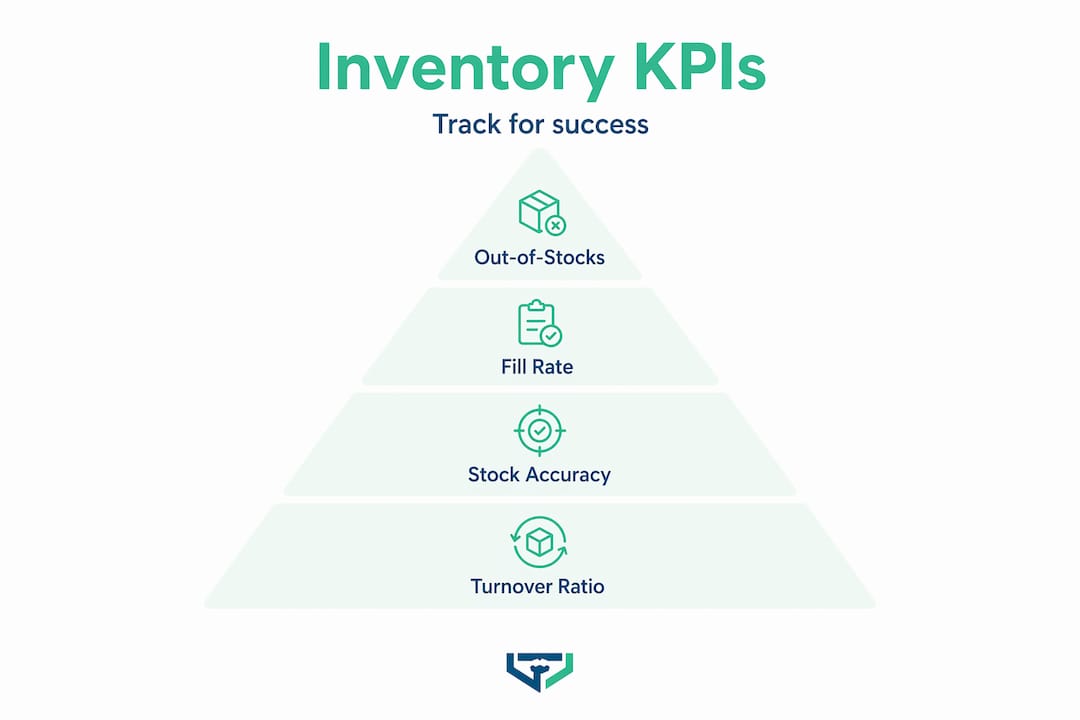
Here is what to track and how often:
| KPI |
What it tells you |
Review frequency |
| Inventory turnover ratio |
How efficiently you are selling through stock |
Monthly |
| Stockout rate |
How often products are unavailable when customers want them |
Weekly |
| Carrying costs |
The cost of holding current stock levels |
Monthly |
| Dead stock percentage |
Proportion of stock not sold within a set period |
Monthly |
| Return rate by SKU |
Which products are being returned most and why |
Weekly |
Build a weekly reporting rhythm into your operations. Every Monday, review your top sellers, flag any products with fewer than two weeks of stock remaining, and check return rates for spikes. This turns inventory management from a reactive scramble into a predictable operational habit.
Adjust your reorder points and safety stock levels based on what the data shows. If a product consistently runs out before the replenishment arrives, increase your safety stock or shorten your reorder point trigger. If you are holding three months of a slow-moving SKU, reduce your order quantity and free up the working capital.
For your inventory management workflow, the goal is a system where exceptions surface automatically and decisions are grounded in real numbers rather than gut feel.
My perspective on getting inventory management right
I have worked with enough e-commerce and retail operations to know that the businesses struggling most with inventory are not using the wrong software. They are skipping the basics inconsistently. Receiving workflows get rushed when the team is busy. Cycle counts are postponed when things are hectic. Returns pile up unprocessed. And then, three months later, someone wonders why the stock report does not match the shelf.
What I have learned is this: inventory accuracy is a daily discipline, not a project. The businesses that get it right treat receiving, counting, and returns with the same seriousness they give to sales and marketing. They do not wait for a crisis to audit their processes.
I have also seen a genuine shift when teams embrace real-time data. Once managers can trust their inventory numbers, they stop over-ordering as insurance and start making sharper decisions about what to stock, when to reorder, and when to clear. That confidence compounds over time.
My honest advice is to pick the two or three habits from this guide that your team is currently skipping, embed them first, and then layer in technology. Automation scales good habits. It does not fix bad ones. If you are exploring options for managing volume growth, understanding why 3PL partnerships scale fulfilment is a worthwhile read alongside what you have learned here.
— Lukasz
How Parcelplanet supports your inventory and fulfilment
Growing your product range and order volumes is exciting. Managing the logistics behind it is where many e-commerce businesses hit their ceiling. Parcelplanet’s order fulfilment services are built to take the operational weight off your team, with accurate pick and pack, real-time tracking, and warehouse management that connects directly to your sales channels.

Through Parcelplanet’s software integrations, your inventory data stays synchronised across your e-commerce platform, marketplace listings, and fulfilment operations without manual updates. Whether you are scaling from hundreds to thousands of orders per week or expanding into new regions, Parcelplanet gives you the infrastructure to grow without the growing pains. Get in touch for a tailored quote and see how the team can support your next stage.
FAQ
What is inventory management in e-commerce?
Inventory management in e-commerce is the process of tracking, ordering, and organising stock so that the right products are available to fulfil customer orders accurately and on time. It covers everything from receiving goods to processing returns.
How do I set a reorder point for my products?
Use the formula: ROP = (average daily demand × supplier lead time) + safety stock. This triggers replenishment at the right moment, preventing stockouts without excessive over-ordering.
What is ABC analysis in inventory control?
ABC analysis categorises your stock by revenue contribution. A items represent the top 20% of products generating around 80% of revenue and require the tightest management, while B and C items receive progressively less intensive oversight.
How often should I count my inventory?
Cycle counting daily or weekly on a rotating schedule is more accurate and less disruptive than an annual full stocktake. Count A items most frequently and work down through B and C tiers based on their value and movement rate.
The most useful KPIs are inventory turnover ratio, stockout rate, carrying costs, dead stock percentage, and return rate by SKU. Reviewing these on a weekly and monthly basis gives you an early warning system for problems before they affect customers.
Recommended