TL;DR:
- Outsourcing fulfilment reduces costs, improves speed, and enhances scalability for growing e-commerce brands.
- Proper preparation, provider evaluation, and pilot testing are essential for successful 3PL partnerships.
- Ongoing performance monitoring and clear SLAs help maximize benefits and maintain customer satisfaction.
Managing rapid order growth while keeping your warehouse running smoothly is one of the hardest operational challenges in e-commerce. When order volumes surge, in-house fulfilment quickly becomes a bottleneck: space runs out, picking errors increase, and your team spends more time packing boxes than driving growth. Outsourcing fulfilment to a trusted third-party logistics provider, known as a 3PL, gives you access to professional infrastructure, volume-based courier rates, and scalable capacity without the fixed overhead. This guide walks you through the benefits, the preparation you need, the practical steps to outsource, and how to verify results once you are live.
Table of Contents
Key Takeaways
| Point |
Details |
| Outsourcing benefits |
Businesses can reduce costs and complexity by hiring specialist fulfilment providers. |
| Preparation is crucial |
Properly assessing needs and readiness avoids costly mistakes later. |
| Follow a phased approach |
Outsourcing in stages with pilots and KPI tracking ensures lasting results. |
| Monitor for success |
Continual measurement and process improvements are key to maximising fulfilment ROI. |
Understanding fulfilment outsourcing and its benefits
Fulfilment outsourcing means handing over your warehousing, picking, packing, and shipping operations to a specialist 3PL provider. When you outsource, you typically gain access to dedicated warehouse space, trained staff, inventory management software, and established courier relationships. The benefits of third-party logistics extend well beyond simply freeing up physical space.
Comparing in-house fulfilment to outsourced fulfilment shows a stark contrast in cost structure:
| Factor |
In-house fulfilment |
Outsourced (3PL) |
| Fixed costs |
High (rent, staff, equipment) |
Minimal |
| Scalability |
Limited by space and headcount |
Flexible, volume-based |
| Courier rates |
Standard retail rates |
Negotiated bulk discounts |
| Tech integration |
Build or buy separately |
Often included |
| Peak capacity |
Risk of bottlenecks |
Provider absorbs spikes |
The financial case is compelling. Businesses can achieve 20 to 30% savings on fulfilment costs and around 15% savings on transport when switching to a 3PL, with SMEs typically saving over £150,000 annually in fixed overheads. The break-even point is often between 100 and 500 orders per month, after which a 3PL is almost always the more cost-effective option.
The outsourcing order fulfilment advantages are particularly significant for growing brands that face seasonal spikes, want to expand internationally, or are managing a wide range of SKUs. Key operational benefits include:
- Faster despatch times through optimised warehouse workflows
- Reduced error rates using barcode scanning and automated pick lists
- Multi-channel support across your own website, Amazon, and other marketplaces
- Returns management handled professionally to protect customer satisfaction
- Real-time inventory visibility through integrated dashboard reporting
When choosing a provider, fit matters as much as price. Top 3PL providers for 2026 include ShipBob for direct-to-consumer brands with global reach, Amazon FBA for Prime-eligible speed, Red Stag for heavy or oversized items, ShipMonk for small to mid-sized brands, and the Shopify Fulfillment Network for Shopify merchants. Your ideal partner depends on your product type, order volume, and target sales channels.
Pro Tip: Before approaching any 3PL, calculate your current cost-per-order in-house, including rent, labour, and packaging. Compare this against 3PL quotes at your current and projected volumes. This exercise usually reveals the break-even point faster than any sales pitch will.
After framing why outsourcing fulfilment is a strategic move, the next step is to prepare for a seamless transition.
Preparation: Evaluate your requirements and readiness
Rushing into a 3PL partnership without proper preparation is one of the most common and costly mistakes e-commerce brands make. Before you begin shortlisting providers, you need a clear picture of your operational requirements.
Start by gathering this essential information:
- Inventory data: Total SKU count, dimensions, weight, and storage requirements
- Order profiles: Average daily orders, peak volumes (such as Black Friday or Christmas), and order complexity
- Special handling needs: Fragile items, age-restricted products, temperature-sensitive goods, or high-value stock
- Returns rate: Your current percentage of returns and any specific returns handling requirements
- Sales channels: All platforms you sell on, including your own site, Amazon, eBay, or retail partners
- Tech stack: Your e-commerce platform, ERP, or inventory management tools that will need to integrate
Understanding your peak and low seasons is especially important. Seasonal peaks require capacity planning well in advance, heavy or fragile items may need a specialist 3PL, and high return rates demand a provider with strong reverse logistics capability. International growth adds another layer, requiring a 3PL with global distribution networks.
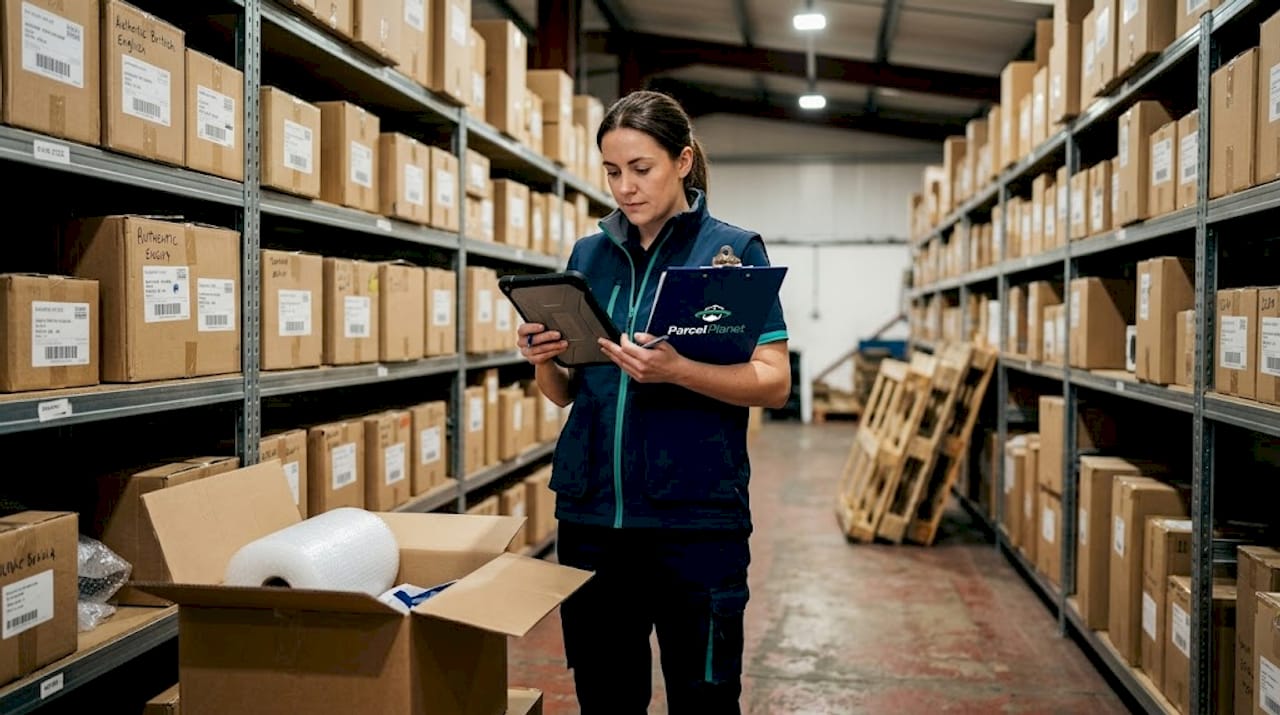
Check the fulfilment outsourcing checklist to confirm you have everything documented before your first provider conversation. You should also consider choosing a fulfilment partner carefully by evaluating their e-commerce experience specifically, not just their general logistics track record.
Common mistakes at this stage include overlooking system integration complexity, failing to read contracts for hidden fees, and underestimating volume spikes. The contract review is critical: look for storage minimums, pick-and-pack fee structures, fuel surcharges, and what happens if the provider fails to meet your SLAs.
Thinking about outsourcing logistics for growth should also include mapping your customer service-level agreements. If you promise next-day delivery, your 3PL must be contractually bound to despatch same-day.
Pro Tip: Before committing to a full migration, run a paid pilot using a small batch of real orders. This reveals integration gaps, processing speed, and packaging quality before they become visible to your wider customer base.
With requirements mapped, you can now confidently navigate the practical steps of outsourcing fulfilment.
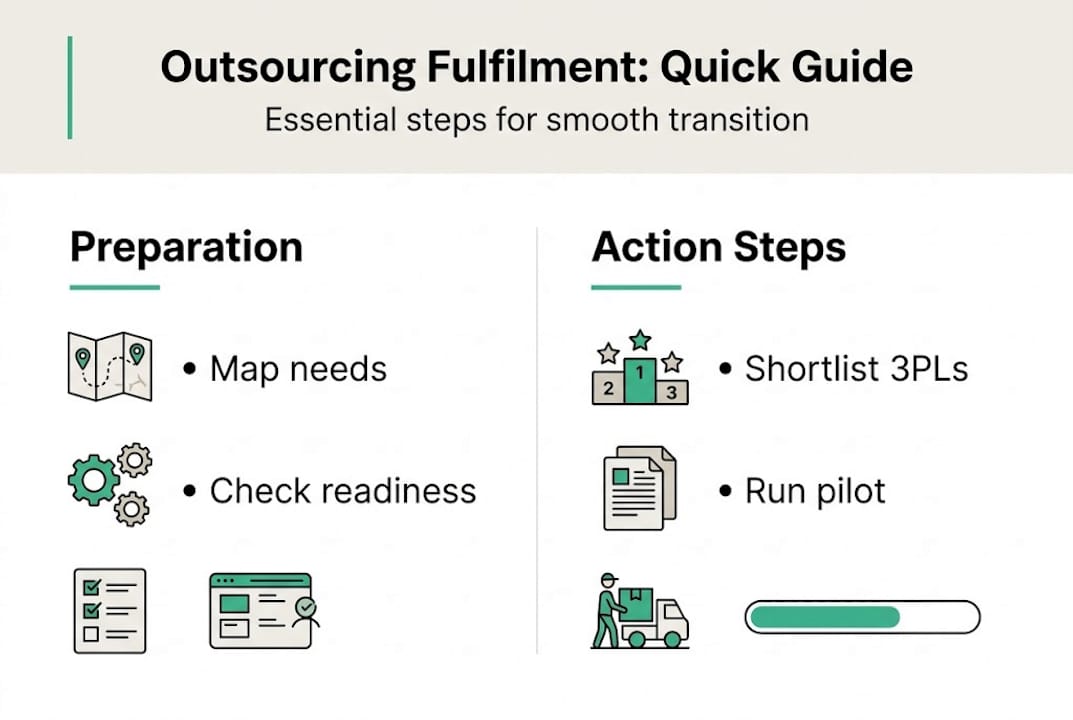
Step-by-step process: How to outsource fulfilment successfully
Following a structured process dramatically reduces risk and speeds up your time to operational readiness. Here is a clear sequence to follow:
- Define your selection criteria. List your non-negotiables: location, platform integrations, specialisms, and pricing model.
- Shortlist three to five providers. Request proposals from providers whose focus aligns with your product type and channel mix.
- Evaluate tech integrations. Confirm they can connect with your Shopify, WooCommerce, or other platform without heavy custom development.
- Negotiate terms and SLAs. Lock in despatch cut-off times, order accuracy guarantees, and clear escalation procedures.
- Plan your inventory transfer. Schedule the physical stock move during a low-volume period to minimise disruption.
- Oversee onboarding. Set up product rules, kitting instructions, and packaging specifications in the provider’s warehouse management system.
- Run a pilot phase. Process a limited order volume first, then review fulfilment KPIs before scaling up fully.
For a detailed walkthrough of each phase, the step-by-step logistics outsourcing guide covers common sticking points and how to resolve them.
Here is a quick comparison of leading 3PL providers to help you shortlist:
| Provider |
Best for |
Key strength |
| ShipBob |
DTC brands, global reach |
Multi-warehouse network |
| Amazon FBA |
High-volume, Prime-eligible products |
Speed and Prime badge |
| Red Stag |
Heavy or oversized items |
Specialist handling |
| ShipMonk |
Small to mid-sized brands |
Flexible pricing |
| Shopify Fulfillment Network |
Shopify merchants |
Native platform integration |
According to 3PL provider analysis for 2026, the right choice depends on your product type, monthly order volume, and the sales channels you prioritise. A mismatch here is expensive to undo.
Important: Never migrate your full inventory to a new 3PL on day one. Brands that skip the pilot phase often discover integration errors or mislabelled SKUs only after customer complaints start arriving.
Reviewing fulfilment strategies for success after your pilot will help you fine-tune before full launch.
Verification: Monitoring, troubleshooting, and maximising results
Going live with a 3PL is not the finish line. Sustained performance requires active monitoring and a willingness to hold your provider accountable.
Track these key performance indicators weekly:
- Order accuracy rate: Target 99% or above; errors erode customer trust fast
- Despatch speed: Measure time from order receipt to shipping confirmation
- Cost-per-order: Compare against your in-house baseline monthly
- Return rate: Rising returns can indicate picking errors or packaging failures
- Inventory discrepancy rate: Spot shrinkage or miscounting early
One of the most impactful changes you can make post-launch is optimising warehouse location. Distributed warehouses reduce shipping costs by 20 to 35% by placing stock closer to your customers, cutting both transit time and carrier zone fees. Most 3PLs with multi-site networks allow you to pilot this approach with a subset of SKUs before committing fully.
When SLAs are missed, escalate quickly and document everything. Ask for root-cause analysis in writing and agree on a corrective action plan with clear timescales. Vague promises are not sufficient. You should also use customer feedback and return reasons as a quality loop: if customers consistently report damaged packaging, feed that directly back to your 3PL’s ops team.
For guidance on scaling your partnership as volumes grow, the partner selection for scalability resource outlines what to look for as your needs evolve. Reviewing the key outsourcing benefits periodically also helps you assess whether your current provider is still the right fit at your new scale.
Avoid complacency. Many brands improve significantly in the first three months and then stagnate because they stop reviewing performance data closely.
Common misconceptions and overlooked truths about outsourcing fulfilment
The biggest mistake we see brands make is treating fulfilment outsourcing as a set-and-forget decision. They sign the contract, transfer the stock, and assume the hard work is done. In reality, outsourcing transfers the physical operation but not the strategic responsibility. You still own the customer experience.
Poor integration between your e-commerce platform and a 3PL’s warehouse management system creates invisible costs: delayed orders, overselling out-of-stock items, and inaccurate tracking details sent to customers. These issues do not appear on a pricing sheet but they do appear in your reviews.
Medium-sized brands often underestimate the competitive advantage available to them through practical 3PL partnerships. Specifically, piloting distributed warehousing at modest volumes can generate meaningful delivery speed improvements without a large upfront commitment.
As common outsourcing pitfalls show, the most damaging errors are choosing a partner without genuine e-commerce experience, ignoring hidden fees, and failing to set measurable SLAs from day one.
Hard-won lesson: Always insist on a documented escalation process before you sign. Knowing who to call when something goes wrong is just as important as negotiating the pick-and-pack fee.
Pro Tip: Negotiate a quarterly business review into your contract from the start. This keeps your 3PL accountable and gives you a structured moment to adjust volumes, review pricing, and plan for upcoming peaks together.
Ready to optimise your fulfilment? Next steps with ParcelPlanet
If this guide has confirmed that outsourcing is the right move for your business, ParcelPlanet is ready to help you make that transition smoothly and confidently.
We work with growing e-commerce brands to provide order fulfilment services that are fast, accurate, and fully integrated with your existing sales channels. Whether you are just starting to understand what order fulfilment involves or you are ready to restructure your entire logistics operation, our team will build a solution around your specific needs. We also support SMEs in finding practical ways to reduce logistics costs with 3PL partnerships. Get in touch today to request a tailored quote and see exactly how we can support your growth.
Frequently asked questions
What is a 3PL in e-commerce fulfilment?
A 3PL, or third-party logistics provider, manages storage, picking, packing, and shipping on behalf of e-commerce brands, saving time and reducing operational costs. Leading 3PL options in 2026 include ShipBob, Amazon FBA, Red Stag, ShipMonk, and the Shopify Fulfillment Network, each serving different product types and volumes.
When does outsourcing fulfilment make financial sense?
Outsourcing typically becomes cost-effective once you are shipping 100 or more orders per month, as 3PL volume discounts and the absence of fixed overheads make the per-order cost lower than running your own warehouse.
How can I avoid mistakes when outsourcing fulfilment?
Shortlist 3PLs with genuine e-commerce experience, clarify all fees upfront, run a pilot before full migration, and verify tech integrations thoroughly. Poor integration and hidden fees are the most common avoidable pitfalls brands encounter.
What savings can I expect by outsourcing?
Most businesses achieve 20 to 30% savings on fulfilment costs and approximately 15% savings on transport by partnering with a 3PL, thanks to bulk courier rates and reduced fixed overhead.
Recommended