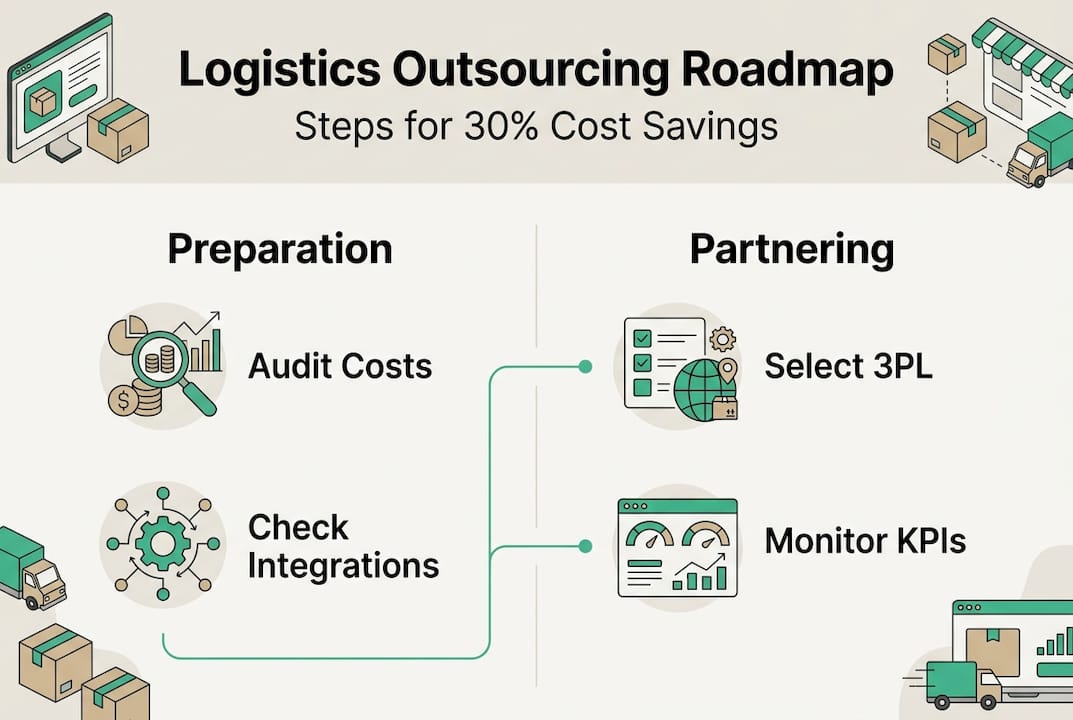
Managing logistics in-house becomes increasingly complex as your e-commerce brand scales. Rising order volumes, expanding product catalogues, and growing customer expectations create operational bottlenecks that drain resources and limit growth potential. Outsourcing logistics to 3PLs enables e-commerce brands and omnichannel retailers to achieve 20-30% cost savings on fulfilment expenses whilst improving operational efficiency. This guide walks you through the strategic process of outsourcing logistics effectively, from recognising when to transition away from in-house operations through to optimising your partnership with external providers. You’ll discover how to prepare your business, select the right partner, and maintain operational excellence throughout the outsourcing journey.
Table of Contents
Key Takeaways
| Point |
Details |
| Cost savings potential |
Outsourcing to third party logistics providers can deliver around twenty to thirty per cent savings on fulfilment costs. |
| Real time visibility |
Real time visibility and data sharing across the supply chain reduce risk in multi tier networks. |
| Strategic 3PL integration |
Partnerships with providers require technology alignment, process documentation and cultural adaptation rather than simple vendor relationships. |
| Audit costs before outsourcing |
Conduct a comprehensive audit of current logistics costs including hidden expenses and compare against 3PL quotes to quantify genuine savings. |
Understanding when and why to outsource logistics
Your in-house logistics operation works brilliantly when processing 50 orders daily. Scale that to 500 orders and suddenly you’re hiring additional warehouse staff, negotiating carrier contracts, managing inventory across multiple locations, and troubleshooting fulfilment errors that damage customer relationships. The operational complexity multiplies faster than revenue growth, creating a resource drain that diverts attention from product development, marketing, and customer acquisition.
Outsourcing logistics to 3PLs enables e-commerce brands and omnichannel retailers to achieve 20-30% cost savings on fulfilment expenses. These savings emerge from volume-based shipping discounts, shared warehouse infrastructure, and specialised fulfilment technology that individual brands cannot justify purchasing independently. Beyond immediate cost benefits, outsourcing transforms fixed logistics costs into variable expenses that scale proportionally with order volume, protecting your margins during seasonal fluctuations.
The strategic value extends beyond pure cost reduction. Third-party logistics providers absorb the operational burden of warehousing, inventory management, order processing, and carrier coordination, freeing your team to focus on revenue-generating activities. You gain access to sophisticated fulfilment technology, multi-channel integration capabilities, and logistics expertise without building these competencies internally. Understanding 3PL fulfilment service timing helps you recognise the optimal transition point before operational challenges constrain growth.
Key signals your brand should outsource logistics:
- Fulfilment operations consume more than 20% of staff time previously allocated to core business activities
- Warehouse space constraints force you to refuse wholesale orders or limit product range expansion
- Shipping costs exceed 12% of revenue due to inability to negotiate volume-based carrier discounts
- Order accuracy falls below 98% as manual picking and packing processes struggle with increased volume
- You’re expanding into new geographic markets requiring distributed inventory and local fulfilment capabilities
- Seasonal demand fluctuations create staffing challenges and warehouse capacity issues
Pro tip: Conduct a comprehensive audit of your current logistics costs, including hidden expenses like warehouse rent, utilities, equipment depreciation, staff wages, and management time. Compare this total against 3PL quotes to quantify genuine savings potential rather than focusing solely on per-order fulfilment fees.
Preparing to outsource logistics: what you need to know and have in place
Successful logistics outsourcing requires thorough preparation before signing contracts or transferring inventory. The transition fails when brands treat 3PL partnerships as simple vendor relationships rather than strategic integrations requiring technology alignment, process documentation, and cultural adaptation. Data sharing mitigates logistics risks across multi-tier supply chains, making real-time visibility infrastructure essential for operational success.
Your e-commerce platform, inventory management system, and customer communication tools must integrate seamlessly with your logistics provider’s warehouse management system. API compatibility enables automatic order transmission, real-time inventory updates, and tracking number synchronisation that maintains customer experience standards whilst reducing manual data entry errors. Without this technical foundation, you’ll face order delays, inventory discrepancies, and customer service challenges that negate outsourcing benefits.
Internal preparation extends beyond technology. Document your current fulfilment processes, including special handling requirements, packaging standards, quality control procedures, and returns management workflows. This documentation becomes the foundation for service level agreements and operational procedures that ensure consistent fulfilment quality. Your team needs training on new workflows, communication protocols, and escalation procedures that differ significantly from in-house operations.
Essential preparation tasks before signing a 3PL contract:
- Audit your product catalogue to identify SKUs requiring special handling, temperature control, or hazardous materials compliance
- Document current packaging standards, including box sizes, protective materials, branding inserts, and gift wrapping options
- Establish baseline performance metrics for order accuracy, fulfilment speed, and customer satisfaction to measure outsourcing impact
- Clean your inventory data to ensure accurate SKU information, dimensions, weights, and product descriptions transfer correctly
- Create detailed standard operating procedures for returns processing, damaged goods handling, and quality control inspections
- Identify key stakeholders across your organisation who require access to fulfilment data and reporting dashboards
Pro tip: Prioritise logistics providers offering robust API capabilities and pre-built integrations with your existing e-commerce platform. Technical compatibility eliminates integration costs and accelerates onboarding timelines significantly.
| Capability area |
Internal requirements |
Provider requirements |
Integration priority |
| Order management |
Real-time order export via API |
Automated order ingestion and processing |
Critical |
| Inventory tracking |
SKU-level stock visibility |
Perpetual inventory system with cycle counting |
Critical |
| Shipping integration |
Multi-carrier rate shopping |
Carrier API connections and label generation |
High |
| Returns processing |
Customer portal for return initiation |
Reverse logistics workflow and inspection protocols |
High |
| Reporting and analytics |
Dashboard access for key stakeholders |
Customisable reporting with data export capabilities |
Medium |
| Customer communications |
Branded tracking notifications |
White-label tracking pages and email templates |
Medium |
Optimising e-commerce logistics data requires establishing clear data governance protocols that define information sharing boundaries, update frequencies, and security requirements protecting sensitive business intelligence throughout the partnership.
Executing the outsourcing process effectively
Selecting the right logistics partner determines whether outsourcing delivers promised benefits or creates new operational challenges. Redefining logistics outsourcing in 2026 shows the industry shifting from pure cost focus towards resilience and partnership models, with multimodal flexibility and human-led exception management becoming critical differentiators amid supply chain volatility.
Begin your provider evaluation by defining non-negotiable requirements based on your business model, product characteristics, and growth trajectory. Geographic coverage matters significantly if you serve customers across multiple regions or plan international expansion. Technology capabilities determine integration complexity and ongoing operational efficiency. Vertical expertise influences how effectively providers handle product-specific challenges like temperature control, fragile items, or regulatory compliance.
Request detailed proposals from shortlisted providers including pricing structures, service level commitments, technology capabilities, and references from similar brands. Conduct site visits to evaluate warehouse conditions, technology infrastructure, and staff competency. The cheapest option rarely delivers best value when factoring in hidden costs from poor service quality, limited technology, or inflexible contract terms.
Critical contract and service level checklist items:
- Guaranteed order accuracy rates with financial penalties for performance failures
- Maximum fulfilment timeframes from order receipt to carrier pickup
- Inventory accuracy commitments with regular cycle counting schedules
- Scalability provisions allowing volume increases without service degradation
- Technology integration specifications including API documentation and support
- Transparent pricing structures covering storage, picking, packing, and ancillary services
- Contract termination clauses protecting your ability to change providers if service deteriorates
- Insurance coverage for inventory loss, damage, or theft whilst in provider custody
| Provider type |
Best suited for |
Typical services |
Cost structure |
| 3PL (Third-party logistics) |
Brands seeking warehousing and fulfilment |
Storage, picking, packing, shipping |
Per-unit fees plus storage |
| 4PL (Fourth-party logistics) |
Complex multi-channel operations |
End-to-end supply chain management |
Management fee plus provider costs |
| Specialised fulfilment |
Niche products requiring expertise |
Category-specific handling and compliance |
Premium per-unit pricing |
| Regional carriers |
Geographic-specific coverage |
Last-mile delivery optimisation |
Distance and weight-based |
Onboarding and communication best practices:
- Schedule weekly check-in calls during the first month to address issues before they escalate into customer-facing problems
- Assign dedicated points of contact on both sides to streamline communication and prevent information gaps
- Conduct test order processing across all product categories before transferring live inventory
- Create escalation protocols defining response timeframes for urgent issues affecting customer orders
- Establish regular business review meetings to analyse performance metrics and identify improvement opportunities
- Document all process changes, special requests, and custom workflows in shared knowledge bases accessible to both teams
Pro tip: Implement human-led exception management protocols that define when automated systems should escalate unusual orders, inventory discrepancies, or shipping issues to experienced staff. Thirty to forty percent of logistics operations require expert judgement that pure automation cannot replicate effectively.
Optimising logistics for growth requires viewing your 3PL partnership as collaborative rather than transactional, with shared responsibility for continuous improvement and customer experience excellence. Understanding shipping strategy workflow helps you design processes that leverage provider capabilities whilst maintaining brand standards.
Verifying and optimising your outsourced logistics
Outsourcing logistics doesn’t mean abandoning oversight. Continuous monitoring ensures your provider maintains service standards, identifies improvement opportunities, and validates that cost savings materialise as promised. Establish clear performance metrics aligned with customer experience priorities rather than focusing exclusively on operational efficiency measures that may not correlate with satisfaction.

Track order accuracy as your primary quality indicator, measuring the percentage of orders fulfilled correctly without requiring customer service intervention. Monitor fulfilment speed from order placement through carrier pickup, identifying bottlenecks that delay shipments. Analyse inventory accuracy through regular cycle count comparisons between your system records and physical warehouse counts. Review shipping cost trends to ensure volume discounts deliver expected savings.
Expert exception handling becomes critical as 30-40% of logistics operations involve scenarios requiring human judgement beyond standard automated workflows. These exceptions include damaged inventory requiring disposal decisions, customer address corrections, special packaging requests, and carrier service failures necessitating alternative shipping methods. Your provider’s competency managing exceptions directly impacts customer satisfaction and operational costs.
Schedule quarterly business reviews analysing performance trends, discussing operational challenges, and planning capacity for upcoming peak periods. These strategic conversations transform transactional vendor relationships into collaborative partnerships focused on mutual success. Share sales forecasts, marketing campaign schedules, and product launch timelines enabling your provider to allocate resources proactively rather than reactively.
Common pitfalls and troubleshooting tips:
- Inventory discrepancies emerge from poor receiving processes; implement photographic documentation of inbound shipments and systematic quality checks
- Fulfilment delays often result from unclear cut-off times; establish and communicate daily order processing schedules explicitly
- Shipping cost overruns frequently stem from incorrect product dimensions; audit your catalogue data and update dimensional weights accurately
- Customer complaints about packaging quality indicate insufficient standards documentation; create visual guides showing acceptable packaging examples
- Returns processing bottlenecks suggest unclear workflows; map detailed procedures covering inspection criteria, restocking decisions, and customer refund timing
- Communication breakdowns typically reflect undefined escalation paths; document who handles specific issue types and expected response timeframes
30-40% of logistics operations require expert exception handling to maintain service quality when automated systems encounter scenarios outside standard parameters. Providers demonstrating strong exception management capabilities deliver superior customer experiences despite inevitable operational anomalies.
Continuous improvement requires collaborative problem-solving rather than blame assignment when issues arise. Analyse root causes systematically, implement corrective actions, and monitor results to verify effectiveness. Share successful process innovations with your provider, encouraging them to adopt improvements across their client base. This collaborative approach builds partnership value extending beyond basic fulfilment services.
Leverage your provider’s expertise by requesting recommendations for packaging optimisation, shipping method selection, and inventory positioning strategies. Experienced 3PLs manage dozens or hundreds of brands, accumulating insights about effective practices that individual companies cannot develop independently. Tapping this knowledge accelerates your operational maturity significantly.
Ecommerce logistics checklist provides systematic frameworks for ongoing operational assessment, whilst reducing fulfilment costs explores advanced optimisation strategies that compound savings over time through incremental improvements across multiple cost drivers.
Improve your logistics outsourcing with ParcelPlanet
Navigating the complexities of logistics outsourcing requires expertise that most e-commerce brands develop only through expensive trial and error. ParcelPlanet specialises in helping growing brands transition from in-house fulfilment to scalable 3PL partnerships that reduce costs whilst improving service quality. Our team understands the operational challenges you face and designs tailored solutions addressing your specific product characteristics, order profiles, and growth objectives.

Whether you’re evaluating 3PL provider logistics cost reduction opportunities or need comprehensive order fulfilment services supporting multi-channel operations, ParcelPlanet delivers the technology integration, operational excellence, and strategic partnership your brand requires. Explore our guidance on 3PL vs 4PL ecommerce fulfilment options to determine which model aligns with your current stage and future ambitions.
How to outsource logistics effectively FAQ
What criteria should I use to select a logistics provider?
Prioritise geographic coverage matching your customer base, technology integration capabilities with your e-commerce platform, vertical expertise handling your product category, and transparent pricing structures without hidden fees. Request client references from similar brands and conduct site visits evaluating warehouse conditions and staff competency.
Establish formal data sharing agreements specifying information access boundaries, encryption requirements, and confidentiality obligations. Verify providers maintain SOC 2 compliance or equivalent security certifications. Limit data sharing to operationally necessary information rather than exposing complete customer databases or proprietary business intelligence.
When is the best time to switch logistics partners?
Transition during your slowest seasonal period to minimise customer impact from potential onboarding issues. Allow 60-90 days for complete provider transitions including technology integration, staff training, and inventory transfer. Avoid switching immediately before peak selling periods when operational disruptions create maximum damage.
What are common mistakes to avoid when outsourcing logistics?
Brands frequently underestimate integration complexity, fail to document current processes thoroughly, select providers based solely on cost rather than capability fit, and neglect ongoing performance monitoring after initial onboarding. Avoid these pitfalls through systematic preparation, realistic timeline expectations, and continuous partnership management.
How does outsourcing affect shipping times and customer experience?
Professional 3PLs typically improve fulfilment speed through dedicated warehouse staff, optimised picking workflows, and later carrier pickup times compared to in-house operations. However, poor provider selection or inadequate integration can increase fulfilment delays. Establish clear service level agreements and monitor performance metrics ensuring customer experience maintains or improves post-transition.
Recommended


