TL;DR:
- Order errors often stem from manual data entry, disconnected systems, and SKU mismanagement, causing costly fulfillment failures.
- Implementing automated capture tools, real-time validation, and human oversight significantly reduces errors and improves order accuracy.
Order errors are defined as any fulfilment mistake that causes a customer to receive the wrong item, wrong quantity, or a delivery that arrives at the wrong address or time. They are one of the most direct causes of returns, refunds, and lost customer loyalty in e-commerce and retail. Knowing how to reduce order errors is not a one-off project. It is a daily operational discipline built on automated data capture, real-time validation, and deliberate human oversight. This guide covers the root causes, the tools you need, and a step-by-step approach to achieving lasting accuracy across your fulfilment workflow.
What are the main causes of order errors and how do they affect your business?
Order errors cluster around seven root causes, and understanding them is the first step to fixing them. The seven causes are: manual data entry, disconnected systems, SKU mismanagement, inventory desynchronisation, carrier logic failures, address validation gaps, and missing exception workflows. Each one creates a distinct failure point in the order lifecycle.
Wrong SKU selection is the most frequent and costly error type, accounting for 35–40% of all order errors. Quantity errors follow at 25–30%, and delivery date errors account for 15–20%. These three categories alone represent the vast majority of fulfilment failures your team will face.
The compounding effect is what makes these numbers serious. A wrong SKU picked in the warehouse triggers a return, a replacement shipment, a customer service interaction, and a potential negative review. Each step adds cost and erodes trust. Manual order processes produce error rates of 1–3%, which translates to 10–30 errors per 1,000 orders. At scale, that volume of mistakes is operationally and financially damaging.
| Error type |
Share of total errors |
| Wrong SKU |
35–40% |
| Wrong quantity |
25–30% |
| Wrong delivery date |
15–20% |
| Address errors |
Remaining share |
The table above shows where to focus first. Fix wrong SKU errors and you address the single largest driver of fulfilment failures in your operation.
The right tools remove the structural conditions that allow errors to occur. API-connected order portals, alias libraries, and validation APIs are the three core technologies for accurate order capture. Without them, your team is manually re-keying data, which is where most errors begin.

Automated capture pipelines with alias libraries reduce wrong SKU errors by mapping customer product references to your internal SKUs automatically. Alias library configuration typically covers 80–90% of order volume within 60–90 days of deployment. That shift changes your order team’s role from data entry to exception handling, which is a far more valuable use of their time.
Real-time stock visibility and ERP synchronisation are non-negotiable prerequisites. If your inventory data is out of sync across channels, even a correctly captured order can result in a fulfilment error. AI vision recognition and real-time barcode scanning create a second layer of verification that flags mismatches before packing begins. This is particularly effective for high-SKU operations where manual checking is impractical.
| Tool |
Primary function |
Key benefit |
| Alias library |
Maps customer SKU references to internal codes |
Reduces wrong SKU errors at capture |
| Validation API |
Checks addresses and mandatory fields |
Catches errors before processing |
| Barcode scanning |
Verifies pick accuracy at pack stage |
Prevents wrong item shipments |
| ERP integration |
Syncs inventory in real time |
Eliminates stock desynchronisation |
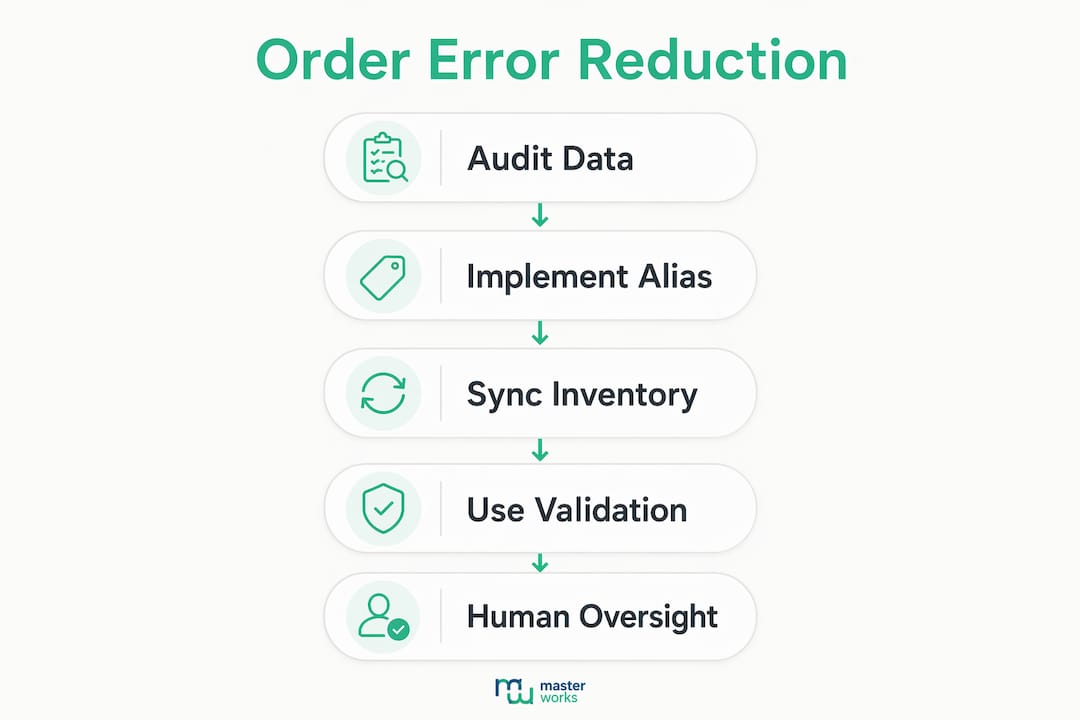
Pro Tip: Before deploying any new tool, audit your product data first. Structured, clean product libraries are the foundation that alias libraries and validation APIs depend on. Garbage in, garbage out.
Step-by-step strategies to reduce order errors in your workflow
A structured approach to minimising order mistakes produces faster results than broad process updates. Start with measurement, then fix the highest-volume failure point before moving to the next.
-
Measure your current error rate. Calculate errors per 1,000 orders and categorise them by type. A customer-reported error rate above 2% signals an immediate need for remediation. Start with your highest-volume error category, which is almost always wrong SKUs.
-
Automate order capture. Replace manual re-keying with API-connected order portals. Eliminating manual data translations is more effective than adding human oversight layers downstream. Automation can reduce errors by 70–90% compared to manual processes.
-
Implement pick, pack, and ship verification scanning. Barcode scanning at each stage confirms the right item is picked, packed, and labelled correctly. This is the most direct way to improve pick and pack accuracy in your warehouse.
-
Enforce data validation on mandatory fields. Set your order management system to reject orders with missing or invalid data before they enter the fulfilment queue. Validation APIs check addresses, postcodes, and product codes in real time.
-
Add address validation via API. Pre-shipment address validation catches 60–70% of address-related shipping failures before parcels leave the warehouse. This single step significantly reduces failed deliveries and redelivery costs.
-
Build exception workflows with Human-in-the-Loop controls. Not every order should be processed automatically. High-value orders, unusual quantities, and flagged addresses should pause for human review before dispatch.
-
Monitor continuously and audit by process step. Fulfilment accuracy improves fastest when managed daily with written accuracy definitions and audits at each stage: pick, pack, and ship.
Pro Tip: Run a 7-cause audit before you invest in new software. Identify which of the seven root causes is generating the most errors in your specific operation. Targeted fixes outperform generic technology upgrades every time.
How do you troubleshoot common pitfalls in order accuracy improvement?
The most common mistake managers make is treating error reduction as a project with a start and end date. Accuracy is an ongoing operational metric, not a one-time fix. The moment daily monitoring stops, error rates creep back up.
- Avoid automation black boxes. Fully automated systems with no human checkpoints create blind spots. When an unusual order slips through unchecked, the downstream cost is far higher than the time saved by skipping the review.
- Address structural causes first. Most errors stem from manual data translations. Adding more human checks at the end of the process does not fix a broken capture stage. Restructure the input before adding oversight at the output.
- Maintain living error definitions. Your definition of an “order error” should be written down, reviewed regularly, and aligned with your current processes. Vague definitions produce inconsistent data and make it impossible to track genuine improvement.
- Track customer-reported errors separately. Internal error logs and customer-reported errors often tell different stories. A customer complaint about a wrong item may not appear in your warehouse data if the pick scan passed. Both data sources are needed for a complete picture.
“Order accuracy needs a written, auditable definition managed daily with measurement by process step to ensure targeted, effective fixes.” — Improve Fulfillment Accuracy in Order Fulfillment
Apply corrective action at the specific process step where the error originated. Broad updates to the entire workflow dilute focus and slow improvement.
What are the benefits of combining technology with human oversight?
Technology alone does not eliminate order errors. Staff must be trained to use AI tools, barcode scanners, and workflow software effectively, because automation does not remove behavioural errors. A picker who overrides a scan warning without reading it defeats the purpose of the system entirely.
Human-in-the-Loop (HITL) controls are the most effective way to balance speed with accuracy. HITL workflows pause risky or exception orders for human judgement, preventing high-cost downstream mistakes without slowing down standard order processing. The key is designing clear escalation points so staff know exactly when to intervene and what to do.
The benefits of combining technology with human oversight include:
- Faster processing of standard orders through automation, with no loss of control on exceptions
- Reduced cognitive load on staff, who focus on decisions rather than data entry
- Improved detection of unusual patterns, such as duplicate orders or suspicious quantities
- Greater accountability, because every exception decision is logged and auditable
- Better delivery accuracy outcomes across the full order lifecycle
The goal is not to replace human judgement but to direct it where it adds the most value. Automation handles volume. Humans handle complexity. That division produces the best accuracy results at scale.
Key takeaways
Reducing order errors requires automated data capture, real-time validation, and daily human oversight working together across every stage of the fulfilment process.
| Point |
Details |
| Wrong SKUs are the top error |
Focus your first fixes on SKU capture and alias library configuration. |
| Automation cuts errors by up to 90% |
API-connected order portals eliminate manual re-keying, the primary structural cause. |
| Address validation prevents failed deliveries |
Pre-shipment API checks catch 60–70% of address errors before dispatch. |
| HITL controls protect against automation blind spots |
Pause high-risk orders for human review to prevent costly downstream mistakes. |
| Daily audits sustain accuracy gains |
Written error definitions and step-by-step audits are required to maintain improvement. |
The accuracy trap most managers fall into
The biggest mistake I see in e-commerce operations is confusing activity with improvement. A team installs barcode scanners, runs a training session, and declares the accuracy problem solved. Three months later, error rates are back where they started.
The reason is almost always the same: the fix targeted the symptom, not the cause. Barcode scanning at the pack stage does not help if the wrong SKU was captured at order entry. You have to trace errors back to their origin in the workflow, not just add checks at the point where they become visible.
What actually drives lasting change is ownership. Someone in your operation needs to own the accuracy metric the way a finance manager owns the P&L. That means reviewing error logs daily, updating definitions when processes change, and holding specific process steps accountable. Generic accountability produces generic results.
The other thing I would push back on is the idea that more automation always means fewer errors. Automation removes human error from repetitive tasks. It does not remove poor system design, bad product data, or misconfigured rules. I have seen highly automated operations with worse accuracy than smaller teams using simpler tools well. The technology is only as good as the process it sits on top of. Build the process first, then automate it.
— ChiefPlaneteer
Parcelplanet’s approach to accurate order fulfilment
Consistent order accuracy requires more than good intentions. It requires the right fulfilment infrastructure, real-time data synchronisation, and verified pick, pack, and ship processes working together every day.

Parcelplanet provides order fulfilment partnership services built specifically for e-commerce and omnichannel brands that need reliable accuracy at scale. From warehouse integration to courier dispatch, every step in the Parcelplanet workflow is designed to catch errors before they reach your customers. If your current fulfilment operation is generating too many mistakes, too many returns, or too many customer complaints, Parcelplanet’s team is ready to help you build a better process. Get in touch to request a tailored quote and see how our fulfilment services can support your growth.
FAQ
What is the most common type of order error?
Wrong SKU selection is the most frequent order error, accounting for 35–40% of all fulfilment mistakes. It is also the most costly because it is typically discovered late in the process, after picking and packing have already occurred.
How much can automation reduce order errors?
Automation can reduce order errors by 70–90% compared to manual processes. Addressing all seven root causes through a combination of automated capture and validation can eliminate 85–95% of errors.
What is a Human-in-the-Loop control in order management?
A Human-in-the-Loop control is a workflow checkpoint that pauses unusual or high-risk orders for human review before they are processed. It prevents automated systems from misprocessing exceptions such as high-value orders or flagged addresses.
How do you measure order accuracy effectively?
Calculate errors per 1,000 orders and categorise them by type and process step. A customer-reported error rate above 2% signals a critical need for immediate remediation, starting with the highest-volume error category.
Does address validation really reduce shipping errors?
Pre-shipment address validation via API catches 60–70% of address-related shipping failures before parcels leave the warehouse. It is one of the highest-impact single steps you can add to your order fulfilment efficiency workflow.
Recommended