Many e-commerce merchants assume outsourcing fulfilment to a third-party logistics provider will inflate their operating costs. This misconception keeps brands locked into inefficient in-house operations, struggling with rising carrier rates and warehouse expenses. The reality is quite different. 3PL providers deliver 15 to 40% shipping discounts compared to standard retail rates, whilst shared infrastructure spreads overhead across multiple clients. This guide reveals how 3PL fulfilment achieves measurable cost savings in 2026, helping you determine when outsourcing makes financial sense for your business.
Table of Contents
Key takeaways
| Point |
Details |
| Shipping discounts |
3PL providers negotiate carrier rates 15 to 40% lower than standard retail pricing through volume leverage. |
| Operational efficiency |
Advanced warehouse management systems reduce order errors and damage claims, cutting costly re-shipments. |
| Break-even threshold |
Most merchants achieve cost parity with in-house fulfilment between 500 and 1,000 monthly orders. |
| Technology scaling |
Integration platforms enable fulfilment growth without proportional increases in labour or infrastructure costs. |
| Hidden fee awareness |
Monthly minimums and peak season surcharges can erode savings if not clearly outlined in contracts. |
Why 3PLs can reduce your fulfilment costs
Third-party logistics providers achieve lower per-unit costs through fundamental economic advantages that individual merchants cannot replicate. The primary driver is volume-based carrier negotiation. Large 3PLs ship millions of packages monthly, securing discounted shipping rates that save 15 to 40% compared to what individual brands pay at retail rates. This single factor often offsets the entire service fee structure.
Shared infrastructure creates additional savings. Warehouse space, material handling equipment, and labour pools serve multiple clients simultaneously. Your business pays only for the storage and picking capacity it actually uses, rather than maintaining fixed overhead regardless of order fluctuations. In-house logistics demands heavy upfront investment in warehouse leases, racking systems, packing stations, and inventory management software before processing a single order.
Operational efficiency improvements further reduce costs. Professional 3PL providers implement cost reduction strategies including proactive exception management, regular KPI reviews, and process optimisation that most in-house teams lack resources to maintain. These practices minimise expensive mistakes like mis-ships, damaged goods, and inventory shrinkage.
Key cost advantages include:
- Carrier rate discounts from consolidated shipping volumes
- Shared warehouse and labour costs across multiple clients
- Reduced capital expenditure on facilities and equipment
- Access to enterprise-grade technology without implementation costs
- Elimination of hiring, training, and managing fulfilment staff
The economies of scale become particularly evident during peak seasons. Whilst in-house operations struggle with temporary staffing and overtime costs, 3PLs distribute seasonal demand across their client base, maintaining consistent per-unit economics. This flexibility transforms fixed costs into variable expenses that scale precisely with your order volume.
Pro Tip: Request detailed cost breakdowns from potential 3PL partners showing carrier rate comparisons, storage pricing tiers, and all ancillary fees before committing to contracts.
How integration and technology drive cost efficiency with 3PLs
Technology infrastructure separates cost-effective 3PLs from those that merely shift expenses rather than reduce them. Modern warehouse management systems automate order routing, inventory tracking, and shipping label generation, eliminating manual data entry that drives up labour costs and error rates. These systems typically cut fulfilment labour costs by 30% compared to manual processes.
Integration capabilities determine scalability without proportional cost increases. When Mobix 3PL enhanced their existing WMS with Pipe17’s connectivity platform, they tripled their operational scale whilst reducing costs by 85%. This dramatic improvement came from eliminating custom integration builds and manual order processing across multiple sales channels.
Without proper orchestration, each new marketplace or sales channel requires custom development work, creating ongoing technical debt. Leading 3PLs invest in pre-built integrations with major e-commerce platforms like Shopify, WooCommerce, Amazon, and eBay. You gain immediate access to these connections without bearing development costs or maintenance burdens.
Real-time inventory visibility prevents costly stockouts and overselling incidents. When your WMS synchronises accurately across all channels, you avoid the dual expenses of rush replenishment shipments and customer compensation for cancelled orders. Automated reorder point notifications help maintain optimal stock levels, reducing both storage costs and lost sales.
Key technology benefits that reduce costs:
- Automated order processing eliminates manual data entry errors
- Multi-channel inventory synchronisation prevents stockouts and overselling
- Intelligent order routing selects the most cost-effective warehouse location
- Batch picking algorithms reduce warehouse labour time per order
- Shipping rate shopping automatically selects the cheapest qualifying carrier
- Returns management systems streamline reverse logistics workflows
The most successful 3PL companies in 2026 distinguish themselves through technology maturity. Before selecting a provider, verify their integration capabilities match your current tech stack and future expansion plans. A comprehensive ecommerce fulfilment checklist helps evaluate whether a 3PL’s technology will genuinely reduce your operational costs.
Pro Tip: Prioritise 3PL providers with proven integration platforms rather than those requiring custom API builds, which create ongoing maintenance costs and technical dependencies.
Breaking down 3PL fulfilment costs in 2026
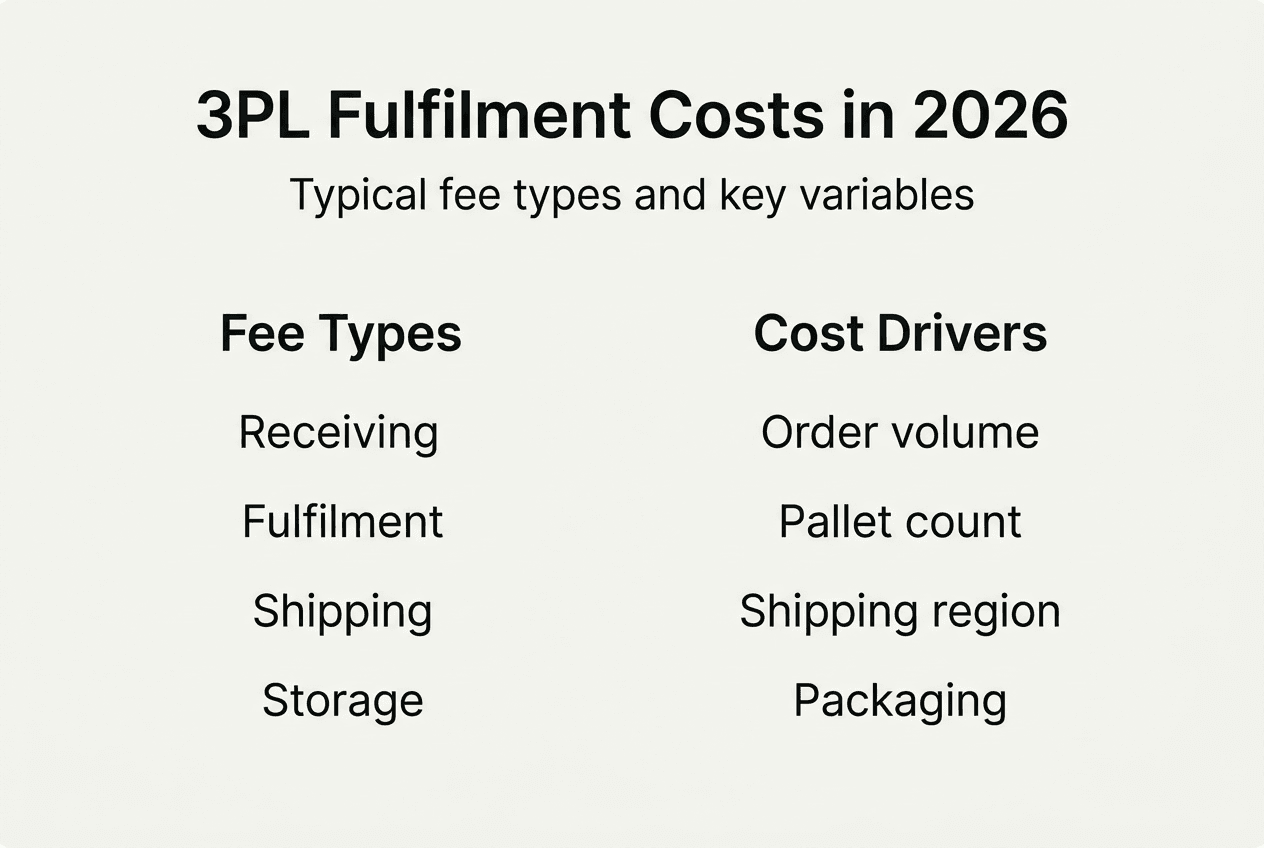
Understanding the complete fee structure helps you accurately compare 3PL proposals and identify genuine savings. Most providers charge across five main categories, each with typical pricing ranges that vary based on order complexity and warehouse location.
Receiving fees cover the labour and systems required to accept inbound shipments, verify quantities, and add inventory to your account. Expect to pay £20 to £35 per pallet for standard receiving, with additional charges for piece-level counting or quality inspections. Storage costs typically range from £15 to £35 per pallet monthly, though this varies significantly by region. Metro warehouses in London or Manchester command 30 to 50% premiums over facilities in less populated areas.
Fulfilment costs represent your largest ongoing expense. The average cost per order ranges from £2.80 to £6.40 for standard single-item shipments in 2026. This includes picking the product from warehouse shelving, packing it securely, printing shipping labels, and handing off to carriers. Multi-item orders, gift wrapping, or custom packaging increase these base rates.
Shipping charges pass through actual carrier costs, though 3PLs add their negotiated discounts. This is where volume leverage creates substantial savings compared to in-house operations paying retail rates. Dimensional weight pricing and fuel surcharges apply regardless of fulfilment method, but 3PL carrier agreements often include more favourable terms.
| Cost Component |
Typical Range |
Key Variables |
| Receiving |
£20 to £35 per pallet |
Piece counting, inspection requirements |
| Storage |
£15 to £35 per pallet monthly |
Location, seasonality, product type |
| Pick and pack |
£2.80 to £6.40 per order |
Items per order, packaging complexity |
| Shipping |
Variable |
Weight, dimensions, destination, speed |
| Returns processing |
£1.60 to £4.00 per return |
Inspection, restocking, disposal |
Hidden costs often erode projected savings. Monthly minimums ranging from £400 to £2,000 guarantee the 3PL baseline revenue regardless of your actual order volume. Peak season surcharges during Q4 can add 15 to 30% to standard fulfilment fees. Non-standard packaging, kitting, or promotional inserts typically incur additional charges not included in base quotes.
Factors influencing your specific costs include:
- Order volume and consistency throughout the year
- Average items per order and product dimensions
- Special handling requirements like fragile goods or temperature control
- Returns rate and processing complexity
- Geographic distribution of your customer base
- Integration requirements and data exchange frequency
To reduce fulfilment costs effectively, request itemised quotes from multiple providers and compare total landed costs rather than individual fee components. A provider with higher pick fees but superior carrier rates might deliver better overall economics.
When is outsourcing to a 3PL financially beneficial?
Order volume serves as the primary indicator of 3PL financial viability. Below 500 monthly orders, most merchants find in-house fulfilment cheaper despite operational inefficiencies. The fixed costs of 3PL minimums and setup fees outweigh the per-unit savings at low volumes. Between 500 and 1,000 monthly orders, break-even points emerge where 3PL economies of scale offset their service fees.
Above 1,000 monthly orders, 3PL advantages compound rapidly. Carrier rate discounts become substantial, shared infrastructure costs spread efficiently, and technology investments deliver clear ROI. Seasonal businesses with dramatic volume fluctuations benefit even more, as 3PLs absorb peak capacity requirements without forcing you to maintain year-round infrastructure.
Beyond pure volume calculations, several business conditions favour outsourcing. Rapid growth strains in-house operations, creating fulfilment bottlenecks that damage customer experience. Geographic expansion requires multiple warehouse locations, multiplying infrastructure costs that 3PLs already maintain. International shipping demands customs expertise and carrier relationships most merchants lack.
However, hidden fees can transform apparent savings into unexpected costs. Carefully scrutinise contracts for monthly minimums that exceed your low-season volumes. Peak season surcharges during Q4 might eliminate annual savings if that quarter represents your primary revenue period. Storage overages, special handling fees, and technology integration charges add up quickly without transparent pricing.
Situations favouring 3PL outsourcing:
- Consistent monthly volumes exceeding 1,000 orders
- Seasonal peaks requiring flexible capacity
- Multi-channel selling across marketplaces and direct-to-consumer
- Geographic expansion into new regions or countries
- Limited warehouse space constraining inventory and growth
- High-value products requiring secure, insured storage
Situations favouring in-house fulfilment:
- Monthly volumes below 500 orders with stable patterns
- Highly customised packaging requiring extensive brand control
- Products with complex assembly or quality control needs
- Subscription boxes with intricate personalisation requirements
- Existing warehouse infrastructure with excess capacity
Deciding when to start using 3PL fulfilment requires analysing your complete cost structure, not just obvious line items. Include the opportunity cost of management time spent on logistics rather than product development or marketing. Factor in the customer experience improvements from faster shipping and professional packaging.
Pro Tip: Evaluate your order volume trends annually and model 3PL costs at projected growth rates to identify the optimal transition point before fulfilment challenges constrain your business expansion.
How ParcelPlanet helps you save on fulfilment costs
ParcelPlanet delivers the cost advantages outlined throughout this guide through tailored order fulfilment solutions designed for growing e-commerce brands. Our scalable warehousing adapts to your order volumes, eliminating the fixed overhead of maintaining your own facility whilst providing the flexibility to handle seasonal peaks without capacity constraints.
Advanced integrations with major e-commerce platforms simplify multi-channel order management, reducing the manual work that drives up labour costs and error rates. Our competitive carrier relationships secure discounted shipping rates that individual merchants cannot access independently. Flexible storage options and transparent pricing eliminate the hidden fees that often erode 3PL savings.
Key features reducing your logistics costs:
- Volume-based carrier discounts passing savings directly to clients
- Real-time inventory synchronisation across all sales channels
- Scalable warehouse capacity matching your growth trajectory
- Transparent pricing without unexpected minimums or surcharges
Explore ParcelPlanet’s order fulfilment services to see how professional logistics management reduces costs whilst improving customer satisfaction. Learn more about the benefits of outsourcing order fulfilment to focus your resources on growing your brand rather than managing warehouse operations.
Frequently asked questions
What are the most common cost savings when using a 3PL?
Shipping discounts represent the most immediate savings, with 3PL carrier rates typically 15 to 40% below retail pricing through volume leverage. Labour cost reductions follow closely, as shared warehouse staff and automated systems eliminate the need for dedicated fulfilment employees. Storage efficiencies from flexible capacity prevent paying for unused space during slow periods, whilst technology platforms reduce costly order errors and re-shipments.
How do hidden fees affect 3PL cost savings?
Monthly minimums, peak season surcharges, and non-standard packaging fees can significantly erode projected savings if not clearly outlined upfront. Some providers charge for services like inventory reporting, system integrations, or customer service contacts that appear included in base quotes. Request comprehensive fee schedules covering all potential charges, including low-volume periods and seasonal adjustments. Transparent contracts specifying exact pricing for every service prevent unexpected costs from eliminating your 3PL financial benefits.
When should my business consider switching to a 3PL?
Most businesses reach financial break-even between 500 and 1,000 monthly orders, where 3PL economies of scale offset service fees. However, order volume alone does not determine optimal timing. Consider switching when fulfilment complexity increases through multi-channel selling, international expansion, or product line growth. Businesses experiencing rapid scaling often benefit from 3PL partnerships before reaching volume thresholds, as professional fulfilment prevents customer experience degradation during growth phases.
Can small businesses benefit from 3PL cost savings?
Smaller businesses below typical break-even thresholds can still benefit when logistics complexity exceeds their operational capabilities. Brands selling internationally, managing multiple sales channels, or offering subscription services often find 3PL partnerships valuable despite lower order volumes. The key is evaluating total costs including management time, error rates, and growth constraints rather than focusing solely on per-unit fulfilment expenses. Some 3PLs specialise in serving smaller merchants with flexible minimums and scalable pricing structures.
Recommended