TL;DR:
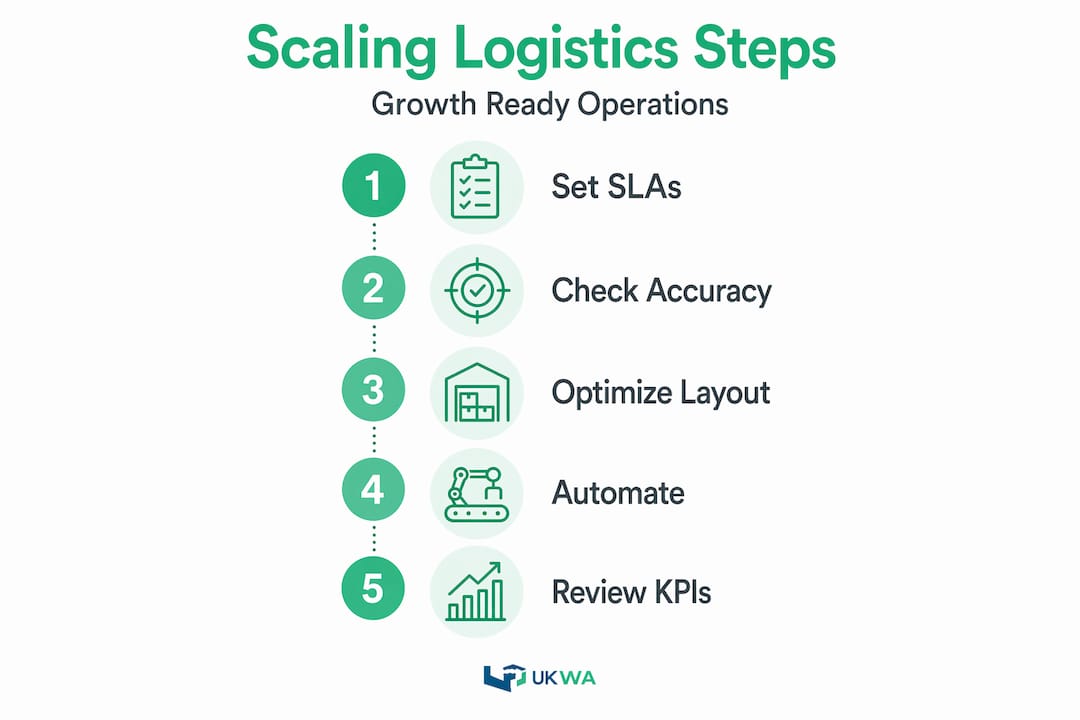
- Scaling logistics requires establishing precise SLAs and ensuring inventory accuracy to maintain customer trust and operational efficiency.
- Operational success relies on warehouse layout optimization, effective labor management, and integrated technology for real-time visibility and route planning.
- Regular KPI monitoring and continuous root cause analysis enable sustainable growth while minimizing disruptions and customer dissatisfaction.
Growing your order volumes is exciting until your fulfilment operation can’t keep up. Knowing how to scale logistics operations without sacrificing accuracy, speed, or customer satisfaction is one of the most practical challenges facing e-commerce managers today. Get it wrong and you erode the trust you’ve spent years building. Get it right and your logistics operation becomes a genuine competitive advantage. This guide covers the four pillars of scalable fulfilment: SLA frameworks, inventory accuracy, warehouse efficiency, and technology integration, so you can grow with confidence.
Table of Contents
Key takeaways
| Point |
Details |
| Set tiered SLAs first |
Match processing time targets to your order volume tier before adding capacity. |
| Fix inventory accuracy early |
Accuracy below 95% demands workflow changes, not more cycle counts. |
| Slot by SKU velocity |
Placing fast-moving SKUs at head-of-line positions directly reduces pick travel time. |
| Pilot automation carefully |
Introduce automation only when labour spend exceeds 20–25% of fulfilment costs and validate it in a pilot zone first. |
| Review SLAs weekly |
A weekly cadence with escalation protocols keeps performance on track as volumes rise. |
How to scale logistics operations: start with SLAs
Most e-commerce businesses add capacity when they hit growth pressure. The smarter move is to set precise service level agreements first, because SLAs define what “scaled correctly” actually means for your operation.
SLA processing time targets vary meaningfully by order volume tier:
| Volume tier |
Processing SLA |
On-time ship target |
| Startup (under 100 orders/day) |
Same day |
98.5% |
| Growth (100 to 1,000 orders/day) |
Under 4 hours |
98.5% |
| Scale (1,000 to 10,000 orders/day) |
Under 2 hours |
99.5% |
| Enterprise (10,000+ orders/day) |
Under 60 minutes |
99.5% |
Copying benchmarks from another warehouse without understanding your own constraints is a common mistake. Instead, break your SLA down into discrete process stages: receiving, put-away, pick, pack, and dispatch. Time each stage separately. You will quickly see where the bottleneck sits rather than guessing.
Two elements most businesses leave out of their SLAs:
- Exception protocols: What happens when a courier collection is missed or a system goes down? Define the escalation path before it happens.
- Ratchet targets: Once your team achieves an SLA consistently for four consecutive weeks, tighten it by a small increment. This incremental ratcheting approach builds sustained improvement without creating operational shock.
Pro Tip: Don’t set a single SLA across all product categories. High-value or time-sensitive SKUs deserve tighter targets, and building that segmentation into your framework from the start saves significant re-engineering later.
Getting inventory accuracy right
Inventory accuracy is an upstream problem that creates downstream chaos. Shortpicks, phantom stock, and mis-shipments all trace back to poor accuracy, and they all get worse as order volumes rise.
Top-performing warehouses maintain 99% or above inventory accuracy. A realistic target for a growing e-commerce operation is 97 to 98%. If you are sitting below 95%, you have a workflow problem, not a counting problem. Accuracy below 95% requires stopping to fix processes rather than increasing cycle count frequency.
Here is a practical four-week plan to recover accuracy:
- Week 1: Audit receiving. Receiving errors account for 30 to 40% of inventory variance. Introduce PO-matched scanning at the goods-in dock so every item is verified against the purchase order before it enters the system.
- Week 2: Tackle returns. Misplaced and unprocessed returns are a hidden accuracy drain. Create a dedicated returns lane with a clear put-away protocol and same-day reconciliation.
- Week 3: Add pick verification. Implement scan-to-verify at the pick stage so discrepancies are caught before despatch rather than after a customer complaint.
- Week 4: Cycle count by zone. Run targeted cycle counts on your highest-variance locations. Cross-reference against your inventory management checklist to confirm you have addressed each variance category systematically.
| Accuracy level |
Status |
Recommended action |
| 99%+ |
Benchmark performance |
Maintain with spot audits and ratchet targets |
| 97 to 98% |
Growth standard |
Monthly cycle counts and pick verification |
| 95 to 97% |
Below target |
Weekly counts and receiving workflow review |
| Below 95% |
Critical |
Stop and fix receiving, returns, and scanning processes |
Pro Tip: The most common cause of accuracy collapse during rapid growth is onboarding new receiving staff without structured scanning protocols. Build a one-page receiving checklist and make PO-matched scanning non-negotiable from day one.
Warehouse layout and labour efficiency
Once your SLAs are defined and inventory accuracy is under control, the operational question becomes throughput. How many orders can you process per hour without adding proportional headcount?

Dynamic slotting is one of the highest-return changes you can make. Place your fastest-moving SKUs in head-of-line positions closest to packing stations. Analyse pick frequency weekly using your warehouse management system and re-slot accordingly. Ignoring SKU velocity leads to unnecessary picker travel that compounds as order volumes rise.
Labour is where most operations lose control during scaling. Three models that work well together:
- Temporary staffing with structured onboarding: Use agency staff for volume spikes but always pair them with an experienced team member for the first two shifts. Unsupervised new staff erode pick accuracy quickly.
- Split shifts: If your order intake pattern peaks in the morning and late afternoon, split-shift scheduling covers both peaks without running a full team all day.
- Incentive pay for throughput: Paid-per-pick models can increase individual output, but only when paired with accuracy checks. Throughput without accuracy is counterproductive.
On automation: introduce it when labour spend exceeds 20 to 25% of your total fulfilment costs. Before committing to a full installation, designate a pilot zone for any new technology, whether that is a pick-to-light system, conveyor, or automated packing line. Pilot zones let you validate actual throughput gains before you scale the investment across the facility.
Pro Tip: Review your scalable fulfilment guide before finalising any warehouse layout changes. Layout decisions made without reference to future volume projections tend to require expensive re-engineering within 18 months.
Technology and route optimisation
The most significant cost gains available to an e-commerce logistics operation sit in the last mile. Last-mile delivery accounts for 50% of total shipping costs, and route optimisation software can reduce overall logistics costs by up to 19%.
The technology stack that supports scalable supply chain operations typically centres on the integration between your warehouse management system and a transport management system. When these two systems share data in real time, you gain visibility across the full order lifecycle, from pick completion to carrier scan. Without that integration, you are managing two separate siloed views and making decisions with incomplete information.
Key capabilities to build into your technology layer:
- Real-time SLA dashboards: Track processing time, pick accuracy, and on-time dispatch rates in a single view. Predictive alerts that flag when a shift is trending behind SLA target allow you to intervene before the problem compounds.
- Multi-carrier management: Distribute volume across carriers based on lane performance. Carrier on-time rates below 92% should trigger a quality review and volume rebalancing to a better-performing alternative.
- AI-powered route and load optimisation: AI-based optimisation tools evaluate multiple routing scenarios simultaneously, factoring in load capacity, time windows, and carrier selection to reduce trips and cost per delivery.
| Integration |
Benefit |
| WMS and TMS data sync |
Full order lifecycle visibility from pick to delivery |
| Carrier API connections |
Automated label generation and real-time tracking |
| E-commerce platform feeds |
Live inventory updates and order routing by stock location |
| Customer notification triggers |
Proactive delay alerts reducing inbound contacts by 30 to 40% |
The last row of that table is worth emphasising. Proactive outreach for delayed shipments reduces customer service contacts by 30 to 40%. That is a measurable cost reduction, not a nice-to-have.
Scaling without a monitoring framework is adding speed without steering. You need a short list of critical KPIs reviewed on a consistent cadence.
The metrics that matter most when scaling supply chain operations are:
- Order cycle time: The elapsed time from order receipt to despatch confirmation. This is your primary indicator of whether SLA targets are being met across the operation.
- Dock turn time: How long it takes from a vehicle arriving at the dock to being cleared. Slow dock turns signal receiving workflow problems before they affect accuracy numbers.
- On-time delivery rate: Track this by carrier, by region, and by product category. Aggregate numbers hide the specific lanes and carriers causing most of the problems.
- Pick accuracy rate: Measured as the percentage of orders despatched without a picking error. Target 99.8% or above at scale.
A weekly SLA review cadence with assigned corrective actions is the operational habit that separates businesses that scale well from those that scale chaotically. Each review should identify the top three failure points, assign a named owner, and set a resolution deadline.
When volume spikes hit, monitor system latency alongside physical KPIs. High order volumes can slow WMS response times, which in turn delays pick confirmations and creates a false picture of processing performance.
Resolving the 20% of logistics issues that cause 80% of customer dissatisfaction is more effective than trying to fix everything simultaneously. Focused root cause analysis on your highest-frequency failure modes delivers faster and more durable improvements than broad operational overhauls.
My perspective on scaling logistics
I’ve worked with enough e-commerce operations to say this with confidence: the biggest mistake businesses make when learning how to scale logistics is treating it as a capacity problem rather than a friction problem. They hire more staff, rent more space, and add more carriers. Then they wonder why performance doesn’t improve proportionally.
What I’ve found actually works is starting upstream. If your inventory accuracy is below 97%, every other improvement you make is fighting a losing battle. A mis-pick caused by a phantom stock record wastes pick labour, packing materials, carrier cost, and customer goodwill simultaneously. Fix the root cause and the downstream gains are disproportionate.
I’m also cautious about automation enthusiasm. The theory sounds compelling, but I’ve seen operations spend heavily on conveyor systems and automated sorting only to find the maintenance overhead and reconfiguration costs eat the throughput gains within two years. Pilot zones exist for a good reason. Use them.
The teams that scale best combine tight SLA frameworks with genuine end-to-end visibility. They don’t manage the warehouse in one system and the carrier network in another. They treat the supply chain as a connected whole, which is exactly what AI-driven optimisation is designed to support. That integrated view is what turns logistics from a cost centre into something that actually strengthens your customer relationships.
— Lukasz
How Parcelplanet supports your scaling goals
Growing your order volumes should not mean growing your operational headaches. Parcelplanet’s order fulfilment services are built specifically for e-commerce brands that need reliable, accurate, and flexible fulfilment as they scale.

Parcelplanet handles warehousing, picking, packing, and despatch across multiple sales channels, with integrations to your existing e-commerce platforms and courier network. Real-time tracking, flexible capacity for volume spikes, and direct support from a team that understands fulfilment complexity means you can focus on growing the business rather than managing the warehouse. Whether you are processing 500 orders a day or 50,000, Parcelplanet’s infrastructure scales with you. Get in touch for a tailored quote and find out how Parcelplanet can support your SLA targets, inventory accuracy goals, and delivery performance from day one.
FAQ
What SLA targets should I set when scaling fulfilment?
SLA processing time targets depend on your daily order volume. Growth-stage operations processing 100 to 1,000 orders per day should target under four hours, while scale-tier operations should aim for under two hours with a 99.5% on-time ship rate.
How do I fix inventory accuracy quickly?
Start at the receiving dock. Receiving errors cause 30 to 40% of all inventory variance, so introducing PO-matched scanning is the fastest single fix. From there, add pick verification and a structured returns protocol.
When does automation make sense in a warehouse?
Automation becomes cost-effective when labour spend exceeds 20 to 25% of total fulfilment costs. Always validate any automation technology in a pilot zone before committing to a full-scale installation.
How often should I review logistics KPIs?
A weekly review cadence is the recommended minimum for teams actively scaling. Each session should identify the top failure points, assign ownership, and set a resolution deadline to maintain accountability.
How can proactive communication reduce logistics costs?
Proactive outreach for delayed shipments reduces inbound customer service contacts by 30 to 40%, which directly lowers support costs and protects customer satisfaction during high-volume periods.
Recommended


