TL;DR:
- Fulfillment is evolving into a strategic, networked function focused on resilience and speed to meet rising customer expectations. Brands are adopting distributed, multi-centre networks supported by automation and AI technologies like RFID to improve accuracy and responsiveness. Emphasizing sustainability and flexible models, companies that partner wisely and adapt strategically will gain a competitive edge in 2026.
Fulfilment is no longer simply about picking products off a shelf and shipping them out. The reality for e-commerce and omnichannel brands in 2026 is far more complex: supply chain volatility, rising customer expectations for next-day delivery, and rapid technological change have forced a complete rethink of how fulfilment networks are structured and operated. Brands that treat fulfilment as a back-office function rather than a strategic growth lever are already falling behind. This article walks through the evidence-backed innovations and structural shifts reshaping fulfilment, so your brand can scale confidently and deliver the customer experience that drives loyalty.
Table of Contents
Key Takeaways
| Point |
Details |
| Distributed network advantage |
Multi-centre fulfilment networks deliver resilience and fast shipping, reducing supply risk. |
| Tech drives efficiency |
AI, robotics and RFID technologies radically enhance accuracy, productivity and speed. |
| Sustainability boosts experience |
Brands prioritising eco-friendly logistics and packaging gain a competitive and customer-facing edge. |
| Flexible models outperform |
Hybrid and modular fulfilment approaches adapt better to changing demands than rigid models. |
How fulfilment networks are evolving for resilience and speed
The era of the single, centralised warehouse serving an entire market is drawing to a close. Today, scalable logistics for brand growth demands a distributed approach, with multiple fulfilment centres positioned closer to end customers to cut transit times and reduce risk.
The numbers tell a clear story. By 2026, 87% of e-commerce companies plan to change their primary manufacturing locations, while 86% intend to open additional fulfilment centres specifically for resilience. This is not incremental change; it is a structural overhaul of global supply chains driven by hard lessons learned during recent disruptions.
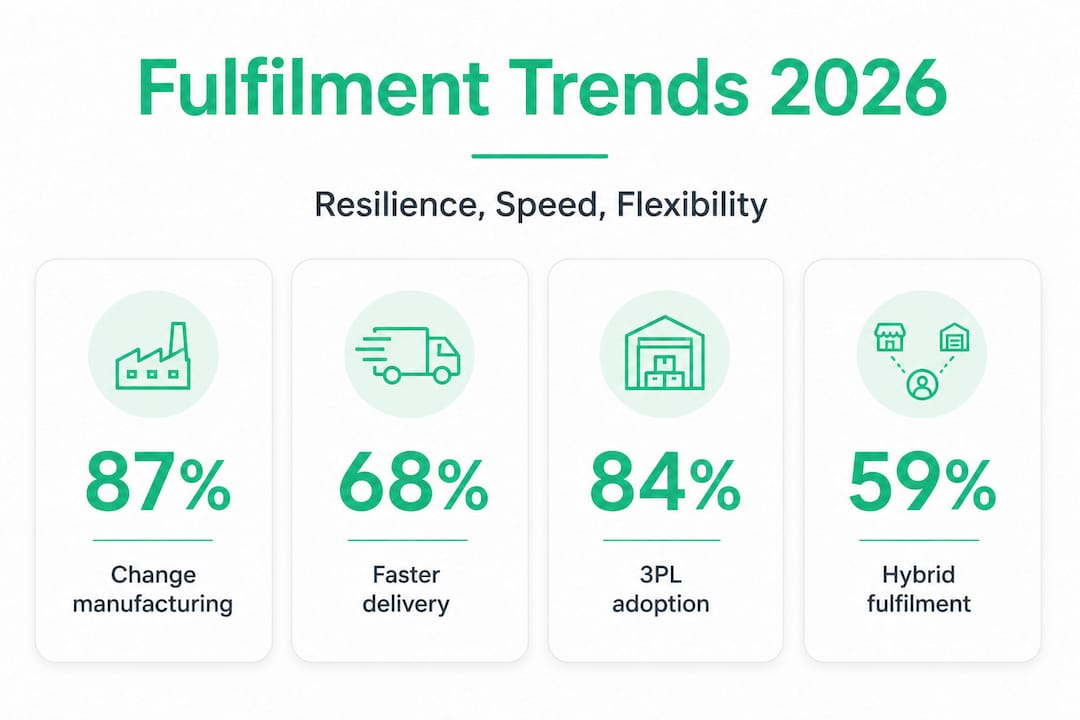
Speed expectations are tightening alongside this shift. 68% of US brands now target two to three day domestic delivery, and 59% already operate multiple fulfilment centres to achieve it. Notably, 84% use a third-party logistics provider for at least a portion of their orders, signalling that pure in-house models are no longer the default.
Understanding the difference between a fulfilment centre and a warehouse is a practical starting point for any brand reassessing its setup. Fulfilment centres are optimised for rapid order processing and customer despatch, whereas warehouses focus primarily on long-term storage. Choosing the wrong model for your growth stage is a costly mistake many brands make far too late.
Key advantages of a distributed, multi-centre fulfilment network include:
- Reduced last-mile transit time by positioning stock closer to key customer regions
- Lower shipping costs through shorter delivery zones and carrier tier optimisation
- Risk diversification by avoiding single-point-of-failure in warehouse operations
- Faster response to regional demand spikes, such as seasonal peaks or flash sales
- Improved customer satisfaction scores through consistent on-time delivery
| Network model |
Typical delivery time |
Resilience level |
Setup complexity |
| Single central warehouse |
3 to 5 days |
Low |
Low |
| Regional multi-centre |
1 to 3 days |
High |
Medium |
| Hybrid 3PL + in-house |
1 to 2 days |
Very high |
Medium to high |
| Fully outsourced 3PL |
1 to 3 days |
High |
Low |
For brands reviewing their options, top fulfilment strategies provide a practical framework for matching your network design to your customer base and order volumes. An efficient distribution guide for logistics managers can also support decision-making when modelling network configurations.
Pro Tip: Use demand data modelling before committing to additional centre locations. Analyse your order origins by postcode or region over a 12-month period to identify where a second or third node would yield the greatest reduction in transit time and cost.
Resilient networks provide the structure, but technology provides the intelligence and speed that modern fulfilment demands. In 2026, the conversation has moved well beyond basic automation. Brands are now adopting systems that orchestrate entire fulfilment operations autonomously, adapting in real time to changing order volumes and inventory levels.
Automation in e-commerce logistics covers a wide spectrum. At one end, autonomous mobile robots (AMRs) navigate warehouse floors dynamically, adapting their routes as stock locations change. At the other, automated storage and retrieval systems (ASRS) use fixed infrastructure to retrieve goods at very high speeds. Each has a distinct use case:
| Technology |
Flexibility |
Speed |
Best for |
Upfront cost |
| AMR (autonomous mobile robots) |
Very high |
High |
Variable SKU environments |
Medium |
| ASRS (automated storage and retrieval) |
Low |
Very high |
High-volume, consistent SKUs |
High |
| Cobots (collaborative robots) |
High |
Medium |
Kitting, packing, mixed orders |
Medium |
| AI-driven WMS |
Very high |
N/A |
Forecasting, labour scheduling |
Low to medium |
Artificial intelligence is the connective tissue across all of these systems. AI-driven warehouse management systems now handle real-time demand forecasting, labour allocation, and route optimisation simultaneously. This moves fulfilment from reactive problem-solving to proactive orchestration. Brands that boost fulfilment efficiency through automation report measurable improvements in order accuracy and throughput within the first quarter of deployment.
One of the most impactful individual technologies is always-on RFID (radio-frequency identification). RFID tags emit signals that scanners read automatically without line-of-sight, giving you a live view of every unit in your facility. The results from real-world deployments are striking:
“Always-on RFID achieves near-100% inventory accuracy, 50% faster omnichannel picking, a 5 to 10% sales uplift, 15 to 25% labour productivity gain, with return on investment typically achieved within 6 to 9 months.”
Those figures represent genuine competitive advantage. When your inventory data is accurate in real time, you eliminate costly overselling, reduce safety stock requirements, and speed up every omnichannel order, whether it originates from your website, a marketplace, or a retail partner. Guidance on achieving rapid and efficient inventory accuracy underlines just how fundamental this capability is to fulfilment performance.
Steps for deploying technology effectively in your fulfilment operation:
- Audit your current accuracy rates by running a physical stock count against your warehouse management system records to establish a baseline.
- Identify your highest-impact bottlenecks, whether picking errors, slow put-away, or carrier handover delays.
- Pilot AMRs or RFID in one zone before scaling, measuring the effect on pick times and accuracy.
- Integrate your WMS with your e-commerce platforms so inventory updates propagate in real time across all sales channels.
- Train your warehouse team alongside the technology rollout so adoption is smooth and confidence builds quickly.
Pro Tip: Do not automate everything at once. Kitting, gift wrapping, and speciality packing still benefit from skilled human hands. Blend technology with human expertise for the best accuracy and the most flexible fulfilment offering for your customers.
Sustainability and customer experience: A new competitive edge
Beyond technology, fulfilment services must balance operational gains with environmental responsibility and evolving customer demands. Sustainability is no longer a marketing exercise. It is increasingly a customer expectation and a cost-saving lever.

Key trends shaping fulfilment in 2026 include a clear shift towards electric vehicle (EV) last-mile delivery fleets, reusable and right-sized packaging, and AI-powered route optimisation that reduces fuel consumption and emissions. These developments are happening simultaneously rather than sequentially, and brands that adopt them gain on multiple fronts.
Practical sustainability improvements that also improve customer experience include:
- Right-sized packaging: Reduces void fill, cuts carrier costs based on dimensional weight pricing, and signals environmental care to customers when they unbox
- EV delivery partnerships: Lower carbon emissions per delivery and increasingly preferred by eco-conscious shoppers in urban markets
- Route optimisation software: Reduces delivery kilometres while improving on-time rates, directly benefiting the customer experience
- Reusable mailers: Particularly valuable for fashion and lifestyle brands where returns are frequent and packaging perception matters
- Carbon offset reporting: Giving customers visibility of the environmental impact of their order, which builds trust and brand affinity
The connection between sustainability and commercial performance is becoming clearer. Brands that optimise their fulfilment for logistics cost reduction and optimisation while adopting greener practices report lower operational costs and higher customer satisfaction scores simultaneously.
Reviewing top fulfilment strategies alongside your sustainability roadmap helps ensure that eco-efficiency is built into operational decisions rather than bolted on as an afterthought. Choosing the right fulfilment partner is also critical here, since your 3PL’s fleet, packaging options, and carrier relationships directly determine your sustainability performance.
Pro Tip: Communicate your sustainability initiatives clearly at checkout and in post-purchase emails. Customers who understand what you are doing for the environment are more likely to return and recommend your brand. Transparency builds loyalty.
Choosing your fulfilment model: 3PL, in-house or hybrid?
With the technology landscape and network design principles clear, the practical question for any brand manager is: which fulfilment model actually fits your scaling ambitions? The answer is rarely one-size-fits-all.
Data from Shipbob’s 2026 report shows that 84% of brands already use a 3PL for some portion of their orders, while 59% run multiple fulfilment centres. The clear direction is towards hybrid and distributed models rather than a single approach. The shift from automated to autonomous fulfilment also suggests that rigid, heavily capitalised in-house systems are being challenged by more flexible, AI-orchestrated approaches.
| Model |
Capital required |
Flexibility |
Best suited to |
Key risk |
| In-house |
High |
Low |
Very large volume, stable SKUs |
Scalability constraints |
| 3PL |
Low |
High |
Growing or seasonal brands |
Less direct control |
| Hybrid |
Medium |
Very high |
Multi-channel, varied volumes |
Coordination complexity |
Understanding why brands rely on 3PL logistics comes down to three factors: access to established infrastructure, the ability to scale up or down without capital exposure, and the expertise that a specialist partner brings to carrier negotiation, compliance, and technology. For many growing brands, attempting to replicate that in-house is neither efficient nor advisable.
How 3PLs power e-commerce growth at the cost, scale, and reach level is well established. For brands evaluating more sophisticated arrangements, the distinction between 3PL and 4PL models is worth understanding before committing to a partner structure.
Steps to transition your fulfilment model effectively:
- Map your current fulfilment costs across warehousing, labour, packaging, and shipping to establish a true cost-per-order figure.
- Define your volume thresholds: identify at what order volume a 3PL relationship becomes more cost-effective than in-house operations.
- Shortlist partners based on their technology integrations, geographical coverage, and experience with your product category.
- Pilot the transition with a single channel or region before full migration to reduce operational risk.
- Review performance quarterly against agreed KPIs for accuracy, despatch speed, and customer satisfaction.
A practical guide to 3PL and an essential logistics terms guide can help your team build a shared understanding before entering partner conversations.
Why radical flexibility is the future of fulfilment (and what most brands miss)
Here is what we see repeatedly: brands invest heavily in a single fulfilment model and then find themselves locked in when market conditions shift. They either over-automate a single warehouse with fixed infrastructure, or they outsource everything and lose the operational visibility they need to manage service quality. Both extremes create vulnerability.
The brands performing best in 2026 are those that treat fulfilment as a modular system. They use a 3PL for core volume, maintain a smaller in-house capability for specialist or high-value orders, and continually reassess network design as their customer geography changes. This is not indecision. It is strategic flexibility, and it is the hardest thing to retrofit once you have committed capital to a rigid model.
The most overlooked pitfall is failing to update your fulfilment strategy as customer expectations evolve. Delivery speed expectations that were exceptional two years ago are now standard. Sustainability practices that were differentiators last year are becoming table stakes. Brands that locked in their fulfilment model based on 2022 or 2023 assumptions are now running to catch up.
Our view is direct: choosing the right fulfilment partner should be treated with the same rigour as choosing a technology platform. The partnership must be designed to evolve. Contracts, SLAs, and technology integrations should allow for change, not resist it. Modular, scalable models outperform rigid ones every time the market moves unexpectedly, and the market always moves unexpectedly.
Take your fulfilment strategy further with ParcelPlanet
If this article has clarified one thing, it should be that fulfilment in 2026 rewards brands that act strategically and partner wisely. The network design choices, technology investments, and model decisions you make now will directly shape your customer experience and growth trajectory for the next several years.

At ParcelPlanet, we support e-commerce and omnichannel brands with order fulfilment services designed to scale with your ambitions. Whether you are exploring what order fulfilment means for your specific operation, or you are ready to take control of your inventory with tools like InventoryPlanner, our team brings the infrastructure, integrations, and expertise to make it work. Get in touch today to discuss a tailored solution that fits your growth stage and your customers’ expectations.
Frequently asked questions
What are the key trends shaping fulfilment services in 2026?
Distributed networks, AI decisioning, robotics, sustainability practices such as EV delivery and reusable packaging, and flexible fulfilment models are the leading forces shaping fulfilment performance in 2026.
How does RFID technology impact fulfilment accuracy and speed?
Always-on RFID delivers near-100% inventory accuracy and 50% faster omnichannel picking, with return on investment typically achieved within six to nine months of deployment.
Is 3PL or hybrid fulfilment better for scaling e-commerce brands?
Hybrid fulfilment offers greater flexibility and resilience, but a 3PL for some orders is the approach used by 84% of brands because the reach and infrastructure benefits are difficult to replicate in-house at scale.
Does sustainable delivery really improve customer satisfaction?
Yes, practices such as EV logistics and reusable packaging are increasingly expected by consumers, and brands that communicate these initiatives clearly report stronger customer trust, repeat purchase rates, and brand affinity.
Recommended


