TL;DR:
- Most e-commerce businesses treat international fulfillment as a costly necessity rather than a strategic system, which is inefficient. Distributed fulfillment networks can reduce global logistics expenses by up to 71%, improving speed, risk management, and operational flexibility. Investing in regional warehouses, unified technology, and localisation strategies enables brands to scale internationally with lower costs and greater customer satisfaction.
Most e-commerce businesses treat international fulfilment as a cost centre to be tolerated rather than a system to be designed. That framing is expensive. Distributed fulfilment networks can reduce global logistics costs by up to 71% compared to centralised models. The gap between brands struggling with international fulfilment challenges and those thriving internationally is rarely about product quality or marketing spend. It is almost always about how the fulfilment operation is structured, what technology sits behind it, and how well it adapts to local markets.
Table of Contents
Key takeaways
| Point |
Details |
| Distributed networks cut costs |
Shifting to regional fulfilment nodes can reduce logistics costs by up to 71% versus centralised models. |
| Geopolitical risk is measurable |
Shipping reroutes due to conflict have added 10 to 21 days to transit times, making multi-carrier models a necessity. |
| Technology siloes cost money |
Disjointed inventory and order systems can erode margins by 15 to 20% through hidden costs and missed visibility. |
| Localisation drives conversion |
Reducing delivery times to 1 to 2 days in markets like Saudi Arabia has directly increased brand market share. |
| Risk mitigation requires proactivity |
AI-driven demand forecasting and distributed stock positioning protect against single points of supply chain failure. |
The real international fulfilment challenges in 2026
The problems brands face in global shipping are not uniform. Some are structural, some are regulatory, and some are simply the result of underestimating how different international markets actually are.
Geopolitical disruption. Shipping reroutes from conflict zones have surged by 2,400%, adding 10 to 21 days to transit times on affected routes. Maritime war-risk premiums have risen by as much as 1,000% in high-conflict zones, with Red Sea surcharges adding £400 to £1,600 per TEU during peak disruption periods. These are not exceptional events any more. They are operational realities you need to plan around.
Customs clearance challenges. Documentation errors, incorrect HS codes, and mismatched declared values are among the most common reasons international shipments are held at border. Each delay compounds your fulfilment cost and your customer’s frustration. The complexity multiplies when you are shipping to multiple regions simultaneously, each with different duty structures and import rules.
Inventory management across regions. Holding stock in a single warehouse and shipping internationally sounds simple. In practice, it leads to inconsistent delivery times, higher last-mile costs, and the constant risk of stockouts in fast-moving markets. Managing stock across multiple regions introduces forecasting complexity, but that complexity is manageable with the right systems in place.
Customer expectations. International shoppers increasingly expect the same delivery speed and return simplicity they get domestically. Local payment preferences and return expectations are invisible barriers to conversion that many brands overlook entirely until they see their international cart abandonment rates.
Fluctuating transport costs. Fuel surcharges, capacity constraints, and carrier rate volatility make budgeting for international fulfilment genuinely difficult. Brands without multi-carrier flexibility are disproportionately exposed when their primary carrier raises rates or loses capacity.
Pro Tip: Build a landed cost calculator for your top five international markets before you commit to a pricing strategy. Factor in duties, insurance, last-mile costs, and average return rates. Pricing your products without this data leads to margin erosion that compounds at scale.
Distributed fulfilment networks as a solution
The traditional model, one central warehouse shipping everywhere, creates a predictable set of problems: long transit times, high shipping costs, and fragility whenever a single node fails. The shift underway in 2026 is structural.
86% of e-commerce businesses are moving towards regionalised fulfilment nodes, placing stock closer to end customers in key markets. This is not just about speed. It is about cost architecture and risk distribution.
Here is how the two models compare in practice:
| Factor |
Centralised fulfilment |
Distributed fulfilment |
| Logistics cost |
Higher last-mile and international freight costs |
Up to 71% reduction through regional positioning |
| Delivery speed |
5 to 10 days internationally |
1 to 3 days within regional zones |
| Geopolitical exposure |
High: single routing dependency |
Low: multiple nodes with rerouting flexibility |
| Customs complexity |
High: cross-border per order |
Reduced: bulk shipments handled regionally |
| Setup complexity |
Low initial overhead |
30 to 45 days for integration and compliance setup |
| Scalability |
Limited by single location capacity |
Scales by adding regional nodes incrementally |
The key operational advantage of distributed models is that you move the complexity upstream. Instead of managing international customs on every individual order, you manage it once for bulk stock movements into regional warehouses. One case demonstrates this clearly: centralised customs management by a specialist fulfilment partner eliminated customs issues entirely over an 18-month operational period.
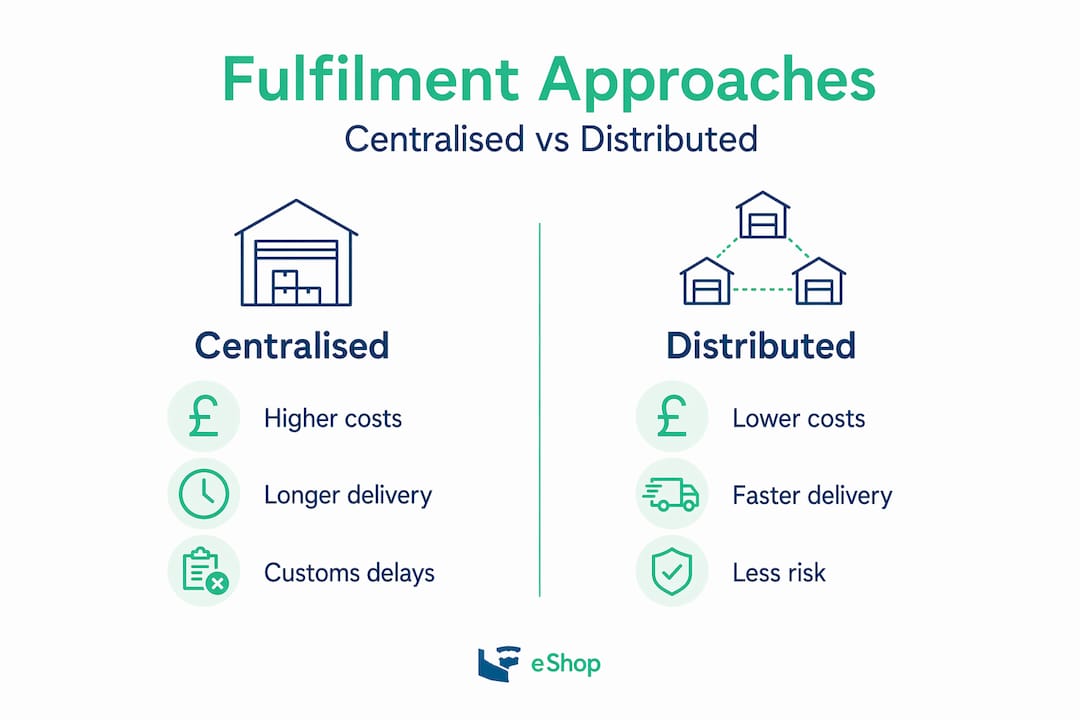
Implementation typically takes 30 to 45 days for a new regional node, covering integration, compliance documentation, and carrier setup. That is a short runway for a structural improvement that pays dividends for years.
Pro Tip: Do not sequence your regional expansion one market at a time. Simultaneous deployment of multiple nodes significantly reduces single points of failure and delivers cost savings faster than a staged rollout.
When you are evaluating where to place regional nodes, consider your cross-border shipping options alongside your top three markets by order volume, your average transit time complaints, and where you are currently losing the most on last-mile delivery costs.
Technology integration for better order management
Technology does not solve fulfilment problems on its own. The wrong technology, or the right technology poorly connected, creates its own class of e-commerce fulfilment problems.

The core issue many growing brands face is fragmentation. Their order management system (OMS) does not talk properly to their warehouse management system (WMS). Their returns platform operates independently of their inventory records. Their carrier integrations update at different intervals. The result is that nobody has a single accurate picture of stock levels, in-transit orders, or return liability at any given moment.
Disjointed technology systems erode margins by 15 to 20% through inventory hoarding, mismanaged returns, and compounding hidden costs. That figure tends to surprise brands until they audit their own operations.
What a unified technology stack actually delivers in cross-border logistics:
- Real-time inventory visibility across all regional warehouses, preventing both overstocking and costly stockouts in high-demand markets
- Automated customs documentation generated at the point of order, reducing manual errors and border delays
- Multi-channel order consolidation, pulling from your Shopify, Amazon, and direct-to-consumer channels into a single fulfilment queue
- Returns processing integration, so returned stock is assessed, restocked, or quarantined without manual intervention
Over 60% of e-commerce brands now outsource to 3PL partners specifically to access this level of technology integration, with leading providers delivering up to 88% improvement in international delivery speed as a result.
When evaluating technology partners, prioritise those with native OMS and WMS integration rather than those relying on middleware to connect separate systems. Middleware adds latency, creates failure points, and typically requires custom development work whenever either system updates.
Pro Tip: Before signing any 3PL or technology contract, ask for a live demonstration of how their system handles a concurrent stockout event across two regional warehouses. If they cannot show you that scenario in real time, their visibility is not what they are claiming.
Localisation as a fulfilment strategy
Most brands think about localisation in terms of language and currency. The smarter framing is to think about it as the entire post-purchase experience.
Consider what iHerb achieved in Saudi Arabia. By reducing delivery times from 5 to 7 days to 1 to 2 days through a local fulfilment centre, they increased market share measurably. The product did not change. The price did not change. The delivery experience changed, and that was sufficient to shift consumer preference.
Here are four localisation elements that directly affect fulfilment performance and conversion rates:
-
Local delivery expectations. Same-day and next-day expectations vary significantly by market. Gulf consumers expect speed. German consumers prioritise precise delivery windows. Knowing your market’s standard means you can position fulfilment nodes accordingly rather than discovering the gap through negative reviews.
-
Return policies adapted to local norms. In some markets, free returns are table stakes. In others, click-and-collect drop-off returns are the expectation. A returns process designed for your home market will underperform internationally if it forces customers into unfamiliar processes.
-
Local payment preferences and post-purchase communications. Cash on delivery remains significant in parts of the Middle East and Southeast Asia. Post-purchase tracking updates sent in the customer’s language, through their preferred channel (WhatsApp versus email, for example), directly affect satisfaction scores.
-
Branded packaging and unboxing. This is underestimated as a retention tool. Localised packaging with culturally relevant design signals that your brand belongs in that market, not just that it ships there. It converts first-time buyers into repeat customers at a meaningfully higher rate.
Localisation of fulfilment functions as a marketing strategy as much as a logistics one. Brands that treat it purely as an operational task leave significant conversion and loyalty gains on the table.
Risk mitigation and future-proofing your operations
The brands that struggled most with supply chain disruption in recent years had one thing in common: single points of failure. One primary carrier. One warehouse. One sourcing region. 2026 has made the cost of that approach very visible.
Building resilience into your international fulfilment operation means addressing these areas:
- Multi-carrier models. Relying on a single carrier creates exposure to rate increases, capacity shortfalls, and service outages. A multi-carrier model with pre-negotiated rates across at least three carriers in each region gives you routing flexibility without sacrificing service level commitments.
- Strategic stock positioning. Geographic diversification of inventory, placing stock in multiple nodes rather than a single distribution centre, directly reduces the impact of any one disruption.
- AI-driven demand forecasting. Predictive analytics applied to order history, seasonal demand patterns, and market signals allows you to pre-position stock ahead of demand rather than reacting to stockouts after the fact. Brands investing in AI and real-time visibility are converting logistics into a competitive advantage rather than a cost overhead.
- Insurance and maritime risk monitoring. With war-risk premiums surging on key chokepoints, monitoring insurance market signals is no longer optional for high-volume international shippers.
Pro Tip: Subscribe to maritime risk briefings from a freight intelligence provider and set threshold alerts for premium changes on your primary shipping routes. A 200% premium increase is a signal to reroute proactively, not a surprise to absorb.
For a detailed look at the scalable fulfilment options available in 2026, including how leading brands are using AI-assisted routing and distributed warehousing together, the gap between reactive and proactive operations has never been wider.
My perspective on what most brands get wrong
I have worked alongside enough e-commerce operations to recognise a consistent pattern. The brands that struggle most with international fulfilment challenges are not the ones facing the hardest problems. They are the ones who made structural decisions early, usually over-centralisation, and then optimised around those decisions rather than questioning them.
Over-centralisation is the single most common and most expensive mistake I see. A brand builds one excellent warehouse, automates it well, and then assumes that shipping internationally from that location is simply an extension of domestic fulfilment. It is not. Every order crossing a border carries customs risk, currency cost, and last-mile unpredictability that compounds at volume.
The second mistake is delaying technology integration until the operation is already at scale. By that point, the cost of migration is much higher, the data quality is poorer, and the business has already absorbed months of invisible margin erosion.
What I have learned is that the brands winning internationally in 2026 made two decisions early: they distributed their stock before they had to, and they invested in a unified technology layer before their systems became difficult to untangle. Neither decision required perfect timing. Both required the willingness to invest ahead of pain rather than in response to it.
If you are reading this article, you are probably at the inflection point where those decisions matter most. Act on them before operational complexity makes them harder.
— Lukasz
How Parcelplanet supports your international growth
Overcoming the international fulfilment challenges described in this article requires more than good intentions. It requires the right operational infrastructure behind your business.
Parcelplanet’s order fulfilment services are designed specifically for e-commerce brands managing cross-border logistics complexity. From distributed warehousing across multiple regions to real-time inventory visibility, customs compliance support, and multi-carrier flexibility, Parcelplanet handles the operational detail so you can focus on growth. The platform integrates with leading e-commerce channels and provides the unified technology layer that prevents the margin erosion caused by siloed systems.
Whether you are launching in a new international market or restructuring an existing fulfilment operation, Parcelplanet’s team provides tailored support at every stage. Use the fulfilment partner guide to understand what to look for in a 3PL, then get in touch with Parcelplanet for a quote tailored to your specific regions, volumes, and growth targets.
FAQ
What are the biggest international fulfilment challenges in 2026?
The most significant challenges are geopolitical shipping disruptions, customs clearance complexity, fragmented inventory management, and rising last-mile costs in new markets. Brands without distributed fulfilment networks and unified technology stacks are most exposed to these issues.
How much can distributed fulfilment reduce logistics costs?
Distributed cross-border networks can reduce global e-commerce logistics costs by up to 71% compared to centralised models, with implementation typically completed within 30 to 45 days.
Adapting delivery speed, return processes, and payment options to local market expectations directly increases conversion rates and customer retention. Reducing delivery windows from 5 to 7 days to 1 to 2 days, as iHerb demonstrated in Saudi Arabia, can produce measurable increases in market share.
What technology do I need for effective cross-border order management?
A unified OMS and WMS integration with real-time inventory data is the foundation. This prevents the inventory hoarding and hidden costs that disjointed systems create, and enables automated customs documentation at the point of order.
When should I consider outsourcing international fulfilment to a 3PL?
When your international order volume is creating customs delays, inconsistent delivery times, or significant last-mile costs, outsourcing to a specialist 3PL gives you immediate access to distributed infrastructure, technology integration, and carrier relationships that would take years to build independently.
Recommended