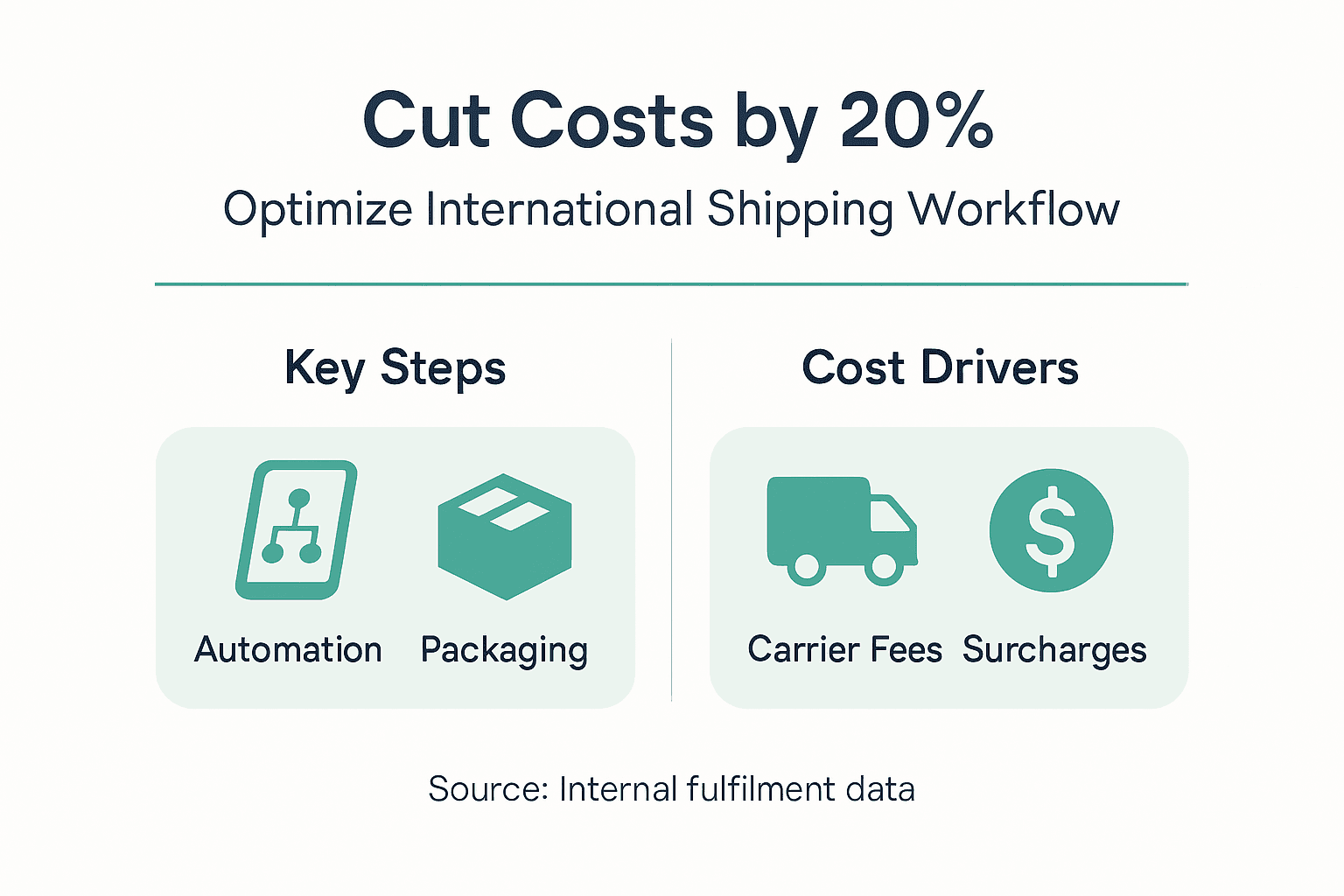
International shipping complexity drains profits from small and medium e-commerce brands faster than most managers realize. Hidden fees, customs delays, and inefficient workflows silently erode margins while frustrating customers. Studies show that 70% of international shipping delays stem from documentation and packaging errors alone. This guide walks you through a complete, actionable workflow to streamline your operations, reduce costs by up to 20%, and scale internationally with confidence.
Table of Contents
Key Takeaways
| Point |
Details |
| Cost Reduction Potential |
International shipping workflow optimization reduces costs by up to 20% through strategic carrier selection and packaging. |
| Documentation Accuracy |
Accurate customs documentation prevents 70% of common international shipment delays and associated fees. |
| Right-Sized Packaging |
Proper packaging based on dimensional weight calculations cuts material waste and dimensional weight charges significantly. |
| Performance Tracking |
Monitoring KPIs like landed-cost accuracy and on-time delivery rates drives continuous shipping efficiency improvements. |
| Common Pitfalls |
Improper packaging, incomplete customs paperwork, and ignoring hidden surcharges are the most costly mistakes to avoid. |
Introduction to International Shipping Workflow
An international shipping workflow is the end-to-end process that moves orders from your warehouse to customers across borders. It includes order receipt, carrier selection, packaging, customs documentation, label printing, dispatch, tracking, and delivery confirmation. Getting this right separates profitable international expansion from costly logistical nightmares.
Small to medium e-commerce brands face unique challenges scaling internationally. Customs compliance varies wildly by country, each with different regulations and documentation requirements. Carrier selection becomes complex when balancing cost against delivery speed across dozens of service options. Packaging costs spiral when dimensional weight pricing catches you off guard. Many managers believe international shipping costs are fixed and delays unavoidable, which is completely wrong.
Inaccurate documentation and poor packaging cause 70% of international shipping delays. These inefficiencies hit your bottom line hard through multiple channels. Hidden fees accumulate from customs holds, redelivery attempts, and dimensional weight surcharges. Customer dissatisfaction grows with each delayed or damaged shipment, directly impacting repeat purchase rates. Meanwhile, competitors with streamlined workflows capture market share by offering faster, cheaper international delivery.
Structured workflows transform these challenges into competitive advantages. You gain predictable costs through automated carrier selection matching shipment characteristics to optimal services. On-time delivery rates climb above 95% when customs documentation follows standardized processes. Customer satisfaction improves dramatically when proactive tracking updates replace delivery surprises.
A well-designed shipping strategy workflow delivers measurable results:
- Reduced per-order shipping costs by 5-20%
- Decreased customs-related delays by up to 70%
- Lower customer complaints by approximately 30%
- Increased international conversion rates by up to 15%
The key is treating international shipping as a strategic system rather than a transactional necessity. Each workflow component connects to the next, creating efficiencies that compound over time.
You cannot optimize what you cannot measure or control. Before implementing workflow improvements, ensure you have foundational tools and knowledge in place. Trying to streamline international shipping without proper infrastructure wastes time and creates new problems.
Start with reliable e-commerce platform integration supporting multiple carriers. Your platform must communicate seamlessly with carrier APIs to pull real-time rates, print labels, and transmit tracking data. Single-carrier limitations force suboptimal routing decisions that inflate costs.
Shipping software automation eliminates manual bottlenecks in label printing, carrier selection, and tracking updates. Integration with multi-carrier shipping platforms and data analytics tools proves vital for efficient operations. Look for solutions offering batch processing, automated customs form generation, and exception management.

Customs regulations knowledge separates smooth deliveries from expensive holds. You need working familiarity with Harmonized System (HS) codes for product classification, duty calculation methods, and country-specific import restrictions. This knowledge prevents the documentation errors causing most delays.
Right-sized packaging options directly impact your dimensional weight fees. Stock various box sizes matching common order profiles, eliminating wasted space that carriers charge for. Include protective materials appropriate for international transit without over-packaging.
Data analytics tools close the optimization loop by monitoring shipping performance. Track key metrics like average shipping cost per order, on-time delivery percentage, customs clearance time, and customer satisfaction scores. Without measurement, you cannot identify improvement opportunities.
Essential prerequisites checklist:
- Multi-carrier integrated e-commerce platform
- Automated shipping software with customs documentation
- Customs regulations database or consultation access
- Varied packaging inventory optimized for dimensional weight
- Analytics dashboard tracking shipping KPIs
- Team training on international shipping best practices
Pro Tip: Before launching international shipping to new countries, research specific ecommerce logistics requirements including prohibited items, value thresholds triggering customs inspection, and documentation language requirements. This 30-minute investment prevents weeks of troubleshooting later.
Step-by-Step International Shipping Workflow
Implementing an optimized international shipping workflow requires executing specific steps in sequence. Each stage builds on the previous one, creating efficiency through systematic processing. Skip steps and you introduce errors that cascade downstream.
1. Automate Order Receipt and Carrier Selection
When international orders arrive, automated systems should instantly evaluate multiple carriers based on destination, package dimensions, delivery speed requirements, and cost. Manual carrier selection wastes time and misses cost-saving opportunities. Configure rules matching shipment characteristics to optimal carriers, automatically routing lightweight packages to postal services and time-sensitive orders to express couriers.
2. Calculate and Apply Right-Sized Packaging
Right-sized packaging reduces dimensional weight fees by up to 20% while lowering material waste. Measure actual product dimensions and select the smallest box providing adequate protection. Use dimensional weight calculators before finalizing packaging to avoid surprise charges. Consider flat-rate options for dense, heavy items where dimensional pricing penalizes you.
3. Generate Accurate Customs Documentation
Customs paperwork accuracy makes or breaks international shipping efficiency. Generate commercial invoices listing each item with correct HS codes, accurate declared values, and clear product descriptions. Use landed-cost calculators estimating duties and taxes, giving customers transparency. Verify recipient addresses match customs requirements for the destination country.
4. Print Labels and Schedule Dispatch
Batch print shipping labels during designated time windows to streamline warehouse operations. Include all required customs forms as label attachments. Schedule carrier pickups matching your order volume patterns, avoiding multiple daily pickups that increase costs. Implement shipping optimization techniques like zone-based picking to improve packing efficiency.
5. Track Shipments and Communicate Proactively
Real-time tracking visibility lets you identify exceptions before customers notice. Configure automated notifications at key milestones: shipped, in transit, customs clearance, out for delivery, and delivered. When delays occur, proactive communication reduces support tickets and maintains customer trust.
| Workflow Stage |
Key Actions |
Common Tools |
| Order Receipt |
Capture order data, verify address |
E-commerce platform API |
| Carrier Selection |
Compare rates, apply routing rules |
Multi-carrier shipping software |
| Packaging |
Measure dimensions, select box size |
Dimensional weight calculator |
| Customs Documentation |
Generate invoices, assign HS codes |
Customs compliance database |
| Label Printing |
Batch print labels with forms |
Shipping label printer |
| Dispatch |
Schedule pickups, update inventory |
Warehouse management system |
| Tracking |
Monitor transit, send notifications |
Tracking dashboard |
Pro Tip: Create an ecommerce logistics checklist specific to high-volume destination countries. Include country-specific requirements like invoice copies needed, restricted product categories, and maximum declared values before customs inspection. This checklist becomes your quality control gate before dispatch.
Consistency matters more than perfection initially. Execute each workflow step the same way every time, then refine based on performance data. Standardization eliminates variability that causes errors.
Common Mistakes and Troubleshooting
Even experienced e-commerce managers fall into predictable international shipping traps. Understanding these pitfalls and their solutions prevents costly disruptions to your workflow.
Incomplete or incorrect customs paperwork causes up to 70% of shipping delays. Common errors include missing HS codes, vague product descriptions like “general merchandise,” and declared values not matching actual prices. Solution: Implement automated customs document generation with validation rules checking for required fields. Maintain a product database with pre-assigned HS codes and detailed descriptions.
Improper packaging creates dual problems: product damage and inflated dimensional weight charges. Oversized boxes trigger dimensional pricing that exceeds actual product weight costs. Insufficient protection leads to damage claims and reshipments. Solution: Conduct packaging audits measuring actual box fill rates. Target 85-90% fill rates balancing protection with dimensional efficiency. Test packaging durability for international transit conditions.
Ignoring address formatting standards causes delivery retries or returns. International addresses follow different conventions than domestic ones, with postal codes in varying positions and region names in local languages. Solution: Use address validation APIs that standardize international addresses to local postal formats. Display address entry guidance specific to the customer’s country.
Neglecting hidden surcharges surprises customers and erodes margins. Fuel surcharges, remote area fees, residential delivery charges, and customs brokerage fees can add 20-40% to base shipping rates. Solution: Enable landed-cost calculation at checkout displaying total delivered cost including all fees and estimated duties. Transparency reduces cart abandonment and customer disputes.
Lack of real-time shipment tracking leaves customers anxious and increases support queries. When issues arise, delayed awareness means missed intervention opportunities. Solution: Implement proactive tracking notifications at every milestone. Set up exception alerts flagging customs holds or delivery failures for immediate team response. Accurate shipping and tracking cuts e-commerce errors by 35%.
Troubleshooting approaches:
- Customs holds: Review documentation for completeness, contact customs broker immediately, have commercial invoices and product details ready
- Delivery failures: Verify address accuracy, check for access restrictions, coordinate redelivery with customer directly
- Damaged shipments: Document with photos, file carrier claims promptly, review packaging adequacy for route conditions
- Unexpected fees: Audit carrier invoices against quoted rates, dispute incorrect surcharges, adjust future cost estimates
Pro Tip: Create a dedicated Slack channel or shared spreadsheet tracking international shipping exceptions. Log each issue with root cause and resolution. This exception database becomes your training resource and reveals systemic problems requiring workflow adjustments.
Expected Results and How to Measure Success
Optimizing your international shipping workflow delivers quantifiable improvements across multiple performance dimensions. Setting clear benchmarks and tracking progress ensures your efforts translate into business value.
Shipping cost reduction typically ranges from 5-20% per order post-optimization. Savings come from better carrier selection, reduced dimensional weight charges, fewer customs delays, and lower damage rates. Calculate your average cost per international order before and after workflow changes to measure impact.
On-time delivery rates should climb above 95% with proper workflow execution. Monitoring delivery performance against promised dates reveals bottlenecks in your process. Track separately by destination region to identify geographic problem areas.
Customs-related delays decrease by up to 70% when documentation accuracy improves. Measure average customs clearance time for shipments to major destination countries. Increases in clearance time signal documentation issues requiring immediate attention.
Customer complaints about shipping drop approximately 30% with workflow optimization. Track support tickets categorized by shipping issues: late delivery, damage, customs fees, tracking visibility. Declining ticket volume in these categories confirms workflow effectiveness.
International order conversion rates increase up to 15% when landed-cost transparency and reliable delivery build customer confidence. Compare conversion rates for international traffic before and after implementing checkout-stage cost calculators and delivery estimates.
| KPI |
Baseline Target |
Optimized Target |
Measurement Frequency |
| Average Cost Per Order |
Varies |
5-20% reduction |
Weekly |
| On-Time Delivery Rate |
75-85% |
95%+ |
Daily |
| Customs Clearance Time |
3-7 days |
1-2 days |
Per shipment |
| Shipping Support Tickets |
Varies |
30% reduction |
Weekly |
| International Conversion Rate |
Varies |
15% increase |
Monthly |
| Landed-Cost Accuracy |
60-70% |
90%+ |
Per order |
Critical KPIs to track:
- Landed-cost estimation accuracy comparing predicted versus actual total costs
- Customs inspection rates by destination country
- Average transit time from dispatch to delivery
- Carrier performance scores based on on-time delivery and condition
- Exception rate measuring shipments requiring manual intervention
- Customer satisfaction scores specifically for international orders
Data collection must be automated to remain sustainable. Manual KPI tracking fails within weeks as operational demands overwhelm good intentions. Integrate analytics dashboards pulling data directly from your shipping software, e-commerce platform, and carrier systems. Set up weekly reports emailed to stakeholders with trend analysis highlighting improvements or concerns.
Pro Tip: Benchmark your performance against shipping workflow success metrics published by logistics providers and industry research. This context reveals whether your results are competitive or if significant optimization opportunities remain untapped.
Advanced Strategies and Tradeoffs
Once core workflow efficiency is established, advanced fulfillment strategies unlock additional cost savings and speed improvements. However, each strategy introduces complexity requiring careful evaluation of tradeoffs.
Distributed inventory positions stock closer to international customers, reducing last-mile delivery costs and transit times. By maintaining inventory in regional fulfillment centers rather than shipping everything from a central warehouse, you cut cross-border shipping frequency. The tradeoff is increased inventory holding costs, split inventory visibility challenges, and potential stock imbalances across locations. This strategy works best for high-volume products with predictable regional demand.
Zone skipping consolidates shipments destined for the same region, transporting them together to a local distribution center before final delivery. Zone skipping reduces shipping costs by up to 20% and shortens last-mile delivery times. The tradeoff is delayed individual shipment dispatch waiting for consolidation batches and increased logistics coordination complexity. Best for brands shipping 50+ daily orders to concentrated geographic areas.
Multi-carrier automation intelligently routes each shipment to the optimal carrier based on real-time rate shopping, service requirements, and performance history. This balances cost savings with delivery reliability but requires integration with multiple carrier systems and ongoing rate negotiation across providers. The operational complexity increases as does the technical integration effort. Worthwhile when shipping volume exceeds 100 international orders weekly.
| Strategy |
Cost Impact |
Speed Impact |
Complexity |
Best For |
| Distributed Inventory |
15-25% reduction |
2-3 days faster |
High |
High-volume, predictable demand |
| Zone Skipping |
15-20% reduction |
1-2 days faster |
Medium |
Concentrated regional orders |
| Multi-Carrier Automation |
10-15% reduction |
Neutral |
Medium |
Diverse shipment profiles |
| Hybrid Fulfillment |
10-20% reduction |
Varies |
Very High |
Omnichannel brands |
Speed versus cost represents the fundamental tradeoff in international shipping. Express services deliver in 2-4 days but cost 3-5 times standard shipping rates. Economy options save money but extend delivery to 10-20 days, increasing customer anxiety and potential cancellations. Solution: Offer tiered shipping options at checkout, letting customers choose their preference while you maintain healthy margins on each tier.
Automation reduces labor costs and error rates but requires upfront investment and team training. Automated systems handle repetitive tasks like label printing and tracking updates flawlessly at scale. However, initial setup demands technical resources and process documentation. Change management becomes critical as staff adapt to new workflows. The breakeven point typically arrives around 50-75 daily international orders.
Outsourcing to third-party logistics (3PL) providers transfers shipping complexity to specialists with established carrier relationships and volume discounts. This reduces your internal logistics overhead and provides instant access to optimized shipping techniques. The tradeoff is reduced direct control over the fulfillment experience and dependence on external partners. Ideal for brands prioritizing growth over operational control.
Pro Tip: Test advanced strategies with small shipment segments before full rollout. Allocate 10-15% of orders to a new approach like zone skipping, measure performance against your control group, then expand based on validated results. This limits downside risk while building confidence in new methods.
Optimize Your International Shipping with ParcelPlanet Solutions
Implementing the strategies outlined here requires expertise, technology, and ongoing optimization that stretches internal resources. ParcelPlanet’s specialized 3PL services remove international shipping complexity while reducing logistics costs for small and medium e-commerce brands. Our multi-carrier integration, automated customs documentation, and real-time tracking deliver the workflow efficiency described throughout this guide without requiring you to build systems from scratch.

Our order fulfilment services scale with your international growth, handling everything from warehousing to final delivery across multiple regions. We leverage volume discounts across carrier networks, passing savings directly to your bottom line. Real-time inventory visibility and exception management ensure smooth operations as you expand into new markets. Understanding 3PL versus 4PL options helps you choose the right fulfillment partnership matching your growth stage and operational priorities.
Frequently Asked Questions
What are the first steps to set up an international shipping workflow?
Start by integrating multi-carrier shipping software with your e-commerce platform, then establish accurate product dimensions and weights in your system. Create a customs documentation template with HS codes for your product catalog and set up automated carrier selection rules based on destination and package characteristics.
How can I prevent customs delays effectively?
Ensure every shipment includes complete commercial invoices with accurate HS codes, detailed product descriptions, and correct declared values matching actual prices. Use automated customs documentation generation with validation rules checking for required fields before dispatch, and maintain updated knowledge of destination country import restrictions.
What packaging considerations save the most on international shipping?
Right-sizing boxes to minimize dimensional weight charges delivers the biggest savings, potentially reducing costs by 20% or more. Stock multiple box sizes matching common order profiles, aim for 85-90% box fill rates, and always calculate dimensional weight before finalizing packaging to avoid surprise charges from carriers.
How do I track shipping KPIs to measure success?
Implement automated analytics dashboards pulling data from your shipping software, e-commerce platform, and carrier systems to track on-time delivery rates, average shipping costs, customs clearance times, and customer satisfaction scores. Set up weekly reports with trend analysis and benchmark your performance against industry standards to identify improvement opportunities.
When should I consider using advanced fulfillment options like zone skipping?
Zone skipping becomes cost-effective when you ship 50 or more daily orders to concentrated geographic regions, allowing consolidation savings to offset coordination complexity. Evaluate whether your order volume and destination patterns support batch consolidation before implementing, and test with a small segment to validate savings before full rollout.
How much can I realistically reduce international shipping costs?
Most e-commerce brands achieve 5-20% cost reduction through workflow optimization, with savings varying based on current efficiency levels and order characteristics. The largest improvements come from better carrier selection, reduced dimensional weight charges through right-sized packaging, and fewer customs delays from accurate documentation.
Recommended


