TL;DR:
- Poor stock visibility harms e-commerce businesses by causing lost sales and eroding customer trust. Implementing a data-driven, five-stage inventory workflow that emphasizes regular cycle counting, technology choice, and role clarity improves accuracy, reduces costs, and supports scaling. Embedding inventory practices into daily operations and utilizing advanced techniques like ABC analysis and location-based counting enhances control and reliability.
Poor stock visibility costs e-commerce businesses more than lost sales. It erodes customer trust, locks up capital in dead stock, and makes scaling feel impossible. A well-structured inventory management workflow changes that. It turns reactive firefighting into a repeatable, data-driven system where every stage — from demand forecasting through to replenishment — feeds the next. This guide walks you through the tools you need, a proven five-stage process, common mistakes to avoid, and expert-level tactics to sharpen accuracy as your order volumes grow.
Table of Contents
Key takeaways
| Point |
Details |
| Workflow is a continuous loop |
The five-stage workflow cycles from forecasting back to forecasting, not a linear process with an endpoint. |
| Technology selection matters early |
Choosing the right IMS, WMS, or ERP before you scale prevents costly migrations and data inconsistencies later. |
| Cycle counting beats annual counts |
Counting roughly 100 SKUs daily across 8,000 items maintains accuracy without shutting down operations. |
| ABC analysis protects your ROI |
Focusing count frequency and accuracy efforts on your highest-value SKUs yields the greatest return. |
| Embed inventory tasks into daily operations |
Treating cycle counting and stock reviews as daily habits rather than periodic projects is what separates accurate from inaccurate operations. |
Building your inventory management workflow
Before you can run an effective stock management workflow, you need the right infrastructure in place. Attempting to optimise a process built on spreadsheets and guesswork will only magnify existing problems. The foundation matters.
Choosing the right software
The three primary technology options are inventory management systems (IMS), warehouse management systems (WMS), and enterprise resource planning (ERP) platforms. Each serves a different scale and complexity of operation.
| System |
Best for |
Key strength |
Limitation |
| IMS |
Small to mid-size e-commerce |
Affordable, quick to deploy |
Limited warehouse-level detail |
| WMS |
Warehouse-heavy operations |
Location-level tracking, pick optimisation |
Higher cost and setup time |
| ERP |
Multi-channel, high-volume brands |
Unified data across finance, sales, stock |
Complex implementation |
For most growing e-commerce brands, a dedicated IMS integrated with your sales platform is the right starting point. As you scale, a WMS or ERP becomes justified.
Automated inventory solutions and data capture
Manual data entry is the single biggest source of inventory errors. AI-driven warehouse tools and barcode or RFID scanning bring significant accuracy gains by removing human transcription from receiving and picking processes. RFID is worth the investment for high-SKU operations where speed and density make barcode scanning impractical.

Data accuracy also requires an upfront cleanse. Before going live on any new system, audit your existing SKU data. Duplicate listings, incorrect units of measure, and missing supplier lead times will corrupt every forecast and replenishment calculation downstream.
Organisational readiness
Assign clear ownership before any system goes live. Someone needs to own receiving accuracy, someone owns cycle count scheduling, and a manager needs to review variance reports weekly. Without defined roles, even the best software becomes shelfware.
Pro Tip: Start with a fulfilment efficiency checklist to audit your current state before committing to any new tools. It saves weeks of painful backtracking.
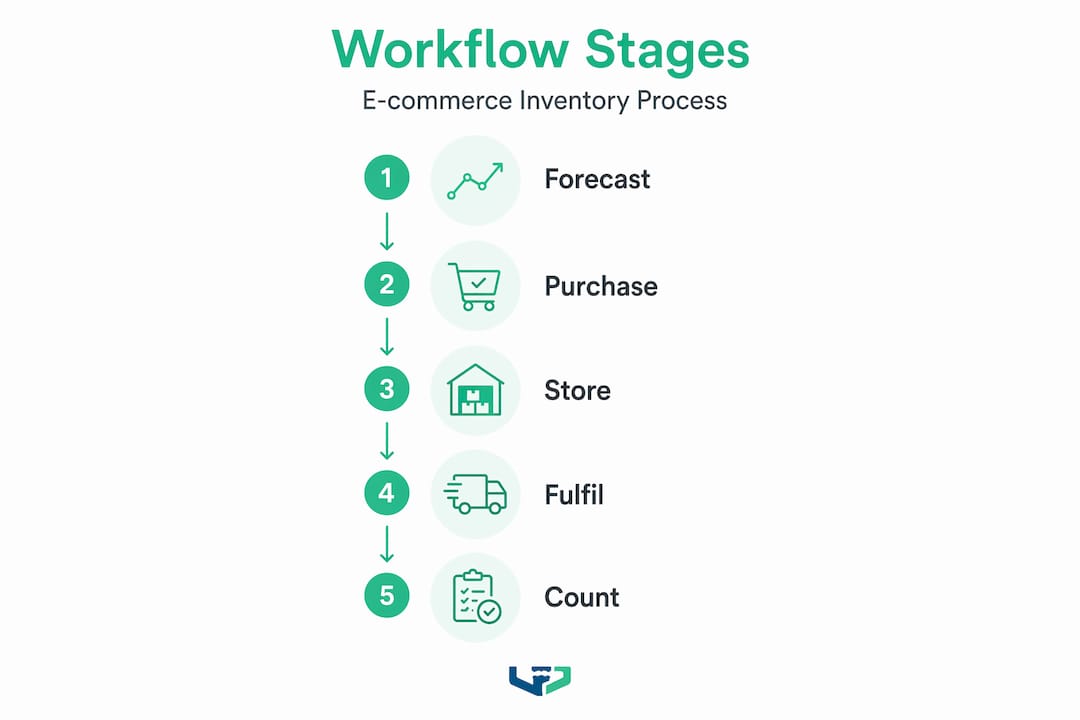
The five-stage inventory management workflow
A sound inventory control process is not a series of disconnected tasks. It is a continuous five-stage loop where each stage produces data that improves the next cycle. Here is how to execute each stage effectively.
-
Demand forecasting. Pull historical sales data, seasonal trends, and any planned promotions into your forecasting model. Real-time data integration from your sales channels gives you a live picture of velocity by SKU. Poor forecasting is the root cause of both stockouts and overstock, so invest time here before touching anything else. Linking your forecasting to fulfilment processes reduces lag between a demand signal and a stock action.
-
Purchasing and receiving. Generate purchase orders based on your reorder points and lead times. When stock arrives, every unit must be counted, scanned, and quality-checked before entering the system. A missed receiving error at this stage creates a discrepancy that will take weeks to trace. Document supplier lead times and any quantity variances from every delivery.
-
Storage and slotting. Where you store items is as important as how many you hold. High-velocity SKUs belong closest to packing stations. Seasonal or slow-moving items go to secondary locations. Strategic slotting reduces pick time, which directly reduces fulfilment cost per order. Review your slotting layout every quarter as your product mix evolves.
-
Order fulfilment. This is where your inventory data meets your customer promise. Accurate stock levels feed your sales channels with reliable availability, preventing oversells. Pick and pack processes should be supported by your WMS or IMS with scanning at every touch point to confirm the correct item and quantity. You can review a six-step order management workflow to tighten this stage further.
-
Tracking, cycle counting and replenishment. Cycle counting feeds real physical data back into your system continuously. Counting by storage location rather than SKU alone catches misplaced and ghost inventory that distort your records. Replenishment triggers fire automatically when stock drops below reorder thresholds. The data from this stage updates your forecasting model, closing the loop.
Pro Tip: Schedule your daily cycle counts during natural operational lulls, such as early morning before pick waves begin. Embedding counts into daily routines rather than treating them as separate events dramatically improves staff compliance and data quality.
Common mistakes in inventory workflows
Even well-intentioned teams make the same errors repeatedly. Knowing what to watch for lets you correct problems before they compound.
-
Irregular or skipped cycle counting. APICS recommends counting your entire inventory at least four times per year, which translates to roughly 100 SKUs per day for an 8,000-item catalogue. Teams that count only when problems appear are always behind the curve.
-
Failing to freeze pending transactions. Counting while warehouse transactions are still processing creates false variances. Complete or pause all pending receipts, pick confirmations, and transfers before a count begins. This single discipline is the difference between 95% and 99.9% accuracy.
-
Overreliance on spreadsheets. Spreadsheets have no audit trail, no real-time updates, and no automated alerts. They are the right tool for analysis, not for live inventory control. If your stock management workflow still runs on a shared Excel file, that is the first thing to change.
-
Treating variance data as just a number to adjust. Top retailers investigate discrepancies as triggers for process improvement, not just corrections to make the system balance. A recurring variance at a specific location or with a specific supplier almost always points to a fixable process failure.
-
No defined role for variance review. Discrepancy data is only useful if someone reviews it with authority to act. Weekly variance reviews should be a standing meeting, not an occasional task.
Advanced strategies for inventory control
Once your core workflow is solid, these techniques bring accuracy and cost control to the next level.
ABC analysis in practice
ABC analysis classifies your SKUs by their contribution to revenue. ‘A’ items, typically 10 to 20% of SKUs that account for 70 to 80% of sales value, deserve the most frequent counting and the tightest replenishment triggers. ‘C’ items can be counted quarterly. This approach lets you focus your team’s effort where the financial impact is highest rather than treating every SKU identically.
Blind counting and verification
Blind counting means the counter does not see the expected quantity before counting. This removes confirmation bias, which is the tendency to stop counting when you hit the expected number. Pairing blind counting with a two-person verification step on high-value items adds a layer of accountability that catches errors the system alone would miss.
Location-based versus SKU-based counting
| Approach |
Best use case |
Key benefit |
| SKU-based |
Standard replenishment review |
Fast, familiar for most teams |
| Location-based |
Dense storage, high SKU count |
Catches misplacement and ghost stock |
| Combined |
High-accuracy operations |
Maximum reliability |
Counting by location rather than by SKU is particularly powerful in dense storage environments. A pallet placed in the wrong bay appears as a loss in one location and a surplus in another, and SKU-based counts will never catch it.
GS1 EPCIS for traceability
For brands operating across multiple channels or preparing for regulatory compliance, GS1 EPCIS traceability standards provide a global framework for recording and sharing supply chain events using GTINs and GLNs. This is the infrastructure that makes real-time visibility and interoperability with retail partners and regulatory bodies possible.
Pro Tip: Even if you are not yet at the scale where GS1 EPCIS is mandatory, setting up your SKU data with GTINs now prevents a painful migration later when a major retail or marketplace partner requires it.
My take on what actually works
I have worked with enough e-commerce operations to say this plainly: the teams that struggle most with inventory accuracy are not using the wrong software. They are treating inventory management as a project rather than a system.
What I have seen work, again and again, is the discipline of daily cycle counting embedded into shift routines. Not a big quarterly count. Not a panic count when a stockout hits. A quiet, daily habit of counting 50 to 100 locations, reviewing the variances the next morning, and asking why when something does not match.
Counting by location changed everything for one warehouse I worked with closely. They had been counting by SKU for years and believed their accuracy was around 94%. When they switched to location-based counting, they discovered a 6% error rate in physical placement that their SKU counts had completely obscured. The fix took two weeks. The habit change took one conversation.
The other thing I would push back on is the idea that technology alone solves this. Scaling warehouse operations requires technology AND process discipline in equal measure. I have seen WMS implementations fail not because the software was wrong but because nobody owned the data quality after go-live. Assign ownership. Review it weekly. Treat variance data as a signal, not an inconvenience.
— Lukasz
How Parcelplanet supports your fulfilment operations

If your inventory management workflow is solid but your fulfilment operation is struggling to keep pace with growth, that is where Parcelplanet comes in. As a dedicated 3PL partner for e-commerce and omnichannel brands, Parcelplanet handles warehousing, pick and pack, and shipping so you can focus on growing your catalogue and your customer base. Real-time tracking, direct integrations with your sales platforms, and flexible capacity mean your order fulfilment services scale with your business rather than against it. Whether you are managing 500 orders a month or 50,000, Parcelplanet’s team has the infrastructure and experience to keep your customers happy. Get in touch for a tailored quote today.
FAQ
What is an inventory management workflow?
An inventory management workflow is a continuous process covering demand forecasting, purchasing, storage, order fulfilment, and cycle counting. Each stage feeds data back into the next, creating a repeatable loop that keeps stock levels accurate and operations running efficiently.
How often should cycle counting be done?
Industry guidance recommends counting your full inventory at least four times per year. For an 8,000-SKU catalogue, this means counting approximately 100 SKUs per day, making it manageable as a daily routine rather than a disruptive periodic exercise.
What is the difference between IMS, WMS, and ERP?
An IMS tracks stock levels and movements at product level. A WMS adds warehouse-level detail including location tracking and pick optimisation. An ERP connects inventory data with finance, sales, and procurement across the whole business. The right choice depends on your scale and operational complexity.
Why does counting by location improve accuracy?
Counting by location catches misplaced and ghost inventory that SKU-based counts miss entirely. When a product is stored in the wrong bay, a SKU count records a loss and a surplus in separate locations without identifying the physical error. Location counting finds the discrepancy at the source.
When should I consider outsourcing fulfilment to a 3PL?
When your internal team spends more time managing logistics than growing the business, or when storage limitations cap your growth, a 3PL partner becomes worth serious consideration. Outsourcing warehousing and fulfilment frees your resources for product development, marketing, and customer experience.
Recommended


