Outsourcing kitting and assembly to a specialist 3PL improves accuracy, reduces costs, and enables scalable growth. The process involves receiving components, precise picking, assembly, quality checks, and timely dispatch with real-time tracking. Proper planning, documentation, and technology integration are essential to avoid delays and errors in the first month.
If you need faster dispatch, fewer picking errors, and the ability to scale up without hiring extra staff, outsourcing your kitting and assembly to a specialist 3PL is the most direct route. Parcelplanet handles the full process, from receiving your components to despatching finished kits, with real-time tracking, integrations with Shopify, WooCommerce, Amazon, and more, and a low-risk sample run to get you started. Request a quote and book your sample run today.
Kitting means grouping individual components or SKUs into a single ready-to-ship or ready-to-use unit. The Lean Construction Institute defines it as sorting, grouping, and packaging related items into one package so workers do not need to search for parts. That principle holds whether you are running an ecommerce brand or a manufacturing facility, though the application differs considerably.
In ecommerce, kitting means pre-bundling multiple SKUs into a single despatch unit: a gift set, a subscription box, or a promotional bundle. The goal is faster pick-and-pack and a cleaner customer experience. In manufacturing and maintenance, kitting means assembling a bill-of-materials kit that supplies every fastener, fixing, and specialist part needed for a scheduled production run or field maintenance task, so technicians arrive with everything they need and nothing they do not.
Dimension
Ecommerce kitting
Industrial / manufacturing kitting
Primary purpose
Pre-bundle SKUs for consumer despatch
Supply all parts for a production or maintenance task
Common kit components include retail gift packs, seasonal promotional bundles, subscription boxes, PR and influencer packs, spare-parts kits for maintenance, and sub-assemblies for electronics or mechanical production.
How the kitting process works inside a UK 3PL
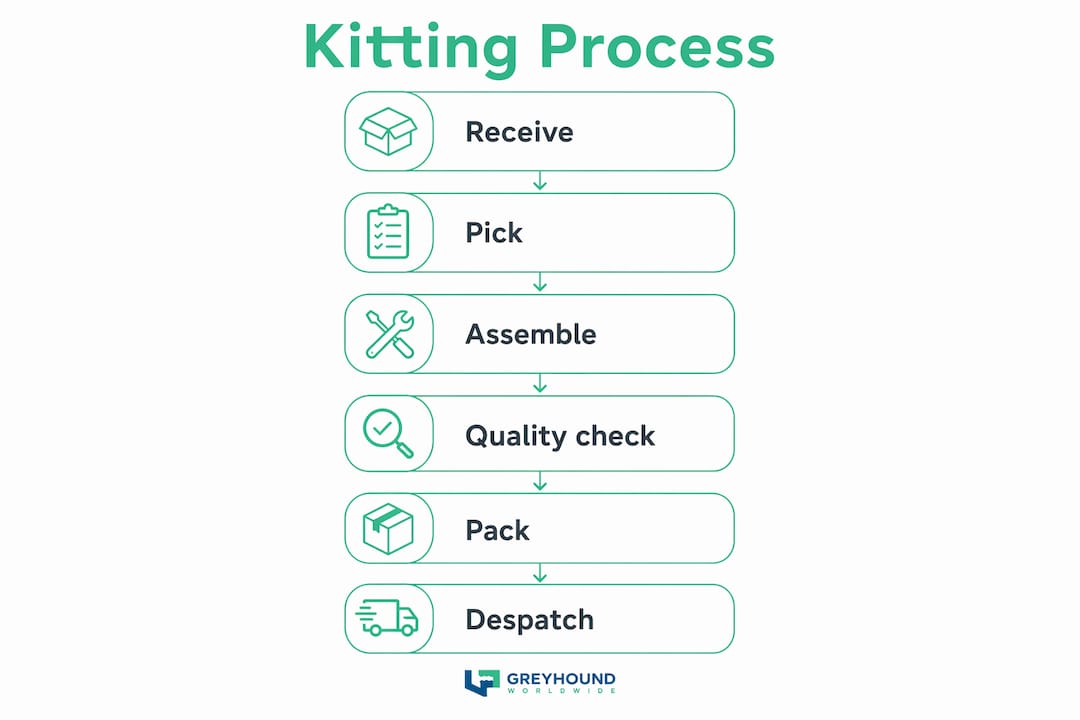
A well-run kitting operation follows a clear sequence, and each stage is where errors either get caught or compound.
Receive and store. Inbound components are booked into the warehouse management system (WMS), assigned locations, and checked against purchase orders. Accurate goods-in data is the foundation of everything that follows.
Pick components. The WMS generates a pick list for each kit batch. Barcode scanning at the pick face confirms the right component and quantity before anything moves to the assembly area. This is where automated processes with manual oversight make a measurable difference to accuracy.
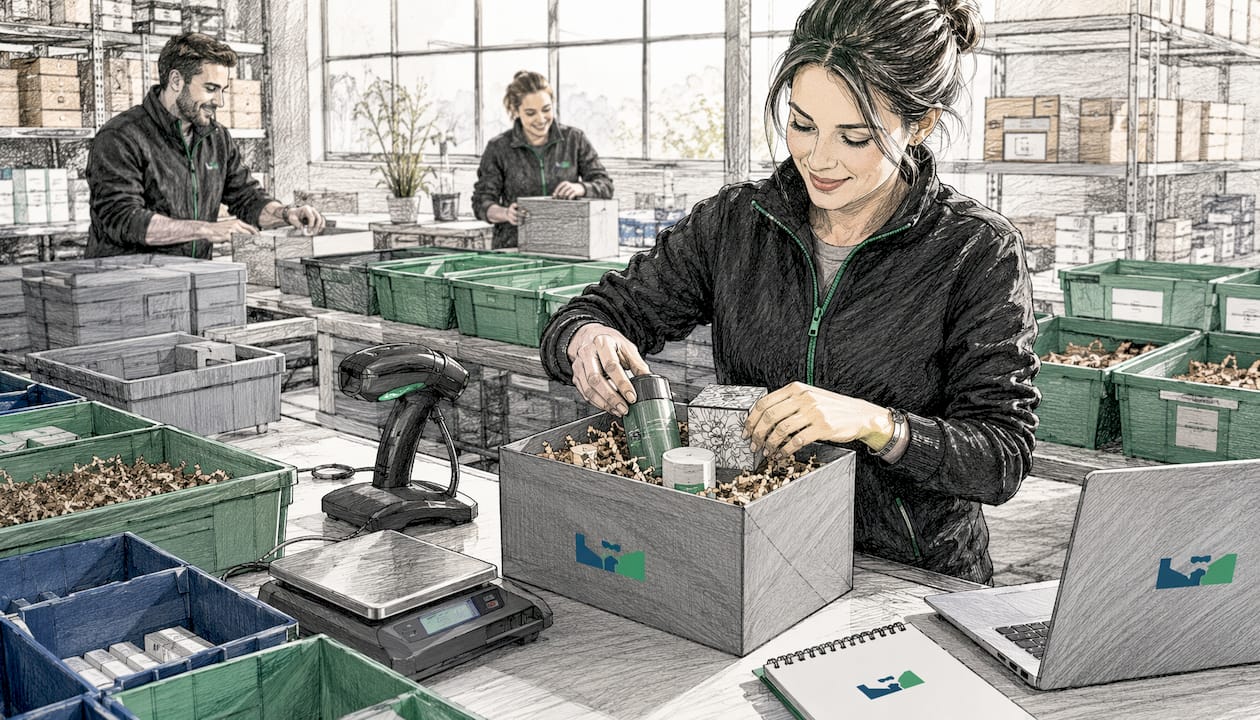
Assemble and kit. Components are brought together at a dedicated assembly station. For simple retail kits this is straightforward collation. For complex assemblies it may involve sub-assembly steps, cable routing, or torque-controlled fastening.
Quality check. Finished kits are weighed, visually inspected, and where required tested against a specification. Weight verification catches missing components quickly and cheaply. Visual checks confirm labelling, orientation, and presentation.
Pack and label. Kits are packed to your specification, labelled with the correct barcode, batch code, or carrier label, and staged for despatch.
Despatch. Orders are handed to the carrier network, with tracking data fed back into the WMS and synced to your ecommerce platform.
Throughput and lead times depend on batch size, SKU complexity, and seasonality. A simple two-component gift set can move from goods-in to despatch within 24 hours. A multi-part electronics sub-assembly with ESD-controlled handling and test requirements will take longer. Before signing with any provider, confirm their traceability records, labelling rules, packing specifications, and whether they hold the facility certifications your product category requires.
Why outsource your kitting and assembly to a 3PL?
The commercial case for outsourcing is straightforward once you account for the hidden costs of doing it in-house.
Time savings. Assembly labour is removed from your team’s workload, freeing operations staff for higher-value tasks.
Fewer errors. A dedicated kitting team with barcode scanning and QC checks consistently outperforms ad-hoc in-house assembly on accuracy rates.
Lower holding costs. A 3PL’s consolidated storage and reduced logistics costs typically beat the cost of maintaining your own warehouse space.
Scalability. A 3PL can flex labour up for peak periods, such as Christmas or a promotional launch, without you recruiting temporary staff.
Shipping consolidation. Kitting at the fulfilment centre means one outbound shipment per order rather than multiple parcels, which cuts carrier costs.
Consistent quality. Documented QC procedures produce repeatable results regardless of order volume.
Pro Tip:The trigger to outsource is not just volume. If your in-house team is spending more than two hours per day on kitting, or if seasonal peaks are causing despatch delays, those are the real signals to move to a 3PL, even at modest monthly order counts.
The top benefits of outsourcing fulfilment extend beyond cost: you gain access to carrier rate cards, technology infrastructure, and compliance expertise that would take years to build internally.
What types of kits do UK businesses typically need?
The right provider depends heavily on which kit type you are running. These are the most common categories UK businesses outsource.
Retail gift packs and seasonal bundles are the highest-volume category for ecommerce brands. They involve collating multiple SKUs, adding branded tissue or inserts, and packing to a presentation standard. Volume spikes sharply in Q4, so holiday fulfilment planning matters here.
Subscription boxes require consistent monthly assembly runs with precise component lists. Any substitution or shortfall directly affects subscriber retention, so BOM accuracy and stock management are critical.
PR and influencer packs are lower volume but high presentation standard. Single-site operations that combine decoration, personalised packing, and despatch under one roof suit this category well, as Geiger’s UK operation demonstrates for branded promotional kitting.
BOM kits for maintenance and production supply every part needed for a scheduled task, from rail maintenance fasteners to field-service spare-parts packs. Pugh & Sanders illustrate how industrial kitting aligns kit contents to work orders, reducing search time and increasing throughput on site.
Electronics sub-assemblies and medical kits require ESD-controlled environments, clean rooms, or specific certifications. General retail fulfilment centres cannot handle these; you need a provider with documented facility capabilities.
The volume threshold that typically triggers specialist kitting is around 200 or more kits per month for retail, or any production BOM kit where a missing component causes a line stoppage.
What technology and integrations should your 3PL offer?
Technology is what separates a reliable kitting partner from one that creates problems at scale. The core requirements are a WMS with barcode scanning at every stage, kit BOM management so the system knows exactly what goes into each SKU, and real-time inventory visibility so you can see stock levels and work-in-progress without calling anyone.
Platform integrations are non-negotiable for ecommerce. Your 3PL should connect directly to:
Shopify and WooCommerce for order sync and inventory updates
Amazon and eBay for marketplace fulfilment
Magento and BigCommerce for mid-market and enterprise ecommerce stacks
API connections for custom platforms or ERP systems
What each integration delivers in practice: order sync removes manual data entry and the errors that come with it; inventory sync keeps your storefront accurate so you do not oversell; kit BOM management means the WMS automatically deducts the correct components when a kit order is picked; exception handling flags shortfalls before they become despatch failures.
Parcelplanet’s ecommerce integrations cover all the major platforms, with real-time reporting so you can monitor kit assembly progress and despatch rates without logging into a separate system.
How do UK 3PLs charge for kitting, and what affects lead times?
Pricing for contract assembly in the UK follows a fairly consistent structure, though the numbers vary with complexity.
Cost component
Simple kit (2–3 SKUs)
Complex assembly (5+ components, testing)
Per-kit labour fee
~$0.50–$1.25
$15+
Set-up / tooling fee
Minimal or none
One-off charge for jigs, fixtures, or documentation
Storage
Per pallet or bin per week
Same, but higher SKU count increases footprint
Bespoke packaging
Per unit if custom box or insert required
Per unit, often higher for branded or protective pack
Sample run
Usually included or low fixed fee
May include engineering time
Published cost benchmarks show per-kit labour fees typically ranging from about $0.50–$1.25 for simple two-to-three SKU groupings, rising to $15 or more for complex, multi-component kits with testing requirements. Sterling equivalents will vary, but the complexity gradient is consistent: every additional component, labelling requirement, or QC step adds to the per-kit cost.
The main cost drivers are SKU count per kit, number of assembly steps, labelling and compliance requirements, testing or inspection time, and whether ESD or cleanroom handling is needed. Lead times are affected by the same factors, plus inbound goods-in timing and batch scheduling.
Pro Tip:Structure your sample run as a formal acceptance test. Agree on a minimum pass rate for weight checks and visual inspection before the full run begins. This protects both parties and gives you a clear baseline for SLA negotiations.
Controlling logistics costs starts with understanding exactly which cost drivers apply to your kit. Get an itemised quote, not a blended per-kit rate, so you can see where complexity is adding cost.
How to start a kitting project with Parcelplanet
Getting started is straightforward when you arrive prepared. Work through this checklist before your first conversation.
Prepare your BOM and SKU list. Document every component that goes into each kit, including quantities, dimensions, and any special handling notes.
Define your labelling requirements. Specify barcodes, batch codes, carrier labels, and any regulatory markings.
Gather packaging specifications. Provide box dimensions, void-fill rules, insert placement, and any branded packaging files.
Send sample components. Parcelplanet will use these to build a process sheet and price the assembly accurately.
Agree sample-run parameters. Set the batch size, acceptance criteria (pass rate for weight and visual checks), and rework rules before the run starts.
Set up platform integrations. Connect your ecommerce platform or ERP so order sync and inventory updates are live from day one.
Review reporting setup. Confirm which metrics you need: kit completion rates, despatch times, exception reports, and stock-level alerts.
Sign off the SLA. Agree despatch cut-off times, turnaround targets for kitting batches, and escalation contacts.
Once your sample run passes acceptance, full production can begin. Parcelplanet’s onboarding process is designed to move from first contact to live fulfilment quickly, with a dedicated contact at each stage.
Proof points: case studies and quality assurance
Parcelplanet’s kitting and assembly work spans both retail and complex fulfilment projects. The Asda Click & Collect integration demonstrates the team’s ability to handle high-volume, time-sensitive despatch with precise labelling and carrier compliance. Gift-wrapping fulfilment projects show the presentation-standard assembly that branded ecommerce clients require, where every kit must look identical and meet a visual specification before it leaves the warehouse.
You can see the process in action in Parcelplanet’s pick, pack and kitting demonstration, which shows the assembly workflow, barcode scanning at each stage, and the QC checks built into the process.
The trust signals buyers should look for in any kitting partner include:
Real-time WMS reporting with kit-level visibility
Barcode scanning at goods-in, pick, assembly, and despatch
Documented weight verification and visual inspection procedures
Courier network coverage: Royal Mail, DPD, DHL, UPS, FedEx
Facility certifications relevant to your product category (ESD, ISO cleanroom, food-safe)
For electronics and medical kits, ESD-controlled environments and documented procurement are requirements, not optional extras. Confirm these in writing before committing to a provider.
Key takeaways
Outsourcing kitting and assembly to a specialist UK 3PL reduces per-kit errors, cuts assembly labour costs, and gives you the capacity to scale through seasonal peaks without hiring.
Point
Details
Outsource when assembly consumes time
If your team spends more than two hours daily on kitting, a 3PL delivers faster and more accurately.
Complexity drives cost
Per-kit fees range from low (simple 2–3 SKU groupings) to significantly higher for multi-component kits with testing.
Technology is non-negotiable
Require WMS barcode scanning, kit BOM management, and direct platform integrations before signing.
Sample run protects both parties
Agree acceptance criteria upfront; a formal sample run sets the SLA baseline and reduces rework risk.
Parcelplanet as your kitting partner
Parcelplanet offers end-to-end kitting and assembly with real-time tracking, major platform integrations, and a structured sample-run onboarding process.
The part most guides skip: what actually goes wrong in the first month
The biggest kitting failures we see are not about picking the wrong provider. They are about arriving unprepared. A client sends components without a confirmed BOM, or the labelling spec changes after the sample run, or the ecommerce integration goes live before inventory is reconciled. Each of these adds days to the onboarding timeline and increases rework costs.
The fix is unglamorous: documentation first, then physical stock. Before a single component arrives at the warehouse, the BOM, labelling rules, and acceptance criteria should be agreed in writing. That single discipline removes the majority of first-month friction.
There is also a tendency to underestimate the value of the sample run. Clients sometimes want to skip it to save time. In practice, a well-structured sample run of 50–100 kits surfaces every process gap before they affect live orders. It is the cheapest quality assurance you will ever buy.
One more point worth making: the gap between retail kitting and manufacturing-grade assembly is wider than most buyers expect. If your product requires ESD handling, cleanroom conditions, or traceability to individual component serial numbers, confirm those facility capabilities before you negotiate price. A provider without the right environment cannot deliver the right outcome regardless of how competitive their rate is.
Ready to get your kitting and assembly running in the UK?
Parcelplanet gives growing ecommerce and manufacturing brands a faster route to accurate, scalable kitting than building the capability in-house. With direct integrations across Shopify, WooCommerce, Amazon, eBay, and Magento, plus a courier network covering Royal Mail, DPD, DHL, UPS, and FedEx, your kits move from assembly to your customer’s door without manual intervention.
The onboarding process starts with a sample run, so you can verify quality and agree SLA milestones before committing to full volume. Parcelplanet’s team handles the BOM setup, platform connection, and reporting configuration, so your operations team is not carrying the integration burden. For brands expanding into the UK market, Parcelplanet also supports multi-region despatch from day one.
Get a quote and book your sample run with Parcelplanet today.
Useful sources and further reading
The following sources informed this article and are worth consulting for deeper detail on specific areas.
Lean Construction Institute: Kitting — Cross-industry definition of kitting and the efficiency rationale behind it. Useful for understanding the shared principles between ecommerce and industrial applications.
Pugh & Sanders: Kitting Solutions — Practical detail on industrial and rail kitting, BOM alignment, and how maintenance kits are structured. Relevant for manufacturing and field-service buyers.
William Hughes: Kitting and Assembly — Manufacturing-grade kitting with JIT delivery, automated handling, and traceability for precision components. Useful for complex sub-assembly requirements.
FC Laser: Assembly Services UK — Integrated fabrication-to-assembly workflows and the lead-time benefits of keeping both under one roof.
EASL: Contract Electronics Manufacturing — Specialist guidance on ESD control, cleanroom requirements, and certifications for electronics and medical kitting.
Geiger UK: Kitting and Warehousing — Single-site branded kitting combining decoration, personalisation, and fulfilment for promotional packs.
Productiv: Kitting and Assembly Cost — Published cost benchmarks for per-kit labour fees across simple and complex assembly categories.
— A three-minute visual overview of the kitting and assembly process, useful for teams new to the concept.