TL;DR:
- Over 60% of global companies outsource logistics to third or fourth-party providers, yet many e-commerce brands struggle to implement these models effectively. Outsourcing involves contracting external specialists for warehousing, order fulfilment, and returns management, enabling scalable operations and cost savings. Successful partnerships require structured evaluation, ongoing relationship management, and strategic integration to maximize growth and customer satisfaction.
Over 60% of global companies now use third-party or fourth-party logistics outsourcing, yet a surprising number of e-commerce brands still struggle to define what outsourcing actually means for their day-to-day operations. The gap between knowing outsourcing exists and knowing how to use it strategically is where most scaling challenges begin. This guide cuts through that confusion, offering a clear definition of logistics outsourcing, practical frameworks for choosing the right model, and actionable steps to apply it effectively. Whether you are managing 500 orders a month or 50,000, the principles here will help you build a more efficient, scalable fulfilment operation.
Table of Contents
Key Takeaways
| Point |
Details |
| Clear outsourcing definition |
Logistics outsourcing involves contracting specialists for warehousing, fulfilment, and shipping. |
| Saves costs and improves accuracy |
Brands can cut logistics costs by 8-15% and reach 98-99% order accuracy with top providers. |
| Choose frameworks for partner selection |
Using structured frameworks is crucial to select providers aligning with service, tech, and sustainability goals. |
| Beware coordination risks |
Multi-provider setups can raise complexity and coordination overhead, potentially offsetting savings. |
| Continuous improvement matters |
Regular partner reviews and integration checks are key to sustained logistics outsourcing success. |
What does logistics outsourcing mean in e-commerce?
Logistics outsourcing, in its simplest form, means contracting external specialists to handle some or all of the physical and operational elements of your supply chain. For e-commerce brands, this typically covers warehousing, order picking and packing, courier management, and returns processing. Rather than managing your own warehouse staff, storage space, and carrier relationships, you hand those responsibilities to a provider whose entire business is built around doing them efficiently.
The contract logistics market was valued at USD 326.38 billion in 2025, with projections pointing to USD 545.02 billion by 2032. That growth reflects just how central outsourcing has become to modern commerce. It is not a niche strategy. It is the operating standard for brands that want to grow without being held back by operational complexity.
Understanding the different provider types helps you make better decisions. The two most common models are:
- 3PL (Third-party logistics): The provider handles warehousing, fulfilment, and shipping on your behalf. You retain control over strategy and customer relationships while the 3PL manages the physical work.
- 4PL (Fourth-party logistics): The provider acts as an orchestrator, managing multiple logistics partners and your entire supply chain on your behalf. This is suited to larger, more complex operations.
- Dedicated vs shared warehousing: Some 3PLs offer shared fulfilment centres where your stock sits alongside other brands, keeping costs lower. Others offer dedicated space for brands with specific storage or handling needs.
- Returns management: A frequently overlooked function, reverse logistics (the process of managing customer returns) is increasingly offered as a core outsourced service.
Exploring the differences between 3PL vs 4PL models in detail can help you decide which structure fits your current stage of growth. For brands just beginning to outsource, a third-party logistics guide is a practical starting point.
| Function |
In-house |
3PL outsourced |
4PL outsourced |
| Warehousing |
Brand-managed |
Provider-managed |
Coordinated by 4PL |
| Order fulfilment |
Brand staff |
Provider staff |
Managed across partners |
| Courier relationships |
Brand-negotiated |
Provider-managed |
4PL-negotiated |
| Technology systems |
Brand-owned |
Provider platforms |
Integrated across network |
| Scalability |
Limited by capacity |
Flexible with provider |
Highly flexible |
The shift from in-house to outsourced logistics is not just operational. It changes how your team spends its time, how your costs behave at scale, and how quickly you can expand into new markets or sales channels.
Why e-commerce brands outsource logistics: Key benefits and drivers
With logistics outsourcing clearly defined, let’s examine why so many e-commerce brands embrace it and what they stand to gain.
The financial case is strong. Optimised outsourcing cuts operational costs by 8 to 15%, and top-tier 3PL providers achieve order accuracy rates of 98 to 99%. For a brand processing thousands of orders per month, even a 1% improvement in accuracy translates directly into fewer customer service queries, fewer returns, and stronger retention rates.
Beyond raw cost savings, outsourcing enables scaling by converting fixed costs into variable expenses. When your logistics is in-house, you are paying for warehouse leases, equipment, and staff whether you ship 200 orders or 2,000 in a given week. With a 3PL, your costs flex with your volume. That flexibility is particularly valuable for brands with seasonal peaks, such as those in fashion, gifting, or homewares.
The key benefits of logistics outsourcing for e-commerce include:
- Cost reduction through shared infrastructure, bulk carrier rates, and reduced staffing overhead.
- Access to technology including warehouse management systems (WMS), real-time inventory tracking, and automated picking tools that would be cost-prohibitive to build in-house.
- Faster delivery through provider networks positioned closer to your customer base, reducing transit times significantly.
- Scalability on demand so you can handle peak trading periods, new product launches, or market expansions without operational strain.
- Improved customer experience because accurate, fast fulfilment directly drives repeat purchases and positive reviews.
- Specialist expertise that your internal team may not have, including customs handling, hazardous goods management, or temperature-controlled storage.
Key statistic: Brands that invest in logistics outsourcing for growth consistently report that access to specialist technology and networks is as valuable as the direct cost savings themselves.
The customer experience angle deserves particular attention. In a market where shoppers expect next-day or two-day delivery as standard, the speed and accuracy of your fulfilment directly affects whether customers return. Partnering with a provider that has invested in sophisticated scalable logistics for e-commerce means you are not building that capability from scratch.
Pro Tip: When evaluating 3PL partners, ask for data on their order accuracy rates, same-day dispatch cut-off times, and the number of carrier integrations they offer. A provider that cannot give you concrete figures on these metrics is one to avoid.
How logistics outsourcing works: Models and practical frameworks
Knowing the benefits and drivers, it is crucial to understand the operational frameworks and models that underpin logistics outsourcing decisions.
Choosing between a 3PL and a 4PL is often the first structural decision you will face. A 3PL is hands-on: they pick, pack, and ship your orders. A 4PL sits above that, managing the entire supply chain on your behalf, including selecting and overseeing multiple 3PL partners. For most growing e-commerce brands, a 3PL relationship is the right starting point. A 4PL makes more sense once your logistics complexity outgrows a single provider.
Selecting the right partner is where many brands stumble. Research on partner selection points to Multi-Criteria Decision-Making (MCDM) frameworks as a reliable method. MCDM is a structured approach that scores potential providers across multiple criteria simultaneously, rather than choosing based on price alone. The typical criteria include:
- Service quality including order accuracy, dispatch speed, and returns handling efficiency.
- Cost structure covering storage fees, fulfilment costs per unit, and carrier rates.
- Technology capability such as WMS integrations, real-time reporting dashboards, and e-commerce platform connectivity.
- Sustainability and ESG credentials including carbon-efficient shipping options and ethical warehousing practices.
- Disruption resilience meaning the provider’s ability to maintain service levels during peak periods, carrier disruptions, or supply chain shocks.
| Selection criterion |
Why it matters |
Questions to ask |
| Service quality |
Accuracy and speed affect customer satisfaction directly |
What is your order accuracy rate? |
| Cost structure |
Variable costs must align with your margin model |
Are fees per order or per SKU stored? |
| Technology |
Integration with your platforms reduces manual work |
Which e-commerce platforms do you integrate with? |
| Sustainability |
Increasingly important to consumers and regulators |
Do you offer carbon-neutral shipping options? |
| Resilience |
Prevents disruption during peaks or carrier issues |
How do you handle Black Friday volume spikes? |
The 2026 logistics landscape is shifting in notable ways. 81% of shippers are currently increasing their outsourcing activity, yet growth is slowing as operational complexity rises. Shippers are prioritising disruption resilience and ESG credentials, while 3PLs are focusing on customisation and flexibility as key differentiators.
“The challenge is not whether to outsource, but how to manage the relationship once you do. Coordination overhead from working with multiple providers can quickly outweigh the cost benefits you were seeking in the first place.”
This is worth emphasising. Using multiple 3PLs simultaneously can appear attractive, particularly for brands operating across regions. However, the coordination overhead, managing separate contracts, reporting systems, and service standards, often produces more friction than savings. The 2026 third-party logistics study highlights that multi-3PL risks frequently outweigh the savings, especially for brands under 50 million in annual revenue.
For most scaling e-commerce brands, the smartest path is a single, well-chosen scalable logistics solution with the flexibility to grow alongside your business.
Applying logistics outsourcing for growth: Steps and pitfalls
Now that the frameworks are clear, let’s walk through the practical steps for applying logistics outsourcing and what to avoid along the way.
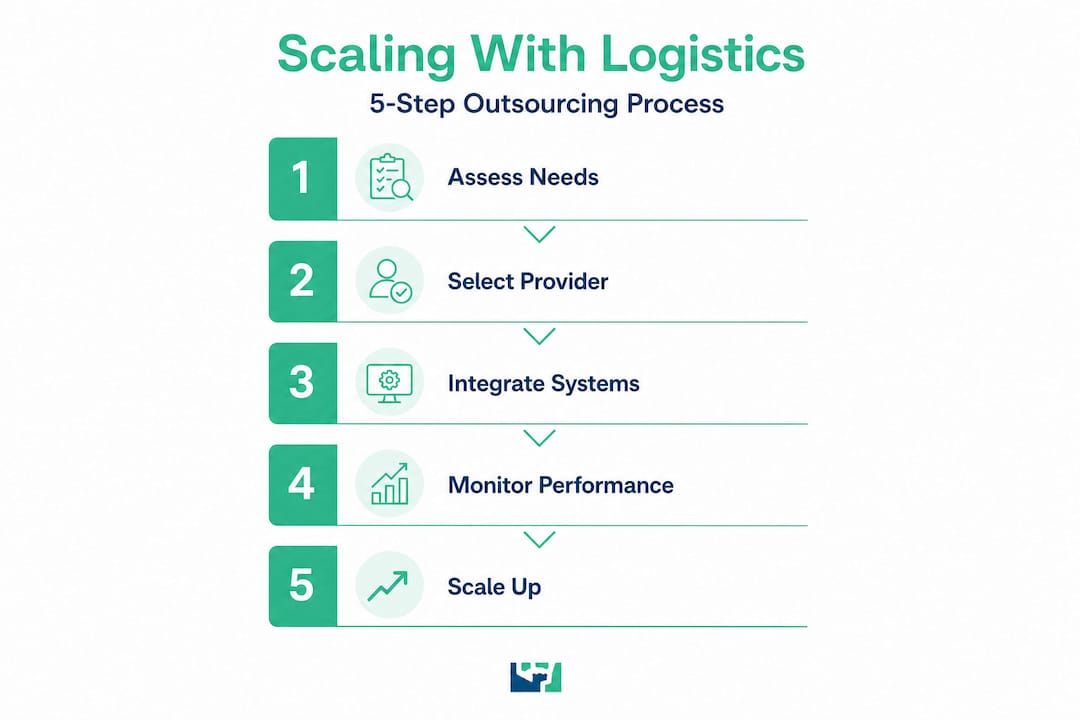
Step-by-step process for outsourcing your logistics:
- Assess your current logistics needs. Map your order volumes, SKU count, storage requirements, peak periods, and return rates. This baseline tells you exactly what you need from a provider.
- Define your service level requirements. Decide on your minimum acceptable standards for dispatch speed, order accuracy, and customer communication. Document these as the basis for your SLA (Service Level Agreement).
- Research potential providers. Shortlist three to five providers based on their geographic coverage, technology integrations, and category experience. Look for providers with a track record in your product type and order volume range.
- Apply your evaluation framework. Use an MCDM-style scoring system to compare providers objectively across service, cost, technology, sustainability, and resilience criteria.
- Negotiate your contract and SLAs. Ensure your SLA includes specific, measurable targets, not vague commitments. Agreed penalties for missed targets keep providers accountable.
- Integrate your systems. Connect your e-commerce platform, inventory management, and reporting tools to your provider’s WMS. This step is critical and often underestimated in complexity.
- Monitor performance from day one. Set up regular reporting cadences and review KPIs (Key Performance Indicators) monthly during the first six months.
The most common pitfalls to avoid:
- Vague SLAs. If your agreement does not specify exact accuracy targets, dispatch cut-off times, and escalation procedures, you have no lever to pull when performance drops.
- Technology mismatch. Choosing a provider whose WMS cannot integrate with your Shopify, WooCommerce, or custom platform creates manual workarounds that erode efficiency fast.
- Underestimating returns logistics. Returns can account for 15 to 30% of e-commerce orders in some categories. A provider without a clear returns process will create customer service headaches at scale.
- Ignoring scalability limits. Some providers are excellent for your current volume but cannot handle a three-fold increase during peak trading. Validate their capacity before you sign.
- Skipping ongoing reviews. Strategic partner selection and avoiding coordination overhead requires active management, not just an annual contract review.
A full step-by-step logistics outsourcing resource can help you structure this process in more detail. For brands already working with a provider and looking to improve performance, optimising logistics for growth offers practical frameworks for continuous improvement.
Pro Tip: Involve your IT or development team in provider conversations from the very first meeting. Integration timelines and technical requirements are frequently underestimated, and discovering a compatibility issue after signing a contract is an expensive lesson.
What most e-commerce brands miss when outsourcing logistics
Having mapped practical application, it is time for a candid perspective: what nearly all brands overlook when outsourcing their logistics.
Most brands focus heavily on two things when choosing a logistics partner: cost and speed. Both matter, of course. But in our experience, the brands that struggle most after outsourcing are not those that chose a slightly more expensive provider. They are the ones that underestimated integration complexity and neglected the ongoing relationship.
Outsourcing your logistics is not a one-time transaction. It is a partnership, and like any partnership, it requires regular communication, honest feedback, and a shared commitment to improvement. The brands that treat their logistics provider as a vendor to be squeezed for the lowest price tend to end up with exactly the service quality that reflects that relationship.
There is also a widespread misconception that outsourcing removes the need for internal logistics oversight. It does not. It changes the nature of that oversight. Instead of managing warehouse staff, you are managing a provider relationship, reviewing performance data, and identifying gaps before they affect customers. That requires a different skill set but no less attention.
Understanding logistics scalability for fulfilment is critical here. Scalability is not just about a provider’s warehouse capacity. It includes their ability to onboard new integrations quickly, add new carrier options as your markets expand, and adapt their processes as your SKU range evolves.
The brands that get the most from logistics outsourcing are those that treat the first year as a period of calibration, not a set-and-forget arrangement. They schedule quarterly business reviews, share forward demand forecasts with their provider, and actively collaborate on identifying process improvements. That level of engagement turns a logistics outsourcing arrangement into a genuine competitive advantage.
Explore tailored logistics outsourcing solutions for your brand
If you are ready to move from strategy to action, the right fulfilment partner can make an immediate difference to your operational efficiency and customer satisfaction. Understanding the frameworks and pitfalls of logistics outsourcing is only valuable when you apply it to a provider relationship built on transparency, technology, and genuine scalability.
At ParcelPlanet, we work with e-commerce and omnichannel brands to deliver order fulfilment services that are fast, accurate, and built to grow with your business. From real-time inventory tracking and courier integrations to returns management and multi-channel fulfilment, our team is ready to support your next stage of growth. If you want to understand the full scope of what outsourcing can do for your brand, our order fulfilment guide is a practical next step. Get in touch today for a tailored quote and discover how our solutions can be shaped around your specific needs.
Frequently asked questions
What is the difference between 3PL and 4PL in logistics outsourcing?
A 3PL handles the physical work of warehousing and fulfilment, while a 4PL oversees your entire supply chain, coordinating multiple logistics partners on your behalf. Over 60% of companies already use one or both models as part of their logistics strategy.
How much can outsourcing logistics save e-commerce brands?
Optimised outsourcing typically reduces logistics costs by 8 to 15% while top 3PL providers achieve order accuracy rates of 98 to 99%. The savings come from shared infrastructure, better carrier rates, and reduced internal staffing requirements.
What is the best way to choose a logistics outsourcing partner?
Use a structured evaluation method like an MCDM framework, scoring potential partners on service quality, cost, technology, and sustainability. Partner selection based on multiple weighted criteria consistently leads to stronger long-term outcomes than choosing on price alone.
Are there risks with using multiple logistics providers?
Yes. While using multiple providers can seem like a way to reduce dependency, coordination overhead from managing separate contracts, systems, and service standards often outweighs any cost savings, particularly for brands under a certain revenue threshold.
Recommended