TL;DR:
- Warehouse picking consumes up to 50% of working hours, yet many logistics discussions focus more on transport issues.
- In 2026, automation, AI-driven management, and real-time visibility are transforming warehouse efficiency and operational decision-making.
Warehouse picking alone can consume up to 50% of working hours in a typical fulfilment operation, yet most logistics conversations still focus on transport. The real inefficiency often lives closer to home. As logistics trends in 2026 accelerate across automation, network design, and compliance, the gap between businesses that adapt and those that struggle is widening fast. This guide covers what’s actually changing, why it matters for your supply chain, and how to apply it practically before your competitors do.
Table of Contents
Technology powering warehouse automation and AI integration
Automation in e-commerce logistics is no longer a future investment. It is the present competitive baseline. According to recent data, 55% of supply chain leaders are increasing technology investments, and 45% plan automation equipment purchases within the next three years. The message is clear: warehouses that still rely primarily on manual labour for picking, sorting, and returns processing are falling behind.
What makes 2026 different from previous years is not just the volume of robots being deployed. It is how those robots are managed. Real-time orchestration of robotics fleets, where a central system dynamically assigns tasks across multiple automated units, delivers far greater efficiency than standalone machines working independently. Think of it as the difference between a team with a coordinator versus a group working in isolation.
AI embedded in warehouse management is now functioning as a genuine decision co-pilot. It guides task prioritisation, flags exceptions before they escalate, and uses computer vision to catch defects and mis-picks that human eyes routinely miss. This is not a replacement for your warehouse staff. It is a tool that makes them considerably more effective.
Key capabilities driving warehouse automation in 2026:
- Autonomous mobile robots (AMRs) guided by real-time orchestration software to handle picking and transport within the warehouse
- Computer vision systems performing zero-touch quality checks at packing stations, catching errors before despatch
- AI-powered exception management that prioritises urgent tasks and alerts staff to genuine problems rather than noise
- Automated returns processing that sorts, assesses, and restocks returned goods without manual intervention
- Predictive labour scheduling based on order volume forecasts, reducing both overstaffing and bottlenecks
“AI is not replacing the human workforce in logistics. It is elevating what that workforce can do, giving people better information and removing the repetitive tasks that cause fatigue and error.” This is the framing that separates businesses succeeding with automation from those that resist it.
Pro Tip: When adopting computer vision for quality control, baseline your current defect and mis-pick rates before go-live. Your ROI calculation will be far more persuasive, and far more accurate, when it is built on error cost reduction rather than labour hours alone.
You can also explore AI in e-commerce examples to see how these tools extend beyond the warehouse into customer experience and demand forecasting.
Enhancing visibility through RFID sensing and real-time tracking
Once a parcel leaves your warehouse, visibility has traditionally depended on manual scans at carrier hubs. A missed scan means a gap in your tracking data, a frustrated customer, and an exception that takes hours to investigate. RFID sensing is changing that entirely.
UPS is expanding RFID package sensing across its US network with the goal of eliminating nearly 20 million manual scans daily. The investment behind this is substantial. Over $100 million has been committed to deploying RFID across hubs, vehicles, and parcel collection points. Packages are detected automatically as they move through the network, without anyone needing to point a scanner at a barcode.
For your customers, this means near-real-time tracking that actually reflects where their parcel is, not where it was last scanned. For your operations team, it means faster exception handling when a misload or delay occurs, because the system surfaces the issue immediately rather than waiting for a manual scan that may never happen.
Key operational benefits of RFID sensing for e-commerce logistics:
- Automatic detection at hubs and on vehicles, removing scan dependency and human error from the visibility chain
- Near-real-time status updates that improve customer confidence and reduce “where is my order” contacts
- Faster misload identification, allowing carriers to intercept and correct routing errors before they reach the delivery stage
- Reduced exception investigation time, as the system holds richer event data than sparse manual scan records
- Greater carrier accountability, because shipment status is recorded continuously rather than at isolated checkpoints
The shift from scanning to sensing is not simply a technology upgrade. It represents a fundamental change in how supply chain visibility is designed, from reactive to proactive.
The transition does require operational adjustment. RFID generates significantly more data than manual scanning, and your exception management workflows need to be built for that volume. Without revised alert protocols, your team may find itself drowning in notifications rather than acting on the ones that matter.
Understanding how to leverage data for logistics visibility is the foundation for making RFID sensing genuinely useful rather than just technically impressive.
Distributed fulfilment networks and multi-carrier strategies for e-commerce
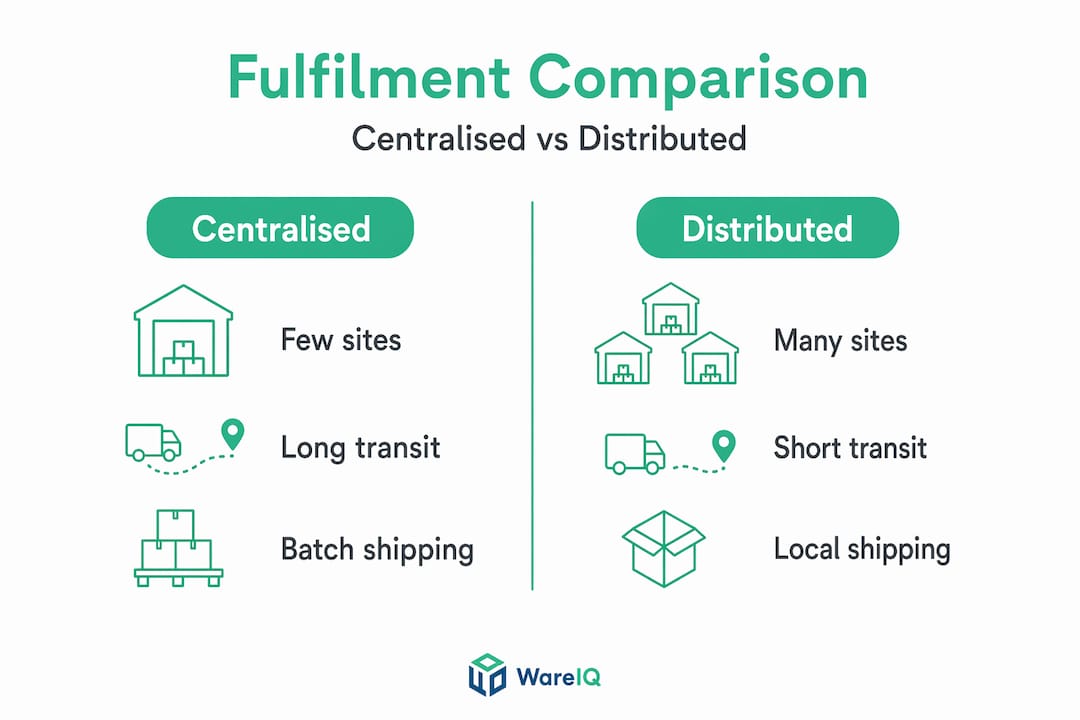
Centralised distribution centres made sense when e-commerce order volumes were modest and two-day delivery was considered fast. In 2026, customer expectations have moved considerably further. E-commerce brands are actively restructuring away from large central DCs toward smaller, strategically positioned fulfilment nodes that reduce delivery distance and last-mile cost.
The logic is straightforward. A parcel travelling 30 miles to a customer is cheaper to deliver, arrives faster, and generates fewer carrier exceptions than one travelling 300 miles. Pair that with a multi-carrier delivery strategy that dynamically assigns each order to the best available carrier based on cost, destination, and performance data, and you have a meaningful competitive advantage.
Centralised versus distributed fulfilment: a direct comparison
| Attribute |
Centralised fulfilment |
Distributed fulfilment |
| Delivery distance |
High |
Significantly reduced |
| Last-mile cost |
Higher per parcel |
Lower per parcel |
| Carrier dependency |
Single or few carriers |
Multi-carrier, dynamic routing |
| Disruption risk |
High (single point of failure) |
Lower (multiple nodes absorb issues) |
| Inventory complexity |
Simpler to manage |
Requires regional coordination |
| Speed to customer |
Slower for distant zones |
Faster across most regions |
| Scalability |
Limited by facility size |
Scalable by adding nodes |
Steps to redesign your logistics network for distributed fulfilment
- Analyse your order geography. Map where your customers are located by postcode or region to identify the highest-volume delivery zones.
- Identify fulfilment node locations. Select warehousing positions, including third-party locations, that reduce average delivery distance to your top zones.
- Segment your inventory by demand. Place your fastest-moving SKUs in each node based on regional demand patterns rather than distributing stock evenly.
- Integrate a multi-carrier management layer. Connect your order management system to multiple carriers so each shipment is automatically routed based on cost, speed, and availability.
- Build performance monitoring by node. Track on-time delivery, cost per parcel, and exception rates at each location so you can rebalance inventory and carrier allocation as demand shifts.
- Review and adjust quarterly. Distributed networks require active management. Review node performance and inventory placement every quarter rather than annually.
Exploring innovative fulfilment solutions purpose-built for this kind of distributed model is a practical starting point.
Navigating 2026 compliance and sustainability demands in logistics
Regulatory and sustainability pressures are no longer background considerations for logistics managers. In 2026, they are directly shaping operational costs and system requirements. New German minimum wage increases, CO2-based lorry tolls, and expanding EU sustainability directives are among the most significant legislative changes affecting freight transportation and supply chain operations this year.
The EU Corporate Sustainability Due Diligence Directive (CSDDD) is particularly consequential. It extends responsibility for environmental and human rights due diligence deep into supply chains, meaning you are increasingly accountable for the practices of your logistics partners, not just your own operations. New packaging rules add further pressure, enforcing reuse targets and requiring measurable reductions in empty space within transport packaging.
Key compliance areas demanding operational attention in 2026:
- Carbon reporting integrated into transport management systems, not handled as a separate manual process
- Packaging compliance tracking, including material reuse percentages and void fill reduction metrics
- Certificate and document management for supplier and carrier compliance within logistics platforms
- Emission data collection that is audit-ready and aligned with EU reporting standards
- Due diligence workflows built into procurement and carrier selection processes
The critical distinction here is between treating compliance as a legal function and embedding it into your logistics systems. When carbon reporting depends on manual data collection, it becomes unreliable and resource-intensive. When it is automated within your transport management software, it becomes accurate and nearly effortless.
Pro Tip: Embed compliance checkpoints and sustainability metrics directly into your transport management and warehouse execution software. This approach reduces the risk of reporting gaps and makes audit preparation a routine task rather than a crisis response.
Here is an uncomfortable truth about how most e-commerce businesses are approaching 2026 logistics trends: they are collecting technologies rather than building systems. A robotics solution here, an AI forecasting tool there, a new carrier integration added to the stack. Each investment makes sense in isolation. Together, they often create more complexity than they resolve.
The genuine competitive edge does not come from owning the most advanced individual tools. It comes from orchestrating end-to-end execution in a way that approaches Amazon-level delivery performance. That means your planning, inventory management, fulfilment execution, and transport operations are sharing data and making decisions together, in real time, not in separate systems that sync overnight.
AI as a co-pilot works across forecasting, early-warning, and execution when the underlying data is unified. Digital twins of your warehouse or fulfilment network allow you to simulate disruptions and test responses before they happen in the real world. Predictive analytics surface problems days before they become customer complaints. None of this is possible when your systems cannot talk to each other.
The businesses we see succeeding with end-to-end logistics integration are not necessarily the ones with the largest technology budgets. They are the ones that prioritised data quality and process integration before adding more tools. They built a foundation that AI can actually act on.
Pro Tip: Before evaluating any new logistics technology in 2026, ask one question first: does this platform share data bidirectionally with my existing systems, or does it create another data silo? The answer will tell you more about its long-term value than any feature comparison.
The businesses that will lead in 2026 are not those chasing individual future logistics innovations. They are the ones building the connective tissue that makes every tool more effective than it would be alone.
How ParcelPlanet supports scalable and compliant logistics in 2026
With a clear picture of where logistics is heading in 2026, the practical question becomes how to implement these changes without disrupting your current operations.

ParcelPlanet’s order fulfilment services are built for exactly this environment. Our platform supports distributed fulfilment models and multi-carrier shipping, giving your business the flexibility to place inventory where it performs best and route orders through the most cost-effective carriers. We integrate directly with your e-commerce platforms and sales channels, providing real-time visibility across every order. If you are still working out what order fulfilment actually involves at a practical level, our resources cover that too. Partnering with ParcelPlanet means focusing your energy on growing your brand while we manage the logistics complexity that 2026 demands.
Frequently asked questions
What are the main logistics technology trends in 2026?
Key trends include increased automation and robotics in warehouses, AI-powered management systems, and widespread adoption of RFID sensing for real-time package visibility, with 55% of supply chain leaders already increasing their technology investments.
How does distributed fulfilment improve e-commerce delivery?
Distributed fulfilment uses multiple smaller, strategically located warehouses to reduce delivery distances and last-mile costs, with e-commerce brands shifting away from large central distribution centres to improve delivery speed and customer satisfaction.
What operational changes does RFID sensing require?
RFID sensing reduces manual scans but requires updates to exception-handling workflows and alert systems, as UPS’s RFID rollout eliminating nearly 20 million daily manual scans demonstrates the scale of data management changes involved.
How should logistics teams address new compliance and sustainability requirements?
Integrating compliance tasks directly into logistics systems, including carbon reporting and packaging regulations, is essential, as new 2026 EU rules require operational embedding of sustainability responsibilities rather than leaving them as legal team functions alone.
Why is an orchestrated logistics system important in 2026?
Orchestrated systems allow AI-driven integration of planning, inventory, and fulfilment, enabling faster decisions and more resilient supply chains, because end-to-end execution across all logistics functions is what separates genuinely competitive operations from collections of disconnected tools.
Recommended


