Most brands assume cart abandonment is a pricing problem. It is not. 38% of shoppers abandon carts when delivery exceeds a week, and late deliveries make 69% of buyers less likely to purchase again. For small and medium-sized e-commerce brands pushing into new markets, the gap between a smooth international launch and a costly failure often comes down to fulfilment. This guide gives you a practical, proven framework to understand the core concepts, apply the right strategies, control your costs, and avoid the compliance traps that catch even experienced operators off guard.
Table of Contents
Key Takeaways
| Point |
Details |
| Phased market entry |
Start with a small number of markets, validate operations, and gradually scale for lower risk and smoother growth. |
| 3PL partnerships |
Partnering with a 3PL enables SMEs to compete with larger brands by improving reach and cost-effectiveness. |
| DDP over DDU |
Delivered Duty Paid provides a better customer experience by avoiding surprise fees and streamlining customs. |
| Measure key metrics |
Track delivery speed, order accuracy, and return rates to continuously optimise your fulfilment strategy. |
| Automate compliance |
Automating customs and compliance processes prevents costly delays and helps international growth. |
Understanding international order fulfilment: Core concepts and challenges
With the cost of getting international fulfilment wrong clearly highlighted, it is vital to grasp its foundations and hidden complexities. International order fulfilment covers every step from receiving a cross-border order to delivering it to a customer abroad, including warehousing, picking, packing, customs clearance, and last-mile delivery. It is fundamentally more complex than domestic fulfilment because it involves multiple jurisdictions, carriers, and regulatory frameworks.
A few key terms you need to know:
- DDP (Delivered Duty Paid): The seller covers all duties and taxes. The buyer receives a clean, surprise-free delivery.
- DDU (Delivered Duty Unpaid): The buyer is responsible for duties on arrival, which often causes frustration and parcel abandonment.
- Importer of Record (IOR): The legal entity responsible for ensuring goods comply with import regulations in the destination country.
- HS codes (Harmonised System codes): Standardised numerical codes used globally to classify products for customs purposes.
- 3PL (Third-Party Logistics): An outsourced provider that manages warehousing, fulfilment, and often shipping on your behalf.
The fulfilment market reached $97 billion in 2022, growing at a 13.9% CAGR, with cross-border e-commerce projected to reach $7.9 trillion by 2027. The opportunity is enormous, but so is the complexity. SMEs face steeper challenges than large enterprises because they lack the volume to negotiate favourable carrier rates, the in-house expertise to manage customs compliance, and the capital to absorb costly errors.
“The brands that win internationally are not necessarily the biggest. They are the ones that build the right operational foundations before they scale.”
If you are thinking about optimising logistics for growth or expanding into the European market, understanding these fundamentals is your starting point.
Key strategies for international order fulfilment success
Now that you understand the lay of the land, let us dig into the proven strategies used by successful SME brands and the nuances in fulfilment setup.
A phased market entry approach is the most reliable way for SMEs to compete globally. Validate demand in a new market before committing to local inventory. Localise your offering once you have proof of traction. Then scale with regional infrastructure.
Here is a practical roadmap:
- Validate: Ship from your existing warehouse to test demand. Monitor conversion rates, return rates, and customer feedback.
- Localise: Translate your storefront, offer local payment methods, and consider DDP pricing to remove friction at checkout.
- Scale: Once you exceed roughly 100 orders per month in a region, explore regional warehousing or a 3PL provider for SMEs to cut delivery times and costs.
- Optimise: Use performance data to refine carrier selection, packaging, and returns processes continuously.
One of the biggest structural decisions you will face is choosing between a centralised fulfilment model (one warehouse serving all markets) and a distributed model (regional warehouses closer to customers). Centralised is simpler and cheaper at low volumes. Distributed reduces delivery times and duties but requires more coordination.
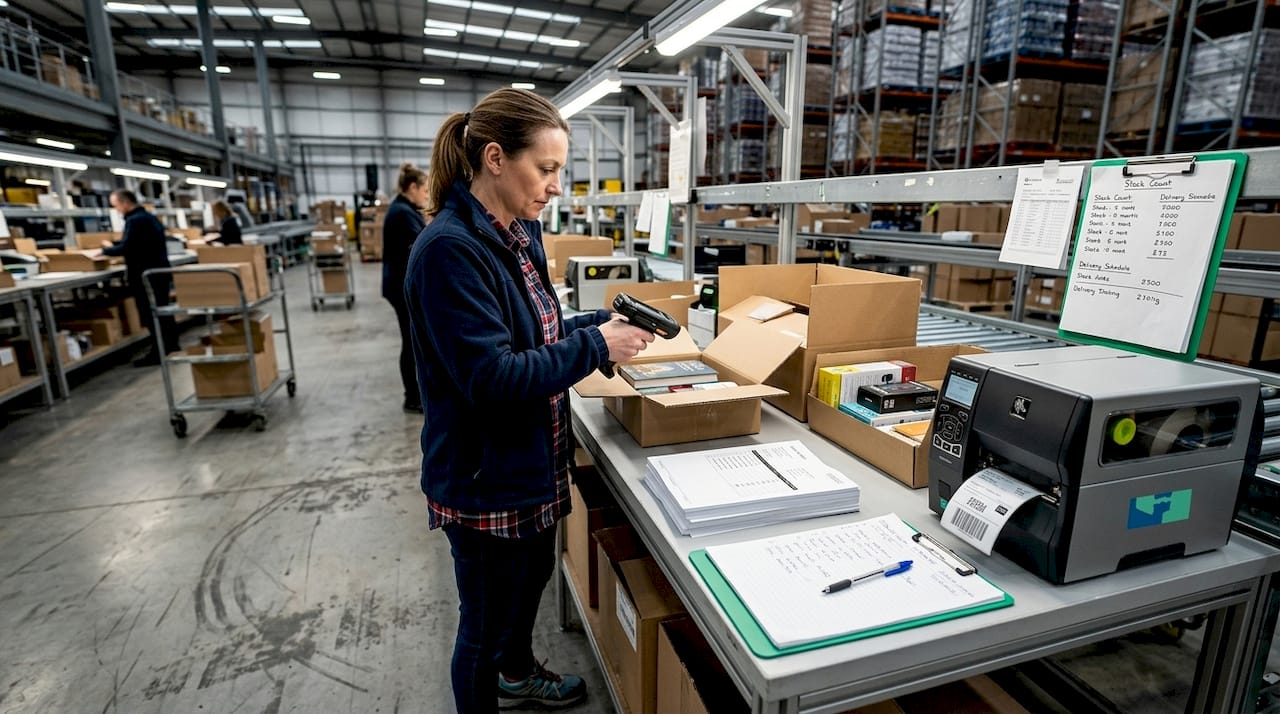
For most growing SMEs, outsourcing fulfilment to a 3PL is the most practical route to global reach without the capital outlay of owned warehouses. You can also explore 3PL vs 4PL options to understand which level of outsourcing suits your complexity.
DDP vs DDU: A quick comparison
| Factor |
DDP |
DDU |
| Who pays duties |
Seller |
Buyer |
| Customer experience |
Smooth, no surprises |
Risk of parcel abandonment |
| Seller complexity |
Higher (compliance burden) |
Lower |
| Best for |
Consumer goods, repeat buyers |
B2B or informed buyers |
| Conversion impact |
Positive |
Often negative |
Pro Tip: If you are selling to consumers in the EU or UK, DDP is almost always the right choice. Unexpected customs charges at the door are one of the top reasons for negative reviews and chargebacks.
For international fulfilment strategies that go deeper on carrier selection and market-specific nuances, Shopify’s enterprise resource is worth reviewing alongside your own data.
Cost drivers and operational benchmarks: What to watch and measure
Strategic choices only pay off if you can measure success and control your costs. Here is what to track.
The main cost drivers in international fulfilment are duties and taxes, last-mile delivery fees, returns handling, warehouse storage fees, and cross-border compliance costs. Last-mile delivery alone can account for over 50% of total shipping costs in some markets, so carrier selection matters enormously.
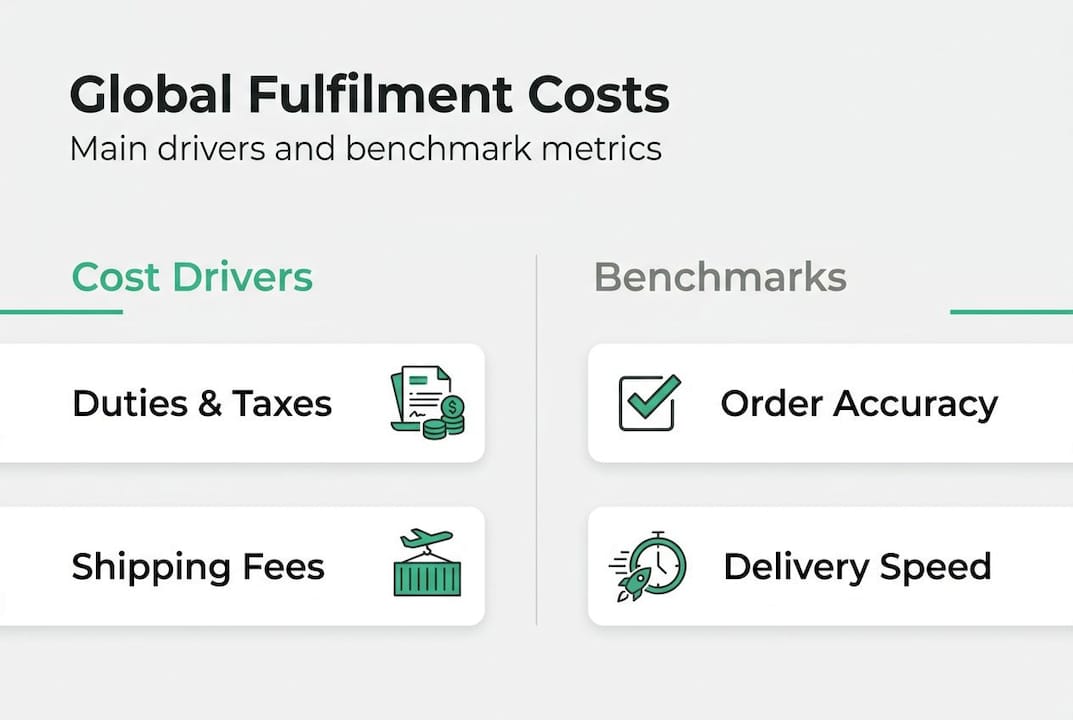
Here are the benchmarks that matter most:
| KPI |
Target benchmark |
Why it matters |
| Order accuracy rate |
98.5% or above |
Errors drive returns and damage trust |
| Delivery time (international) |
2 to 5 business days |
Keeps customers satisfied and loyal |
| Return rate |
Below 15% |
High returns erode margin fast |
| Perfect order rate |
Above 95% |
Measures end-to-end fulfilment quality |
Top 3PLs achieve 98.5% order accuracy, and 66% of brands now ship outside their home market. Shipping preferences also matter: 79% of US consumers prioritise free shipping, a trend mirrored across European markets.
Use these benchmarks to hold your 3PL accountable. Build them into your service level agreements (SLAs) from day one. If your provider cannot report on order accuracy and delivery performance, that is a red flag. Tracking reducing logistics costs through better data is one of the fastest ways to improve your margin without changing your product.
Customs, compliance, and common pitfalls: How to avoid fulfilment disasters
As you refine your operations, do not let regulatory or packaging details undermine months of effort. Here is what even seasoned managers can overlook.
HS code misclassification can lead to seizures, and customs holds can occur post-2025 even for DDP shipments. Getting your product classification wrong is not just an administrative inconvenience. It can result in fines, delayed shipments, and reputational damage with customers who receive nothing.
Here are the most common pitfalls to avoid:
- Incorrect HS codes: Always verify codes with a customs broker or automated classification tool. Do not guess.
- No validated Importer of Record: Without a properly designated IOR, your goods can be held indefinitely at the border.
- Undervaluing goods on customs declarations: This is illegal and can result in seizure or bans from certain markets.
- Ignoring restricted or prohibited items: Each country has its own list. What ships freely in Ireland may be restricted in the UAE.
- Poor returns planning: International returns cost 3 to 5 times more than domestic returns. Without a clear returns policy and local returns address, you will haemorrhage margin.
“Compliance is not a one-time setup task. Regulations change, and your processes need to keep pace.”
Pro Tip: Use real-time API tools that calculate duties and taxes at checkout. This removes the guesswork for your customers and ensures your DDP pricing is accurate, not estimated.
For guidance on cross-border fulfilment challenges and when you are searching for a new 3PL, it is worth reviewing your compliance processes before you switch providers. And if you are unsure when to use a 3PL, the answer is usually: earlier than you think.
Optimising your fulfilment for long-term global growth
With the essential risks covered, here is how to turn effective international fulfilment into a sustained growth lever for your brand.
Localising inventory in high-volume regions once you exceed 100 orders per month, and automating customs processes, are the two most impactful steps for scaling efficiently. Here is a practical roadmap for the next 12 to 18 months:
- Audit your current fulfilment data. Identify your top five international markets by order volume and return rate. These are your priority regions.
- Regionalise strategically. Once a market hits consistent volume, move stock closer to customers. This cuts delivery times and often reduces duties.
- Automate customs paperwork. Manual customs documentation is slow and error-prone. Invest in fulfilment technology that generates compliant paperwork automatically.
- Choose 3PLs with multi-market integration. Your fulfilment partner should connect seamlessly with your e-commerce platform, marketplaces, and courier network.
- Build a CX-focused returns process. Offer a local returns address where possible, clear timelines, and automated refund triggers. This turns a pain point into a loyalty driver.
The brands that sustain international growth are not the ones that move fastest. They are the ones that build repeatable, measurable processes and use data to improve continuously. Outsourcing for growth is not about handing over control. It is about gaining the infrastructure and expertise to scale without the overhead.
Partnering for effortless cross-border fulfilment
If you are ready to reach new markets without losing sleep over logistics, here is how to connect with a partner who can help you succeed.
At ParcelPlanet, we work with growing e-commerce and omnichannel brands that need reliable, scalable fulfilment across multiple markets. Whether you are shipping to five countries or fifty, our network and technology are built to handle the complexity so you can focus on growing your brand. From real-time tracking and platform integrations to accurate picking, packing, and customs-ready documentation, we give you the operational backbone your international expansion needs.

If you want to boost your e-commerce sales through smarter fulfilment, or you are weighing up 3PL or 4PL fulfilment options for your next stage of growth, our team is ready to help. Get in touch today for a tailored quote and find out how ParcelPlanet can make international fulfilment your competitive advantage.
Frequently asked questions
What is the most cost-effective shipping method for international e-commerce?
For SMEs, working with a reputable 3PL and using DDP is usually the most cost-effective and customer-friendly approach, as 3PL partnerships and DDP are core strategies for competing globally without absorbing excessive overhead.
How can I avoid customs and duties delays for my international shipments?
Automate customs paperwork, validate your Importer of Record, and use real-time duty calculation tools to minimise hold-ups. Automated compliance and a validated IOR are especially critical following post-2025 regulatory changes.
What are the main risks with international order fulfilment?
Common risks include customs holds, costly returns, errors in HS codes, and unexpected fees for buyers. HS code misclassification and customs holds remain the top risks for cross-border sellers in 2026.
How fast should international orders be delivered?
Top brands aim for delivery in 2 to 5 business days to keep customers satisfied and encourage repeat purchases. 69% of buyers are less likely to return after a late delivery, making speed a direct revenue driver.
Is it better to localise inventory or ship from a central warehouse?
Localising in key markets with more than 100 orders per month cuts delivery times significantly, but a central warehouse is simpler and more cost-effective at lower volumes. Localising inventory in high-volume regions is one of the most impactful steps for scaling efficiently.
Recommended


