Scaling logistics isn’t simply about moving more parcels or adding warehouse space. Many brands mistakenly believe that logistics growth equals volume expansion, overlooking the strategic choices that truly enable sustainable scalability. Effective scalable logistics require deliberate decisions about fulfilment models, technology investments, and operational partnerships that balance cost efficiency with customer satisfaction. This guide explores proven frameworks for choosing the right fulfilment network, leveraging omnichannel strategies, evaluating 3PL versus in-house options, and deploying warehouse technology to support your brand’s growth trajectory intelligently.
Table of Contents
Key Takeaways
| Point |
Details |
| Fulfilment models balance cost |
Different fulfilment models balance cost, speed and control. |
| Omnichannel inventory unification |
Omnichannel strategies unify inventory and optimise delivery promises. |
| 3PL versus in house |
Choosing between 3PL and in house depends on order volume and cost factors. |
| Automation lowers costs |
Warehouse technology and automation reduce costs and increase efficiency. |
| AI and WMS gains |
AI and WMS systems significantly improve pick rates and cost savings. |
Understanding fulfilment network models for scalable logistics
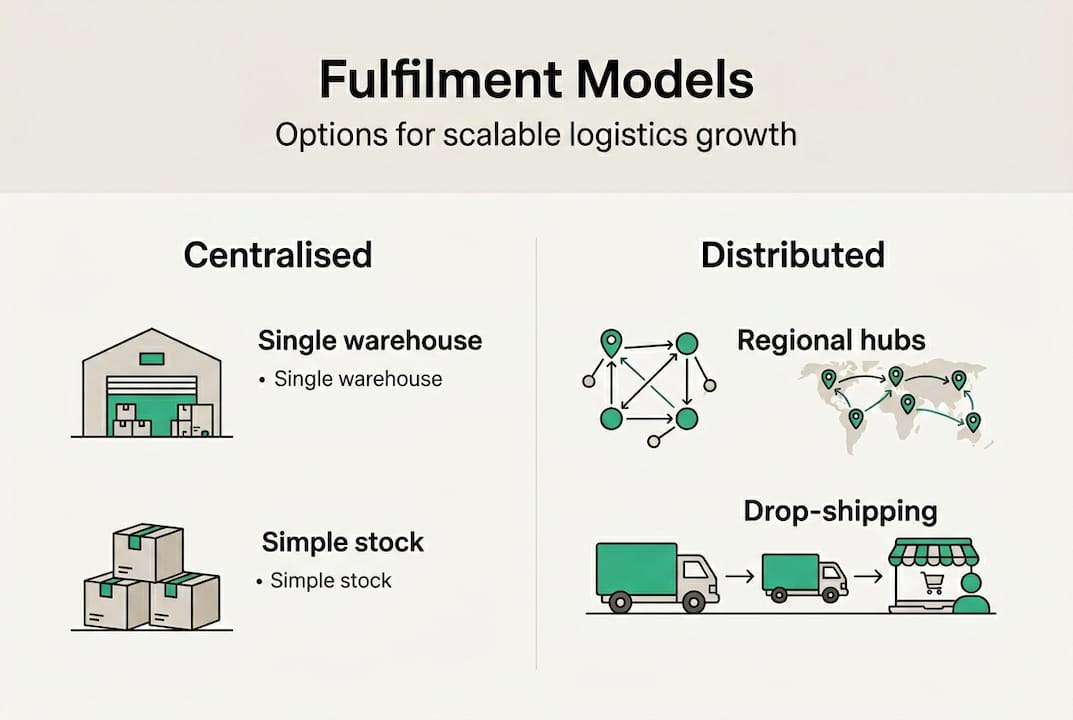
Your fulfilment network architecture determines how quickly you can reach customers, how much inventory capital you tie up, and how flexibly you can adapt to demand shifts. Key fulfilment network models include centralised fulfilment, regional hubs, drop-shipping, and MEIO for stock placement optimisation, each offering distinct trade-offs that impact your logistics scalability optimisations.
Centralised fulfilment consolidates inventory in a single warehouse, simplifying stock management and reducing holding costs. You maintain complete visibility over every SKU and streamline quality control processes. However, delivery times extend for customers located far from your facility, and shipping costs rise proportionally with distance. This model suits brands with concentrated customer bases or those prioritising inventory control over delivery speed.
Regional hub networks distribute stock across multiple local warehouses positioned near key customer clusters. You achieve faster delivery times and lower last-mile costs whilst improving customer satisfaction through proximity. The trade-off comes in higher holding costs, increased inventory complexity, and the challenge of forecasting demand accurately across multiple locations. Brands serving geographically dispersed markets benefit most from this approach.
Drop-shipping transfers inventory ownership to manufacturing or wholesale partners who ship directly to your customers. You eliminate warehousing capital expenditure and reduce operational overhead dramatically. Yet you sacrifice control over delivery speed, packaging quality, and customer experience whilst depending entirely on partner reliability. This model works for brands testing new products or those with limited working capital.
Multi-echelon inventory optimisation (MEIO) applies sophisticated algorithms to determine optimal stock placement across your entire network of warehouses, stores, and fulfilment centres. You balance service levels against inventory investment by positioning fast-moving items closer to customers whilst centralising slower SKUs. This approach requires advanced planning systems but delivers substantial cost savings at scale.
| Model |
Cost efficiency |
Delivery speed |
Inventory complexity |
Capital requirement |
| Centralised |
High |
Low |
Low |
Medium |
| Regional hubs |
Medium |
High |
High |
High |
| Drop-shipping |
Very high |
Variable |
Very low |
Very low |
| MEIO |
High |
High |
Very high |
High |
Several factors should guide your network choice:
- Monthly order volume and average order value determine breakeven points for distributed networks
- Customer geographic concentration influences whether regional hubs justify their cost premium
- Product characteristics like weight, fragility, and shelf life affect warehousing economics
- Available investment capital constrains how quickly you can expand physical infrastructure
- Competitive delivery promises in your category set minimum service level expectations
Pro tip: Consider hybrid models that combine regional hubs for bestselling items with centralised or drop-ship fulfilment for slower SKUs. This approach balances delivery speed where it matters most whilst controlling inventory risk across your entire catalogue. The omnichannel fulfilment framework provides detailed guidance on architecting these sophisticated networks.
Leveraging omnichannel fulfilment for consistent service and cost efficiency
Omnichannel logistics transforms isolated sales channels into an integrated fulfilment ecosystem where inventory flows dynamically to meet customer demand through the most efficient path. Omnichannel fulfilment uses shared inventory and orchestration rules to optimise fulfilment nodes, achieving 2-day delivery coverage up to 84% and 96% on-time BOPIS, fundamentally improving both service quality and operational economics.
Shared inventory visibility connects distribution centres, retail stores, and micro-fulfilment centres into a unified pool that any channel can access. When a customer orders online, your system evaluates all available inventory locations rather than limiting fulfilment to dedicated e-commerce warehouses. A store with excess stock can ship directly to nearby customers, whilst DCs handle bulk orders and stores focus on immediate local demand. This flexibility reduces stockouts by 20-30% compared to siloed inventory management.
Orchestration rules determine which fulfilment node handles each order based on factors like proximity, inventory availability, labour capacity, and service promise. You might prioritise buy-online-pickup-in-store (BOPIS) for customers within 5 miles of retail locations, ship-from-store for next-day delivery zones, and DC fulfilment for standard shipping. These rules balance customer expectations against unit economics, ensuring you don’t sacrifice profitability whilst improving service.
The benefits extend across multiple dimensions:
- Increased sales conversion through consistent delivery promises regardless of purchase channel
- Improved customer satisfaction from faster delivery and convenient pickup options
- Reduced shipping costs by selecting the nearest fulfilment node automatically
- Lower inventory holding costs through better stock utilisation across the network
- Enhanced flexibility to handle demand spikes by leveraging all available capacity
Yet omnichannel logistics introduces operational challenges that require careful management. Inventory silos emerge when systems don’t synchronise in real time, leading to overselling and customer disappointment. Store associates face disruption when fulfilment tasks compete with customer service responsibilities during peak periods. Returns fraud increases when customers exploit pickup policies across multiple channels. Data latency between systems creates visibility gaps that undermine orchestration accuracy.
Pro tip: Prioritise unit economics per service type by excluding low-margin SKUs from labour-intensive options like BOPIS. Reserve these convenient services for products where customer lifetime value justifies the operational cost. Track cost-to-serve metrics religiously and adjust orchestration rules quarterly based on actual profitability data. Many omnichannel fulfilment examples demonstrate how selective service offerings protect margins whilst still delivering competitive customer experiences.
Choosing between third-party logistics and in-house fulfilment
The decision between outsourcing to a 3PL provider or building in-house fulfilment capabilities fundamentally shapes your operational scalability, cost structure, and strategic focus. 3PL providers offer scalability and 15-40% shipping cost savings above 500-1000 orders/month, whilst in-house operations provide maximum control for brands with specialised requirements or lower volumes.
Third-party logistics partners bring immediate scalability without capital expenditure on warehouses, equipment, or permanent labour. You access established carrier relationships that deliver negotiated shipping rates typically 20-35% below retail pricing. Operational expertise accumulated across hundreds of clients translates into optimised pick-pack processes, inventory management best practices, and technology platforms you couldn’t justify building internally. Geographic flexibility allows you to expand into new markets by leveraging existing 3PL facilities rather than constructing your own infrastructure.
Hidden costs plague in-house fulfilment that inexperienced operators frequently underestimate. Labour overhead extends beyond hourly wages to include recruitment, training, benefits, and management supervision. Warehouse leases lock you into long-term commitments that become burdensome when demand fluctuates seasonally. Equipment depreciation, maintenance, and eventual replacement create ongoing capital drains. Most critically, lack of carrier rate shopping leaves you paying published shipping rates that erode margins silently.
Volume thresholds determine economic breakeven points between fulfilment models. Below 500 monthly orders, in-house operations often prove more cost-effective because 3PL per-order fees exceed your actual labour and shipping costs. Between 500-1000 orders monthly, the equation shifts as 3PL economies of scale and carrier discounts outweigh their service fees. Above 1000 orders, 3PL advantages compound through automation investments and network optimisation that smaller operators cannot justify.
| Factor |
3PL fulfilment |
In-house fulfilment |
| Upfront cost |
Low (no capital) |
High (facility, equipment) |
| Scalability |
Excellent |
Limited by capacity |
| Shipping rates |
Negotiated bulk |
Retail or small volume |
| Customisation |
Limited |
Complete control |
| Technology |
Included platform |
Separate investment |
| Geographic reach |
Multi-location |
Single facility |
Key considerations when evaluating options:
- Current monthly order volume and projected growth trajectory over 12-24 months
- Product customisation requirements like gift wrapping, kitting, or personalisation
- Available working capital for facility investment versus operational expense preference
- Strategic importance of fulfilment as a competitive differentiator versus cost centre
- Geographic distribution of your customer base and desired delivery speed promises
Pro tip: Integrate rate-shopping tools into in-house operations to mitigate the carrier discount disadvantage. Platforms that compare real-time rates across multiple carriers can reduce shipping costs 15-25% even at modest volumes. This technology investment narrows the 3PL cost advantage whilst preserving operational control. Explore 3PL benefits for scalable logistics to understand how partnership models evolve as your business grows.
Scaling warehouse operations through technology and automation
Warehouse technology transforms static storage facilities into dynamic fulfilment engines that process orders faster, more accurately, and at lower unit costs as volume scales. Automation and optimised warehouse layouts can reduce costs by up to 30%; AI-driven WMS improve pick rates and save around $1300 per 10,000 lines, fundamentally changing the economics of fulfilment operations.
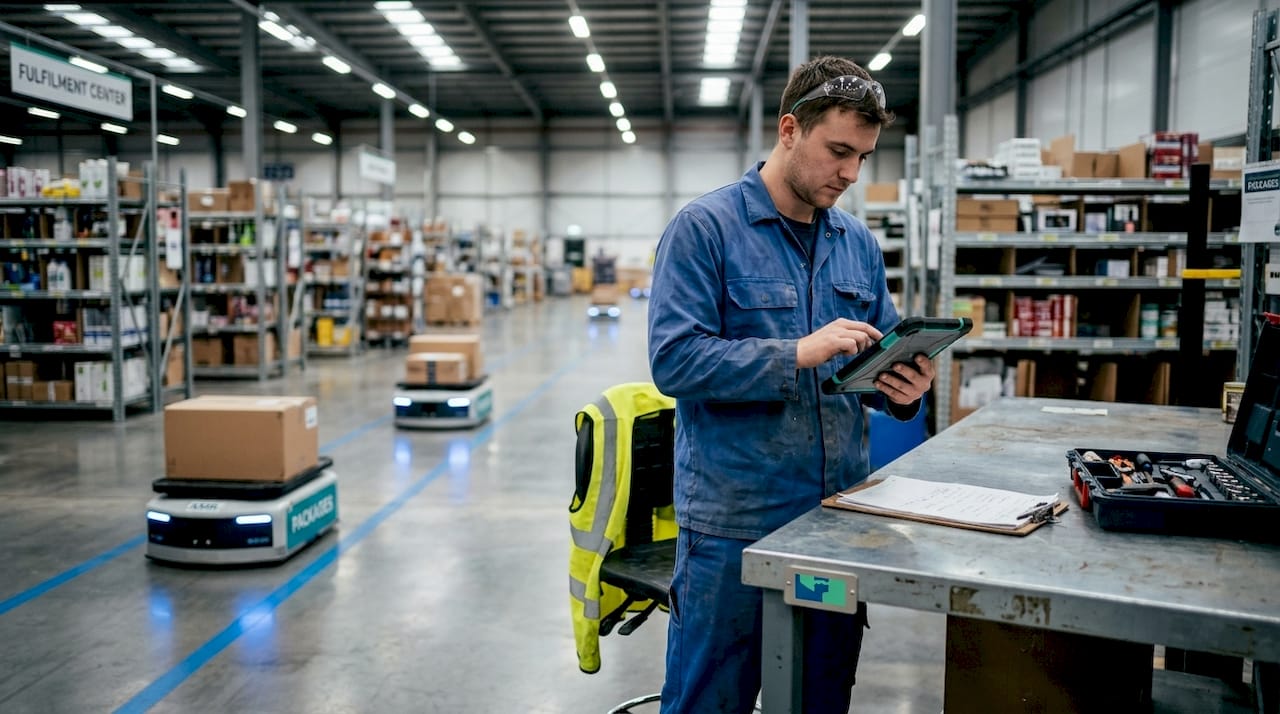
Modular warehouse layouts adapt to changing inventory profiles and order patterns without costly facility redesigns. You configure adjustable racking systems that accommodate varying product dimensions and seasonal volume fluctuations. Vertical storage maximises cubic capacity, particularly valuable in high-rent urban locations where proximity to customers justifies premium real estate costs. Slotting optimisation positions fast-moving SKUs in easily accessible zones whilst relegating slower items to higher shelves or remote areas, reducing picker travel time by 25-40%.
Autonomous mobile robots (AMRs) revolutionise order picking by bringing products to stationary pickers rather than requiring workers to traverse warehouse aisles. These robots navigate dynamically around obstacles, adapt to layout changes instantly, and scale capacity simply by adding units during peak periods. Conveyor systems automate product movement between receiving, storage, picking, and packing zones, eliminating manual transport labour whilst accelerating throughput. Together, these technologies reduce order processing time from 8-12 minutes to 3-5 minutes per order.
Warehouse management system (WMS) software integrates inventory visibility, task management, and carrier coordination into a single platform that orchestrates all fulfilment activities. Real-time inventory tracking eliminates stockouts and overselling by synchronising physical counts with order management systems. Intelligent task assignment directs pickers along optimised routes and batches compatible orders to maximise efficiency. Automated carrier selection chooses the most cost-effective shipping option for each order based on weight, destination, and service level requirements.
AI/WMS technology benchmarks show 100% network growth, 15% pick rate increase, and $0.10 item savings, demonstrating measurable returns on technology investment. Advanced systems apply machine learning to forecast demand patterns, optimise inventory placement, and predict equipment maintenance needs before failures occur.
| Metric |
Traditional warehouse |
Automated warehouse |
| Pick rate (units/hour) |
60-80 |
120-150 |
| Order accuracy |
96-98% |
99.5-99.9% |
| Labour cost per order |
£3.50-£5.00 |
£1.80-£2.50 |
| Capacity utilisation |
65-75% |
85-95% |
Technology benefits compound across operations:
- Reduced picking errors through barcode scanning and automated verification systems
- Faster order processing from optimised workflows and reduced manual handling
- Improved inventory accuracy through real-time tracking and cycle counting automation
- Lower training requirements as systems guide workers through standardised processes
- Enhanced scalability by adding technology capacity rather than proportional labour
Pro tip: Regularly review warehouse layout and technology ROI as order volumes evolve. What optimises efficiency at 1000 orders monthly may create bottlenecks at 5000 orders. Conduct quarterly time-motion studies to identify emerging constraints before they impact service levels. Budget 2-3% of revenue annually for technology upgrades and process improvements. Discover practical warehouse management tips to implement these optimisation strategies systematically.
Discover scalable logistics solutions tailored for your brand
Implementing the scalable logistics strategies outlined requires expertise, technology, and operational infrastructure that many growing brands lack internally. ParcelPlanet specialises in delivering comprehensive 3PL solutions designed specifically for e-commerce and omnichannel brands seeking to improve efficiency whilst controlling costs. Our services integrate advanced warehouse management systems, omnichannel fulfilment capabilities, and carrier optimisation to support your growth trajectory without the capital investment of building in-house operations.

We understand the unique challenges facing SME brands as they scale beyond initial success into sustainable growth. Our flexible approach adapts to your specific requirements, whether you need regional distribution, specialised handling, or technology integration with your existing platforms. By partnering with ParcelPlanet’s 3PL expertise, you access the operational capabilities of much larger enterprises whilst maintaining the personalised service your brand deserves. Explore our comprehensive order fulfilment services or learn more about 3PL versus 4PL options to determine the ideal logistics partnership for your business.
Frequently asked questions
What is scalable logistics and why does it matter?
Scalable logistics refers to fulfilment systems and processes that grow efficiently alongside increasing order volumes without proportional cost increases or service degradation. Rather than simply adding capacity, scalable logistics optimise technology, automation, and operational models to handle 2-5x volume growth whilst maintaining or improving unit economics. This matters because brands that scale logistics effectively capture market opportunities without sacrificing profitability, whilst those that merely expand capacity face margin erosion and operational chaos during growth periods. Effective scalability directly impacts customer satisfaction through consistent delivery promises and competitive advantage through cost efficiency.
How do I know if my brand should use a 3PL or in-house fulfilment?
Brands processing over 500-1000 orders monthly typically benefit from 3PL partnerships through shipping discounts, operational expertise, and scalability without capital investment. The 15-40% cost savings on shipping alone often justify the transition, whilst technology platforms and multi-location capabilities provide competitive advantages difficult to replicate in-house. Smaller volumes or highly specialised fulfilment requirements like complex customisation, hazardous materials, or extreme quality control may favour in-house operations where you maintain complete process control. Evaluate your current volume, growth trajectory, available capital, and strategic importance of fulfilment control to determine the optimal approach.
What role does technology play in scaling warehouse operations?
Technology fundamentally transforms warehouse economics by reducing labour costs up to 30% whilst improving accuracy and throughput. Automated systems like warehouse management software, mobile robots, and conveyor networks process orders 40-60% faster than manual operations whilst virtually eliminating picking errors. AI-driven platforms optimise inventory placement, predict demand patterns, and coordinate carrier selection to minimise costs per order. As volume scales, technology investments deliver compounding returns through better capacity utilisation and reduced training requirements, making growth profitable rather than merely possible.
What are common challenges in omnichannel logistics and how can they be managed?
Inventory silos emerge when systems don’t synchronise in real time across channels, leading to overselling and customer disappointment. Store fulfilment disrupts retail operations when associates must balance picking orders with serving in-person customers during peak periods. Returns fraud increases as customers exploit lenient policies across multiple channels. Advanced data integration platforms that update inventory every 15-30 minutes mitigate silo risks, whilst clear orchestration rules that exclude low-margin SKUs from labour-intensive services protect profitability. Implement fraud detection algorithms that flag suspicious return patterns and establish store labour models that separate fulfilment from customer service roles during busy periods.
Recommended


