TL;DR:
- Many e-commerce brands mistakenly see multi-channel logistics as simply listing products across platforms, but true success requires coordinated inventory, order routing, and fulfillment.
- Proper integration of these elements prevents chaos, overselling, and inefficiencies, enabling brands to grow smoothly across multiple channels.
- While multi-channel logistics manages separate channels independently, omnichannel offers a unified, seamless customer experience through shared inventory and integrated systems.
Selling across multiple platforms feels like progress, and it genuinely is. But many e-commerce brands make the mistake of treating multi-channel logistics as simply a matter of listing products on more marketplaces and waiting for orders to roll in. The real work happens behind the scenes. Without smart coordination of your inventory, order routing, and fulfilment operations, expanding your sales channels can create more problems than it solves. This guide cuts through the confusion, defines what multi-channel logistics truly involves, and offers a practical roadmap to help your brand grow efficiently across every channel you operate.
Table of Contents
Key Takeaways
| Point |
Details |
| True coordination is critical |
Managing inventory and orders holistically across all sales channels is core to multi-channel logistics. |
| Technology powers efficiency |
Real-time data and dynamic orchestration rules are essential for promise accuracy and fulfilment speed. |
| Choose the right logistics model |
Comparing multi-channel and omnichannel approaches helps businesses scale efficiently and meet customer demands. |
| Continuous improvement matters |
Ongoing monitoring and refinement of fulfilment rules ensure operational agility and customer satisfaction. |
Defining multi-channel logistics: More than many sales channels
Multi-channel logistics is the coordinated management of inventory, order fulfilment, and shipping operations across multiple sales platforms simultaneously. Those platforms might include your own website, marketplaces like Amazon or eBay, physical retail locations, and social commerce channels. The word “coordinated” is doing a lot of work in that definition. It is the difference between growth and operational chaos.
When your channels operate in silos, you risk overselling stock that does not exist, under-serving customers on your highest-performing platform, and absorbing the cost of returns and re-shipments that could have been avoided. The integration of your systems is what determines whether your multi-channel expansion strengthens or weakens your business.
The three core processes that make multi-channel logistics function are:
- Inventory visibility: Knowing exactly how much sellable stock you hold, where it is located, and how it is allocated across channels at any given moment.
- Order routing: The automated or rule-based process of directing each incoming order to the most appropriate fulfilment node (warehouse, store, or third-party location) based on stock levels, location, and cost.
- Performance monitoring: Ongoing tracking of key metrics such as fill rate, on-time delivery, and order accuracy to identify issues before they escalate.
As shared inventory visibility, order orchestration, and node capacity are core to modern logistics frameworks, brands that invest in these capabilities early gain a significant operational advantage. You can explore more on this in our multi-channel fulfilment guide.
“The goal of multi-channel logistics is not simply to fulfil orders from multiple places. It is to fulfil the right order, from the right place, at the right cost, every time.”
Pro Tip: Build a channel-agnostic fulfilment infrastructure from the start. Rather than creating separate warehousing or inventory rules for each sales channel, design your operations so that any channel can draw from the same inventory pool. This dramatically reduces the risk of stockouts on one platform while another sits on excess stock.
The essential components of a multi-channel logistics network
Now that we know what multi-channel logistics is, let us break down its essential moving parts. Understanding each component helps you identify where your current operations may have gaps and where investment will have the greatest impact.
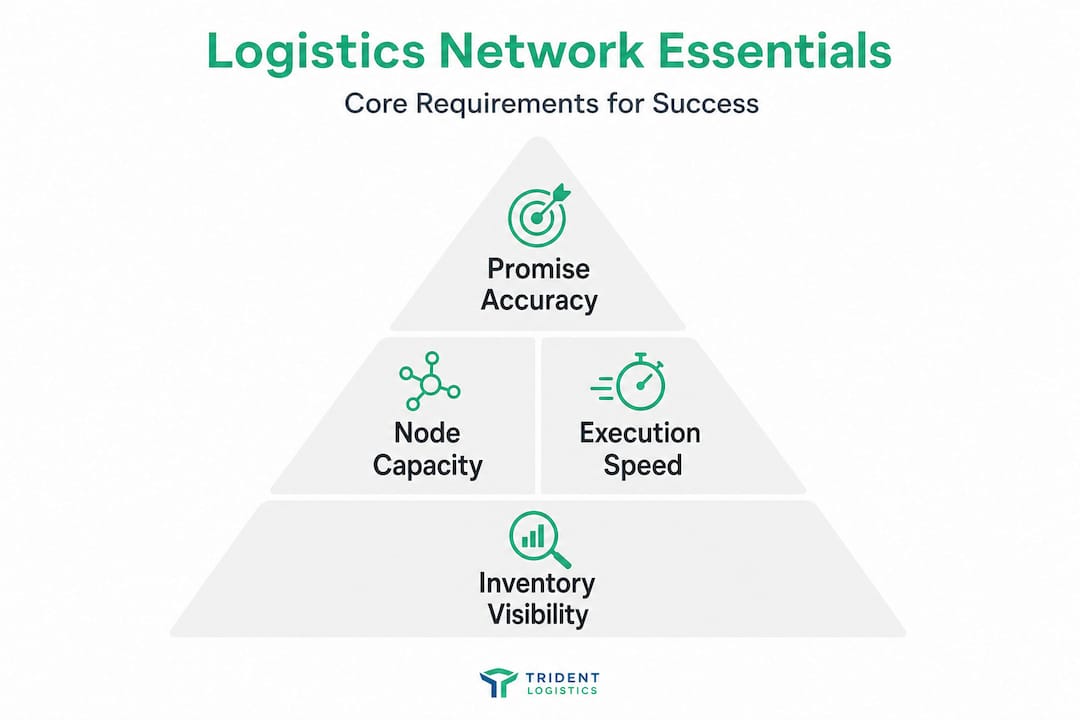
The four most critical requirements for a well-functioning multi-channel network are promise accuracy, node capacity, exception handling, and sellable-availability integrity. Here is what each one means in practice:
| Component |
What it means |
Why it matters |
| Promise accuracy (ATP) |
Available-to-promise: Can you genuinely fulfil what you have committed to? |
Prevents failed deliveries and customer complaints |
| Node capacity |
The throughput capability of each fulfilment location |
Avoids bottlenecks during peak trading periods |
| Exception handling |
Rules for managing stockouts, carrier failures, or system errors |
Maintains service levels when things go wrong |
| Sellable-availability integrity |
Ensuring only genuinely available stock is displayed as sellable |
Stops overselling and protects brand reputation |
Each of these components depends on the others. A strong ATP calculation is useless if your node capacity is not accurately reflected in your system. Equally, excellent node capacity means nothing if your exception handling protocols are poorly defined.
Here is a step-by-step view of how a healthy multi-channel logistics network processes an order:
- Order received: A customer purchases a product through your website or a marketplace.
- Inventory check: Your system queries real-time stock levels across all fulfilment nodes.
- Node selection: Orchestration rules determine the optimal fulfilment location based on stock availability, proximity to the customer, and cost.
- Order dispatched: The selected node picks, packs, and ships the order, with tracking details passed back to the customer automatically.
- Exception triggered (if needed): If the preferred node cannot fulfil the order (due to a stockout or capacity issue), the system reroutes automatically to the next best option.
- Performance data captured: Fill rate, delivery time, and accuracy are logged for ongoing review.
Exploring omnichannel fulfilment strategies can help you apply these components more effectively at scale. You may also find it useful to review top fulfilment strategies used by brands managing high order volumes.
Pro Tip: Invest in dynamic order orchestration systems rather than static rules. Static rules (such as “always fulfil from Warehouse A first”) quickly become inefficient as your business grows. Dynamic systems evaluate multiple variables in real time, selecting the optimal node for each individual order based on current conditions.
Multi-channel versus omnichannel logistics: What’s the difference?
After understanding the core of multi-channel logistics, it helps to see how it compares with the omnichannel model that is often discussed in the same breath. The two terms are frequently used interchangeably, but they describe meaningfully different approaches. Getting this distinction right will help you choose the model that fits your brand’s current stage and future ambitions.
The clearest summary is this: omnichannel models centre on shared inventory and consistent customer experience, while multi-channel logistics can and often does operate with channels working independently of one another.
| Feature |
Multi-channel logistics |
Omnichannel logistics |
| Inventory visibility |
Can be channel-specific |
Shared across all channels |
| Order orchestration |
Often separate per channel |
Unified, cross-channel orchestration |
| Customer experience |
May vary by channel |
Consistent regardless of channel |
| Flexibility |
Easier to implement initially |
Greater long-term scalability |
| Returns handling |
Channel-dependent processes |
Centralised, unified process |
| Technology complexity |
Moderate |
Higher, but more powerful |
Multi-channel logistics is often the right starting point for brands that are growing their channel presence but are not yet ready for the full investment that omnichannel operations require. Omnichannel is the natural evolution for brands that want to deliver a seamless experience regardless of where a customer shops or returns a product.
Signs that your business should consider moving towards omnichannel logistics include:
- You are frequently experiencing stockouts on one channel while holding excess inventory on another.
- Customers are reporting inconsistent delivery experiences or return policies across your channels.
- Your team is managing inventory manually across different platforms, creating errors and inefficiencies.
- You are expanding into new geographies or physical retail alongside your digital channels.
- Order volumes have grown to a point where channel-specific operations are no longer cost-effective.
Reviewing examples of omnichannel fulfilment from comparable brands can help you determine whether the transition makes sense now. For a broader view of the commercial benefits, explore the omnichannel selling benefits available to brands that make the shift.
Implementing multi-channel logistics: Steps for e-commerce brands
With an understanding of the models, let us look at the practical steps to putting multi-channel logistics into action for your business. Whether you are setting up for the first time or optimising an existing network, a structured approach will save time, reduce risk, and deliver faster results.
Monitoring and refining rules and inventory placement is essential for ongoing optimisation, which means implementation is never truly complete. It is an iterative process that improves with every order cycle.
-
Assess your current state. Map your existing sales channels, fulfilment locations, and inventory management processes. Identify gaps in visibility and any manual processes that could be automated. Be honest about where inefficiencies are costing you time or money.
-
Integrate your systems. Connect your sales channels, warehouse management system (WMS), and order management system (OMS) so that data flows automatically between them. Platform integrations with tools like Shopify, WooCommerce, or your preferred marketplace are typically the starting point.
-
Define your fulfilment rules. Establish the logic that will govern how orders are routed. Consider factors including stock availability, fulfilment node proximity, shipping cost, and delivery promise. Build in exception rules for scenarios such as stockouts or carrier disruptions.
-
Set up real-time inventory visibility. Ensure that every sales channel reflects accurate, real-time stock levels. This single step prevents overselling, reduces customer disappointment, and protects your brand reputation across all platforms.
-
Monitor performance consistently. Track key metrics including fill rate, on-time delivery percentage, order accuracy rate, and returns volume. Use this data to identify underperforming nodes or processes that need attention.
-
Refine and improve continuously. Schedule regular reviews of your fulfilment rules, inventory placement strategy, and system integrations. As your order volumes grow and your channel mix evolves, your logistics setup must evolve with them.
Building flexible fulfilment into your operations from the outset gives you the agility to adapt quickly when market conditions shift. For brands with serious growth ambitions, investing in scalable logistics strategies will support long-term efficiency as volumes increase.
Pro Tip: Create regular feedback loops between your sales, fulfilment, and customer support teams. Sales will spot channel-specific demand trends early. Fulfilment will flag operational pressure points. Customer support will highlight the downstream impact of logistics failures. Bringing these perspectives together monthly means you improve continuously rather than reactively.
What most guides miss about multi-channel logistics
Most articles on multi-channel logistics focus heavily on the technology: which platforms to integrate, which WMS to choose, which orchestration tools to evaluate. Technology matters, but it is only part of the picture. In our experience supporting growing e-commerce and omnichannel brands, the brands that struggle most with multi-channel logistics are not struggling because they chose the wrong software. They are struggling because they underestimated the ongoing commitment required to make the systems work well.
The hardest truth about multi-channel logistics is that it is never “set and forget.” Fulfilment rules that worked perfectly in January may be entirely wrong by October when your sales channel mix has shifted, new SKUs have been added, and peak season is approaching. Brands that build monitoring and refinement into their regular operations consistently outperform those that treat implementation as a one-time project.
There is also a human dimension that rarely appears in technical guides. Cross-functional collaboration between sales, operations, and customer support is genuinely one of the most powerful drivers of logistics performance. When these teams communicate well, problems are caught early. When they operate in their own silos, the same issues repeat month after month.
The concept of sellable-availability integrity deserves more attention than it typically receives. Displaying accurate, genuinely available stock across all channels is the foundation of customer trust. When a customer orders a product that turns out to be unavailable, the impact is not just a lost sale. It is a lost customer. Brands that prioritise this aspect of their logistics operation protect both their reputation and their revenue. Addressing common fulfilment challenges proactively, rather than waiting for customer complaints to drive change, is what separates brands that scale successfully from those that stall.
Scale smarter with tailored logistics solutions
Understanding multi-channel logistics is one thing. Executing it consistently at scale is another challenge entirely. The right fulfilment partner does not just store and ship your products. They give you the infrastructure, integrations, and expertise to manage inventory and orders across every channel with accuracy and speed.

At ParcelPlanet, we provide order fulfilment solutions built for e-commerce and omnichannel brands that are serious about growth. From real-time inventory visibility to seamless courier integrations and multi-channel order routing, our team handles the operational complexity so you can focus on your brand. Whether you are just starting to explore what order fulfilment involves or are ready to optimise an existing network, we can tailor a solution to your needs. Explore our inventory management tools and get in touch to find out how we can support your next stage of growth.
Frequently asked questions
How does multi-channel logistics improve order fulfilment speed?
It enables orders to be fulfilled from the optimal fulfilment node with available stock, reducing delays and improving delivery times for customers across every channel.
What is ‘promise accuracy’ (ATP) in logistics?
ATP (available-to-promise) is the ability to fulfil delivery commitments made to customers based on actual inventory levels held at each fulfilment node at the time of ordering.
Can small e-commerce brands benefit from multi-channel logistics?
Yes. Even smaller brands gain significant advantages from coordinating inventory and orders across platforms, as shared inventory management reduces stockouts and improves operational efficiency regardless of business size.
What’s the main difference between multi-channel and omnichannel logistics?
Multi-channel logistics manages fulfilment across separate sales channels that may operate independently, while omnichannel logistics coordinates inventory and customer experience seamlessly across all channels from a unified system.
Recommended


