TL;DR:
- Efficient packing reduces errors, returns, and costs while boosting customer trust and retention.
- Optimized setup and standardized workflows improve packing speed and accuracy significantly.
- Regular process review and automation are essential for sustaining scalability and quality.
One wrong item in a box can cost you far more than a refund. It costs you the customer. A single packing error triggers a return request, a negative review, and quite often, a buyer who never comes back. For small and medium e-commerce brands, where every order counts and margins are tight, a poorly managed packing process is a genuine threat to growth. This guide walks you through everything you need to build an efficient, accurate order packing workflow, from setting up your station and executing the process step by step, to avoiding common mistakes and verifying every shipment before it leaves your hands.
Table of Contents
Key Takeaways
| Point |
Details |
| Optimised packing cuts time |
Streamlined stations and standardised steps can reduce packing time by up to 30 percent. |
| Right tools boost accuracy |
Having the correct supplies and workstation layout minimises errors and increases order accuracy. |
| Step-by-step workflow matters |
A standardised process with checks at each stage prevents costly mistakes and speeds fulfilment. |
| Regular verification is vital |
Consistently reviewing packed orders and tracking key metrics guards against errors and keeps customers satisfied. |
| Professional partners scale efficiency |
When internal processes reach their limits, fulfilment specialists like ParcelPlanet offer scalable solutions. |
Why efficient order packing matters in e-commerce
Packing is not just a physical task. It is a direct reflection of your brand’s reliability. When customers receive a damaged, incomplete, or incorrectly packed order, trust breaks down quickly. Returns are expensive to process, refunds eat into your margin, and negative reviews on platforms like Trustpilot or Google can deter new buyers for months.
The operational stakes are equally significant. Slow packing creates bottlenecks that delay dispatch, push orders past cut-off times, and damage your reputation with courier partners. The good news is that the gains from fixing this are measurable. Optimised packing stations and standardised procedures can reduce packing time by up to 30%, which is a transformational improvement if you are currently processing hundreds of orders per day.
Speed potential also varies significantly by product category. Pick rates vary by sector: apparel typically achieves 60 to 110 lines per hour, while health and beauty products reach 100 to 160 lines per hour. The constraint is rarely staff effort. It is usually slotting density, meaning how well your products are positioned relative to your packing stations.
Key business impacts of inefficient packing include:
- Increased return rates due to wrong or damaged items shipped
- Higher operational costs from re-packing, re-shipping, and customer service handling
- Lower customer retention caused by poor unboxing experiences
- Missed courier cut-off times from slow throughput at the packing station
- Wasted materials from poor box selection and over-packing
Investing in warehouse optimisation for e-commerce goes hand in hand with improving packing efficiency. Getting your layout right is one of the fastest ways to unlock meaningful throughput gains.
Before you can improve your packing speed and accuracy, you need the right environment. Many brands underestimate how much their physical setup affects performance. A cluttered, poorly arranged packing station forces unnecessary movement, increases the chance of errors, and slows everyone down.
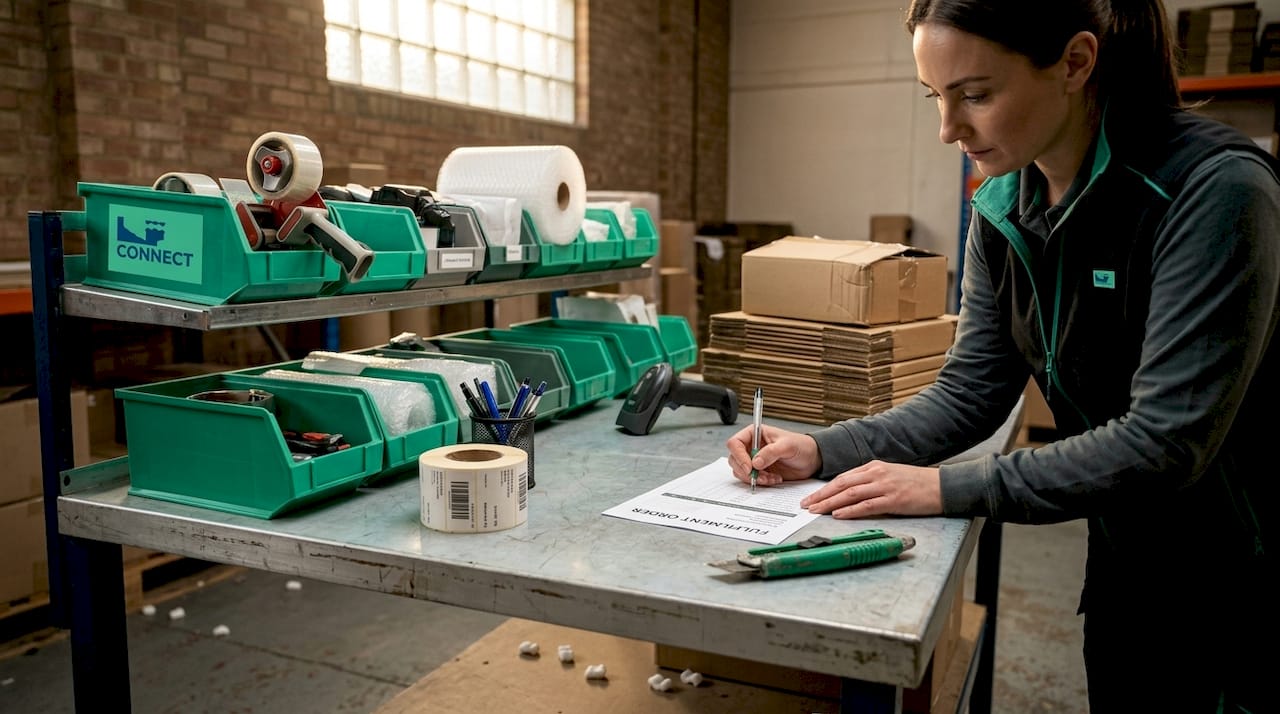
Here is a practical checklist of what every packing station should have in place before the first order is touched:
Basic packing supplies:
- Correctly sized cardboard boxes and mailer bags
- Tissue paper, void fill, or bubble wrap for product protection
- Packing tape and a quality tape dispenser
- Labels and a dedicated label printer
- Scissors and a box cutter
Advanced tools for higher-volume operations:
- Barcode scanner for order verification
- Weighing scales for accurate postage calculation
- Digital order management display or printed pick list
- Segmented shelving for packaging materials within arm’s reach
| Tool |
Purpose |
Essential or optional |
| Barcode scanner |
Verify items against order |
Essential |
| Label printer |
Print accurate shipping labels fast |
Essential |
| Weighing scales |
Calculate correct postage |
Essential |
| Void fill dispenser |
Protect items and reduce material waste |
Recommended |
| Box size guide |
Match packaging to product dimensions |
Recommended |
| Digital pick list display |
Reduce paper and improve accuracy |
Optional |
Station layout is just as important as the tools themselves. Position your most frequently used materials closest to your dominant hand. Keep tape, labels, and void fill within arm’s reach so your team never has to walk away from the bench mid-pack. This single adjustment, informed by the principle that optimised packing stations reduce packing time significantly, can deliver noticeable improvements within a single shift.
You should also consider how automation in packing can support your team at higher volumes, particularly for repetitive SKUs where semi-automated solutions can dramatically increase throughput without sacrificing accuracy.
Pro Tip: Walk your packing station as if you are new to the role. Count how many times a packer has to turn, reach, or walk to complete one order. Each unnecessary movement is a hidden time cost. Eliminating even three to four movements per order adds up significantly across a day’s volume.
How to execute the perfect order packing process
A consistent, repeatable workflow is the foundation of accurate and efficient packing. Without a defined process, each team member inevitably develops their own approach, which leads to inconsistency, errors, and wasted time. Standardising your workflow is one of the most impactful things you can do, especially as your team grows.
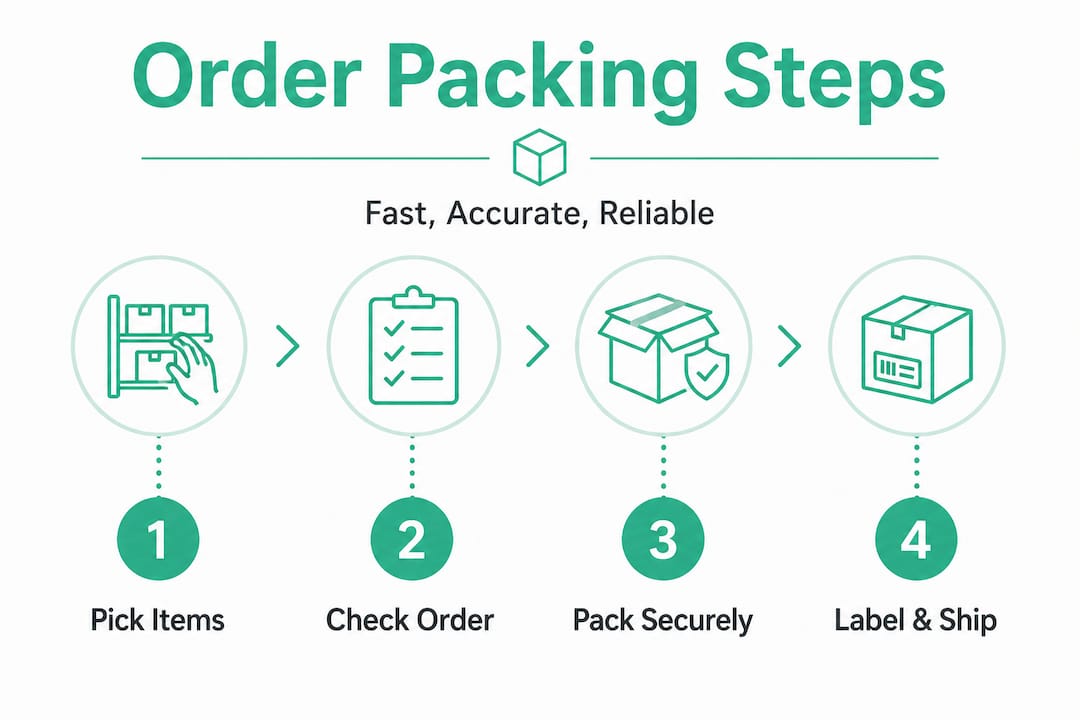
Follow this step-by-step packing workflow for each order:
- Retrieve the pick list or order details from your order management system and confirm you have the correct customer information.
- Pick all items for the order from their designated storage locations, scanning each barcode as you collect them.
- Verify items against the order before you begin packing, checking quantities, variants (such as size, colour, or flavour), and product condition.
- Select the correct packaging size based on the item dimensions and fragility. Oversized boxes waste material and increase shipping costs.
- Add appropriate protective fill to prevent movement during transit. Consider sustainability here as well since customers notice it.
- Place items carefully ensuring fragile products are wrapped and positioned away from box edges.
- Include all inserts such as invoices, returns slips, promotional materials, or personalised notes.
- Seal the package securely with adequate tape across all seams and edges.
- Apply the shipping label clearly on the largest flat surface of the package, avoiding seams or curves.
- Conduct a final weight check to confirm the package matches the expected weight for the order.
Warehouse layout optimisation can reduce packing time by 25%, and following a structured workflow like the one above is how you realise that saving in practice. You can explore additional optimising logistics workflow strategies to further refine your process over time.
| Factor |
Single order packing |
Batch packing |
| Best for |
Complex, high-value, or custom orders |
High volume, standard SKU orders |
| Error risk |
Lower, due to focused attention |
Moderate, requires disciplined sorting |
| Speed |
Slower per order overall |
Faster throughput during peak periods |
| Training required |
Minimal |
Moderate, especially for sorting stages |
| Recommended period |
Everyday fulfilment |
Peak seasons and promotional campaigns |
Pro Tip: During peak trading periods, switch to batch packing for your standard product lines. Group orders by SKU first, pack in bulk, then sort and label. This approach can dramatically improve your throughput without requiring additional staff. Review order fulfilment tips to tailor this method to your specific operation.
Avoiding common mistakes and troubleshooting packing challenges
Even well-run packing operations encounter problems. The key is recognising the most common failure points early so you can address them before they affect your customers.
The most frequent packing mistakes in e-commerce include:
- Picking the wrong variant such as the wrong size, colour, or flavour, due to similar-looking SKUs stored too close together
- Using oversized packaging which increases shipping costs and creates a poor customer experience
- Insufficient protective fill leading to damage in transit, particularly for fragile or high-value products
- Missing inserts such as invoices, return forms, or promotional materials
- Incorrect labelling including wrong addresses or labels applied over seams
- Rushing during peak periods without maintaining the standard verification steps
Standardisation is your strongest defence against these issues. When every packer follows the same process, deviations become easier to spot and correct. Optimised packing stations and standardisation reduce packing time by up to 30%, which means speed and accuracy are not at odds. They improve together when the process is properly defined.
“The root cause of most packing errors is not carelessness. It is a process that was never clearly defined in the first place. When expectations are implicit rather than written down and trained, mistakes become inevitable. Standardisation is not bureaucracy. It is the foundation of consistent customer experience.”
Bottlenecks often emerge at specific points in the workflow. If your team is slowing down at the labelling stage, for example, investigate whether your label printer is positioned correctly, whether labels are pre-printed or generated on demand, and whether the process requires unnecessary screen navigation. Small friction points compound quickly at volume.
Reviewing your shipping optimisation tips can also help you connect packing efficiency improvements to faster, more cost-effective dispatch.
Verifying packed orders for accuracy and efficiency
Verification is the final safeguard before an order leaves your facility. Skipping this step to save a few seconds per order is a false economy. A single mispacked order that reaches a customer costs far more in time, materials, and goodwill than the verification step ever could.
Here is a practical verification process to implement:
- Scan the packed box against the order reference to confirm all items were recorded as picked and packed.
- Check the shipping label for correct recipient name, address, and postcode before sealing.
- Weigh the completed package and compare against the expected weight range for that order. An unexpected variance signals a missing or additional item.
- Inspect the package exterior for secure sealing, undamaged surfaces, and label placement.
- Log the completed order in your order management system and trigger the tracking notification to your customer.
Technology plays a significant role in making verification faster and more reliable. Barcode scanners connected to your warehouse management system (WMS) can flag discrepancies in real time, preventing errors from progressing to dispatch. Many e-commerce platforms support integration with scanning hardware, making this accessible even for smaller operations.
Tracking the right metrics is essential for continuous improvement. Key performance indicators (KPIs) to monitor include:
- Error rate per 1,000 orders to benchmark your accuracy over time
- Average packing time per order to identify slowdowns and measure the impact of process changes
- Return rate attributed to packing errors to distinguish operational failures from product issues
- Customer satisfaction scores (CSAT) linked to fulfilment experience
Packing station optimisation consistently shows a 25 to 30% reduction in packing time when implemented correctly. Tracking your metrics before and after process changes is the only way to confirm whether your improvements are delivering real results. Explore data-driven logistics improvement approaches to build a measurement framework that supports ongoing refinement.
What most e-commerce guides get wrong about packing efficiency
Most guides treat packing efficiency as purely a speed problem. Pack faster, save time, ship more. This framing misses something important, and in our experience, it actively leads brands in the wrong direction.
Speed without a quality foundation creates a compounding problem. When teams are pushed to pack faster without adequate training or process reinforcement, error rates climb. Returns increase. Customer complaints rise. The time you saved packing is spent handling complaints and re-shipping replacements. The net result is a slower, more expensive operation than you started with.
The brands that consistently achieve both speed and accuracy share one trait: they invest in ongoing process improvement, not just initial training. They treat the packing workflow as something that evolves. They gather feedback from packing staff regularly, because the people doing the work every day see inefficiencies that managers reviewing data from a screen simply cannot.
There is also a significant but underappreciated opportunity in packaging design itself. One brand we observed made a small change to how their tissue paper wrap was folded around products. It saved roughly eight seconds per order. At 500 orders per day, that is over an hour of recovered capacity. The change came from a suggestion by a packing team member, not a consultant.
Peak demand periods expose every weakness in your process. Brands that only train staff at onboarding and never revisit packing standards during high-volume periods often experience their worst error rates precisely when accuracy matters most. Re-training before seasonal peaks is not optional; it is a core part of operational readiness.
Review your advanced fulfilment efficiency tips to see how these principles translate into measurable fulfilment gains. The most effective brands treat packing as a living process, not a one-time setup.
How ParcelPlanet can streamline your order packing process
Improving your in-house packing process is a worthwhile investment, and the steps above will help you make meaningful progress. But there comes a point for many growing brands when the volume, complexity, or operational overhead of managing packing in-house starts to limit what is possible.

That is where a professional fulfilment partner makes the difference. At ParcelPlanet, we handle picking, packing, and dispatch for e-commerce brands across multiple sectors and channels, applying standardised processes, trained teams, and integrated technology to every order we fulfil. Whether you are scaling rapidly, approaching a peak trading period, or simply looking to reclaim operational time and focus on growth, our solutions are designed to scale with you.
Explore our ParcelPlanet fulfilment partnership options or review our full range of fulfilment service options to find the right fit for your business. Get in touch with our team today for a tailored quote.
Frequently asked questions
What are the most common causes of packing errors in e-commerce?
Packing errors are most frequently caused by disorganised stations, similar-looking SKUs stored too close together, and the absence of standardised checks at each stage. Implementing standardised packing processes can reduce packing time by up to 30% while simultaneously cutting error rates.
How can I reduce packing time without sacrificing accuracy?
Standardise your workflow, optimise station layout to minimise movement, and regularly review each step for bottlenecks. Optimised packing stations consistently deliver time savings of up to 30% without compromising order accuracy when procedures are properly defined and followed.
Barcode scanners connected to your order management or warehouse management system are the most effective tool for real-time verification. Digital pick lists and weight checks at the final stage also significantly reduce the risk of incorrect or incomplete orders being dispatched.
Is it better to pack orders individually or in batches?
Batch packing is more efficient during peak periods for standard, straightforward SKUs, while single-order packing suits complex, high-value, or custom products. Pick rates by sector show that the limiting factor is typically slotting density rather than packing speed, so your storage layout matters as much as your packing method.
How do I know when to outsource my order packing process?
When order volumes exceed your team’s capacity without errors increasing, or when customer satisfaction scores start to dip due to fulfilment issues, it is time to consider a specialist fulfilment partner. A 3PL provider can scale with your growth and apply professional processes from day one.
Recommended


