Choosing the right packaging solution shapes your e-commerce brand’s logistics efficiency, customer satisfaction and growth trajectory. Packaging selection should balance protection, cost, sustainability, scalability and customisation to align with e-commerce needs. Wrong choices drive up costs, damage products in transit and erode customer trust. This guide walks you through key criteria and packaging options to optimise your fulfilment strategy.
Table of Contents
Key takeaways
| Point |
Details |
| Balance protection with cost and sustainability |
Packaging must safeguard products whilst controlling expenses and meeting environmental expectations. |
| Corrugated boxes suit fragile items; poly mailers for light goods |
Match packaging type to product characteristics and dimensions for optimal protection. |
| Customisation enhances brand loyalty but increases costs |
Branded packaging can lift repeat purchases, yet requires careful budget evaluation. |
| MOQ flexibility and turnaround times impact scalability |
Low minimum order quantities support startups; faster turnarounds prevent supply delays. |
| Automation and smart packaging benefit high-volume operations |
Technology integration increases throughput and adds traceability for large e-commerce brands. |
How to choose the right packaging solution for e-commerce
Selecting packaging demands a systematic framework that addresses multiple factors simultaneously. You need to match packaging type to your product’s fragility and dimensions first. A ceramic mug requires structural protection, whilst a cotton T-shirt can travel safely in flexible film.
Cost evaluation sits at the heart of every packaging decision. Balance material expenses against the protection level your product demands. Cheaper options that lead to damaged goods and returns ultimately cost more than robust packaging upfront. Reducing fulfilment costs requires strategic packaging choices that minimise dimensional weight charges whilst maintaining product integrity.
Sustainability has shifted from optional to essential due to consumer demand and regulatory pressure. Brands using recyclable or biodegradable materials signal environmental responsibility, building customer loyalty. However, sustainable options sometimes carry premium pricing that you must weigh against marketing benefits.
Scalability encompasses minimum order quantities, turnaround times and the ability to handle growing order volumes. Startups need suppliers offering low MOQs to test markets without excess inventory risk. As you scale, packaging solutions must accommodate seasonal spikes and consistent quality at higher volumes. An ecommerce fulfilment checklist helps ensure packaging choices support operational growth.
Customisation adds brand value through printed logos, custom colours and unique unboxing experiences. Branded packaging strengthens recognition and creates shareable moments on social media. Yet customisation increases per-unit costs and often requires higher MOQs, so evaluate whether marketing gains justify expenses.
Pro Tip: Start with stock packaging to validate your market, then invest in custom solutions once consistent order volumes justify the added cost.
Key selection criteria include:
- Product fragility and dimensions
- Cost per unit and total packaging spend
- Environmental impact and recyclability
- Supplier MOQs and order flexibility
- Turnaround times for delivery
- Customisation capabilities and branding potential
Primary packaging types for e-commerce brands
Four main packaging formats dominate North American e-commerce, each offering distinct advantages for specific product categories and shipping scenarios.
Corrugated boxes provide the strongest protection for fragile items and multi-product orders. Over 60% of e-commerce shipments in North America use corrugated packaging due to protection and recyclability. These boxes withstand compression during stacking, resist punctures and cushion products against impact. They work brilliantly for electronics, glassware, cosmetics sets and subscription boxes. Corrugated materials are widely recyclable, meeting sustainability goals whilst offering excellent branding surfaces through printing.
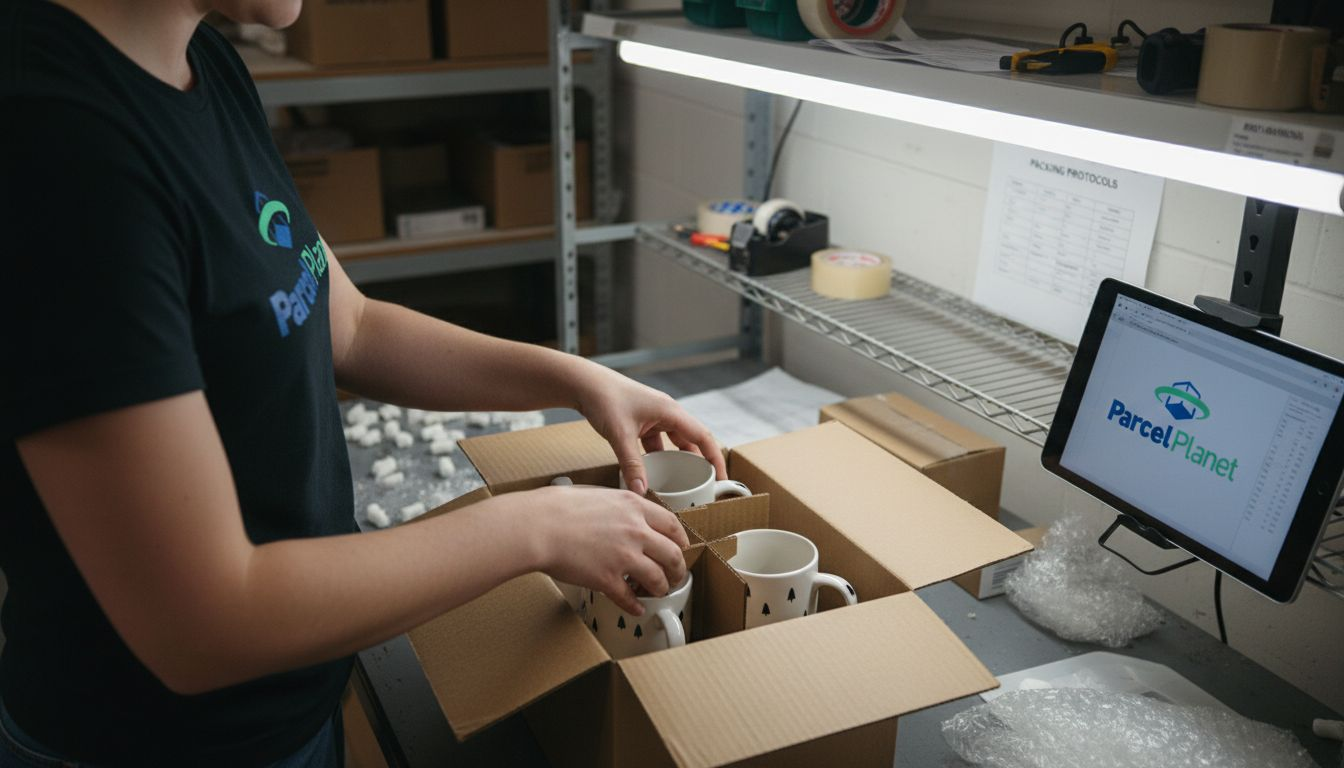
Poly mailers suit apparel, textiles and non-fragile goods where lightweight shipping drives cost savings. Poly mailers can reduce shipping package weight by up to 40% compared to boxes. These flexible envelopes resist moisture and tearing whilst occupying minimal space. Fashion brands and direct-to-consumer companies favour poly mailers for their low cost and branding flexibility. However, they offer limited protection for items requiring cushioning.
Bubble mailers balance protection with weight efficiency for small delicate items. The built-in bubble lining cushions products like jewellery, phone accessories and small electronics without the bulk of boxes. They cost more than standard poly mailers but less than corrugated boxes, creating a middle ground for moderately fragile goods.
Paper mailers represent the eco-friendly alternative for lightweight, non-fragile shipments. Made from recycled kraft paper, they decompose naturally and appeal to environmentally conscious consumers. Brands prioritising sustainability often choose paper mailers for apparel and soft goods, accepting slightly higher costs for environmental benefits. Customised packaging options exist across all these formats, enabling brand differentiation.
| Packaging Type |
Protection Level |
Cost Range |
Sustainability |
Best Use Cases |
| Corrugated boxes |
High |
Moderate to high |
Excellent (recyclable) |
Fragile items, multi-product orders, electronics |
| Poly mailers |
Low to moderate |
Low |
Poor (but recyclable options exist) |
Apparel, textiles, non-fragile goods |
| Bubble mailers |
Moderate to high |
Moderate |
Fair |
Small delicate items, jewellery, accessories |
| Paper mailers |
Low to moderate |
Moderate |
Excellent (biodegradable) |
Lightweight non-fragile goods, apparel |
Customisation and branding in packaging
Custom packaging transforms functional necessity into marketing opportunity, creating memorable unboxing experiences that drive customer loyalty. Customisation ranges from simple logo printing to elaborate embossing, custom tissue paper and branded inserts that tell your brand story.
Branded packaging can increase repeat purchase rates by up to 30% by enhancing perceived value and creating shareable social media moments. When customers photograph and post your distinctive packaging, you gain organic marketing reach that paid advertising cannot replicate. Premium unboxing experiences signal quality and attention to detail, justifying higher price points.
Customisation costs must balance against marketing benefits. Simple one-colour logo printing adds modest expense, whilst full-colour graphics, special finishes and custom structural designs significantly increase per-unit costs. MOQs for custom packaging typically start higher than stock options, requiring upfront investment that smaller brands may struggle to justify.
Sustainable branding uses eco-friendly materials and printing methods to align packaging aesthetics with environmental values. Water-based inks, recycled paperboard and biodegradable films let you create distinctive packaging without compromising sustainability commitments. This approach particularly resonates with younger consumers who scrutinise brands’ environmental practices.
Shipping using customised packaging requires coordination with your fulfilment operations to ensure consistent execution at scale. Custom inserts, tissue paper and thank-you cards add personal touches, yet they increase picking and packing time. Evaluate whether your operations can handle additional steps without slowing throughput.
Pro Tip: Test custom packaging with a limited run before committing to large MOQs. Customer feedback reveals whether enhanced packaging drives measurable loyalty gains.
Customisation considerations include:
- Printing techniques: digital, flexographic or lithographic
- Structural modifications: custom sizes, windows, inserts
- Finishing options: matte, gloss, embossing, foil stamping
- Branded materials: tissue paper, stickers, thank-you cards
- Environmental impact of customisation methods
Your shipping strategy workflow should integrate custom packaging decisions early to avoid fulfilment bottlenecks and ensure brand consistency across all customer touchpoints.
Selection criteria: MOQ, pricing, turnaround, and scalability
Logistical and financial factors often determine packaging feasibility more than product suitability. Understanding these constraints prevents costly mistakes and supply interruptions.
MOQs range from as low as 100 units to over 10,000 depending on vendor capabilities and customisation complexity. Startups need suppliers offering flexible minimums to test markets without tying up capital in excess inventory. As you grow, higher MOQs unlock better per-unit pricing, yet they require accurate demand forecasting to avoid obsolete packaging during product pivots.
Pricing transparency matters enormously. Request detailed quotes breaking down material costs, printing fees, tooling charges and shipping expenses. Some suppliers advertise low base prices but add hidden fees that inflate total costs. Compare quotes on a cost-per-unit basis after accounting for all charges to identify genuine value.
Digital printing turnaround times domestic 5 to 10 days; overseas production 21 plus days impacts your ability to respond to demand changes and seasonal spikes. Domestic suppliers cost more but deliver faster, reducing inventory risk. Overseas manufacturers offer lower prices yet require longer lead times and larger orders to justify shipping costs. Build buffer inventory to prevent stockouts during production cycles.
Scalability ensures your packaging solution grows with your business. Suppliers must handle increasing order volumes without compromising quality or delivery schedules. Test their capacity during peak seasons before committing long term. An ecommerce fulfilment checklist helps evaluate whether packaging suppliers align with your growth trajectory.
Planning packaging orders strategically for seasonal spikes prevents expensive rush orders and stockouts. Follow these steps:
- Forecast demand using historical data and market trends
- Place orders 6 to 8 weeks before peak seasons
- Maintain safety stock covering 2 to 3 weeks of average sales
- Establish backup suppliers for emergency capacity
- Review performance quarterly and adjust ordering patterns
Key questions to ask suppliers:
- What are your standard and minimum MOQs?
- Do you offer tiered pricing for volume increases?
- What are typical turnaround times for reorders?
- Can you scale production during seasonal peaks?
- What are your payment terms and rush order policies?
Advanced packaging technologies and automation in e-commerce
Technology innovation reshapes packaging operations, particularly for high-volume e-commerce brands seeking efficiency gains and competitive advantages. Automation can increase throughput by up to 25% and reduce downtime by 15% in packaging operations.
Automation encompasses filling machines, labelling systems and conveyor handling that eliminate manual steps and reduce labour costs. Automated packing stations measure products, select appropriate box sizes and apply shipping labels without human intervention. These systems work best for brands shipping hundreds or thousands of orders daily, where labour savings justify equipment investment.
Smart packaging adds QR codes, NFC tags and track-and-trace capabilities that enhance supply chain visibility and consumer engagement. Customers scan codes to verify authenticity, access product information or participate in loyalty programmes. You gain granular data on package location and condition throughout the fulfilment journey, enabling proactive issue resolution.
Reusable and circular packaging supports sustainability by eliminating single-use materials. Brands ship products in durable containers that customers return for cleaning and reuse. Subscription services and direct-to-consumer companies pioneering circular models report strong customer engagement, though logistics complexity increases significantly.
“Integration of automation in ecommerce logistics transforms packaging from a cost centre into a competitive advantage, reducing errors whilst accelerating fulfilment speed.”
Advanced technologies particularly benefit operations managing diverse SKUs and fluctuating order volumes. Automated systems adapt to different product dimensions and packaging requirements without manual reconfiguration. This flexibility lets you introduce new products or seasonal variations without operational disruptions.
Shipping optimisation tips include integrating packaging decisions with carrier selection and warehouse layout. Right-sized packaging reduces dimensional weight charges, whilst strategically placed packing stations minimise travel time for warehouse staff.
Smaller brands might wonder whether automation applies to their operations. Start with semi-automated solutions like label printers and tape dispensers before investing in full robotic systems. As order volumes grow, incremental automation additions build toward comprehensive systems without overwhelming capital requirements.
Key technologies to consider:
- Automated box erectors and filling systems
- Print-and-apply labelling machines
- Conveyor systems for package routing
- Smart packaging with embedded technology
- Reusable packaging programmes
Competing effectively means matching technology adoption to your operational scale. Even small e-commerce brands can compete with giants like Amazon by selectively implementing technologies that address specific bottlenecks.
Summary comparison of packaging solutions
This comparative overview consolidates key attributes across packaging formats, enabling quick evaluation of options against your specific requirements.
| Packaging Type |
Protection |
Cost per Unit |
Sustainability Score |
Typical MOQ Range |
Best Use Cases |
| Corrugated boxes |
Excellent |
£0.50 to £2.50 |
Excellent |
100 to 1,000 |
Fragile items, multi-product orders, premium goods |
| Poly mailers |
Fair |
£0.10 to £0.40 |
Fair |
500 to 5,000 |
Apparel, non-fragile goods, lightweight items |
| Bubble mailers |
Good |
£0.30 to £0.80 |
Fair |
250 to 2,500 |
Small delicate items, jewellery, accessories |
| Paper mailers |
Fair |
£0.20 to £0.60 |
Excellent |
500 to 3,000 |
Lightweight goods, sustainable brands, apparel |
| Custom corrugated |
Excellent |
£1.00 to £5.00 |
Good |
1,000 to 10,000 |
Branded experiences, subscription boxes, gifts |
| Reusable containers |
Excellent |
£3.00 to £10.00 |
Excellent |
100 to 1,000 |
Circular economy brands, high-value repeat shipments |
Protection levels reflect each format’s ability to safeguard products during transit and handling. Costs represent typical ranges in 2026 for North American suppliers, varying based on size, customisation and order volume. Sustainability scores consider recyclability, biodegradability and environmental manufacturing impact. MOQ ranges indicate typical minimum orders, though some suppliers offer greater flexibility.
This table helps you quickly gauge suitability by cross-referencing your product requirements, budget constraints and sustainability objectives against packaging capabilities. Use it as a starting framework, then dive deeper into specific suppliers matching your priority criteria.
Situational recommendations for e-commerce brands
Practical packaging choices vary dramatically based on business stage, product characteristics and brand values. These scenarios illustrate how to apply selection criteria to real situations.
Startups testing product-market fit should prioritise poly mailers or paper mailers with low MOQs. Stock packaging lets you iterate quickly without capital tied up in custom inventory. Choose suppliers offering 100 to 500 unit minimums and fast turnarounds, enabling rapid adjustments based on customer feedback. Accept standard branding initially, investing in customisation only after validating demand.
Fragile or high-value products demand corrugated boxes with custom inserts and cushioning materials. Electronics, cosmetics, glassware and premium goods require structural protection that justifies higher packaging costs. Design inserts that immobilise products during transit, preventing damage that leads to returns and negative reviews. Consider branded unboxing experiences for premium items where packaging reinforces perceived value.
Sustainability-driven brands must align packaging with environmental messaging to maintain customer trust. Choose FSC-certified materials, recycled content and biodegradable fillers that demonstrate genuine commitment. Communicate sustainability credentials on packaging and marketing materials, turning environmental responsibility into competitive advantage. Accept potentially higher costs as brand-building investments that attract loyal eco-conscious customers.
High-volume operations benefit from automation integration and standardised custom packaging that streamlines fulfilment. Invest in equipment that handles your most common box sizes and products, reducing manual labour whilst increasing accuracy. Negotiate volume pricing with suppliers and establish backup vendors to prevent disruptions. Your shipping strategy workflow should optimise packaging decisions across the entire fulfilment chain.
Key recommendations by scenario:
- Testing new products: stock packaging, low MOQs, flexible suppliers
- Scaling operations: volume pricing, automation readiness, backup suppliers
- Premium positioning: custom branding, quality materials, enhanced unboxing
- Environmental focus: certified materials, biodegradable options, transparent sourcing
- Multi-channel selling: standardised packaging across channels, platform integrations
Explore parcelplanet’s scalable logistics and fulfilment solutions
Selecting optimal packaging represents just one piece of effective e-commerce fulfilment. ParcelPlanet’s expert 3PL services integrate packaging strategy with warehousing, picking, packing and shipping to drive logistics efficiency across your entire operation.
Our order fulfilment solutions accommodate evolving packaging needs as you scale, handling everything from initial market testing through high-volume seasonal peaks. We understand that the role of a 3PL provider in reducing logistics costs extends beyond warehousing to strategic packaging decisions that optimise shipping costs and customer satisfaction.
Whether you’re evaluating 3PL vs 4PL fulfilment options or seeking to enhance existing operations, ParcelPlanet delivers tailored solutions matching your growth trajectory. Our order fulfilment services combine packaging expertise with operational excellence, enabling you to focus on building your brand whilst we handle logistics complexity.
Frequently asked questions
What is the best packaging solution for fragile e-commerce products?
Corrugated boxes with protective inserts offer the best protection for fragile items, cushioning products against impacts during transit. Custom foam or moulded pulp inserts immobilise contents, preventing damage that leads to costly returns and negative reviews. Bubble wrap or air pillows provide additional cushioning for particularly delicate items.
How do minimum order quantities affect packaging choices for startups?
Low MOQs enable startups to test packaging without excess cost or inventory risk, typically starting from 100 to 500 units depending on the supplier. Many suppliers offer tiered MOQs that let you start small and increase orders as demand grows. This flexibility prevents capital being tied up in packaging that might change as you refine products based on market feedback.
What sustainable packaging options exist for e-commerce brands?
FSC-certified paper mailers and recycled corrugated boxes are popular sustainable choices that maintain protection whilst reducing environmental impact. Biodegradable fillers like mushroom packaging or cornstarch peanuts further reduce waste compared to plastic alternatives. Water-based inks and minimal packaging designs also contribute to sustainability goals without compromising branding.
How can automation improve packaging efficiency in e-commerce fulfilment?
Automation increases throughput by eliminating manual steps in box assembly, product insertion, labelling and sealing processes. Automated systems reduce labour costs whilst decreasing downtime caused by human fatigue or errors. Smart packaging with embedded tracking adds traceability throughout the supply chain and enables interactive consumer engagement through QR codes and NFC tags.
Should I use domestic or overseas packaging suppliers?
Domestic suppliers offer faster turnarounds of 5 to 10 days and lower MOQs, ideal for brands needing flexibility and quick response times. Overseas manufacturers provide cost savings on large orders but require 21 plus day lead times and higher MOQs to justify shipping expenses. Balance cost savings against inventory risk and your ability to forecast demand accurately over longer production cycles.
Recommended