Effective peak season fulfilment is the difference between a Q4 that builds your brand and one that damages it. The process covers everything from inventory positioning and 3PL coordination to system readiness and customer communication during the highest-volume sales windows of the year. Black Friday, Cyber Monday, and the Christmas rush are not separate problems. They are the same operational challenges, compressed and amplified. The businesses that handle them well start preparing in July, not October.
The essential components of a successful peak season are:
- Demand forecasting grounded in last year’s sell-through data, adjusted for growth
- Inventory accuracy with buffer stock on your top SKUs and clear inbound schedules
- 3PL capacity agreements locked in 60–90 days before peak
- End-to-end system testing across your e-commerce platform, ERP, and warehouse management tools
- Staff readiness covering both warehouse and customer service teams
- Proactive customer communication with shipping deadlines published well in advance
- Contingency planning for carrier delays, weather disruption, and stock shortfalls
Parcelplanet works with growing e-commerce brands across the UK to provide scalable fulfilment solutions built around exactly these requirements.
Table of Contents
What makes peak season fulfilment so difficult?
Order volume spikes 3x to 5x above normal during peak weeks, and that surge exposes every weakness in your operations simultaneously. A warehouse that handles 400 orders per day in September can be overwhelmed at 1,200 to 2,000 per day in late November. The inventory system that barely coped in October fails completely when Black Friday hits.
The most common bottlenecks include:
- Inventory shortfalls caused by late purchase orders or supplier delays
- Carrier capacity constraints as major networks apply demand surcharges and reduce availability
- Staffing shortages when temporary recruitment is left too late
- Integration failures between your storefront, ERP, and fulfilment systems
- Communication breakdowns leaving customers without tracking updates or delivery estimates
Returns add further pressure. Retailers anticipate a 17% higher holiday return rate than their annual average, driven by gifting and sizing issues. Without a clear, extended return policy and a prepared reverse logistics workflow, the post-Christmas period becomes a second operational crisis.
“The biggest cause of peak season fulfilment failure is backend integration breakdown, particularly if order routing or fulfilment workflows are not tested end-to-end before volume surges.” — Operations experts cited by ScaleOps
The lesson is consistent: brands that invest in marketing but neglect their backend systems find that online sales only create problems they cannot fulfil their way out of.

Your step-by-step UK preparation timeline for 2026
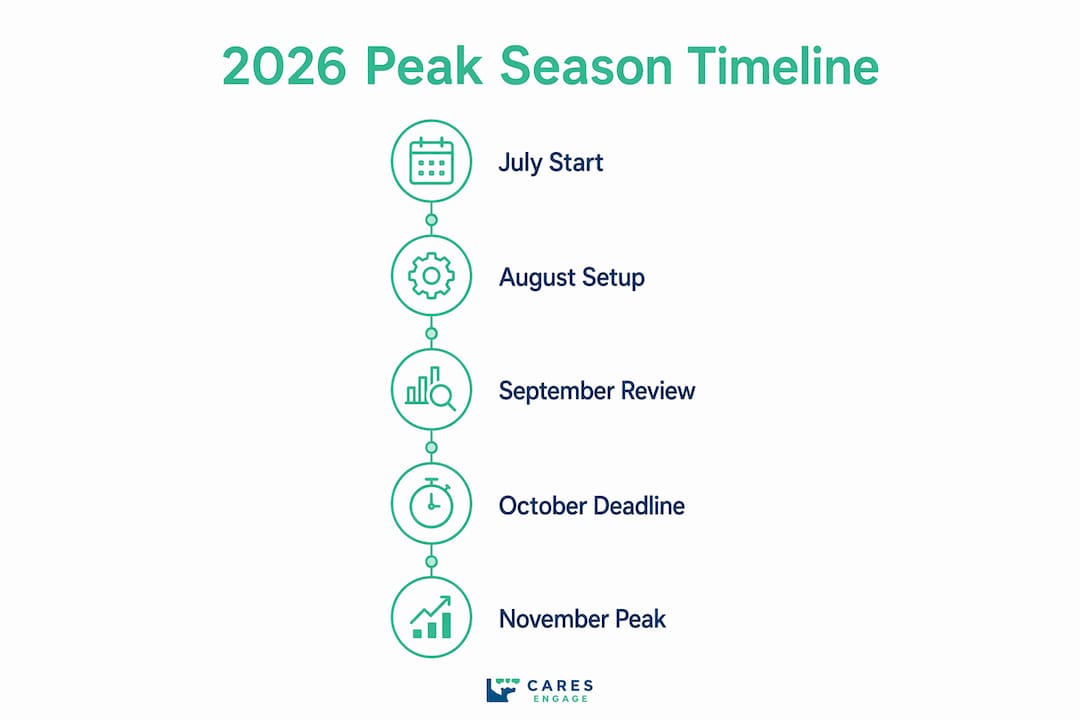
Starting operational groundwork in July and August gives brands a measurable competitive edge over those who begin in October. A phased preparation calendar keeps your team focused on the right priorities each month.
| Month |
Key activities |
| July |
Review last year’s results, audit fulfilment performance, set revenue targets |
| August |
Build demand forecast, segment SKUs, place first purchase orders |
| September |
Reserve 3PL inbound capacity, lock in carrier rates, refresh packaging |
| October |
Test all integrations, train support staff, position inventory at fulfilment centres |
| November |
Launch BFCM campaigns, monitor daily metrics, communicate shipping deadlines |
| December |
Hit carrier cut-off dates, manage exceptions, prepare returns workflows |
| January |
Process returns, run post-mortem, begin planning for next peak |
The numbered milestones that matter most:
- By 1 August: Complete your velocity analysis. Pull two years of Q4 sales data and identify your top 20% of SKUs by revenue.
- By 15 August: Finalise your demand forecast with a 15–20% buffer on top SKUs. Place purchase orders with suppliers.
- By 1 September: Provide your 3PL with week-by-week volume forecasts and inbound receiving schedules to secure staffing and dock capacity.
- By 1 October: Complete end-to-end integration testing under simulated peak load. Stress-test order routing at realistic volumes.
- Three weeks before peak: All inventory must be received, counted, and put away at your fulfilment centre. Inventory arriving during peak competes with outbound orders for dock time.
- 30 days before peak: Build your customer communication calendar with shipping deadlines, FAQ updates, and checkout page notices.
- 14 days before peak: Run a full readiness review with your 3PL. Confirm inventory status, carrier account setups, and escalation contacts.
UK-specific note: Royal Mail, DPD, and Evri all publish Christmas cut-off dates in October. Build your published delivery guarantees around those dates, with a conservative buffer to cover carrier delays.
Common peak season fulfilment mistakes and how to avoid them
Most peak season failures are predictable. The same five mistakes appear year after year, and each one is preventable with the right preparation.
- Insufficient forecasting buffers. Brands that forecast without a safety margin run out of bestsellers in early December. Apply a moderate buffer on your top SKUs and a 10% buffer on the rest. Brands that position Q4 inventory early convert 18% better than those sending replenishments in November.
- Skipping system stress tests. Order routing rules that work at 200 orders per day can break at 800. Test your full fulfilment path, including split orders, backorders, and returns, before peak begins.
- Poor 3PL communication. Sending your 3PL a volume forecast in late October is too late. Formal capacity discussions need to happen 60–90 days out, with week-by-week projections and inbound schedules.
- Reactive customer messaging. Waiting until orders are delayed to communicate with buyers generates support tickets and damages trust. Publish shipping deadlines on your homepage, checkout page, and order confirmations at least 30 days before peak.
- Last-minute staffing. Temporary warehouse and customer service staff need time to train. Leaving recruitment until November means undertrained teams handling your busiest days.
Pro Tip: Your backend systems need as much attention as your marketing campaigns. A perfectly executed Black Friday promotion that overwhelms an untested order routing system will cost you more in customer service and refunds than the campaign generated in revenue.
How 3PL providers help you handle peak demand
A third-party logistics provider gives you access to capacity, expertise, and infrastructure that would take years to build in-house. During peak season, that access becomes the deciding factor between smooth fulfilment and operational breakdown.
The core advantages of a 3PL partnership during peak periods include:
- Flexible warehousing capacity that scales with your order volume without long-term fixed costs
- Experienced pick-and-pack teams already trained and ready to handle volume surges
- Established carrier relationships with negotiated rates and priority access during constrained periods
- Advanced tracking and integration capabilities connecting your storefront to the warehouse in real time
- Specialist packaging options including gift wrapping, branded tissue paper, and promotional inserts
“3PLs that have not received your volume projections will allocate capacity to clients who gave them advance notice. The brands that get prioritised during peak are the ones that had the capacity conversation 60 to 90 days out and gave their operations team real numbers to plan against.” — ScaleOps peak season guide
To get the most from your 3PL partnership, provide a formal pre-season briefing covering your week-by-week units-per-day projections, your inbound receiving schedule, any special handling requirements, your priority SKU list, and a direct contact for your operations team during peak. Get written confirmation of their SLA for peak processing times. A 3PL that ships same-day in September may move to a 24–48-hour processing window in November. Knowing this in advance lets you set accurate delivery expectations at checkout.
For guidance on managing seasonal order spikes with a 3PL partner, Parcelplanet has published a detailed operations guide covering Black Friday and Cyber Monday preparation.
Signs your in-house fulfilment can’t keep up
Growing e-commerce businesses often hold on to in-house fulfilment longer than the operation can support. The warning signs are usually visible months before a crisis point.
- Recurring order delays during busy periods, even before peak season begins
- Rising error rates on picks and packs as order volume increases
- Inventory management complexity that your current system cannot handle accurately
- Operational costs climbing faster than revenue, driven by overtime and emergency courier spend
- Inability to scale your warehouse team quickly when volume spikes
- Customer service queues dominated by “where is my order” tickets
The risk of ignoring these signals is not just a bad peak season. It is customer churn, negative reviews, and lost revenue that takes months to recover. Many UK e-commerce brands find that a hybrid model works well: handling standard volume in-house while routing peak overflow to a 3PL. Others move to full outsourcing once their order volume crosses a threshold their warehouse cannot absorb. Periodic capacity reviews ahead of each peak season help you make that decision before it becomes urgent.
How AI and automation improve peak season operations
Technology has changed what is possible during peak season, particularly for brands that previously relied on manual processes and spreadsheets.
- AI-driven demand forecasting analyses historical sales data, seasonal patterns, and growth rates to generate more accurate inventory plans than manual methods
- Automated low-stock alerts flag when a top SKU drops below a set threshold, giving you time to reorder before a stockout occurs
- Order routing automation selects the optimal fulfilment source based on inventory availability, customer location, and carrier cut-off times
- Real-time inventory syncing across your e-commerce platform, ERP, and warehouse management system prevents oversell events during demand surges
- Automated customer notifications at every order stage reduce “where is my order” tickets without manual intervention
- Predictive carrier analytics identify slow lanes or backed-up routes before delays reach your customers
Automation across inventory alerts, order routing, and customer communications reduces manual errors and improves throughput during peak periods. Tools like NetSuite Inventory Management use demand-based replenishment to dynamically manage reorder points using historical and seasonal sales data. For rate management across carriers, platforms like Logivo support split shipment decisions and backorder processing during high-volume periods.
The integration layer connecting your storefront, ERP, and 3PL is where most peak season technology failures occur. Load-test that layer, not just your website front end, before November arrives.

How Parcelplanet supports your peak season
When your order volume doubles or triples and your current setup cannot keep pace, outsourcing to a specialist 3PL is the most direct route to a peak season your customers will not notice.
Parcelplanet provides tailored order fulfilment services for UK e-commerce and omnichannel brands, covering warehousing, picking and packing, shipping, and real-time order tracking. The platform integrates directly with major e-commerce platforms and courier networks, so your orders flow from storefront to customer without manual intervention. Unlike building warehouse capacity in-house, Parcelplanet scales with your volume, meaning you pay for what you need during peak without carrying fixed costs year-round.
For brands preparing for Black Friday, Cyber Monday, or the Christmas rush, Parcelplanet’s team works with you ahead of peak to agree capacity, handling requirements, and SLAs. You get a fulfilment partner that is ready when your busiest weeks arrive. Get in touch with Parcelplanet to discuss your peak season fulfilment requirements and receive a tailored quote.
Key takeaways
Effective peak season fulfilment depends on starting early, testing thoroughly, and communicating clearly with both your 3PL and your customers before volume surges.
| Point |
Details |
| Start planning in July |
Brands that complete operational groundwork in July and August outperform those who begin in October. |
| Inventory must arrive early |
All stock should be received and put away at your fulfilment centre at least three weeks before peak begins. |
| 3PL briefings need 60–90 days |
Provide week-by-week volume forecasts and inbound schedules to secure capacity and avoid deprioritisation. |
| Test systems before November |
Load-test your order routing and integrations under simulated peak volume to prevent queue backlogs and data gaps. |
| Parcelplanet scales with you |
Parcelplanet offers tailored 3PL fulfilment for UK e-commerce brands, with integrations and capacity built for peak demand. |
Recommended