TL;DR:
- Slow delivery impacts customer loyalty, reviews, and revenue in e-commerce.
- Optimizing workflows and leveraging technology can greatly speed up order fulfillment.
- Strategic warehouse placement and clear communication enhance overall delivery speed and customer trust.
Slow deliveries are quietly damaging your e-commerce business. Research consistently shows that customers who experience late or delayed orders are far less likely to return, and many will leave a negative review before you even have a chance to respond. In a market where next-day and same-day delivery are increasingly the norm, falling behind on fulfilment speed is not just an inconvenience. It is a direct threat to your revenue and reputation. This guide walks you through practical, proven steps to improve your delivery speed using smarter processes, technology, and third-party logistics (3PL) partnerships.
Table of Contents
Key Takeaways
| Point |
Details |
| Map current workflow |
Identifying bottlenecks is the essential first step in speeding up your delivery process. |
| Adopt warehouse automation |
Automation like WMS, pick-to-light, and conveyor systems significantly boost fulfilment speed and accuracy. |
| Implement distributed inventory |
Placing inventory in multiple localised warehouses shortens shipping times and lowers costs. |
| Continually optimise shipping |
Review carrier contracts and packaging regularly for ongoing gains in cost and speed. |
Assess and optimise your current delivery workflow
Before you invest in new systems or partnerships, you need to understand where time is actually being lost. Most e-commerce businesses assume their slowdowns happen during shipping, but the reality is often quite different. Bottlenecks frequently occur much earlier in the process, during picking, packing, and order processing.
Common workflow bottlenecks include:
- Manual order entry that delays processing by hours
- Poor warehouse layout forcing staff to travel unnecessarily long distances
- Disconnected inventory systems causing stock discrepancies and reprocessing
- Insufficient staffing during peak periods, leading to backlogs
- Lack of real-time visibility into stock levels and order status
To get a clear picture of your performance, compare your current metrics against optimised benchmarks.
| Metric |
Current average |
Optimised target |
| Pick time per order |
8-12 minutes |
2-4 minutes |
| Order accuracy rate |
92% |
99%+ |
| Average ship time |
2-3 days |
Same or next day |
| Returns processing time |
5-7 days |
1-2 days |
Once you have your numbers, it becomes clear where to focus. A fulfilment operations checklist can help you systematically audit each stage of your process. Automation enhances picking accuracy and speed, and a warehouse management system (WMS) provides real-time visibility into every stage of your operation. Reviewing your warehouse management tips alongside your workflow data gives you a solid foundation for improvement.
Pro Tip: Map the full customer journey from the moment an order is placed to the moment it arrives at the door. This exercise often reveals hidden slowdowns, such as delays in carrier handover or late-night order cut-offs, that internal metrics alone do not capture.
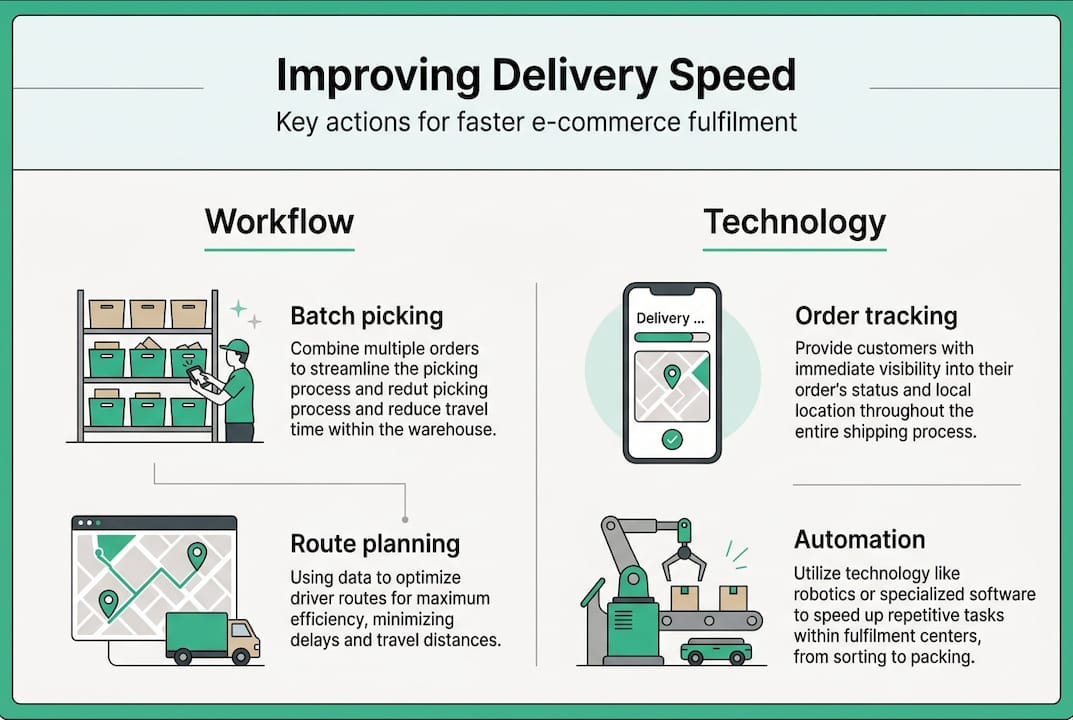
Quick wins to consider immediately include consolidating your picking routes, introducing batch picking for high-volume SKUs, and setting up automated order confirmation triggers. These changes require minimal investment but can shave meaningful time off each order cycle. Pair these with a structured warehouse optimisation review to ensure your layout supports the volume you are targeting.
Leverage technology and automation for faster fulfilment
Once you have pinpointed your bottlenecks, the next step is applying the right technology to eliminate them. Modern fulfilment centres rely on a layered approach to automation, starting with a solid WMS and building upward from there.
Here is how manual and automated picking processes compare:
| Factor |
Manual picking |
Automated picking |
| Speed |
60-80 picks per hour |
200-400 picks per hour |
| Error rate |
1-3% |
Less than 0.5% |
| Scalability |
Limited by headcount |
Scales with volume |
| Cost over time |
Increases with growth |
Reduces per-unit cost |
Leveraging technology like WMS, pick-to-light, and conveyor systems reduces errors, increases throughput, and speeds up picking and packing across all order volumes. The automation in logistics landscape has matured significantly, meaning even growing brands can access enterprise-grade tools without enterprise-grade budgets.
A practical implementation approach for businesses at different stages:
- Start with a cloud-based WMS. This gives you real-time inventory visibility and order routing without requiring physical infrastructure changes.
- Introduce pick-to-light systems. Light-directed picking guides warehouse staff to the correct locations, dramatically reducing errors and pick times.
- Add conveyor and sorting systems. Once order volumes justify it, conveyor systems move goods from pick stations to packing areas without manual handling.
- Integrate your sales channels. Connect your WMS to your e-commerce platforms so orders flow directly into the fulfilment system without manual input.
- Review and refine. Set monthly benchmarks and measure your technology’s impact against the metrics you established during your workflow audit.
Pro Tip: Resist the temptation to invest in advanced robotics before your foundational systems are solid. A scalable WMS integrated with your sales platforms will deliver far greater results in the short term, and it provides the data infrastructure that more advanced automation requires later. The fulfilment automation benefits compound over time when the basics are in place first.
Strategic inventory and warehouse placement
Technology alone cannot overcome geography. If your warehouse is located far from your primary customer base, even the fastest fulfilment operation will be undermined by long transit times. This is where strategic inventory placement becomes critical.

Distributed fulfilment, storing stock across multiple warehouse locations closer to end customers, is one of the most impactful changes a growing e-commerce brand can make. Rather than shipping every order from a single central location, you position inventory regionally so that orders are always dispatched from the nearest fulfilment point.
Strategic inventory placement in distributed fulfilment centres near customers reduces shipping zones and transit times, often cutting delivery times by one to two days without any changes to carrier relationships. Brands that move from a single centralised warehouse to a distributed network typically see a 20 to 40 per cent reduction in average transit times, depending on their customer geography.
When selecting warehouse locations for a distributed fulfilment network, consider:
- Proximity to your highest-order-density postcodes
- Access to motorway and transport links for fast carrier collection
- Local carrier availability and their service level agreements
- Cost per square foot balanced against the transit time savings achieved
- Scalability of the facility to accommodate seasonal volume increases
Inventory zoning within each warehouse also matters. Grouping your fastest-moving SKUs closest to packing stations reduces internal travel time and speeds up each individual pick. Pair this with a smart shipping strategy workflow and you create a seamless path from order placement to despatch.
Pro Tip: You do not need to own multiple warehouses to benefit from distributed fulfilment. Partnering with a 3PL provider that already has a network of locations lets you expand your geographic reach quickly and cost-effectively, without the capital investment of setting up your own sites. This is one of the fastest routes to reduce fulfilment costs while simultaneously improving delivery speed.
Optimise shipping, packaging and cost for maximum speed
Effective warehouse strategies set the stage, but delivery speed is ultimately won or lost in the final steps. Carrier selection, packaging decisions, and cost management all play a direct role in how quickly an order reaches your customer.
Start by reviewing your carrier contracts using these steps:
- Audit your current carrier performance. Review on-time delivery rates, damage rates, and cost per zone across all carriers you use.
- Benchmark against the market. Use your volume data to approach alternative carriers and request competitive quotes.
- Negotiate based on volume commitments. Carriers offer better rates and priority service to businesses that can guarantee consistent volumes.
- Diversify your carrier mix. Relying on a single carrier creates risk. Having two or three active carrier relationships ensures continuity when one experiences delays.
- Use data-driven route optimisation tools to automatically assign orders to the fastest and most cost-effective carrier for each delivery zone.
Proactive cost management through negotiating carrier contracts and optimising packaging to reduce dimensional weight charges is one of the most frequently overlooked levers available to e-commerce brands. Dimensional weight (the calculation carriers use to charge based on package volume rather than actual weight) can significantly inflate your shipping costs if packaging is not carefully matched to product dimensions.
Packaging practices that support faster, more reliable delivery:
- Use the smallest appropriate box or mailer for each product type
- Stock a range of packaging sizes to avoid void fill that adds weight and bulk
- Pre-kit bundled products to reduce packing time per order
- Label packaging clearly and consistently to reduce carrier sorting errors
- Invest in packaging that protects products adequately to avoid returns
Optimising logistics with data lets you track which packaging configurations generate the fewest carrier surcharges and which shipping optimisation tips drive the best on-time delivery performance for each region.
What most e-commerce brands miss about delivery speed
After working with numerous e-commerce businesses on their fulfilment operations, we have observed a consistent pattern. Brands invest heavily in warehouse technology and carrier contracts, then wonder why their customer satisfaction scores do not improve as expected. The missing piece is almost always communication.
Delivery speed matters. But customers are surprisingly tolerant of reasonable delivery windows when they are kept informed. A two-day delivery with proactive tracking updates and clear communication feels faster than a next-day delivery where the customer has no idea what is happening. Speed without visibility leaves customers anxious, and anxiety creates complaints.
The brands that sustain delivery improvements long-term treat logistics as an end-to-end customer experience, not just an operational metric. They invest in integrating logistics systems so that tracking data flows seamlessly from the warehouse to the customer’s inbox without manual intervention. They review their performance consistently, not just during crisis points. And they build partnerships, with 3PL providers, carriers, and technology vendors, that allow them to adapt as their business evolves. Speed is the goal. Trust is what makes it last.
Take your e-commerce delivery speed further with expert solutions
If you are ready to put these methods into practice, working with a specialist 3PL partner can significantly accelerate your results. ParcelPlanet provides tailored order fulfilment services designed for growing e-commerce and omnichannel brands, covering everything from picking and packing to real-time tracking and returns management.

Our warehousing and distribution solutions give your business access to strategically located facilities without the overhead of managing your own sites. Combined with our logistics software integration capabilities, your sales channels connect directly to our fulfilment operation for seamless, fast despatch. Get in touch with our team today to discuss a tailored solution for your business.
Frequently asked questions
What is the most effective way to speed up e-commerce deliveries?
The combination of warehouse automation, WMS, and pick-to-light systems alongside distributed inventory placement delivers the fastest improvement for most e-commerce brands.
How can inventory placement affect delivery speed?
Locating stock in distributed centres closer to your customers cuts shipping distances, reducing transit times and overall delivery costs significantly.
Should I invest in pick-to-light and conveyor systems?
Yes. Pick-to-light and conveyor systems enhance picking speed and accuracy, particularly as your order volumes grow and manual processes begin to create bottlenecks.
How can I reduce the cost impact of fast shipping?
Negotiate carrier contracts and optimise packaging to minimise dimensional weight charges while maintaining the delivery speed your customers expect.
Recommended


