TL;DR:
- Planning and locking supplier and carrier agreements by August are essential for a successful Q4. Completing strategic planning by September and positioning inventory mid-October ensure readiness for peak season demands. Testing operations in lower-volume months helps prevent costly disruptions during the busiest shopping period.
Secure your supplier orders by August, lock carrier capacity agreements before early August, and complete all strategic planning by 1 September. Those three actions determine whether your Q4 runs on your terms or the market’s. Q4 accounts for a significant portion of annual retail sales, and brands that delay capacity commitments face punishing spot rates and degraded delivery SLAs when November arrives. The window to act is shorter than most operations teams realise.
Hard deadlines at a glance:
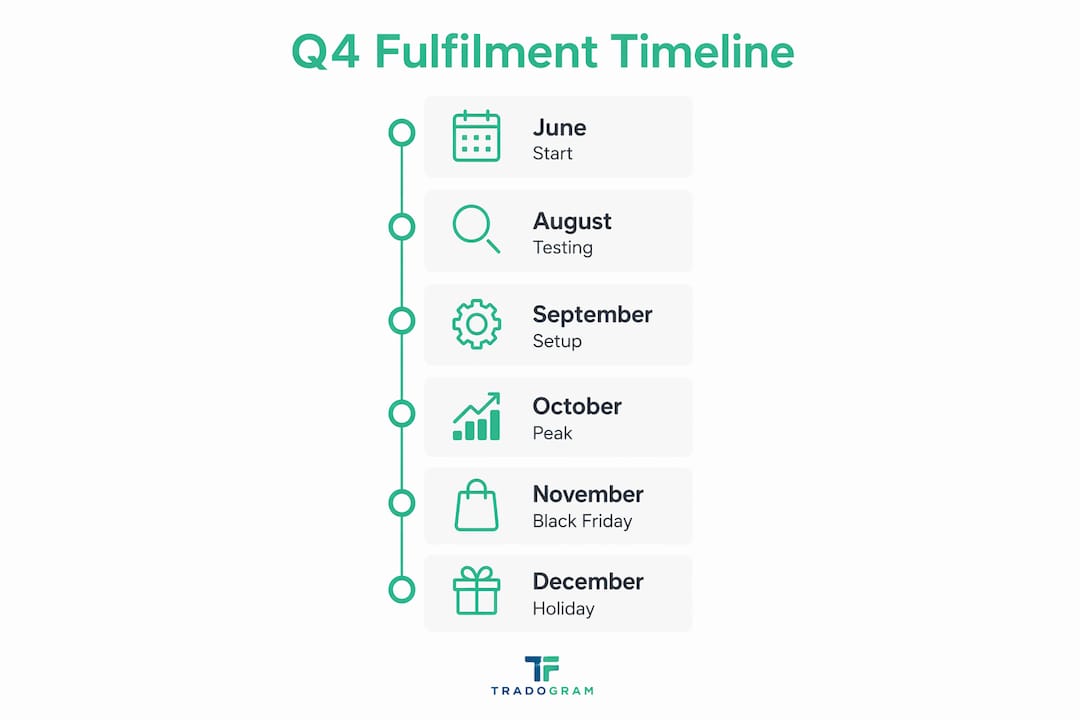
- Q2 (April–June): Begin supplier conversations, audit carrier mix, seed marketing calendars
- July: Open formal carrier rate negotiations; start inventory forecasting with SKU-level data
- August: Place final supplier orders; lock carrier volume commitments; begin automation tests
- 1 September: All strategic planning complete; no major pivots after this date
- Mid-October: All inventory positioned in fulfilment nodes before peak demand arrives
- November–December: Execution only
Risk if you delay: Spot market carrier rates spike sharply during peak season, and shipment volumes can surge substantially above forecast. Brands without committed capacity absorb both the cost and the SLA damage.
Table of Contents
What does a month-by-month Q4 planning timeline look like?
Starting Q4 infrastructure work in late June is the minimum viable position. By the time September arrives, you should be executing, not deciding.
| Month |
Priority actions |
| April–May |
Audit last year’s OTIF, order accuracy, and returns data; identify SKU velocity trends |
| June |
Begin supplier conversations; seed Q4 ad campaigns; review warehouse layout and staffing model |
| July |
Formal carrier negotiations (Royal Mail, DPD, DHL and regional carriers); inventory forecasting with marketing calendar overlay |
| August |
Place final supplier orders; lock carrier rate agreements; run automation and integration tests |
| 1 September |
Strategic planning complete; hand off to ops execution |
| October |
Receive and position all inventory; complete staffing ramp; finalise returns packaging |
| November |
Peak execution; daily KPI monitoring; activate contingency protocols if needed |
| December |
Execution and performance review; draft budget inputs by mid-November |
Do not miss these dates:
- Supplier order cutoff: August (non-negotiable for UK importers)
- Carrier rate lock: early August
- Planning sign-off: 1 September
- Inventory in nodes: mid-October
Pro Tip: Use August, while volumes are lower, to run end-to-end carrier waterfall tests. Send real orders through each carrier tier and measure transit times, label accuracy, and exception rates before peak demand exposes any gaps.
How do you forecast inventory and set safety stock for Q4?
Accurate seasonal inventory management starts with SKU-level velocity data, not category-level assumptions. Pull the last two years of daily sales by SKU, overlay your confirmed marketing calendar, and build at least two scenarios: a base case and a +15% upside.
Forecasting checklist:
- Pull 24 months of SKU-level sales data; weight the most recent Q4 more heavily
- Overlay confirmed promotional dates (Black Friday, Cyber Monday, Christmas cut-offs)
- Stress-test against a +15% volume scenario for your top 20 SKUs
- Calculate safety stock using: (maximum daily demand × maximum lead time) minus (average daily demand × average lead time)
- Set reorder points that trigger before the August supplier cutoff
For UK importers, account for Golden Week and supplier diversification risks when calculating lead times. A factory shutdown in October can leave you short in November if your reorder point assumes a standard 30-day lead time.
Stock positioning: Split inventory across multiple fulfilment nodes. Distributed networks reduce transit times and cut regional stockout risk, particularly for brands serving both mainland UK and Ireland.
How do you secure carrier capacity and control peak surcharges?
Carrier peak surcharge schedules are finalised early, and the difference between a committed rate and a spot rate during November can be substantial. Audit your current carrier mix in July, then open formal negotiations before early August.
Immediate carrier actions:
- Audit current carrier performance: on-time rate, damage rate, cost per zone
- Negotiate volume commitments with primary carriers (Royal Mail, DPD, DHL) before early August
- Agree tiered surcharge caps where possible; get peak rate schedules in writing
- Identify one or two regional carriers as secondary options for overflow or cost arbitrage
- Build a carrier waterfall: primary carrier by zone and SLA, secondary for overflow, tertiary for emergency
A carrier waterfall assigns orders to the most cost-effective carrier that can meet the SLA for that zone. For example: next-day domestic orders route to your primary carrier; standard 2–3 day orders route to a regional carrier at a lower rate; international orders route to DHL or an equivalent. Test this logic in August, not November.
Pro Tip: Negotiate a separate returns contract at the same time as your outbound agreements. Returns volumes spike in January, and a pre-agreed returns rate protects margin when you are least able to absorb ad hoc costs.

Are your operations ready to scale for peak season?
Staffing and materials procurement are the two areas most likely to fail under pressure, and both require longer lead times than most managers budget for. Treat August and September as your rehearsal window.
Staffing checklist:
- Confirm permanent headcount requirements based on forecast volume
- Agree flexible or temporary staffing arrangements with agencies by August
- Schedule training for new staff before October
- Build surge rosters for Black Friday week and the pre-Christmas cut-off period
- Assign a named escalation contact for each shift during peak weeks
Packing and materials:
- Order packaging materials and labels in September at the latest; suppliers face their own Q4 capacity constraints
- Pre-kit high-volume SKUs where possible to reduce pick/pack time per order
- Audit warehouse layout for peak throughput: pick paths, packing stations, and despatch staging
Automation and integration tests (August–September):
- Run end-to-end order flows through your eCommerce platform integrations (Shopify, WooCommerce, Amazon, eBay)
- Test rate-shopping logic under simulated peak volumes
- Validate returns portal automation and label generation
- Confirm real-time tracking feeds are live and accurate
When does outsourcing to a 3PL make sense for Q4?
Three signals suggest it is time to consider a 3PL partner: your warehouse is at capacity during peak, you are expanding into new geographies (Ireland, EU), or your in-house carrier mix cannot cover the SLAs your customers expect. If any of those apply, evaluating a 3PL vs in-house model now gives you enough lead time to onboard before October.
3PL benefits for Q4:
- Scalable pick and pack capacity without fixed headcount costs
- Pre-negotiated carrier rates across Royal Mail, DPD, DHL, and regional networks
- Multi-node inventory positioning to cut transit times across UK and Ireland
- Returns management with automated approvals and pre-stocked packaging
- Direct integrations with Shopify, WooCommerce, Magento, Amazon, and eBay
Typical onboarding timeline with Parcelplanet:
| Phase |
Duration |
Key activities |
| Discovery and setup |
1–2 weeks |
SKU mapping, platform integration, SLA agreement |
| Test inbound |
1 week |
Sample stock received, pick/pack tested, tracking validated |
| Live go-live |
Week 3–4 |
Full volume transferred; daily reporting active |
Brands that complete onboarding by mid-September have a full month to run at live volume before Black Friday. That buffer is where peak season fulfilment confidence is built.
What contingency plans should you have in place before peak?
Contingency checklist:
- Identify a backup carrier for each primary carrier in your waterfall
- Agree overflow fulfilment terms with a secondary 3PL or Parcelplanet before October
- Define safety stock drawdown rules: at what stock level do you trigger emergency reorders?
- Pre-stock return packaging at your fulfilment node before November
Returns flow (step by step):
- Customer initiates return via automated portal
- System checks eligibility against pre-set rules (value, condition, return window)
- Approved returns receive a pre-paid label automatically
- Item received at returns node; condition assessed and restocked or quarantined
- Refund or exchange triggered within agreed SLA
Automated returns can handle 70–80% of requests without manual intervention, which protects your customer service team’s capacity during the busiest weeks. Set a separate returns SLA and communicate it clearly on your website before peak season begins.
Escalation roster: Name one owner for carrier escalations, one for supplier issues, and one for customer service triage. Distribute contact details to all relevant teams before 1 November.
Which KPIs should you monitor in real time during Q4?
| KPI |
Definition |
Target threshold |
Alert owner |
| OTIF (On Time In Full) |
Orders delivered on time and complete |
— |
Operations manager |
| Order accuracy |
Orders picked and packed without error |
— |
Warehouse manager |
| Average transit time |
Days from despatch to delivery |
Within agreed SLA |
Carrier manager |
| Returns rate |
Returns as % of orders despatched |
Monitor vs prior Q4 baseline |
Operations manager |
| Carrier on-time rate |
% of shipments delivered within SLA by carrier |
— per carrier |
Carrier manager |
| Warehouse throughput |
Orders processed per hour per station |
Against forecast |
Warehouse manager |
Reporting routine:
- Daily: OTIF, order accuracy, and throughput during peak weeks (Black Friday to Christmas cut-off)
- Weekly: Carrier on-time rate, returns rate, inventory levels vs forecast
- Bi-weekly: Full KPI review with operations, commercial, and customer service leads
Alert thresholds should trigger an immediate escalation to the named owner, not a weekly review. If OTIF drops below 90% on any single day, treat it as a live incident.
Pre-peak checklist and action owner table
Final checklist (complete before 1 November):
- [ ] Supplier orders placed and confirmed (owner: Procurement; deadline: August)
- [ ] Carrier rate agreements signed (owner: Operations; deadline: early August)
- [ ] Strategic planning signed off (owner: Commercial lead; deadline: 1 September)
- [ ] Inventory received and positioned in fulfilment nodes (owner: Warehouse manager; deadline: mid-October)
- [ ] Staffing ramp complete and surge rosters confirmed (owner: HR/Operations; deadline: October)
- [ ] Packaging and labelling materials in stock (owner: Procurement; deadline: September)
- [ ] All integrations and automation tested (owner: Tech/Operations; deadline: September)
- [ ] Returns portal live and tested (owner: Tech; deadline: October)
- [ ] Contingency carriers and overflow agreements confirmed (owner: Operations; deadline: October)
- [ ] KPI dashboards live and alert thresholds set (owner: Operations manager; deadline: 1 November)
| Action |
Owner |
Deadline |
| Supplier orders placed |
Procurement |
August |
| Carrier agreements signed |
Operations |
Early August |
| Strategic planning complete |
Commercial lead |
1 September |
| Inventory in nodes |
Warehouse manager |
Mid-October |
| Integrations and automation tested |
Tech/Operations |
September |
| Returns portal live |
Tech |
October |
| KPI dashboards and alerts active |
Operations manager |
1 November |
For workflow templates and a shipping strategy framework your ops team can use directly, Parcelplanet’s resource library covers the key planning documents.
Key takeaways
Effective Q4 fulfilment planning requires supplier orders placed by August, strategic planning complete by 1 September, and all inventory positioned in fulfilment nodes before mid-October.
| Point |
Details |
| August is the hard cutoff |
Place all supplier orders by August to guarantee inventory arrives before mid-October peak. |
| Plan by 1 September |
All strategic decisions must be finalised before September; December is for execution only. |
| Test carriers in August |
Run carrier waterfall tests during lower-volume months to expose gaps before Black Friday. |
| Monitor OTIF daily in peak |
Target — OTIF; treat any single-day drop below 90% as a live incident requiring immediate escalation. |
| Parcelplanet as Q4 partner |
Parcelplanet’s multi-node fulfilment, courier integrations, and 3–4 week onboarding timeline make it a practical Q4 option for brands at capacity. |
The mistake most e-commerce teams make with Q4 preparation
The single most common operational error is treating Q4 as a planning problem rather than an execution problem. Teams spend September finalising strategies that should have been locked in July, which means October becomes a scramble and November becomes a firefight.
The brands that handle peak season well are not necessarily the ones with the largest warehouses or the most carriers. They are the ones that used June, July, and August to test everything: carrier waterfalls, integration flows, returns portals, and staffing rosters. By the time Black Friday arrives, there is nothing left to decide. Every threshold is set, every escalation owner is named, and every backup carrier is contracted.
The quieter summer months are genuinely the most valuable time in the logistics calendar. Use them to stress-test your systems, build carrier relationships, and validate your forecasting assumptions. Q4 should feel like a controlled execution of a plan you made months ago, not a series of reactive decisions under pressure.
Parcelplanet’s Q4 fulfilment support for growing brands
Brands that have outgrown their in-house fulfilment capacity or need multi-node coverage across the UK, Ireland, and the EU have a practical alternative in Parcelplanet. Rather than absorbing the fixed costs of additional warehouse space and headcount, you get scalable pick and pack capacity, pre-negotiated rates with Royal Mail, DPD, and DHL, and direct integrations with Shopify, WooCommerce, Magento, Amazon, and eBay.

Onboarding takes three to four weeks from discovery to live go-live, which means brands that start conversations now can be fully operational before mid-October. Parcelplanet handles warehousing, picking, packing, shipping, returns management, and real-time tracking across all channels, so your operations team focuses on growth rather than logistics firefighting. To discuss your Q4 capacity requirements and get a tailored quote, visit Parcelplanet’s order fulfilment services page and request a consultation.
Useful sources and further reading
- Q4 Fulfilment Strategy: Maximising Holiday Success — Qualfon
- LM Reader Survey: 2026 Peak Season Outlook — SupplyChain247
- How to Prepare Your E-commerce Business for Q4 — Ecommerce Times
- How Logistics Businesses Can Prepare for Year-End Delivery Surges — Xendit
- 2026 Logistics Planning: What Importers Must Prepare For — Cubic
- Proactive Year-End Strategies for Warehouses — Honeywell
- Parcelplanet: Peak Season Fulfilment Guide
- Parcelplanet: Handling Seasonal Order Spikes
Recommended

