TL;DR:
- Courier accounts provide negotiated shipping rates, credit billing, and operational tools that improve logistics efficiency for high-volume e-commerce sellers. They enable seamless integration with marketplaces and OMS, automating labeling, scheduling, and tracking to reduce errors and enhance customer experience. Using multi-carrier platforms increases resilience, reduces failed deliveries, and optimizes operational performance.
A courier account is a formal business arrangement that gives sellers negotiated shipping rates, credit billing terms, and dedicated operational tools that retail shipping simply cannot match. For e-commerce sellers shipping 50 or more parcels monthly, these accounts are the foundation of efficient logistics. They connect directly with order management systems (OMS) and marketplaces such as Amazon, reducing manual work at every stage. The result is faster dispatch, fewer errors, and a delivery experience that keeps customers coming back.
What is the role of courier accounts for sellers?
Courier accounts are purpose-built for businesses, not occasional shippers. Business courier accounts offer negotiated rates 20–40% below retail pricing, alongside monthly credit billing with 15–30 day payment terms. That combination directly reduces two of the biggest friction points in e-commerce logistics: cost and cash flow. Sellers gain a pricing structure that scales with volume, rather than paying full retail on every consignment.

The operational tools bundled with these accounts go well beyond discounts. Automated label generation, COD (cash on delivery) reconciliation, and dedicated pickup scheduling all reduce the manual workload on warehouse teams. Integration with platforms like Amazon, Flipkart, and Myntra means order data flows directly into the shipping workflow without re-keying. Sellers using courier services at this level are not just saving money. They are building a more reliable, repeatable fulfilment operation.
What benefits do courier accounts offer beyond cost savings?
The financial benefits are real, but the operational gains are where courier accounts genuinely change day-to-day business. Monthly credit billing with 15–30 day terms improves cash flow efficiency, which is particularly valuable for sellers managing high volumes of COD orders. Switching from prepayment to credit terms frees up working capital that would otherwise be tied up in shipping costs before revenue arrives.
Warehouse operations benefit directly from pickup consistency secured through negotiated contracts. Predictable collection times and repeat drivers mean teams can plan packing schedules with confidence. This matters more than most sellers realise. A missed or late pickup creates a cascade of delays that damages delivery promises and customer trust.
The customer experience improvements are equally significant. Courier accounts enhance satisfaction through tracking visibility, proactive delivery notifications, and proof of delivery (POD). Each of these reduces inbound customer queries about order status. Fewer support tickets means lower operational costs and a better post-purchase experience.
Key operational benefits at a glance:
- Automated label generation removes manual data entry and reduces despatch errors
- COD reconciliation is handled systematically, cutting finance team workload
- Dedicated pickup scheduling prevents warehouse bottlenecks and missed collections
- Tracking and notifications keep customers informed without seller intervention
- Proof of delivery provides dispute resolution evidence and builds buyer confidence
Pro Tip: Set up automated delivery notifications at the point of despatch, not just at delivery. Customers who receive early updates are far less likely to contact support, even when a parcel is slightly delayed.
How do courier accounts integrate with marketplaces and OMS?
Integration is where courier accounts shift from useful to genuinely powerful. Automated tracking and label creation via API connections with marketplaces and OMS platforms removes the need for manual data transfer between systems. Every order placed on a marketplace triggers a shipping label, a tracking number, and a customer notification without a human touching the process. That level of automation is what separates high-volume sellers from those stuck in manual workflows.
COD and refund reconciliation also benefits from integration. When shipping data flows directly between the courier account and the OMS, payment matching becomes systematic rather than manual. Errors drop, and finance teams spend less time chasing discrepancies. For sellers managing hundreds of COD orders weekly, this is a material saving in both time and money.
Marketplace compliance is another direct benefit. Platforms like Amazon and Flipkart measure seller performance against strict service level agreements (SLAs). Meeting despatch and delivery SLAs affects buy-box eligibility, which directly influences sales volume. A well-integrated courier account management setup gives sellers the data and automation to consistently meet those requirements.
Pro Tip: Before connecting a courier account to your OMS, map every data field that needs to transfer, including weight, dimensions, and delivery service type. Gaps in field mapping are the most common cause of label errors at scale.
The choice between a single-carrier account and a multi-carrier aggregator platform is one of the most consequential decisions a growing seller makes. Both models have distinct advantages, and the right choice depends on your volume, geography, and risk tolerance.
A single-courier account works well for sellers with stable, predictable volumes concentrated in specific regions. The relationship is direct, rates are negotiated based on committed volume, and service expectations are clearly defined. The downside is exposure. Single-carrier dependency creates real risk during peak demand periods or regional service disruptions. When one carrier struggles, your entire fulfilment operation feels it.
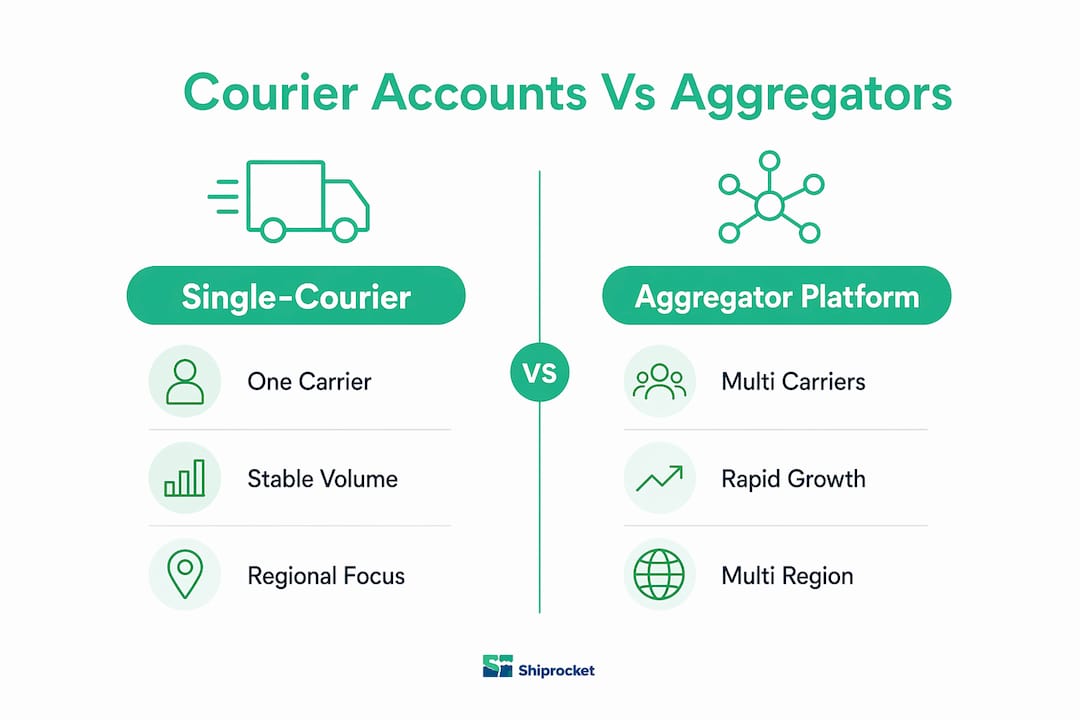
Aggregator platforms, such as those offering access to 42–550+ courier partners via a unified dashboard, solve that problem directly. Logistics aggregators centralise rate comparison, carrier selection, and RTO management across dozens of carriers in one place. Automated parcel routing by region and price means the system selects the best carrier for each shipment without manual input. That is a structural advantage that compounds as order volumes grow.
| Feature |
Single-courier account |
Aggregator platform |
| Carrier access |
One carrier |
42–550+ carriers |
| Rate negotiation |
Direct with carrier |
Centralised comparison |
| Resilience |
Low (single point of failure) |
High (automatic rerouting) |
| Billing |
Single invoice |
Unified dashboard billing |
| Best for |
Stable volume, one region |
Growing brands, multi-region |
| Setup complexity |
Low |
Moderate |
For sellers shipping across multiple regions or experiencing rapid growth, the multi-carrier comparison approach offers both cost and operational advantages. For sellers with consistent, localised volume, a direct account with a single trusted carrier remains a practical and cost-effective choice.
Pro Tip: Even if you primarily use a single carrier, maintain an active account with at least one aggregator platform. It costs little to keep active and gives you an immediate fallback during peak periods or carrier disruptions.
How can sellers use courier accounts to reduce returns and failed deliveries?
Return to origin (RTO) rates of 20–25% are common in several e-commerce markets. Each failed delivery costs the seller in both logistics fees and lost revenue. Courier accounts, particularly those connected to aggregator platforms, include tools specifically designed to reduce this problem.
A practical approach to reducing RTO using courier account features:
- Activate address verification at checkout. Many courier account integrations include address validation APIs that flag undeliverable addresses before despatch. Catching errors early is far cheaper than managing a return.
- Schedule automated pre-delivery notifications. Sending an SMS or email the day before delivery significantly increases the chance the customer is available. Aggregator platforms often include this as a built-in workflow.
- Use automated rescheduling for failed attempts. When a first delivery attempt fails, the system should automatically offer the customer a rescheduled slot rather than defaulting to a return. This single step recovers a meaningful proportion of failed deliveries.
- Require proof of delivery on all orders. POD data, whether a signature or a photo, provides evidence for dispute resolution and discourages fraudulent return claims.
- Analyse RTO patterns by carrier and region. Courier account dashboards provide delivery performance data by carrier and postcode. Use that data to switch carriers in underperforming regions rather than accepting poor delivery rates.
Automated RTO management through courier account workflows protects seller margins in a way that manual processes simply cannot replicate at scale. The logistics role in brand growth is directly tied to how well sellers manage the last mile, and courier accounts are the primary tool for doing so.
Key takeaways
Courier accounts are technology integrations that automate shipping, protect margins, and build customer trust, not simply cost-reduction tools.
| Point |
Details |
| Negotiated rates and credit terms |
Business courier accounts offer rates 20–40% below retail with 15–30 day billing terms. |
| Operational automation |
Label generation, COD reconciliation, and pickup scheduling reduce manual errors and warehouse bottlenecks. |
| Marketplace integration |
API connections with OMS and marketplaces automate SLA compliance and protect buy-box eligibility. |
| Multi-carrier resilience |
Aggregator platforms with 42–550+ carriers prevent single-carrier disruption and enable automated routing. |
| RTO reduction |
Automated address verification, notifications, and rescheduling workflows cut failed delivery costs materially. |
Why courier accounts are more than a shipping contract
Most sellers I speak with treat their courier account as a billing arrangement. They negotiate a rate, sign a contract, and move on. That framing misses the point entirely.
A courier account, when properly integrated, is the connective tissue between your warehouse and your customer. The sellers who get the most from these accounts are not the ones who negotiated the lowest per-parcel rate. They are the ones who connected the account to their OMS, activated every automation available, and used the delivery data to make better carrier decisions month after month.
The shift from single-carrier to multi-carrier thinking is where I see the biggest gains. Sellers who rely on one carrier are one bad peak season away from a fulfilment crisis. Those using aggregator platforms with automated routing treat carrier disruptions as a minor inconvenience rather than a business emergency. That resilience is worth more than any per-parcel discount.
The future of courier partnerships is data-driven. Delivery performance by region, carrier, and time of year will increasingly determine which sellers win on marketplaces. The sellers building that analytical capability now, through their courier account dashboards, will have a genuine operational advantage in 2026 and beyond. Explore the types of courier partners available to understand which model fits your current growth stage.
— ChiefPlaneteer
How Parcelplanet supports sellers in getting the most from courier accounts
Parcelplanet works with e-commerce and omnichannel brands that want the benefits of multi-carrier logistics without building the infrastructure themselves. As a third-party logistics provider, Parcelplanet manages carrier integrations, centralised tracking, and billing across multiple couriers, so your team focuses on selling rather than managing shipping relationships.

For sellers ready to move beyond a single-carrier arrangement, Parcelplanet’s order fulfilment services connect your store directly to a network of courier partners with real-time tracking and dedicated account support. Whether you are managing 500 orders a month or 50,000, the infrastructure scales with your business. Get in touch with the Parcelplanet team to request a tailored quote and see how integrated fulfilment changes what your operation can achieve.
FAQ
What is a business courier account?
A business courier account is a formal shipping arrangement for companies sending 50 or more parcels monthly. It provides negotiated rates 20–40% below retail, monthly credit billing, and access to operational tools like automated label generation and dedicated pickup scheduling.
How do courier accounts improve cash flow for sellers?
Monthly credit billing with 15–30 day payment terms means sellers pay for shipping after revenue arrives, rather than upfront. This is particularly valuable for businesses with high COD order volumes.
A courier account is a direct relationship with one carrier. An aggregator platform gives sellers access to 42–550+ carriers via a single dashboard, with centralised billing and automated carrier selection by region and price.
How do courier accounts help reduce RTO rates?
Courier accounts with aggregator integrations include automated RTO management tools such as address verification, pre-delivery notifications, and rescheduling workflows. These features reduce failed deliveries before they become costly returns.
Do courier accounts work with Amazon and other marketplaces?
Yes. Courier account integrations use API connections to automate tracking updates, label creation, and SLA compliance reporting directly within marketplace seller dashboards, supporting buy-box eligibility on platforms like Amazon and Flipkart.
Recommended


