TL;DR:
- Effective same-day delivery relies on strict operational discipline, real-time system integration, and precise customer communication to succeed.
- Scaling this service gradually within targeted regions and SKU ranges while tracking key KPIs ensures reliability and sustainable growth.
Same-day delivery strategies are structured operational approaches that e-commerce businesses use to fulfil and dispatch orders within hours of placement, balancing speed, reliability, and cost. 32% of consumers choose retailers specifically for fast or same-day delivery options, making this a direct driver of customer acquisition. That figure means same-day capability is no longer a premium add-on. It is a baseline competitive requirement. The businesses winning on this front are not simply moving faster. They are building tighter operational systems around cutoff times, inventory positioning, carrier integration, and customer communication.
1. Essential components of same-day delivery strategies
Effective same-day delivery, known in logistics as rapid fulfilment or on-demand dispatch, starts with validating whether your customer base and geography actually support it. Offering same-day shipping to customers 80 miles from your warehouse is a promise you cannot keep. Start by mapping your delivery radius and confirming order density within that zone before committing to the service.
The most critical operational lever is your order cutoff time. Same-day delivery is only feasible if orders close for processing by late morning, typically between 11 AM and noon, to allow pick, pack, and dispatch before courier collection windows close. Missing this window by even 30 minutes collapses the entire same-day promise.
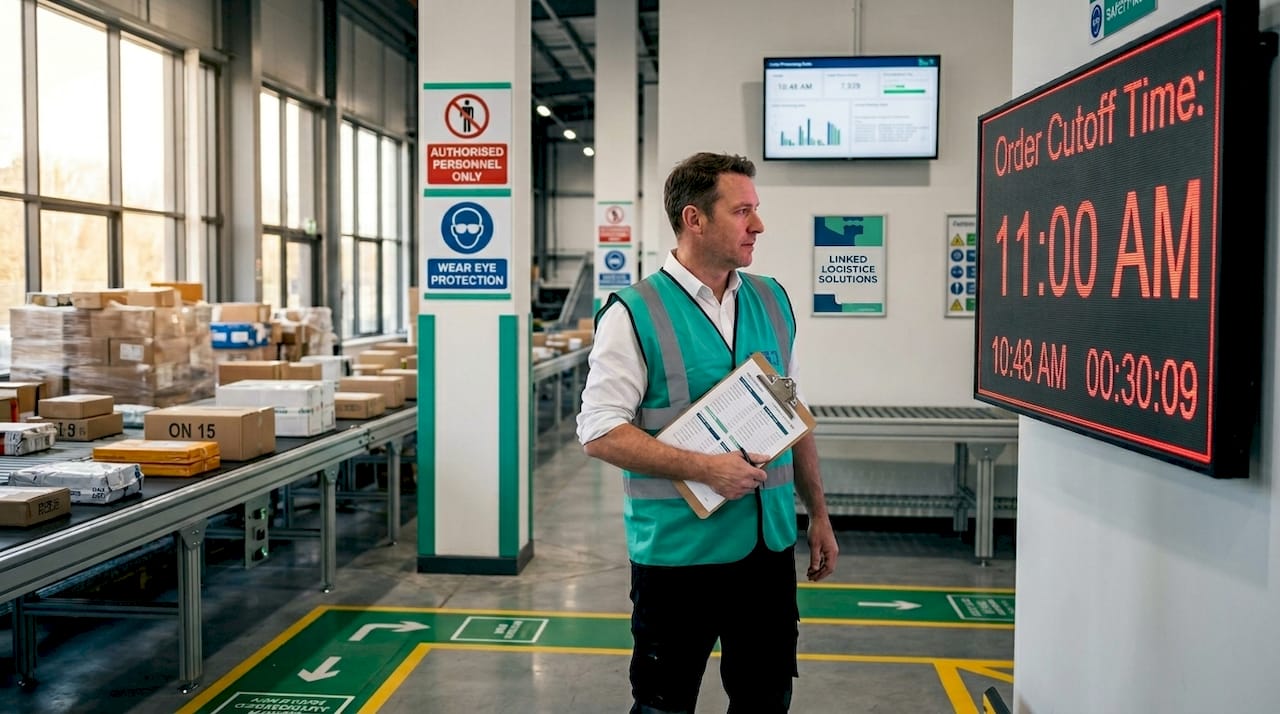
Your warehouse layout directly affects whether you can hit that window consistently. Optimising warehouse slotting to place high-velocity same-day SKUs nearest packing stations saves valuable minutes per order. In a high-volume operation, shaving three minutes per pick across 200 daily same-day orders saves ten hours of labour every single day.
The final essential component is real-time system integration. Your order management system (OMS), inventory platform, and courier booking tool must communicate without manual intervention. Any gap in that chain, such as a courier booking that requires a separate login or a stock check done by spreadsheet, introduces delay that same-day timelines cannot absorb.
- Confirm geographic radius and order density before launching
- Set a firm cutoff time between 11 AM and noon
- Slot high-velocity SKUs closest to packing stations
- Integrate OMS, inventory, and courier systems in real time
- Plan carrier contingencies for peak days and driver shortages
Pro Tip: Negotiate SLAs with your 3PL or courier partners that include guaranteed cutoff times, real-time inventory updates, and penalty clauses. A verbal agreement on speed is worthless without contractual accountability.
2. Technologies that improve delivery speed and reliability
Technology does not replace operational discipline, but it does make discipline scalable. An OMS that syncs with your warehouse management system and courier API in real time is the backbone of any fast fulfilment strategy. Without it, order routing becomes a manual bottleneck that grows worse as volume increases.
Inventory management software with AI-driven demand forecasting prevents the most common same-day failure: a confirmed order for a product that is actually out of stock. Tools like Linnworks, Brightpearl, and Cin7 give growing e-commerce brands the stock visibility needed to make same-day promises with confidence. Inaccurate inventory is the silent killer of same-day delivery programmes.
Delivery tracking and customer communication platforms are equally important. Same-day delivery compresses the post-purchase experience into hours, which means automated, proactive communication is not optional. Platforms like Klaviyo for email and Twilio for SMS can trigger order confirmation, packing notification, out-for-delivery alerts, and delivery confirmation automatically.
Route planning tools powered by real-time traffic data are the final technology layer. AI-assisted route optimisation, stop clustering, and live traffic integration reduce cost per delivery and tighten arrival windows. For urban operations, some brands are now incorporating cargo e-bikes into their last-mile fleet to bypass traffic entirely in dense city centres.
Pro Tip: Integrate a delivery orchestration platform to coordinate exceptions, billing reconciliation, and multi-carrier handoffs. When your primary courier fails, the platform should automatically reroute to a backup without human intervention.
Measuring same-day delivery performance requires a tighter set of KPIs than standard next-day or two-day shipping. The key last-mile metrics that matter most are on-time delivery rate, first-attempt delivery success, average cost per package, and customer satisfaction scores. Tracking these daily, not weekly, gives you the feedback loop needed to catch problems before they compound.
An on-time delivery rate of 94% or above is the operational target for credible same-day services. Below that threshold, customer complaints rise sharply and repeat purchase rates decline. First-attempt delivery success is equally important because a missed delivery on a same-day order is not just a logistics failure. It is a broken promise that erodes trust faster than a two-day delay ever would.
| KPI |
Target |
Why it matters |
| On-time delivery rate |
94%+ |
Below this, complaint volume rises and repeat purchases fall |
| First-attempt success |
90%+ |
Failed attempts destroy the same-day value proposition entirely |
| Average cost per package |
Varies by zone |
Route optimisation directly reduces this figure |
| Customer satisfaction (CSAT) |
4.5/5 or above |
Reflects the full post-purchase experience, not just speed |
| Time-window accuracy |
Within 1-hour window |
Customers judge reliability by precision, not just arrival date |
Use these metrics to identify bottlenecks in your operation. If your on-time rate drops on Fridays, the issue is likely volume spikes or courier capacity. If first-attempt success is low in a specific postcode, the problem is probably address data quality or delivery window communication at checkout.
4. Pricing and communication tactics that drive uptake
Pricing same-day delivery correctly is harder than it looks. Only 23% of shoppers would pay extra for same-day delivery on every order, which means blanket premium pricing will suppress uptake. The most effective model offers same-day delivery free above a basket threshold, typically £40 to £60, with a set fee of £5 to £12 for orders below that level.
Shopify recommends communicating a consistent, clearly visible cutoff time at checkout rather than burying it in the FAQ. Customers who see “Order before 11 AM for delivery by 8 PM tonight” at the point of purchase convert at significantly higher rates than those who have to hunt for delivery terms. Specificity builds confidence.
Communication after the order is placed matters just as much as the checkout message. A customer who orders at 9 AM and hears nothing until 7 PM is anxious, regardless of whether the parcel arrives on time. The communication stack for same-day orders should include:
- Order confirmation within two minutes of placement
- Packing notification when the order enters the pick queue
- Out-for-delivery SMS with driver name and estimated arrival window
- Delivery confirmation with photo proof where available
- Proactive delay alert if anything changes, sent before the customer notices
“Operational discipline, clear communication, and realistic promises are crucial to winning the same-day delivery race now that speed alone is insufficient.” — Roadie, 2026
Frame your delivery promise around a specific time window rather than a vague “same day.” “Delivered by 8 PM tonight” is a commitment. “Same-day delivery available” is a suggestion. Customers remember the difference, and so does your reputation.
5. How to scale same-day delivery without losing control
Scaling same-day delivery sustainably means resisting the urge to expand too quickly. Many mid-sized retailers start by limiting their same-day offering to a specific SKU range and a defined geographic radius, then expand only after proving the unit economics work. Launching same-day across your full catalogue and entire customer base simultaneously is how brands create operational chaos and damage their reputation in one move.
The pilot approach works best in high-demand metro areas where order density is sufficient to justify dedicated courier capacity. Walmart’s operation, which delivers millions of under-30-minute orders across 19,000 ZIP codes, was built incrementally over years. That scale did not emerge from a single national launch. It was the result of repeated local pilots, measurement, and expansion based on proven performance.
| Approach |
Best for |
Key risk |
| In-house courier fleet |
High-volume urban brands |
High fixed costs, difficult to scale down |
| 3PL with same-day capability |
Growing brands outsourcing fulfilment |
SLA discipline required from the 3PL partner |
| Crowdsourced driver networks |
Flexible, variable-demand operations |
Inconsistent service quality without strong oversight |
| Carrier partnerships (e.g., DoorDash Drive) |
Brands needing rapid market entry |
Limited control over last-mile experience |
Partnering with a 3PL that already has same-day infrastructure in place is often the fastest route to market for brands that lack warehouse capacity or courier relationships. The key is logistics flexibility that allows you to scale capacity up or down without renegotiating contracts every quarter.
Pro Tip: Review your carrier SLAs every six months. Same-day delivery volumes and route costs change with seasons and demand patterns. An SLA negotiated in January may be significantly underpriced or overpriced by August.
Key takeaways
Effective same-day delivery strategies require operational discipline around cutoff times, real-time system integration, and proactive customer communication to deliver consistent results.
| Point |
Details |
| Cutoff time is non-negotiable |
Orders must close by 11 AM to noon to meet same-day dispatch windows reliably. |
| Technology enables scale |
OMS, inventory forecasting, and route optimisation tools are required infrastructure, not optional extras. |
| Metrics drive improvement |
Track on-time rate, first-attempt success, and CSAT daily to catch problems before they escalate. |
| Pricing must match behaviour |
Only 23% of shoppers pay extra every time; use threshold-based free delivery to drive uptake. |
| Start narrow, then expand |
Pilot with limited SKUs and a defined radius before scaling to avoid operational breakdown. |
The uncomfortable truth about same-day delivery
Most brands I speak with assume same-day delivery is a speed problem. Get the courier faster, cut the pick time, and you win. That framing is wrong, and it leads businesses to invest in the wrong places.
Customer loyalty depends more on consistent delivery within promised windows than on the fastest possible delivery. A customer who receives their order at 7:55 PM after being told it would arrive by 8 PM is satisfied. A customer who was promised 8 PM and receives nothing until 9 PM is not, regardless of how fast your warehouse operates.
The brands I have seen build genuinely successful same-day programmes share one trait: they treat the cutoff time as sacred. Not a guideline. Not a target. A hard operational boundary that the entire team, from warehouse staff to customer service, understands and protects. When that discipline slips, everything else unravels.
My honest advice is to start smaller than feels comfortable. Limit your SKUs. Limit your radius. Measure your on-time rate obsessively for 90 days before expanding. The brands that rush to offer same-day across their full range in week one are the same brands that quietly pull the service back three months later after a wave of complaints. The e-commerce delivery speed gains that stick are the ones built on a foundation of reliability, not ambition alone.
— Lukasz
How Parcelplanet supports your same-day fulfilment goals
If you are ready to offer same-day or next-day delivery but lack the warehouse infrastructure, carrier relationships, or technology to execute it reliably, Parcelplanet is built for exactly that challenge.

Parcelplanet’s order fulfilment services are designed for e-commerce and omnichannel brands that need fast, accurate dispatch without the overhead of managing their own warehouse. With real-time inventory visibility, courier integrations, and a team that understands the operational demands of rapid fulfilment, Parcelplanet gives your business the infrastructure to make same-day promises you can actually keep. Explore how Parcelplanet can support your fast shipping goals and get a tailored quote today.
FAQ
What is a same-day delivery cutoff time?
A same-day delivery cutoff time is the latest point at which an order can be placed and still be fulfilled and dispatched on the same day. Most operations set this between 11 AM and noon to allow sufficient pick, pack, and courier handoff time.
How do I improve delivery speed for my e-commerce business?
Improving delivery speed requires optimising warehouse slotting, integrating your OMS with courier systems in real time, and setting firm cutoff times. Partnering with a 3PL that already has same-day infrastructure in place accelerates the process significantly.
What KPIs should I track for same-day delivery?
The most important KPIs are on-time delivery rate (target 94% or above), first-attempt delivery success, average cost per package, and customer satisfaction scores. Tracking these daily rather than weekly allows faster identification of operational problems.
Is same-day delivery worth the cost for smaller e-commerce brands?
Yes, if you start with a limited SKU range and a defined geographic radius. Piloting in a high-demand metro area with a small product selection allows you to prove unit economics before committing to broader rollout.
How should I price same-day delivery?
The most effective model offers same-day delivery free above a basket threshold and charges a set fee below it. Because only 23% of shoppers pay extra for same-day on every order, blanket premium pricing suppresses uptake without improving margins.
Recommended


