Scaling order fulfilment is one of the most critical yet challenging aspects of e-commerce growth. As your business expands, the systems and processes that once handled a few hundred orders weekly can quickly buckle under thousands. Poor fulfilment doesn’t just frustrate customers, it directly erodes loyalty and revenue. Nearly half of shoppers will not return after just one bad fulfilment experience. This guide walks you through preparing infrastructure, implementing automation, and maintaining quality as you scale, ensuring your fulfilment operations support rather than hinder growth.
Table of Contents
Key takeaways
| Point |
Details |
| Clear architectural design enhances system robustness |
Layered system architecture clarifies responsibilities and prevents failures during high-volume periods. |
| Adopt adaptable infrastructure to handle growth |
Flexible warehouse setups and capacity planning enable seamless scaling during seasonal peaks. |
| Automate processes to maintain efficiency |
Automation of order processing, packing, and shipping reduces errors and speeds fulfilment as volumes increase. |
| Maintain quality even at high volumes |
Consistent monitoring of key metrics and standardised procedures protect customer satisfaction during rapid growth. |
Understanding the order fulfilment challenge
Customer loyalty hinges on fulfilment experience more than most e-commerce businesses realise. When orders arrive late, damaged, or incorrect, shoppers don’t blame the courier, they blame your brand. This makes scaling fulfilment a uniquely high-stakes challenge. You’re not just moving more boxes, you’re protecting the trust that drives repeat purchases.
As order volumes climb, several risks emerge that can cripple growth. Bottlenecks appear in picking and packing workflows. Inventory accuracy deteriorates. Shipping errors multiply. These aren’t minor inconveniences, they’re systemic failures that compound rapidly. A warehouse designed for 500 daily orders will struggle at 2,000 without fundamental changes to layout, staffing, and technology.
Poor architectural design amplifies these problems. When your fulfilment systems lack clear separation between application, domain, and integration layers, a single point of failure can cascade into complete outages. During peak trading periods, this translates directly into lost sales and damaged reputation. Adopting layered architectural designs clarifies responsibilities at each level, building robust fulfilment systems.
Reliable fulfilment underpins sustainable growth. It’s the operational backbone that allows you to invest confidently in marketing, expand product ranges, and enter new markets. Without it, growth becomes a liability rather than an opportunity. Understanding these order fulfilment challenges early positions you to address them proactively.
Consider these common scaling pitfalls:
- Warehouse space constraints that force inefficient storage patterns
- Manual processes that can’t keep pace with order velocity
- Inadequate inventory visibility leading to stockouts or overselling
- Carrier relationships unable to handle volume surges
- Staff training gaps that increase error rates under pressure
Scaling fulfilment isn’t about doing the same things faster, it’s about fundamentally redesigning processes to handle complexity whilst maintaining precision.
Preparing to scale: infrastructure and system design
Successful scaling begins long before you hit capacity limits. The foundation lies in designing infrastructure and systems that can flex with demand rather than break under it. This preparation phase determines whether growth feels manageable or chaotic.

Layered system design improves fulfilment reliability dramatically. The application layer handles request routing, protocol conversion, and result assembly duties, whilst the domain layer manages business logic and the integration layer connects external systems. This separation means you can upgrade one component without destabilising others, crucial when scaling requires frequent adjustments.
Flexible warehouse setups enable seasonal and volume changes without complete overhauls. Modular shelving systems, clearly defined pick paths, and designated packing stations create adaptability. When November brings triple your usual orders, you can add temporary staff and workstations without redesigning the entire floor. This flexibility extends to technology, cloud-based warehouse management systems scale capacity on demand rather than requiring expensive hardware upgrades.
Strategic capacity planning prepares for demand fluctuations before they arrive. This involves:
- Analysing historical order patterns to identify seasonal peaks and growth trends
- Calculating buffer capacity needed above average volumes
- Establishing relationships with temporary staffing agencies for rapid scaling
- Negotiating flexible warehouse space agreements that allow expansion
- Testing systems under simulated high-volume conditions to identify bottlenecks
Resource optimisation is vital for matching demand efficiently. This means right-sizing everything from staff schedules to packaging inventory. Overstaffing during slow periods wastes money, understaffing during peaks creates delays. The solution lies in data-driven forecasting and flexible resource pools.
Pro Tip: Map your entire fulfilment workflow on paper before scaling. Identify every handoff, decision point, and potential bottleneck. This visualisation reveals inefficiencies invisible in day-to-day operations and guides targeted improvements.
| Infrastructure element |
Scalable approach |
Rigid approach |
| Warehouse space |
Flexible lease with expansion options |
Fixed long-term lease |
| Staff model |
Core team plus on-demand temps |
All permanent staff |
| Technology systems |
Cloud-based, API-integrated |
On-premise, standalone |
| Carrier relationships |
Multi-carrier with volume tiers |
Single carrier contract |
This warehouse optimisation guide provides detailed strategies for creating adaptable fulfilment spaces. Understanding logistics scalability helps you design systems that grow with your business rather than constrain it.
Executing scaling with technology and process automation
Once infrastructure is prepared, execution focuses on implementing technology and automation that multiply your fulfilment capacity without proportionally increasing costs or errors. This is where preparation transforms into operational reality.
Integrate scalable fulfilment platforms to handle volume spikes seamlessly. Modern platforms connect your e-commerce store, inventory management, warehouse operations, and carrier systems into one cohesive workflow. When an order arrives, it routes automatically to the optimal fulfilment location, triggers picking lists, generates shipping labels, and updates inventory, all without manual intervention. This integration eliminates the data entry and coordination overhead that bogs down manual systems.
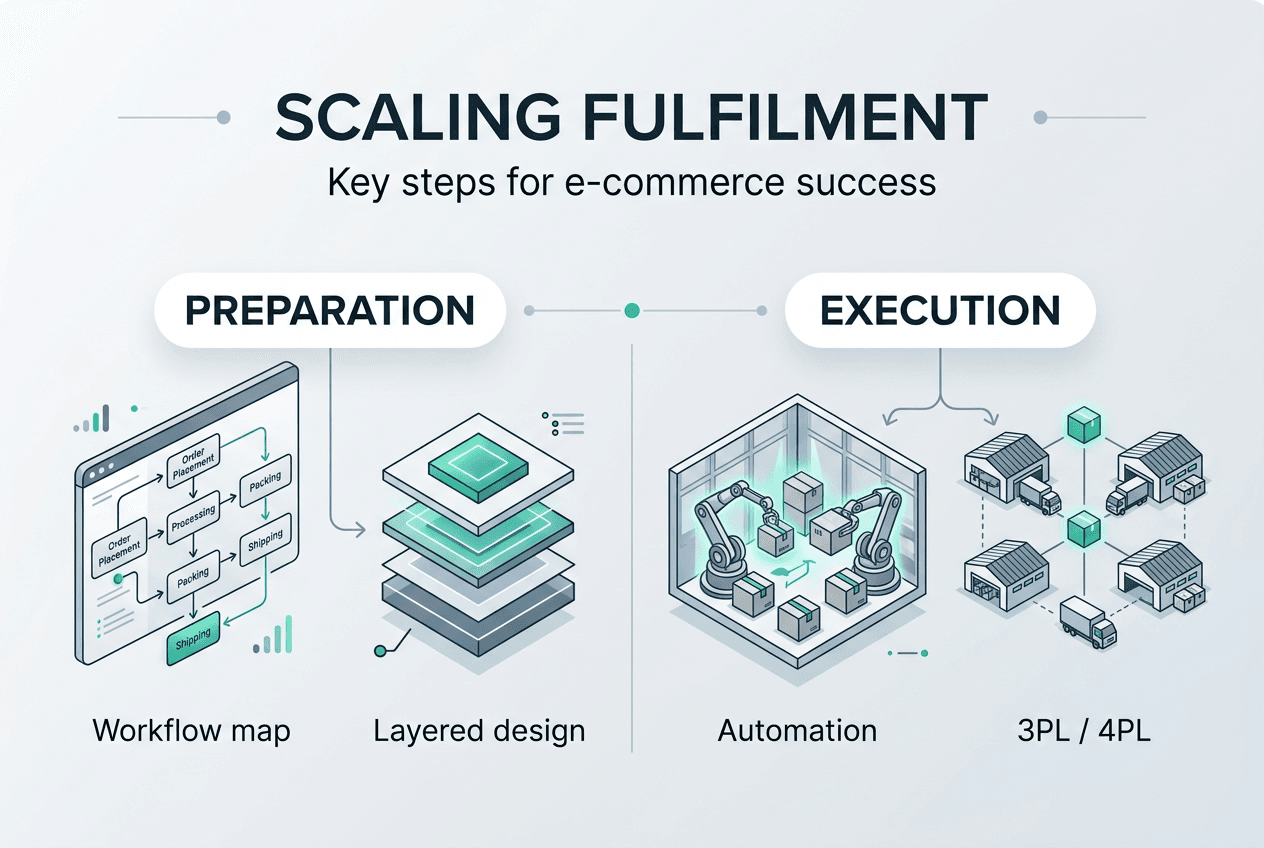
Automate order processing, packing, and shipping steps wherever possible. Barcode scanning confirms pick accuracy, automated weighing systems select appropriate packaging, and thermal printers produce labels instantly. These automations don’t just save time, they eliminate the human errors that damage customer experience. A picker scanning the wrong SKU triggers an immediate alert rather than shipping the wrong product.
Key automation opportunities include:
- Automatic order import from all sales channels
- Rule-based order routing to appropriate fulfilment centres
- Batch picking optimisation for multi-order efficiency
- Automated carrier selection based on destination and service level
- Real-time inventory updates across all channels
- Automated tracking notifications to customers
Compare 3PL versus 4PL options for scalable fulfilment carefully. Third-party logistics providers handle warehousing and shipping, giving you instant scalability without capital investment. Fourth-party logistics providers add strategic oversight, managing multiple 3PLs and optimising your entire supply chain. The right choice depends on your complexity and growth trajectory.
| Feature |
3PL fulfilment |
4PL fulfilment |
| Service scope |
Warehousing, picking, packing, shipping |
End-to-end supply chain management |
| Best for |
Single-region, straightforward fulfilment |
Multi-region, complex logistics |
| Control level |
Operational partnership |
Strategic partnership |
| Cost structure |
Per-unit fulfilment fees |
Management fee plus fulfilment costs |
Maintaining service quality requires consistent processes even as volume scales. Document standard operating procedures for every fulfilment step. Train staff thoroughly and implement quality checkpoints at critical stages. Consistency matters more than speed, rushed orders with errors cost far more than slightly longer processing times.
Pro Tip: Start automation with your highest-volume, most repetitive tasks. Automating order import and label generation typically delivers immediate ROI and frees staff for tasks requiring human judgement.
Explore top scalable logistics solutions to identify technologies matching your specific needs. Use this e-commerce fulfilment checklist to ensure you’ve addressed all critical automation opportunities before scaling.
Verifying and maintaining quality during rapid growth
Scaling execution must be paired with rigorous verification and quality maintenance. Growth that sacrifices accuracy or customer satisfaction ultimately fails. This phase focuses on monitoring, measuring, and optimising to sustain excellence at scale.
Use analytics for demand forecasting and planning proactively. Data-driven forecasting helps predict and prepare for seasonal peaks and growth patterns. By analysing historical order data, marketing campaign schedules, and market trends, you can anticipate volume surges weeks in advance. This foresight allows you to secure additional warehouse space, hire temporary staff, and increase inventory levels before demand hits.
Monitor key metrics to detect bottlenecks early, before they impact customers. Essential fulfilment KPIs include:
- Order processing time from receipt to shipment
- Pick accuracy rate and error frequency
- On-time shipping percentage
- Inventory accuracy and stockout frequency
- Customer complaint rate and return reasons
- Cost per order across different volume levels
These metrics provide early warning signals. If pick accuracy drops from 99.5% to 98%, investigate immediately. That seemingly small decline represents doubled error rates that will generate customer complaints and returns.
Maintain consistent quality to keep customers loyal throughout growth phases. Standardise procedures so every order receives identical care regardless of volume. Implement quality checkpoints where supervisors spot-check packed orders before shipping. Create feedback loops so warehouse staff learn from errors and continuously improve.
Optimise staffing and partnerships to match demand fluctuations precisely. This requires:
- Flexible scheduling that adjusts daily based on forecasted order volume
- Cross-training staff to handle multiple fulfilment roles
- Partnerships with staffing agencies for rapid temporary hiring
- Clear performance metrics that identify top performers for retention
- Regular capacity reviews with 3PL partners to ensure alignment
Effective shipping strategy workflow integration ensures your carrier relationships scale alongside fulfilment operations. Selecting the right fulfilment partner becomes increasingly critical as complexity grows, their expertise and infrastructure determine your scaling ceiling.
Quality maintenance isn’t a one-time achievement, it’s an ongoing commitment. Schedule monthly reviews of all fulfilment metrics. Gather customer feedback systematically through post-delivery surveys. Benchmark your performance against industry standards and identify improvement opportunities. This continuous improvement mindset separates businesses that scale successfully from those that collapse under their own growth.
Scale smarter with ParcelPlanet’s fulfilment solutions
Scaling order fulfilment effectively requires expertise, infrastructure, and technology that most e-commerce businesses can’t build alone. ParcelPlanet specialises in providing scalable order fulfilment services tailored specifically to small and medium-sized e-commerce brands facing these exact growth challenges.

Our 3PL and 4PL services optimise logistics costs whilst maintaining the quality and speed your customers expect. Whether you need straightforward warehousing and shipping or comprehensive supply chain management across multiple regions, we adapt to your unique requirements. Understanding 3PL vs 4PL fulfilment options helps you choose the right partnership level for your growth stage. Our experts support you through every scaling challenge, from demand forecasting to carrier optimisation, so you can focus on growing your business whilst we handle the operational complexity. Discover how 3PL provider benefits translate directly into reduced costs and improved customer satisfaction.
Frequently asked questions
How can small e-commerce businesses start scaling their order fulfilment?
Start by implementing scalable systems and flexible warehouse setups before you hit capacity limits. Prioritise automation in high-volume, repetitive tasks like order import and label generation to free staff for complex work. Seek expert logistics partners early, their infrastructure and expertise accelerate scaling whilst avoiding costly mistakes. Review these order fulfilment challenges faced by small businesses to identify your specific bottlenecks, then apply targeted warehouse optimisation tips to address them systematically.
What technology solutions best support order fulfilment scaling?
Cloud-based, integratable fulfilment platforms provide the foundation for scalable operations. These systems connect your e-commerce store, inventory management, warehouse operations, and carriers into seamless workflows that handle volume surges automatically. Process automation software eliminates manual data entry and reduces errors in picking, packing, and shipping. Advanced analytics for demand forecasting enable proactive planning rather than reactive firefighting. Explore scalable logistics solutions to identify technologies matching your budget and complexity, then use this e-commerce fulfilment checklist to ensure comprehensive implementation.
How do I maintain service quality while scaling order fulfilment?
Implement standardised procedures for every fulfilment step and document them clearly so all staff follow identical processes. Monitor fulfilment KPIs regularly, tracking metrics like pick accuracy, processing time, and on-time shipping to detect quality degradation early. Scale resources in line with demand shifts by using flexible staffing and maintaining buffer capacity for unexpected surges. Quality checkpoints at critical stages catch errors before they reach customers. Integrate effective shipping strategy workflow practices to maintain consistency across all fulfilment aspects as volume grows.
When should I consider outsourcing fulfilment to a 3PL provider?
Consider outsourcing when warehouse space constraints limit growth, fulfilment costs per order rise with volume, or you lack expertise to implement scalable systems. If you’re spending more time managing logistics than growing your business, a 3PL partnership often delivers better outcomes. Most e-commerce businesses benefit from outsourcing once they exceed 500 to 1,000 monthly orders, though the exact threshold depends on product complexity and margins. 3PL providers offer instant scalability, established carrier relationships, and fulfilment expertise that would take years to build internally.
What are the biggest mistakes to avoid when scaling order fulfilment?
Avoiding infrastructure preparation is the most common mistake, scaling on inadequate systems guarantees failure. Don’t sacrifice quality for speed, errors damage customer loyalty far more than slightly longer processing times. Failing to automate repetitive tasks wastes resources and increases error rates unnecessarily. Underestimating seasonal demand surges leads to stockouts and delayed shipments during your most critical sales periods. Finally, trying to manage everything internally rather than partnering with fulfilment experts limits your growth potential and diverts focus from core business activities.
Recommended


