TL;DR:
- Fulfilment accuracy is the critical front line of customer trust, directly impacting loyalty and reputation.
- Operational failures, such as inventory mismatches and shipping errors, create hidden costs and increase the risk during growth peaks.
Fulfilment accuracy is not a background operational metric. It is the front line of your customer relationship. When an order arrives wrong, late, or damaged, the impact on trust is immediate and often permanent. Growing e-commerce brands frequently underestimate how quickly small picking errors, inventory mismatches, and reporting blind spots compound into serious reputation damage. This article examines exactly why accuracy matters, what operational risks you face as you scale, and which strategies will help you build a fulfilment operation that consistently delivers on its promises.
Table of Contents
Key Takeaways
| Point |
Details |
| Accuracy wins customer loyalty |
Correct orders and timely deliveries build trust and drive repeat sales. |
| Mistakes cost reputation |
Unreliable fulfilment damages your brand and increases negative reviews. |
| Scalable systems reduce risk |
Automated, evidence-based workflows minimise errors during volume spikes. |
| Continuous improvement matters |
Tracking KPIs and refining processes keeps your fulfilment performance strong. |
| Specialist partners improve accuracy |
Trusted fulfilment providers and integrations can help your brand scale seamlessly. |
Why fulfilment accuracy makes or breaks customer satisfaction
Every order that arrives correctly is an opportunity to build loyalty. Every error is an opportunity for a customer to leave and never return. That cause-and-effect relationship is straightforward, yet many brands fail to treat fulfilment accuracy as the strategic priority it deserves.
Consider what happens after a single mistake. A customer receives the wrong size, the wrong colour, or simply the wrong product entirely. They contact support, wait for a resolution, and deal with the inconvenience of a return. Even if you resolve the problem quickly, the friction has already eroded their confidence in your brand. Repeat that experience once more, and you have almost certainly lost that customer permanently.
Accurate fulfilment drives positive outcomes across several dimensions:
- Repeat purchase rates increase significantly when customers receive exactly what they ordered, on time
- Positive reviews are far more likely after seamless delivery experiences, building organic social proof
- Reduced support costs follow naturally when fewer errors require customer service intervention
- Lower return rates mean less reverse logistics spend and stronger margins overall
- Word-of-mouth referrals are earned through consistent, reliable delivery performance
The challenge intensifies as your brand grows. High-volume peaks erode accuracy without scalable systems in place, and complex SKUs or product variants dramatically increase the probability of picking errors. Brands that learn to boost delivery accuracy during periods of growth gain a measurable competitive advantage, because their competitors are making the very mistakes that drive customers away.
Building scalable logistics efficiency from the outset means accuracy does not have to degrade as order volumes rise. Getting this right is not just operationally sensible. It is one of the most direct investments you can make in long-term customer retention.
The operational risks of inaccurate fulfilment
Understanding why accuracy matters to customers is one thing. Seeing how operational failures create hidden costs for your business is another. Inaccurate fulfilment does not just frustrate customers. It creates tangible financial and reputational damage behind the scenes.
Here is a summary of the most significant operational risks and their typical business impact:
| Risk area |
Common cause |
Business impact |
| Inventory mismatch |
Poor stock reconciliation |
Overselling, cancellations, refunds |
| Wrong item shipped |
Manual picking errors |
Returns, reshipping costs, lost trust |
| Late delivery |
Poor carrier coordination |
Negative reviews, lost repeat orders |
| Quantity errors |
Inadequate scan verification |
Customer complaints, inventory distortion |
| Damage in transit |
Insufficient packing standards |
Replacements, brand damage |
The financial cost of each error is almost always higher than it first appears. You are not just covering the replacement product. You are absorbing return shipping, customer service time, and the long-term cost of a customer who no longer buys from you.

Peak trading periods amplify every one of these risks. When order volumes surge during events like Black Friday or seasonal campaigns, teams working under pressure are far more likely to make mistakes. Without systems designed to handle that volume accurately, errors multiply rapidly.
The steps below outline how operational vulnerabilities typically develop in growing brands:
- Manual processes that work at low volume become error-prone as orders scale
- SKU catalogues grow in complexity, adding more variants and increasing picking confusion
- Third-party logistics providers underreport errors, masking the true scale of the problem
- Inventory records drift further from reality as reconciliation lags behind live order data
- Customer complaints accumulate before the root cause is identified and addressed
“Many brands discover their fulfilment error rate is significantly higher than reported, simply because their 3PL was not tracking quantity mismatches, damages, and late shipments as separate failure categories.”
This gap in reporting is a serious issue. Investing in scalable logistics for fulfilment means building systems that capture granular data, not just headline accuracy figures. Understanding logistics scalability in 2026 requires recognising that accurate measurement is just as important as operational performance.
Pro Tip: Map your fulfilment workflow and identify every point where an “edge case” could occur. Edge cases, such as bundled SKUs, fragile items, or split shipments, are where errors concentrate. Addressing these proactively prevents disproportionate damage to your error rate.
Scalable strategies for error-free fulfilment
Now that we have covered the risks, it is time to explore best-in-class solutions for achieving fulfilment accuracy at scale. The good news is that the strategies available to growing brands today are more accessible and more powerful than ever before.
The fundamental question many brands face is whether to rely on automation or continue with manual tracking. Both approaches have merit, but the trade-offs are significant as volume grows.
| Factor |
Manual tracking |
Automated systems |
| Setup cost |
Low |
Higher upfront investment |
| Accuracy at low volume |
Adequate |
Excellent |
| Accuracy at high volume |
Degrades quickly |
Maintains consistently |
| Error visibility |
Limited, reactive |
Real-time, proactive |
| Scalability |
Poor |
Strong |
| Reporting depth |
Basic |
Granular, customisable |
Automation consistently outperforms manual processes once order volumes reach a meaningful scale. Barcode scanning at pick and pack stations, automated inventory updates, and integrated courier tracking eliminate entire categories of human error. The upfront investment pays back quickly through reduced reshipping costs and stronger customer retention.
A practical framework for scalable, accurate fulfilment includes the following elements:
- Warehouse management system (WMS) integration that connects inventory data directly to your e-commerce platform in real time
- Barcode or RFID scanning at every pick, pack, and dispatch stage to verify each item before it leaves the warehouse
- Automated carrier allocation that selects the right courier service based on order specifications, reducing manual intervention
- Real-time inventory reconciliation that flags discrepancies immediately rather than allowing them to accumulate
- Exception reporting that surfaces errors by category, such as quantity mismatches, damages, and late dispatches, rather than bundling them into a single headline figure
Complex SKUs and variants increase errors substantially, so your system must be capable of distinguishing between closely related product variants at the point of picking. A system that looks identical for two different size options is a system that will generate returns.
Explore scalable logistics solutions that are designed specifically for growing e-commerce brands. When you are scaling order fulfilment, the architecture of your fulfilment operation matters as much as its day-to-day execution. Build your shipping strategy workflow around verification at every stage, not just at dispatch.
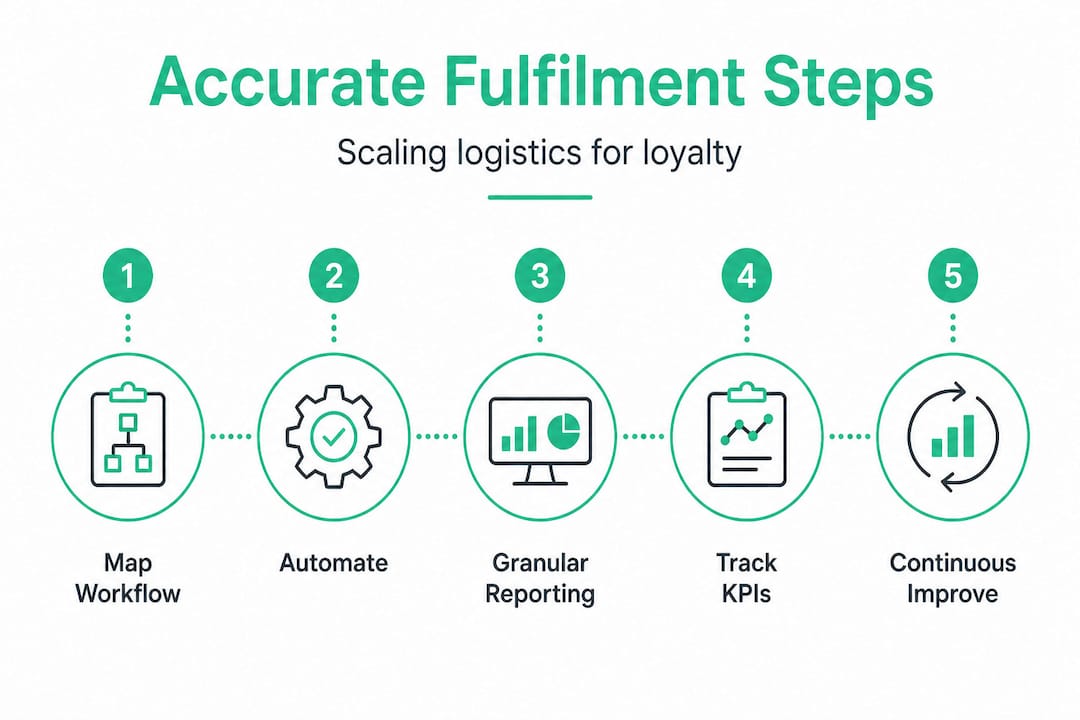
Pro Tip: Invest in platforms that report granular error data broken down by SKU, picking station, courier, and time period. Aggregate accuracy percentages tell you very little. Granular data tells you exactly where to improve.
Measuring fulfilment accuracy: KPIs and improvement tactics
To ensure your strategies deliver results, you need a clear framework for measuring accuracy in real operations. Without measurement, improvement is guesswork. With the right KPIs in place, you can identify problems early, track improvement over time, and hold every part of your operation accountable.
Here are the core steps for building a meaningful fulfilment accuracy measurement programme:
- Define your order accuracy rate: Calculate the percentage of orders shipped with the correct items, quantities, and packaging. This is your primary headline KPI.
- Track your error rate by category: Separate picking errors, packing errors, inventory variances, damages, and late shipments. Each category has different root causes and different solutions.
- Monitor late delivery percentage: Measure the proportion of orders that miss their committed delivery window, broken down by courier and region.
- Record your return rate: Track returns by reason code to identify whether errors or product issues are driving the volume.
- Benchmark against targets: Set clear monthly targets for each KPI and review performance weekly during peak periods.
Beyond the metrics themselves, a set of practical improvement tactics helps turn data into action:
- Conduct regular cycle counts to reconcile physical inventory against system records, catching discrepancies before they cause fulfilment errors
- Implement a structured error review process that investigates every reported mistake to its root cause, rather than simply correcting the immediate problem
- Use pick accuracy audits, where a proportion of completed picks are verified by a second team member, to identify training needs and process weaknesses
- Review carrier performance data monthly to identify routes or partners where late deliveries are concentrated
- Share KPI dashboards with your 3PL partner so that accountability is transparent and improvement targets are agreed jointly
As high-volume peaks erode accuracy without scalable systems, your KPI framework needs to be particularly robust in the weeks leading up to and during peak trading. Accuracy tends to degrade precisely when the stakes are highest, so monitoring frequency should increase proportionally.
Practical resources on improving fulfilment efficiency provide useful frameworks for structuring this kind of continuous improvement programme. Reviewing order fulfilment efficiency tips alongside fulfilment improvement techniques will give you a practical foundation for building an accuracy programme that scales with your business.
Our perspective: What most ‘scaling’ guides overlook in fulfilment accuracy
Here is our take on what actually matters as your brand scales fulfilment, and it differs from what most industry guides tell you.
The majority of scaling advice focuses on speed and cost reduction. Ship faster, spend less per order, process higher volumes. These are reasonable goals. But they consistently overshadow the subtler, more damaging accuracy risks that grow in proportion with your catalogue and order complexity.
Most guides do not talk about SKU complexity in any meaningful way. When a brand moves from 20 SKUs to 200, the picking environment changes dramatically. Variants that look nearly identical on a pick list, such as size medium in navy versus size medium in midnight blue, become a genuine error risk. Without barcode verification at the pick stage, that error rate will grow invisibly until customers start complaining loudly.
The 3PL reporting problem is equally overlooked. When 3PLs underreport by ignoring quantity mismatches, damages, and lates, brands are operating on inaccurate data. You might believe your accuracy rate is 99.2% when the true figure, accounting for all error categories, is closer to 97%. At scale, that difference represents thousands of unhappy customers per year.
Granular error reporting is not a nice-to-have feature. It is a strategic requirement. Brands that demand detailed breakdowns from their fulfilment partners gain a clear view of where problems originate and can address them before they escalate. Those who accept headline figures alone are, in effect, choosing to remain unaware.
Our advice: treat your brand growth logistics approach as a data discipline, not just an operational one. The brands that sustain accuracy through rapid growth are the ones that measure everything, question their 3PL’s reported figures, and build accountability into every stage of the fulfilment process.
Next steps: Enhance fulfilment accuracy with trusted partners
Improving fulfilment accuracy is achievable, but it requires the right systems, the right data, and the right operational partner working alongside you. At ParcelPlanet, we provide order fulfilment services built around precision, transparency, and scalability for growing e-commerce brands.

Whether you are just beginning to understand what order fulfilment truly involves at scale, or you are ready to overhaul an underperforming operation, we are here to help. Our e-commerce integrations connect your sales channels directly to our fulfilment infrastructure, reducing manual intervention and the errors that come with it. Get in touch today to request a tailored quote and discover how ParcelPlanet supports accurate, scalable operations that keep your customers coming back.
Frequently asked questions
What are the most common causes of fulfilment errors?
High-volume peaks, complex SKUs, and unreliable 3PL reporting are the most frequent causes of fulfilment mistakes. These risks compound quickly without scalable systems and granular oversight in place.
How can e-commerce managers track fulfilment accuracy?
Fulfilment accuracy is best tracked using KPIs including order error rate, inventory variance, and late delivery percentage, reviewed by category rather than as a single aggregate figure. Consistent monitoring against defined targets is essential for meaningful improvement.
Why do scalable systems matter for fulfilment accuracy?
Scalable systems maintain accuracy when order volumes surge, preventing the breakdowns in picking, packing, and inventory reconciliation that directly harm customer experience. Without them, error rates rise sharply during peak trading periods.
Can 3PLs reliably report fulfilment accuracy?
Many 3PLs underreport errors by excluding quantity mismatches, damages, and late shipments from their headline accuracy figures. Brands should insist on granular, categorised error reporting to understand their true performance.
What is the first step to improve fulfilment accuracy?
The first step is to audit your current fulfilment workflows and identify every stage where human error or system weakness can occur. Starting with this honest assessment gives you a clear baseline from which to measure and drive improvement.
Recommended


