TL;DR:
- Shipping costs are eroding e-commerce profit margins, with fulfillment expenses rising due to surcharges and inefficient packaging. Implementing strategies such as data-driven audits, packaging optimization, automated rate shopping, and address validation can significantly reduce expenses and maintain savings over time. Parcelplanet offers integrated fulfilment solutions that streamline shipping workflows, improve accuracy, and maximize cost savings for growing online businesses.
Shipping costs are quietly eating into your profit margins. For many e-commerce businesses, fulfilment and delivery account for 10–20% of revenue, and rising carrier surcharges are making that figure harder to control every year. The good news is that following structured shipping cost reduction steps can recover a significant portion of that spend without switching carriers or renegotiating from scratch. This guide walks you through exactly what to do, starting with the data you need to collect and finishing with the systems that keep your savings intact over time.
Table of Contents
Key takeaways
| Point |
Details |
| Gather data before acting |
Audit your current shipping spend, surcharges, and top SKU weights before changing anything. |
| Packaging drives bigger savings |
Right-sizing boxes tackles dimensional weight charges, which often exceed base rates. |
| Automate rate comparisons |
Multi-carrier rate shopping tools can save 8–15% and eliminate manual comparison work. |
| Validate addresses at order entry |
Catching bad addresses before labelling prevents costly correction fees and surcharge misclassification. |
| Audit invoices continuously |
Freight bill errors run at 2–3% of total spend and require systematic audits to recover. |
Shipping cost reduction steps: where to start
Before you change a single carrier setting or swap a box size, you need a clear picture of what you are currently spending and why. Skipping this step is the most common reason cost reduction efforts fail. You might cut a base rate by 5% while an unchecked dimensional weight surcharge quietly grows by 12%.
Start by pulling three to six months of carrier invoices and categorising every charge. Break it down into base rates, fuel surcharges, residential delivery fees, address correction charges, and dimensional weight (DIM) charges. You will almost certainly find that accessorial surcharges account for a larger share than expected.
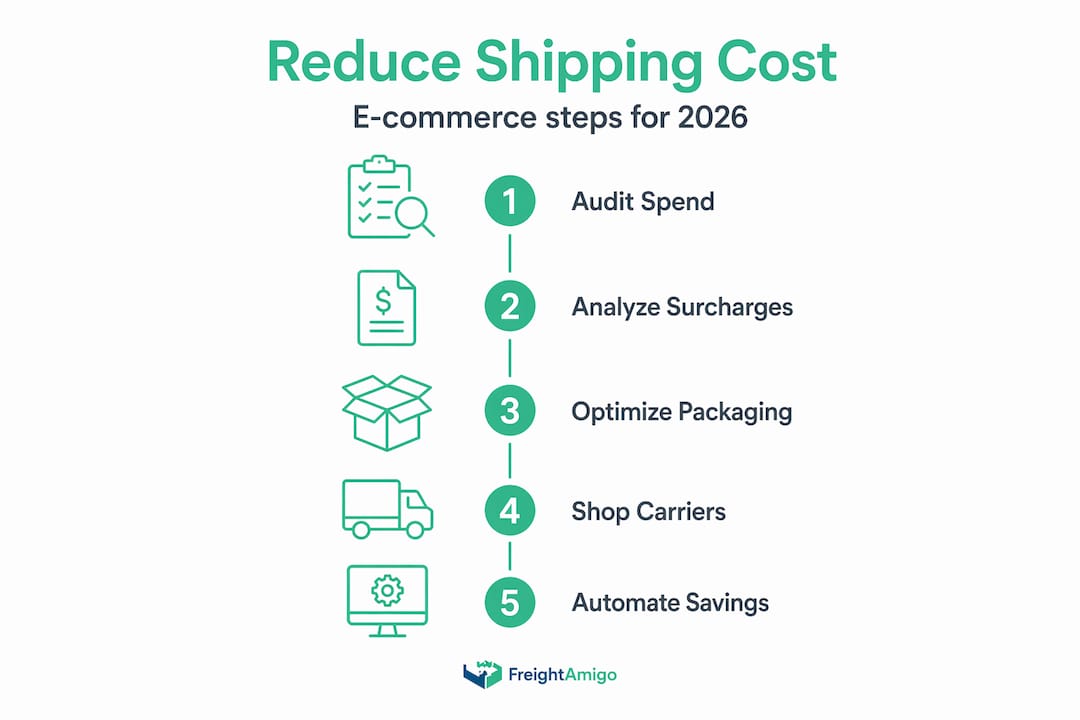
Next, measure the actual dimensions and weights of your top 20 SKUs. This matters because carriers use dimensional weight pricing, where the billable weight is whichever is greater between actual weight and calculated DIM weight. Getting these numbers wrong at the audit stage means all your downstream estimates will be off.
Gather the following data points for each of those top SKUs:
- Actual product weight (in grams or kilograms)
- Outer carton dimensions: length, width, and height
- Average shipping zone (distance between your warehouse and the customer’s postcode)
- Carrier and service type used per shipment
- Frequency of residential versus commercial delivery addresses
Use an address validation tool and a carrier rate calculator alongside this data. Both are typically available through your existing shipping software or as low-cost add-ons. Getting this baseline in place takes roughly two to three days for most small to mid-size operations, and it directly informs every other step in this process.
Pro Tip: Export your carrier data into a spreadsheet and filter by surcharge type. Sorting by total cost per surcharge category, rather than per shipment, often reveals one or two charge types that account for the majority of your overspend.
Packaging optimisation to cut DIM charges
Dimensional weight pricing is one of the most misunderstood billing mechanisms in e-commerce shipping. The carrier does not charge you solely for how heavy your parcel is. They charge you for the space it takes up in their vehicle. A small, light product shipped in an oversized box will be billed at its DIM weight, which can be two or three times its actual weight.
The DIM factor varies by carrier. USPS uses a DIM factor of 166 versus 139 for UPS and FedEx, and this applies to all parcels above one cubic foot for USPS while UPS and FedEx apply DIM pricing to all shipments regardless of size. That difference becomes significant at volume.
Here is a practical process for auditing and right-sizing your packaging:
- Select a pilot cohort of 20 to 50 SKUs, prioritising those with the highest DIM weight charges per the invoice audit you completed earlier.
- Measure the void fill percentage in each current box. If more than 30% of the box is air or padding, that SKU is a strong candidate for a smaller carton.
- Source alternative box sizes or mailer bags for each SKU. Poly mailer bags are particularly effective for soft goods like clothing, as they have near-zero DIM weight impact.
- Run a controlled pilot before rolling out changes at scale. Track three metrics: shipping cost per unit, damage rate, and average pack time.
- Review pilot results after four to six weeks and scale only the changes that show net savings across all three metrics.
A packaging right-sizing pilot across 20 to 50 SKUs is the recommended methodology precisely because DIM savings can be negated by increased damage rates or slower pack times. One e-commerce brand might find that switching from a box to a mailer reduces their shipping cost by £1.20 per unit but increases damage claims by £2.00 per unit. The numbers need to work together.
| Packaging type |
DIM weight impact |
Best suited for |
Risk level |
| Standard cardboard box |
High if oversized |
Fragile or rigid products |
Medium |
| Poly mailer bag |
Very low |
Soft goods, apparel |
Low |
| Padded mailer |
Low |
Small electronics, books |
Low |
| Custom-fit box |
Minimal |
High-volume single SKUs |
Low |

Pro Tip: When sourcing new box sizes, order in small batches first. Warehouses often end up with thousands of units of the wrong size when packaging changes are rushed into production.
Relying on a single carrier is one of the most expensive habits an e-commerce business can have. Every carrier has pricing strengths based on zone, package size, and service level. UPS may offer the best rate for a 2kg parcel travelling three zones, while Royal Mail or Evri might win on a lighter parcel going the same distance. No single carrier wins across all combinations.
The solution is a multi-carrier approach backed by automated rate shopping. Automated rate shopping eliminates the labour-intensive process of manually comparing carriers per order and can save 8–15% on shipping costs. For a business shipping 1,000 orders per day, manual comparison would consume around 25 labour-hours daily. Automation removes that cost entirely.
Here is what to look for in a rate shopping setup:
- Real-time rate comparison across all contracted carriers at point of despatch
- Rule-based routing so that, for example, all parcels above a certain weight automatically route to the carrier with the strongest rate for that weight band
- Carrier performance tracking so that cost comparisons account for damage rates and delivery reliability, not just price
- API integration with your order management or warehouse management system to avoid manual re-entry
Businesses that move from single-carrier to multi-carrier operations with automated routing typically save 15–35% on overall shipping spend without changing their carrier contracts at all. The savings come from matching the right carrier to the right shipment every time, rather than defaulting to one relationship.
Volume negotiation also becomes more effective when you have multi-carrier data. Walking into a carrier negotiation with six months of spend data across three carriers gives you genuine leverage. You can show what you are spending elsewhere and what it would take for them to win more of your volume.
For practical guidance on comparing shipping rates across carriers for cost-effective delivery, the process starts with knowing your own shipment profile in detail.
Address validation to prevent surcharge exposure
Address errors are not just an inconvenience. They are a direct cost. Every time a carrier corrects an address on your behalf, they charge a correction fee per package. When a commercial address is misclassified as residential, you pay a residential delivery surcharge that can add £2 to £5 per parcel. At scale, this is significant money.
Residential misclassification affects 12–18% of shipments, and 90-day invoice audits typically recover 1–3% of total parcel spend from surcharge errors related to misclassification. Many businesses have no idea they are paying these fees until they look.
Follow these steps to build address validation into your process:
- Implement validation at order entry. Validation at order entry is the most effective prevention method. CASS-certified tools check addresses against postal databases in real time as the customer types.
- Add a pre-labelling check. Even correctly typed addresses can be misclassified. Real-time multi-stage checks at both order entry and pre-labelling are necessary because a correctly typed address does not guarantee accurate carrier classification for surcharges.
- Audit your carrier invoices monthly for residential surcharges and correction fees. Flag any address that was billed as residential where your records show a commercial delivery.
- Dispute inaccurate charges directly with the carrier, backed by documentation. Most carriers have a formal dispute process and will credit legitimate claims.
- Consider alternative delivery options for known residential zones, such as parcel locker networks or click-and-collect points, which typically carry lower surcharges.
“Correctly typed addresses do not guarantee accurate carrier classification for surcharges. Multi-stage validation is the only way to catch misclassification before it costs you.”
The operational lift here is modest. Good address validation APIs take an afternoon to integrate and pay for themselves within the first billing cycle for most businesses shipping over 500 parcels per week.
Monitoring, auditing, and sustaining savings
Implementing the steps above delivers savings. Keeping those savings requires a different discipline: consistent monitoring and periodic review.
The core activities that sustain shipping cost reduction over time include:
- Quarterly rate benchmarking. Benchmarking freight rates quarterly enables renegotiation as market rates shift. Spot rates may fall below your contract rate, giving you a basis to request better terms.
- Automated freight auditing. Freight bill errors occur at 2–3% of total spend and are recoverable through systematic audit processes. Automated auditing tools check every invoice line against contracted rates and flag duplicate billing, incorrect surcharges, and missed discounts.
- Surcharge pattern tracking. Review monthly which surcharges are growing as a percentage of total spend. A rising residential surcharge rate often signals a shift in your customer base or a new fulfilment zone that needs address validation attention.
- Damage rate monitoring. Packaging changes can improve DIM weight costs but increase damage. Track damage claims per SKU after any packaging change for at least 90 days.
- TMS integration. A transportation management system gives you a single view of carrier spend, service performance, and contract compliance, making all of the above significantly easier.
Pro Tip: Set a calendar reminder for quarterly carrier contract reviews. Shipping markets move quickly in 2026, and a contract that was competitive six months ago may now be 10–15% above current market rates.
For broader shipping optimisation guidance, revisiting your entire workflow at least twice per year keeps your cost base aligned with market conditions.
My take: packaging beats rate chasing every time
I’ve worked with enough e-commerce businesses to know that the first thing most operators do when they want to reduce shipping expenses is call their carrier account manager and ask for a discount. Sometimes it works. More often, it results in a marginal reduction that gets eroded within six months by new surcharges.
In my experience, packaging right-sizing is the single most undervalued lever in shipping cost management. It is controllable, it compounds, and it does not depend on carrier goodwill. A box that is 15% smaller reduces your DIM weight charge every single time it ships, regardless of what the carrier decides to do with fuel surcharges next quarter.
What I’ve learned from watching businesses run packaging pilots is that the ones who succeed measure all three variables: cost, damage, and pack time. The ones who fail usually only measure cost, then scale a change that turns out to cause packaging failures in transit. They end up spending more on damage claims and customer service than they saved on DIM charges.
Address validation is the other step that businesses consistently underinvest in. I’ve seen businesses recovering thousands of pounds per month from misclassification disputes once they actually looked at their invoices. The data was there the whole time.
Automation ties it together. Once your packaging is right and your addresses are clean, automated rate shopping locks in the gains and removes the daily friction of manual comparison. The combination of all three is where the real savings are, not any single one in isolation.
— Lukasz
How Parcelplanet can support your shipping strategy
Putting these shipping cost reduction steps into practice requires the right infrastructure, and that is where Parcelplanet makes a direct difference to your bottom line.

Parcelplanet’s order fulfilment services are built specifically for e-commerce and omnichannel brands that want to reduce shipping expenses without managing the complexity themselves. The platform integrates multi-carrier rate shopping, real-time address validation, and packaging guidance directly into the fulfilment workflow, so every order is shipped at the best available rate with the correct address classification applied from the start.
Beyond cost, Parcelplanet handles warehousing, picking, packing, and despatch across multiple sales channels, giving your team time back while improving delivery accuracy and customer satisfaction. Whether you are shipping 200 orders per week or 20,000, the approach scales with your business.
Get in touch with Parcelplanet today for a tailored quote and see how much your business could save.
FAQ
What are the most effective shipping cost reduction steps?
The most effective steps combine packaging right-sizing to reduce dimensional weight charges, multi-carrier rate shopping to match each parcel to the lowest-cost carrier, and address validation to prevent surcharges and correction fees. Businesses can reduce shipping expenses by 15–35% using this combination.
How does dimensional weight pricing affect my shipping costs?
Carriers charge the greater of actual weight or dimensional weight, calculated by dividing the parcel volume by a DIM factor. USPS uses a DIM factor of 166 while UPS and FedEx use 139, meaning an oversized box often costs significantly more to ship than its actual weight suggests.
How often should I audit my carrier invoices?
Monthly audits are recommended for identifying surcharge trends and correction fees, with a deeper quarterly benchmarking review to compare contracted rates against current market rates. Freight bill errors typically account for 2–3% of total spend and require systematic auditing to recover.
What is address validation and why does it reduce shipping costs?
Address validation checks delivery addresses against postal databases at order entry and again before labelling to confirm accuracy and carrier classification. This prevents residential delivery surcharges and address correction fees, which affect 12–18% of shipments when misclassification occurs.
When should I consider outsourcing fulfilment to reduce shipping costs?
Outsourcing to a 3PL like Parcelplanet becomes cost-effective when managing carrier relationships, packaging logistics, and address validation in-house consumes more resource than the savings justify. A 3PL with multi-carrier integrations and built-in rate shopping delivers the benefits of a large shipping operation without the overhead.
Recommended